
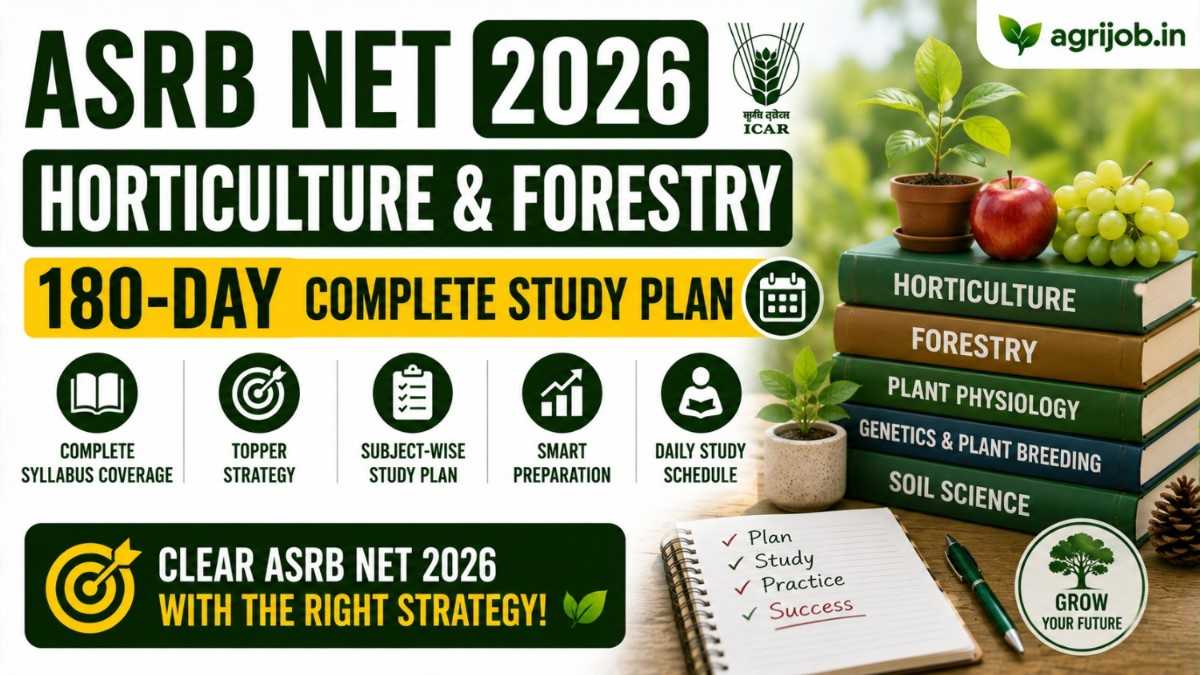
ASRB NET 2026 Horticulture and Forestry
ASRB NET Horticulture 2026 is one of the most sought-after disciplines under the National Eligibility Test conducted by the Agricultural Scientists Recruitment Board (ASRB) — and for good reason. India’s horticulture sector, producing over 320 million tonnes of fruits and vegetables annually, drives massive demand for qualified teaching faculty and research scientists at State Agricultural Universities (SAUs) across the country. Whether you are an MSc Horticulture fresher aiming for your first attempt or a Forestry candidate building a parallel career pathway in the academic ecosystem, a structured 180-day study plan is the single most powerful tool separating a NET qualifier from a repeat aspirant. This complete guide covers the full unit-wise syllabus for both Horticulture and Forestry disciplines, a phase-wise 180-day timetable, topper-tested preparation strategy, the definitive best books list, exam pattern with qualifying marks, and a step-by-step application guide — everything you need to qualify in 2026.

📋 Table of Contents
- Key Facts at a Glance
- ASRB NET Exam Pattern & Qualifying Marks 2026
- Eligibility Criteria for Horticulture & Forestry Candidates
- Horticulture Syllabus: Unit-wise Breakdown
- Forestry Syllabus: Unit-wise Breakdown
- 180-Day Subject-wise Study Plan
- Sample Weekly Timetable
- Topper Strategy: What Works in Horticulture NET
- Best Books List for Horticulture & Forestry
- Who Should Follow This Study Plan?
- 180-Day Plan vs Last-Minute Crash Course
- Important Horticulture & Forestry Career Terms
- How to Apply for ASRB NET 2026
- Frequently Asked Questions
Key Facts at a Glance: ASRB NET Horticulture & Forestry 2026
🔑 Key Facts at a Glance

| Conducting Body | Agricultural Scientists Recruitment Board (ASRB), Govt. of India |
| Exam Name | National Eligibility Test (NET) — Horticulture / Forestry discipline |
| Total Questions / Marks | 150 MCQs / 150 Marks |
| Duration | 2 Hours (Online CBT) |
| Negative Marking | 1/3 mark deducted per wrong answer; nil for unattempted |
| Exam Language | English and Hindi both available |
| Minimum Qualifying Marks | 50% (UR), 45% (OBC/EWS), 40% (SC/ST/PwBD) |
| Eligibility | MSc Horticulture / Forestry, 55% marks (50% reserved) |
| Age Limit (NET stream) | 21 years minimum; no upper age limit |
| Certificate Validity | Lifetime — never expires |
| Expected Notification | August 2026 (Next cycle) via asrb.org.in |
| Application Mode | Online via asrb.org.in |
The ASRB NET is not a job — it is a lifetime qualification certifying you as eligible to apply for Assistant Professor and Lecturer posts whenever State Agricultural Universities (SAUs) advertise vacancies. India currently has over 75 State and Central Agricultural Universities; faculty demand in Horticulture departments remains consistently high across institutions like IARI New Delhi, TNAU Coimbatore, BSKKV Dapoli, and YSPUHF Nauni. A single qualified NET attempt opens doors across all of them, permanently.
ASRB NET Exam Pattern & Qualifying Marks 2026
The ASRB NET Horticulture paper is a single-stage, fully objective exam. It contains 150 MCQs worth 1 mark each, to be completed in 2 hours, conducted entirely online (Computer-Based Test). There is a 1/3 mark deduction for every wrong answer and no deduction for unattempted questions. The paper difficulty is set at Master’s degree (postgraduate) level and is available in both English and Hindi. Unlike the ARS, SMS (T-6), and STO (T-6) exams which have a 3-stage process including a 300-mark descriptive Mains and a 45-mark viva voce, NET candidates need to clear only this one paper — making it the most accessible academic qualification in the ASRB examination system.
| Category | Minimum Marks Required | Qualifying Percentage | Score to Target |
|---|---|---|---|
| Unreserved (UR / General) | 75 / 150 | 50% | 90–110 (safe score) |
| OBC / EWS | 67.5 / 150 | 45% | 80–100 (safe score) |
| SC / ST / PwBD | 60 / 150 | 40% | 70–90 (safe score) |
There are no sectional cut-offs in ASRB NET — your cumulative score across all units determines qualification. This means strong performance in your best units (say, Pomology and Floriculture) can offset relatively weaker areas, as long as the overall total crosses the threshold for your category.
Eligibility Criteria for Horticulture & Forestry Candidates
- 🎓 Educational Qualification: Master’s degree (MSc) in Horticulture or any recognised sub-discipline — Pomology / Fruit Science, Floriculture and Landscape Architecture, Olericulture / Vegetable Science, Spices and Plantation Crops, Post-Harvest Technology, or Forestry — from an ICAR-accredited or UGC-recognised Indian university.
- 📊 Minimum Marks in MSc: 55% aggregate marks for General, OBC, and EWS category candidates; 50% for SC, ST, and PwBD candidates.
- 🎂 Age Limit: Minimum 21 years as on January 1 of the application year. There is no upper age limit for the NET (Lectureship) stream — working professionals at any age can qualify.
- 🇮🇳 Nationality: Indian citizens. Candidates from Nepal, Bhutan, and persons of Indian origin from certain countries are also eligible with a Government of India eligibility certificate.
- 📝 Final-year MSc candidates: May apply provisionally in most cycles, subject to submitting the final degree certificate at document verification stage. Always confirm from the official notification for the specific year.
- 🔁 No attempt limit: There is no restriction on the number of times you can appear for ASRB NET, making it a highly accessible long-term qualification target.
Horticulture Syllabus: Unit-wise Breakdown
The ASRB NET Horticulture syllabus is structured to cover all major branches of the discipline. Understanding this unit architecture before planning your daily schedule is non-negotiable — every MCQ traces back to one of these core areas. Download the official syllabus PDF directly from asrb.org.in to cross-reference topics.
| Unit / Area | Core Topics Covered |
|---|---|
| Fundamentals of Horticulture | Importance, scope and divisions of horticulture; orchard layout and establishment; propagation methods (seeds, cutting, budding, grafting, layering); nursery management; growth regulators; climate and soil requirements; canopy management and training systems |
| Pomology / Fruit Science | Commercial varieties and cultivation of tropical fruits (mango, banana, papaya, guava, pineapple, litchi, sapota), sub-tropical fruits (citrus, grapes, pomegranate, fig, jamun), temperate fruits (apple, pear, peach, plum, almond, walnut, strawberry); rootstock-scion interaction; physiology of fruit set and development; major physiological disorders; maturity indices and post-harvest handling |
| Olericulture / Vegetable Science | Production technology of cool-season crops (potato, cole crops, peas, root crops, bulb crops) and warm-season crops (tomato, brinjal, chilli, okra, cucurbits, cowpea); hybrid seed production; vegetable breeding methods; nutritive values; tissue culture in vegetables |
| Floriculture & Landscape Architecture | Commercial production of cut flowers (rose, chrysanthemum, gladiolus, carnation, gerbera, anthurium, orchid, tuberose); bulbous ornamentals; potted plants; nursery techniques; landscape design principles; garden styles; turf management; export potential of Indian floriculture |
| Spices, Plantation, Medicinal & Aromatic Plants | Production and management of plantation crops (tea, coffee, rubber, coconut, arecanut, cashew, cocoa); seed and tree spices (black pepper, cardamom, ginger, turmeric, coriander, cumin, fenugreek); medicinal and aromatic crops (mentha, lemongrass, vetiver, isabgol, senna, Aloe vera, tulsi) |
| Post-Harvest Technology (Horticulture) | Maturity indices; pre-harvest factors affecting quality; physiological changes during ripening (climacteric vs non-climacteric); ethylene management; storage methods (ventilated, refrigerated, MAS, CA/MA storage); processing — canning, juices, jams, jellies, pickles, dehydration; packaging and cold chain logistics; post-harvest losses in India |
| Breeding of Horticultural Crops | Breeding objectives and methods in fruit, vegetable, and ornamental crops; self- and cross-pollination mechanisms; hybrid seed production in vegetables; heterosis; mutation and polyploidy breeding; biotechnology tools — tissue culture, molecular markers, marker-assisted selection (MAS), genomics; plant variety protection and DUS testing |
Forestry Syllabus: Unit-wise Breakdown
Forestry is a separate discipline under the ASRB NET system and draws heavily from silviculture, forest ecology, forest management, and policy. Candidates appearing for the Forestry paper should verify their exact discipline code and syllabus from the official ASRB notification, as Agroforestry is listed separately from General Forestry in some cycles. The ICAR official website at icar.org.in also carries relevant forestry research updates useful for the applied-question section.
| Unit / Area | Core Topics Covered |
|---|---|
| General Forestry & Forest Types | History and scope of forestry; global and Indian forest resources; types of forests in India (Champion and Seth classification); forest ecosystems; ecosystem services; status of forest cover (FSI reports); deforestation causes and consequences; forests and rural livelihoods |
| Silviculture | Site factors (climatic, edaphic, physiographic, biotic); forest regeneration — natural and artificial; silvicultural systems — high forest and coppice systems; nursery technology and tree seed handling; tending operations (weeding, cleaning, thinning, pruning); silviculture of important Indian tree species: Tectona, Dalbergia, Shorea, Acacia, Eucalyptus, Pinus, Populus, Santalum, Azadirachta, Gmelina |
| Plantation Forestry | Global and Indian plantation scenarios; taungya and social forestry; afforestation of wastelands; energy and industrial plantations; high-density short-rotation (HDSR) systems; carbon sequestration projects; density management; mechanisation of silvicultural operations |
| Forest Ecology & Environment | Forest ecology principles; ecological succession; biodiversity conservation; wildlife biology and protected area management; climate change and forests; GIS and remote sensing applications in forest management; forest fire ecology and management |
| Forest Management & Working Plans | Principles of forest management; sustained yield concept; working plans and working circles; forest mensuration — timber volume estimation, increment measurement; forest inventory; growth models; yield regulation |
| Non-Timber Forest Products (NTFPs) & Utilisation | Timber harvesting, logging and transportation; wood seasoning and preservation; composite wood products; NTFPs — minor forest produce, bamboo, cane, gums, resins, essential oils; their management and economic importance |
| Forest Policy, Law & Economics | Indian Forest Policy 1894, 1952, 1988; Forest Conservation Act 1980; Wildlife Protection Act 1972; Forest Rights Act 2006; CAMPA; forest economics — cost-benefit analysis; social forestry and joint forest management (JFM); REDD+ and international forestry commitments |
180-Day Subject-wise Study Plan
This 180-day plan assumes 6 to 7 hours of focused daily study and is divided into three clearly defined phases. It is designed for Horticulture candidates primarily, with adaptation notes for Forestry aspirants at the end. The key principle throughout is spaced repetition — covering a unit thoroughly, then revisiting it progressively at wider intervals rather than reading and forgetting in one go.
Phase 1: Foundation Building — Days 1 to 90
- 📅 Days 1–18 — Fundamentals of Horticulture: Propagation methods, orchard management, nursery techniques, and growth regulators. Make a visual comparison chart of vegetative vs seed propagation across major crops — a high-frequency MCQ area.
- 📅 Days 19–40 — Pomology / Fruit Science: This is the highest-weightage area in Horticulture NET. Cover each fruit crop systematically — origin, botanical classification, commercial varieties, cultivation requirements, and post-harvest management. Use K.L. Chadha’s Handbook of Horticulture as the primary reference.
- 📅 Days 41–60 — Olericulture / Vegetable Science: Cool-season and warm-season crops, hybrid seed production mechanisms, and vegetable processing basics. Focus on physiological disorders and their nutritional causes — these generate frequent MCQ questions.
- 📅 Days 61–75 — Floriculture & Landscape Architecture: Commercial cut flower production, bulbous ornamentals, and garden design principles. Export data and India’s rank in global floriculture — often tested as current affairs MCQs within the subject paper.
- 📅 Days 76–90 — Spices, Plantation, Medicinal & Aromatic Crops: Focus on tea, coffee, rubber, coconut, black pepper, and cardamom cultivation essentials. Keep concise 1-page summaries per crop covering agroclimatic zone, propagation, yield, and major disorders.
Phase 2: Integration and Practice — Days 91 to 135
- 📅 Days 91–115 — Post-Harvest Technology + Horticultural Crop Breeding: Cover these 2 units together since post-harvest physiology (ethylene, ripening, CA storage) directly connects to fruit science and breeding (variety development for shelf-life). These are moderate-weightage but highly scoreable with focused effort.
- 📅 Days 116–128 — Previous Year Papers (Round 1): Attempt at least 8 to 10 years of ASRB NET and ARS Horticulture previous papers under strict timed conditions. Log every incorrect answer in a dedicated error notebook — unit, topic, and reason for error.
- 📅 Days 129–135 — Weak Area Targeting: Based on error notebook analysis, revisit the 2 or 3 weakest topic clusters (most commonly floriculture specifics, plantation crop statistics, or breeding terminology) with focused 1-page notes only — no re-reading entire chapters.
Phase 3: Revision and Mock Tests — Days 136 to 180
- 📅 Days 136–155 — Full Syllabus Revision Pass: One complete, rapid pass through all units using only condensed short notes — target 2 to 3 units per day. At this stage, textbooks should be closed; only your own notes and flash cards should drive revision.
- 📅 Days 156–170 — Full-Length Mock Tests: Take a minimum of 10 full 150-question mock tests at exact 2-hour conditions, including negative marking discipline. After each test, analyse wrong answers immediately while the reasoning is fresh.
- 📅 Days 171–180 — Final Revision and Current Developments: Light revision only. Quickly scan recent ICAR research on protected cultivation, precision horticulture, drone-based orchard management, and new commercial variety releases — topics that appear in applied-question MCQs in recent exam cycles. Do not start any new topic.
✅ Pro Tip for Forestry Candidates: Adapt this 180-day plan by replacing the 7 Horticulture areas with the 7 Forestry units above, maintaining identical phase timings. Prioritise Silviculture (Days 19–40) and Forest Policy (Days 76–90) as your highest-investment phases, since forest policy questions and silviculture of named species are the most consistently asked MCQ categories across previous Forestry NET/ARS papers.
Sample Weekly Timetable
| Day | Morning Session (3 hrs) | Evening Session (3 hrs) |
|---|---|---|
| Monday to Friday | New concept study from current unit (textbook + ICAR e-course) | MCQ practice (20–30 questions) + short notes writing |
| Saturday | Weekly revision of all 5 days’ topics covered | Topic-wise mini test (50 questions, 40 minutes) |
| Sunday | Error notebook review and concept gap filling | Light reading — ICAR journals, recent variety releases, export data |
Topper Strategy: What Works in Horticulture NET
Based on insights gathered from qualified ASRB NET Horticulture candidates, faculty mentors at SAUs, and coaching instructors at ICAR alumni-run platforms, a set of strategic patterns clearly separates candidates who qualify in their first or second attempt from those who keep getting close but missing the cut-off. These patterns are consistent across exam cycles and candidate profiles.
💡 What Toppers Consistently Recommend:
- Treat Pomology as the backbone: Fruit science generates the highest volume of questions in ASRB NET Horticulture — candidates who can name the variety, rootstock, yield, and physiological disorder for each major fruit crop consistently outscore those who only know general cultivation principles.
- Know your botanical classification cold: Family, genus, species, and chromosome number for every horticultural crop covered in the syllabus — these generate 10 to 15 directly answerable MCQs per paper according to pattern analysis of previous years.
- Post-harvest and storage MCQs are gift questions: Climacteric vs non-climacteric fruits, CA storage temperature ranges, and ethylene management facts are memorisable, frequently asked, and rarely missed by well-prepared candidates — a bank of easy marks.
- Previous year papers over mock tests: ASRB NET Horticulture and ARS Horticulture papers show strong question pattern repetition. Solving 8 to 10 years of actual papers is more productive than unlimited generic mock tests that lack pattern accuracy.
- Negative marking kills unprepared guessing: At 1/3 mark per wrong answer, a candidate who attempts 120 questions and gets 20 wrong loses 6.67 marks — the equivalent of 7 questions. Qualifying candidates consistently report skipping genuinely unknown questions rather than gambling.
Best Books List for Horticulture & Forestry
| Book Title | Author(s) | Best For |
|---|---|---|
| Handbook of Horticulture | K.L. Chadha (ICAR Publication) | Master reference for all horticulture units — the single most important book |
| Floriculture in India | G.S. Randhawa and A. Mukhopadhyay | Floriculture and Landscape Architecture unit |
| Post-Harvest Technology of Fruits and Vegetables | E.B. Pantastico (Ed.) | Post-Harvest Technology unit — storage, ripening, processing |
| A Competitive Book of Horticulture | Multiple authors (ICAR / SAU faculty compilation) | All 7 horticulture units with MCQ-style coverage for competitive exams |
| Fundamentals of Horticulture | Jitendra Singh (Kalyani Publishers) | Fundamentals, propagation and orchard management units |
| ASRB NET / ARS Horticulture Previous Year Papers | Compiled — multiple publishers | Pattern recognition, question frequency analysis — all units |
| Silviculture of Indian Trees (Vols. I–IV) | P.W. Champion and S.K. Seth | Forestry candidates — silviculture of named species unit |
| Forest Ecology and Conservation | A.K. Bhattacharya | Forestry candidates — forest ecology and environment unit |
Supplement all textbooks with freely available ICAR e-Krishi Shiksha e-courses in Horticulture and Forestry, which are aligned to the same PG-level syllabus tested in ASRB NET and offer concise, structured content for quick revision. Access them through the ICAR portal at icar.org.in.
Who Should Follow This Study Plan?
- 🎓 MSc Horticulture (any specialisation — Pomology, Olericulture, Floriculture, Plantation Crops, Post-Harvest Technology) final-year and result-awaited students targeting their first NET attempt
- 🌲 MSc Forestry, Agroforestry, or Silviculture graduates seeking Lecturer eligibility at State Forest Colleges or Agricultural Universities
- 🔬 Candidates simultaneously targeting ARS, SMS (T-6), or STO (T-6) — the 180-day plan prepares for all 4 exam streams simultaneously since the syllabus is identical across NET and ARS for the same discipline
- 👩🌾 Working agricultural extension officers, KVK Horticulture SMS, or nursery managers seeking a formal academic qualification to transition into teaching
- 📚 Repeat aspirants who narrowly missed the qualifying score in a previous cycle and need a structured rebuild of preparation
- 🏡 Self-study candidates from Bihar, UP, MP, Maharashtra, Andhra Pradesh, Tamil Nadu, and other horticulture-dominant states who have no access to full-time coaching but need a proven daily framework
180-Day Plan vs Last-Minute Crash Course
| Parameter | 180-Day Structured Plan | 30–45 Day Crash Course |
|---|---|---|
| Subject coverage | All 7 Horticulture / Forestry units — complete | Only 3–4 highest-scoring units at most |
| Botanical classification depth | Full — every crop, family, and chromosome number | Partial — only most common crops |
| Mock test count | 10–12 full-length 150-Q tests | 2–3 at most |
| Previous year paper analysis | 8–10 years, fully solved and reviewed | 1–2 years, often skimmed only |
| Stress level by exam day | Low — thorough preparation builds confidence | High — cramming fatigue and syllabus anxiety |
| Best suited for | All aspirants — freshers and repeat candidates | Only those with very recent, strong MSc base |
| First-attempt success probability | High — systematic coverage leaves few blind spots | Moderate to Low — coverage gaps risk cut-off miss |
🎯 Expert Verdict: The 180-day plan is the optimal route for all ASRB NET Horticulture and Forestry aspirants, whether first-time or repeat candidates. The sheer breadth of the Horticulture syllabus — spanning 7 distinct sub-disciplines from fruit science to floriculture to post-harvest processing — makes selective, crash-course preparation extremely risky. A structured long-horizon plan is the only reliable path to a safe, above-cut-off score in this discipline.
Important Horticulture & Forestry Career Terms You Must Know
- ASRB NET (ICAR NET): The qualifying eligibility test conducted annually by the Agricultural Scientists Recruitment Board for lectureship and Assistant Professor positions at all State Agricultural Universities (SAUs) and Agricultural Universities (AUs) in India.
- ARS — Agricultural Research Service (Horticulture): A 3-stage ICAR Scientist recruitment exam sharing the same syllabus as NET. Scientist-B posts carry an approximate take-home pay of Rs.60,000 to Rs.80,000 per month depending on location and allowances.
- SMS (T-6) — Subject Matter Specialist: A Govt. of India Gazetted post at Krishi Vigyan Kendras (KVKs) under ICAR; available for Horticulture and Forestry disciplines, selected via the same combined ASRB examination.
- Climacteric Fruit: A classification type that generates 2 to 3 direct MCQs per paper — examples: mango, banana, tomato, apple (climacteric); grape, citrus, pineapple, cucumber (non-climacteric).
- Controlled Atmosphere (CA) Storage: A high-value post-harvest technology topic; storage conditions for apple (1–2% O2, 2–5% CO2), along with MA storage for other crops, are very frequently tested.
- Taungya System: A traditional agro-silvicultural system — a frequently tested Forestry NET topic where trees are grown together with agricultural crops during plantation establishment.
- Joint Forest Management (JFM): India’s community-based forest protection framework introduced in 1990 — a standard Forest Policy and Economics MCQ topic in Forestry NET papers.
- DUS Testing: Distinctness, Uniformity, and Stability testing for plant variety registration under the PPV&FR Act, 2001 — a biotechnology and breeding unit topic tested in Horticulture NET.
- Lifetime Validity of NET Certificate: Once qualified, your ASRB NET lectureship eligibility never expires — you can apply for faculty positions at any SAU whenever vacancies open without repeating the exam.
- NTFP — Non-Timber Forest Products: Minor forest produce, bamboo, gums, resins, and medicinal plants managed from forest land — a key Forest Economics and Utilisation unit topic in Forestry NET.
How to Apply for ASRB NET 2026
Based on the annual examination cycle pattern, the ASRB NET 2026 notification (for the next examination cycle) is expected around August 2026, with the Computer-Based Test (CBT) scheduled approximately in November 2026 and any Mains for ARS/SMS/STO streams around March 2027. Always confirm exact dates, fees, and application windows from the official notification PDF released on asrb.org.in — do not rely solely on third-party websites for application deadlines.
- Visit asrb.org.in and click the “Apply Online” link for NET once the official notification is live.
- Complete new user registration with your name, valid mobile number, and email ID — login credentials are generated via OTP verification.
- Log in and fill the application form accurately — personal details, academic qualifications, and most critically, your chosen discipline (Horticulture or Forestry).
- Upload all required scanned documents in the prescribed format and file size: recent photograph, signature, and MSc degree/marksheet certificates.
- Pay the application fee online as applicable to your category (General/OBC/SC/ST/PwBD/EWS) — payment must be completed before final submission.
- Review the entire form carefully before submitting — discipline selection cannot be changed after submission under any circumstances.
- Submit and immediately download the confirmation receipt / acknowledgement page for all future references including admit card retrieval and document verification.
✅ Pro Tip: If you are considering both the Horticulture NET and ARS/SMS/STO streams, select all applicable options carefully during the application — you can appear for NET as a standalone qualifying exam and simultaneously register for ARS/SMS/STO in the same discipline within a single application, since ASRB conducts these as a combined examination. The Prelims paper is the same 150-question CBT for all four streams.
For authoritative information on university recognition status, visit the UGC official website to verify that your MSc institution holds current recognition. Candidates from universities with pending or lapsed recognition have had their candidatures cancelled at document verification stage — confirm this before applying.
Frequently Asked Questions
What is the syllabus for ASRB NET Horticulture 2026?
The ASRB NET Horticulture 2026 syllabus covers seven major areas: Fundamentals of Horticulture, Pomology and Fruit Science, Olericulture and Vegetable Science, Floriculture and Landscape Architecture, Spices, Plantation, Medicinal and Aromatic Plants, Post-Harvest Technology, and Breeding of Horticultural Crops. All 150 MCQs in the exam are drawn from these discipline-specific units as published by ASRB at asrb.org.in.
How many months are needed to prepare for ASRB NET Horticulture?
A focused 180-day (6-month) study plan is sufficient for most MSc Horticulture candidates. This divides into 90 days for unit-wise concept building across all horticulture branches, 45 days for previous year paper practice and integration, and 45 days for intensive revision and full-length mock tests before the examination date.
What are the best books for ASRB NET Horticulture preparation?
The top recommended books include the Handbook of Horticulture by K.L. Chadha (ICAR publication) as the master reference for all units, Floriculture in India by G.S. Randhawa and A. Mukhopadhyay for the ornamental horticulture unit, Post-Harvest Technology of Fruits and Vegetables by E.B. Pantastico, and ICAR Horticulture e-courses. ASRB/ARS previous year question papers are also indispensable for pattern-based practice.
What is the minimum qualifying mark for ASRB NET 2026?
Candidates must score at least 50% (75 out of 150) for the Unreserved category, 45% for OBC and EWS candidates, and 40% for SC, ST and PwBD candidates to qualify the ASRB NET exam. There are no sectional cut-offs — the overall cumulative score across all 150 questions determines whether a candidate qualifies.
What is the eligibility for ASRB NET Horticulture exam?
Candidates must hold a Master’s degree in Horticulture or any recognised sub-discipline — Pomology, Floriculture, Olericulture, Spices and Plantation Crops, or Post-Harvest Technology — with at least 55% marks (50% for SC/ST/PwBD) from an ICAR-accredited or UGC-recognised university. Minimum age is 21 years with no upper age limit for the NET lectureship stream.
Is ASRB NET Horticulture and ASRB NET Forestry the same exam?
No, they are separate disciplines under the same ASRB NET examination framework. Candidates must select either Horticulture or Forestry as their discipline in the application form — this cannot be changed after submission. Both share the same exam format of 150 MCQs, 150 marks, 2 hours, and 1/3 negative marking, but have completely different unit-wise syllabi and question papers.
How is ASRB NET Horticulture different from ARS Horticulture?
ASRB NET Horticulture is a one-stage qualifying exam for lectureship eligibility — clear the 150-question CBT above the cut-off and you are NET qualified. ARS Horticulture is a 3-stage recruitment exam for Scientist posts — the same Prelims CBT, followed by a 300-mark descriptive Mains and a 45-mark Interview — with an approximate Scientist take-home pay of Rs.60,000 to Rs.80,000 per month at ICAR institutes.
What are the most important topics in ASRB NET Horticulture?
The highest-weightage topics in ASRB NET Horticulture are fruit crop physiology and management covering mango, banana, citrus, grapes, and apple, vegetable crop production technologies for both cool and warm-season crops, post-harvest technology including CA storage and ethylene management, plant propagation methods, and breeding of horticultural crops. Floriculture including rose, chrysanthemum, and gladiolus commercial production also appears consistently across previous year question papers.
How many attempts are allowed for ASRB NET Horticulture?
There is no limit on the number of attempts for ASRB NET as long as candidates meet the minimum age of 21 years and hold a valid MSc degree in the relevant discipline. The NET certificate, once awarded after qualifying, is valid for a lifetime with no expiry date — you can apply for faculty positions at any SAU or AU at any point in your career once qualified.
Disclaimer: This guide is compiled from official ASRB notifications, syllabus documents published at asrb.org.in, and publicly available examination-pattern resources for general informational and educational purposes. Exam dates, qualifying marks, application fees, vacancy numbers, and eligibility criteria are subject to change with each official ASRB notification — candidates must verify all details from the official ASRB website before making any application or preparation decisions. Agrijob.in is not affiliated with ASRB, ICAR, or any government body. This guide is regularly reviewed and updated for accuracy. Bookmark this page for the latest 2026 notifications and updates.
Last Updated: June 2026