

AAU CET 2026 vs ICAR AIEEA: Best Exam? Compare Now
AAU CET 2026 is the gateway state-level entrance test for students who want a BSc Agriculture, Horticulture, Fishery Science, or Community Science seat at Assam Agricultural University, but it is far from the only agriculture entrance exam open to Indian science students this year. Many freshers preparing for BSc agriculture admission Assam 2026 get stuck choosing between the AAU’s own exam and the national-level ICAR AIEEA route, unsure which one offers better odds, stronger placements, and a higher long-term salary ceiling. This guide covers everything: AAU CET 2026 eligibility and application form details, AAU CET syllabus 2026 and exam pattern, a full side-by-side comparison with ICAR AIEEA, fee structures, the step-by-step application process, career scope after both routes, and a 10-question FAQ section answering the exact queries students search on Google before picking an exam.

- 1. What is AAU CET 2026?
- 2. AAU CET Eligibility 2026
- 3. AAU CET Application Form 2026 & Fee Structure
- 4. AAU CET Syllabus 2026 & Exam Pattern
- 5. AAU CET Exam Date 2026 & Important Dates
- 6. What is ICAR AIEEA?
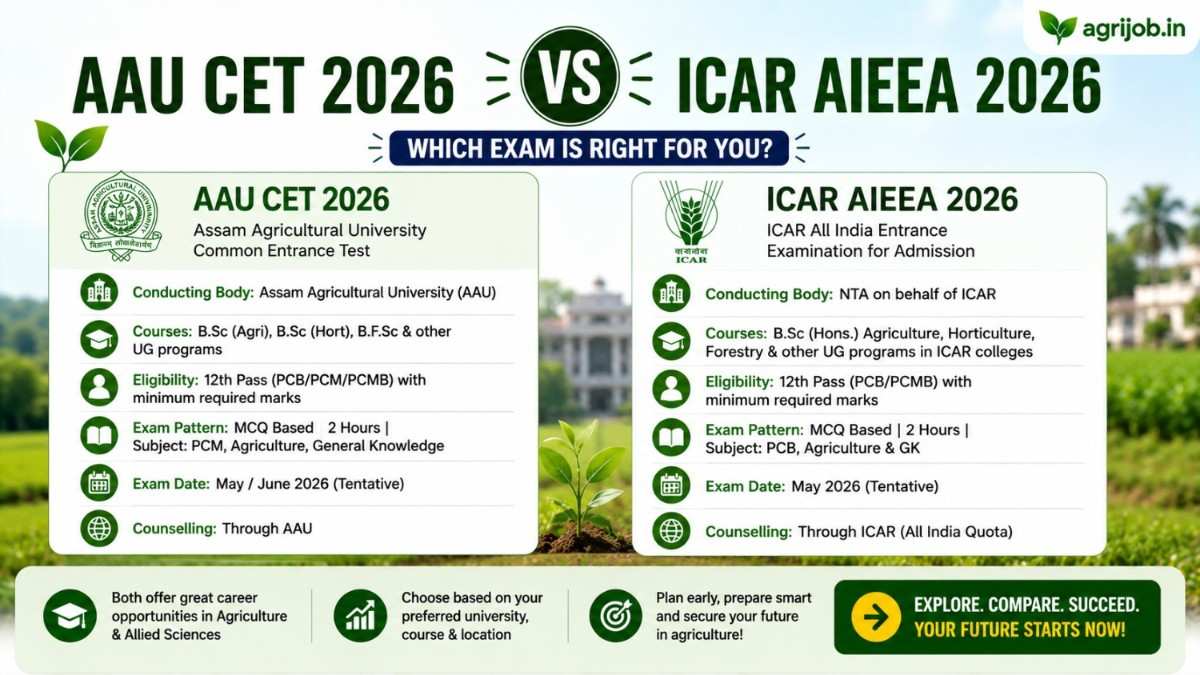
- 7. AAU CET vs ICAR AIEEA: Full Comparison Table
- 8. Who Should Apply for AAU CET 2026?
- 9. Step-by-Step: How to Apply for AAU CET 2026
- 10. Agriculture Jobs After AAU CET — Salary & Career Scope
- 11. High-Value Agriculture Entrance Exam Terms You Must Know
- 12. Frequently Asked Questions
- Exam Name: AAU CET 2026 (Common Entrance Test for UG Programmes)
- Conducted By: Assam Agricultural University, Jorhat
- Total Seats: Approx. 150+ in BSc Agriculture alone, across multiple constituent colleges
- Application Window: 11 May 2026 to 20 May 2026 (online)
- Exam Date: 29-30 June 2026 (UG)
- Application Fee: Rs.1,000 (General/OBC/EWS), Rs.500 (SC/ST/PwBD)
- Eligibility: 10+2 PCB/PCAg with 50% (40% for reserved categories)
- Alternative Route: ICAR AIEEA UG (CUET) score also accepted for inter-state quota
- Apply At: admission.aau.ac.in
What is AAU CET 2026?
AAU CET 2026 stands for the Common Entrance Test conducted by Assam Agricultural University for admission into undergraduate degree programmes for the 2026-27 academic session. The test is designed to assess applicants for entry into Agriculture, Horticulture, Sericulture, Fishery Science, and Community Science courses, and it draws its syllabus directly from the 10+2 curriculum set by the Assam Higher Secondary Education Council. Unlike a generic state CET, this exam is run exclusively by AAU itself rather than a separate state CET cell, which means the question paper, evaluation, and merit list are all handled in-house by the university’s examination wing.
The assam agricultural university entrance exam is conducted as a Computer Based Test (CBT) at multiple centres across Assam, with the question paper available bilingually in English and Assamese. A common merit list is then prepared using percentile-based normalisation across sessions, since the test typically runs in two or three shifts to accommodate the volume of applicants. Importantly, BSc Veterinary Science (BVSc & AH) does not fall under AAU CET; it has its own separate AAU VET examination, so candidates aiming for veterinary admission must apply to that test instead.

AAU CET Eligibility 2026
Before filling the AAU CET application form 2026, candidates must check that they satisfy the university’s academic, age, and domicile requirements. Eligibility differs slightly by category and by the specific UG programme chosen, so it is worth reviewing the official Information Bulletin carefully before payment, since application fees are non-refundable once submitted.
| Eligibility Criteria | General / OBC / EWS | SC / ST / PwBD |
|---|---|---|
| Minimum Qualification | 10+2 with PCB or PCAg | 10+2 with PCB or PCAg |
| Minimum Aggregate Marks | 50% | 40% |
| Board Recognition | Recognised Indian board (CBSE/ICSE/State) | Recognised Indian board (CBSE/ICSE/State) |
| Domicile Preference | Assam / North-East Region for HFC seats | Assam / North-East Region for HFC seats |
| Appearing Students | Allowed, subject to passing before admission | Allowed, subject to passing before admission |
| Age Limit (UG, general route) | No strict upper cap for most UG courses | Relaxation as per category norms |
One important nuance in the AAU CET eligibility 2026 framework: students who have already qualified the ICAR AIEEA UG exam (now linked to CUET) are also permitted to seek admission at AAU through the inter-state quota and special categories, without necessarily sitting for AAU’s own CET. This dual-channel system is one of the more student-friendly features of AAU admissions, and it directly feeds into the comparison discussed later in this guide.
AAU CET Application Form 2026 & Fee Structure
The aau cet application form 2026 opened on 11 May 2026 and the online application window closes on 20 May 2026, with the entrance test itself scheduled across 29-30 June 2026 for undergraduate admission. All registrations are submitted exclusively through admission.aau.ac.in, and candidates need a working mobile number and email ID to complete the sign-up step before filling academic details.
| Category | Application Fee | Payment Mode |
|---|---|---|
| General / OBC / EWS | Rs.1,000 | Debit Card, Credit Card, Net Banking, UPI |
| SC / ST / PwBD | Rs.500 | Debit Card, Credit Card, Net Banking, UPI |
| NRI / Sponsored Quota | Rs.1,000 + additional affidavit | Online + document upload |
Candidates should keep scanned copies of their photograph, signature, and category certificates ready in the prescribed format and size (typically under 150KB each) before starting the form, since the portal does not allow saving an incomplete submission for long periods. NRI-sponsored applicants additionally require a sponsor affidavit in PDF format as part of the supporting document set.
AAU CET Syllabus 2026 & Exam Pattern
The aau cet syllabus 2026 is based entirely on the Higher Secondary (10+2) curriculum prescribed by the Assam Higher Secondary Education Council, covering Physics, Chemistry, Botany, and Zoology in equal proportion. There is no separate “Agriculture” subject paper at the UG level the way some other state CETs include one; instead, the science fundamentals from Class 11 and 12 are tested directly.
| Exam Feature | Detail |
|---|---|
| Mode | Computer Based Test (CBT) |
| Duration | 2 hours |
| Total Questions | 160 (40 each from Physics, Chemistry, Botany, Zoology) |
| Total Marks | 160 |
| Question Type | Multiple Choice Questions (MCQs) |
| Negative Marking | 0.25 marks deducted per wrong answer |
| Language of Paper | English and Assamese (bilingual) |
| Number of Sessions | 2-3 sessions across test centres |
Because AAU CET runs in multiple shifts, your raw score isn’t directly comparable across sessions — the university normalises scores using percentile ranking before preparing the common merit list. Don’t panic if your shift’s paper feels tougher; focus on accuracy and speed within your own session rather than comparing notes with friends who sat a different shift.
AAU CET Exam Date 2026 & Important Dates
Keeping track of the aau cet exam date 2026 timeline is critical since AAU does not typically reopen the application window once it closes. Here is the complete schedule for the current admission cycle.
- 📅 Application Start Date: 11 May 2026
- 📅 Application Closing Date: 20 May 2026
- 📅 Admit Card Release: Expected 2-3 weeks before the exam (aau cet admit card 2026)
- 📅 Exam Date (UG): 29-30 June 2026
- 📅 Result Declaration: Expected within 3-4 weeks of the exam (aau cet result 2026)
- 📅 Counselling & Seat Allotment: Round-wise, starting shortly after result declaration
- 📅 Academic Session Commencement: 2026-27 session, typically by August
Candidates preparing with aau cet previous year papers should note that while the subject-wise weightage has stayed largely consistent over recent cycles, official past papers are not always published publicly by AAU, so most aspirants rely on the 10+2 NCERT-aligned PCB/PCAg textbooks and AHSEC board material as the closest proxy for practice.
What is ICAR AIEEA?
ICAR AIEEA is the All India Entrance Examination for Admission, a national-level test that opens doors to 75 ICAR-affiliated institutions across the country, including 64 State Agricultural Universities, 4 ICAR Deemed Universities such as IARI New Delhi and NDRI Karnal, and several Central Universities with agriculture faculties. From recent admission cycles, UG admission under this umbrella is processed through CUET (ICAR-UG) scores rather than a standalone AIEEA-UG paper, while postgraduate admission continues through the dedicated AIEEA-PG exam, both conducted by the National Testing Agency (NTA).
Roughly 15,000 undergraduate and 11,000 postgraduate seats are distributed across these participating universities each year, making ICAR AIEEA the single largest agriculture admission pathway in India by seat volume. For PG aspirants specifically, the AIEEA PG 2026 application opened on 8 May 2026 with the exam conducted on 4 July 2026, carrying eligibility of a relevant Bachelor’s degree with 60% aggregate for General/OBC/EWS candidates and 50% for SC/ST/PwD candidates.
AAU CET vs ICAR AIEEA: Full Comparison Table
This is the section most students searching for aau cet 2026 actually want: a direct, side-by-side breakdown of how the state-level AAU route stacks up against the national ICAR AIEEA pathway across the factors that matter most for admission strategy and long-term career value.
| Factor | AAU CET 2026 | ICAR AIEEA (CUET-UG / AIEEA-PG) |
|---|---|---|
| Conducting Body | Assam Agricultural University | National Testing Agency (NTA), on behalf of ICAR |
| Scope | Single university (AAU and its colleges) | 75 universities across India |
| Total UG Seats Covered | ~150-300 across AAU’s own UG programmes | ~15,000 nationally |
| Application Fee | Rs.500-1,000 | Rs.800-1,500 (varies by category and exam) |
| Competition Level | Lower; largely Assam/NE domicile pool | Higher; pan-India applicant pool |
| Exam Pattern | 160 MCQs, 2 hours, PCB/PCZ based | Domain-specific MCQs via CUET (UG) / specialised PG paper |
| Best Suited For | Assam-domicile students wanting AAU specifically | Students open to relocating for IARI, NDRI, PAU, or other top SAUs |
| Career Ceiling | Strong regional government and SAU pathways | Access to premier ICAR institutes, research roles, higher PG scholarships |
| Cross-Acceptance | AAU also accepts ICAR AIEEA UG scores for inter-state quota | ICAR universities generally do not accept AAU CET scores outside Assam |
If you are firmly rooted in Assam and want the most straightforward, lower-competition path into a respected BSc Agriculture programme close to home, AAU CET 2026 is the more efficient choice. But if you are open to relocating and want a shot at premier institutes like IARI or NDRI, or simply want to maximise your number of usable attempts and seat options, registering for the CUET (ICAR-UG) pathway alongside AAU CET gives you the broadest safety net. Many smart aspirants do both — there is no rule preventing a student from applying through AAU CET while also keeping the national ICAR AIEEA route open as a backup.
Who Should Apply for AAU CET 2026?
AAU CET 2026 is not equally suited to every science student. Here is a clear breakdown of who gets the most value from choosing this particular entrance route over the national ICAR AIEEA alternative.
- 🌱 Assam-domicile 10+2 PCB/PCAg students who want a BSc Agriculture, Horticulture, or Fishery Science seat without relocating out of state.
- 👩🌾 Women candidates from rural Assam who benefit from AAU’s regional hostel and women’s safety infrastructure compared to relocating to a distant SAU.
- 🎓 SC/ST/PwBD category aspirants who qualify for the discounted Rs.500 application fee and the 40% minimum aggregate relaxation.
- 📍 North-East Region (NER) candidates outside Assam who are eligible for HFC quota seats under AAU’s special category provisions.
- 🔁 Repeat aspirants who narrowly missed an ICAR AIEEA-linked seat and want a second, lower-competition shot at an ICAR-recognised degree.
- 🧪 Students stronger in regional board (AHSEC) syllabus alignment rather than the broader pan-India CUET domain subject format.
- 💰 Budget-conscious families who want to minimise relocation, hostel, and travel costs tied to studying outside their home state.
- 🏛️ Candidates also targeting AAU’s PG and Ph.D pipeline later, since familiarity with the university’s systems and faculty early on can help with future GAT-B or AIEEA-PG transitions.
Step-by-Step: How to Apply for AAU CET 2026
Follow this numbered process carefully to avoid the most common application errors that lead to rejection during AAU’s verification stage.
- Visit the Official Portal: Go to admission.aau.ac.in and locate the active AAU CET 2026 / CETUGAAU26 notification link.
- Register: Create a login using a valid, regularly checked mobile number and email ID — all further communication, including the admit card link, comes through this registered ID.
- Fill Personal & Academic Details: Enter your 10+2 marks, board, category, and domicile information exactly as shown on your certificates.
- Upload Documents: Upload scanned copies of your photograph, signature, and required category/domicile certificates in the specified format and size (typically under 150KB each).
- Pay Application Fee: Pay Rs.1,000 (General/OBC/EWS) or Rs.500 (SC/ST/PwBD) online via debit card, credit card, net banking, or UPI.
- Review & Submit: Carefully recheck every field before final submission, since corrections are often not allowed once the application is locked.
- Print Confirmation: Download and print the application confirmation/receipt page for your records and for future reference at the exam centre.
- Download Admit Card: Once released (usually 2-3 weeks before the exam), download and print your aau cet admit card 2026 from the same portal.
- Appear for the Exam: Reach your allotted centre well before the reporting time on 29 or 30 June 2026 with the admit card and a valid photo ID.
- Check Result & Counselling: Track admission.aau.ac.in for aau cet result 2026 and proceed to fill college/course preferences during counselling rounds.
Regularly check www.aau.ac.in and admission.aau.ac.in for updates on the admit card, exam schedule, and result, since AAU primarily communicates schedule changes through the official website rather than mass SMS or email blasts. Bookmark this page and the official portal together for the fastest access to any revision.
Agriculture Jobs After AAU CET — Salary & Career Scope
Whether a student clears AAU CET or gains admission via ICAR AIEEA-linked CUET scores, the resulting BSc Agriculture (or allied) degree from an ICAR-recognised university opens broadly similar career doors. Agriculture jobs after aau cet typically fall into four buckets: public sector banking, central research bodies, state agriculture departments, and the fast-growing private agribusiness/agritech sector.
| Career Path | Entry Monthly Salary | Annual Earning (Approx.) | Allowances |
|---|---|---|---|
| IBPS AFO (Agriculture Field Officer) | Rs.48,480 | Rs.5.8-6.5 LPA | HRA, DA, medical, PF |
| NABARD Grade A | Up to Rs.85,000 | Rs.10-12 LPA | HRA, DA, leave travel, gratuity |
| FCI Agriculture Graduate Trainee | Rs.40,000-55,000 | Rs.5-7 LPA | IDA scale benefits, PF, medical |
| State Agriculture/Extension Officer | Rs.35,400-1,12,400 (varies by state) | Rs.5-9 LPA | DA, HRA, travel allowance |
| ICAR Junior Research Fellow (post-MSc) | Rs.31,000-35,000 | Rs.3.7-4.2 LPA (fellowship) | HRA on fellowship |
| Private Agribusiness Manager | Rs.25,000-50,000 | Rs.3-6 LPA | Performance bonus, travel |
The ICAR AIEEA PG route adds a further layer of opportunity: clearing it secures a seat in an MSc Agriculture programme along with an ICAR PG Scholarship worth Rs.12,640 per month for two years, and subsequently clearing ICAR JRF/SRF unlocks a funded PhD at Rs.31,000/month for the first two years and Rs.35,000/month in year three, plus HRA. Career outcomes at the senior end include Scientist roles at ICAR institutes, Assistant Professor positions at agricultural universities, and openings at international bodies like CGIAR and FAO — paths that are equally accessible whether your undergraduate journey began through AAU CET or the national ICAR AIEEA channel.
High-Value Agriculture Entrance Exam Terms You Must Know
Understanding the terminology around agriculture entrance exams helps you read official notifications accurately and avoid missing a step in the admission process.
- 📘 CUET (ICAR-UG): The undergraduate admission pathway into 75 ICAR-affiliated universities, replacing the older standalone AIEEA-UG paper; top institutes like IARI typically require a 95+ percentile.
- 📘 AIEEA-PG: The dedicated national postgraduate entrance exam for MSc Agriculture and allied programmes, carrying an associated ICAR PG Scholarship of Rs.12,640/month.
- 📘 GAT-B: The Graduate Aptitude Test in Biotechnology, an alternative national-level route some AAU PG programmes accept instead of AIEEA-PG.
- 📘 Common Merit List: A single ranked list prepared by normalising percentile scores across multiple shifts or sessions of an entrance test.
- 📘 HFC Seats: Home/Family Connection quota seats reserved at AAU for North-East Region candidates with family ties to Assam.
- 📘 NTA Score: The normalised percentile-based score issued by the National Testing Agency, used for ICAR AIEEA, CUET, and several other central exams.
- 📘 ICAR Deemed University: A premier ICAR institution (such as IARI, NDRI, IVRI, or CIFE) that admits 100% of seats purely on ICAR AIEEA/CUET score, with no separate state quota.
- 📘 NAC (National Apprenticeship Certificate): A credential separate from a BSc degree, relevant mainly to apprenticeship-based banking and BFSI Sector Skill Council programmes some graduates pursue after their degree.
- 📘 Inter-State Quota: Seats at a state agricultural university (like AAU) reserved for candidates from outside the home state, usually filled via national exam scores like ICAR AIEEA UG.
- 📘 Reservation Categories (SC/ST/OBC/EWS/PwBD): Government-mandated category-wise relaxations in minimum marks, age limit, and application fee applied uniformly across both AAU CET and ICAR AIEEA.
Frequently Asked Questions
What is AAU CET 2026?
AAU CET 2026 is the Common Entrance Test conducted by Assam Agricultural University, Jorhat, for admission to undergraduate degree programmes such as BSc Agriculture, Horticulture, Fishery Science, and Community Science. The exam is a 2-hour, 160-mark Computer Based Test drawn from the 10+2 Physics, Chemistry, Botany, and Zoology syllabus.
Is ICAR AIEEA the same as AAU CET?
No. AAU CET is a state-level test run directly by Assam Agricultural University, while ICAR AIEEA is a national-level exam conducted by the NTA for 75 ICAR-affiliated universities across India, including AAU. A student can use an ICAR AIEEA UG (CUET) score to apply for an AAU seat under the inter-state quota, but AAU CET itself is exclusive to AAU’s own admission cycle.
What is the AAU CET 2026 application fee?
The AAU CET 2026 application fee is Rs.1,000 for General, OBC, and EWS candidates and Rs.500 for SC, ST, and PwBD candidates. Payment can be made online via debit card, credit card, net banking, or UPI through the official AAU admission portal.
What is the salary after BSc Agriculture from AAU or an ICAR university?
Entry-level government roles after BSc Agriculture, regardless of whether the degree was completed via AAU CET or an ICAR AIEEA-linked university, typically pay Rs.25,000 to Rs.55,000 per month. IBPS AFO offers around Rs.48,480/month, NABARD Grade A reaches up to Rs.85,000/month, and private agribusiness roles start around Rs.3-6 LPA, rising sharply with an MSc or specialisation.
Which is easier, AAU CET or ICAR AIEEA?
AAU CET generally has a smaller, regional applicant pool restricted mostly to Assam and North-East domicile candidates, making competition comparatively lower. ICAR AIEEA (now via CUET for UG) draws applicants from across India competing for seats at 75 universities including premier institutes like IARI and NDRI, so cutoffs at the top colleges are considerably higher.
Can I get a National Apprenticeship Certificate equivalent after BSc Agriculture?
BSc Agriculture itself is a full degree, not an apprenticeship, so it does not issue a National Apprenticeship Certificate (NAC). However, graduates from both AAU and ICAR-affiliated universities remain eligible for BFSI Sector Skill Council certifications and apprenticeship-linked banking exams such as IBPS AFO that value the ICAR-recognised degree as core eligibility.
What is the AAU CET 2026 exam pattern?
The AAU CET 2026 UG exam pattern consists of 160 multiple-choice questions worth 1 mark each, covering 40 questions from each of Physics, Chemistry, Botany, and Zoology, to be completed in 2 hours. The test follows a 1/4th mark negative marking scheme for each incorrect answer, and the question paper is set in both English and Assamese.
How many universities accept ICAR AIEEA scores compared to AAU CET?
ICAR AIEEA and the linked CUET (ICAR-UG) score is accepted by 75 participating universities nationwide, including 64 State Agricultural Universities, 4 ICAR Deemed Universities, and several Central Universities. AAU CET, in contrast, is valid only for admission within Assam Agricultural University and its constituent and affiliated colleges in Assam.
Does AAU accept ICAR AIEEA UG scores for admission?
Yes. AAU runs a dual-channel admission system where Assam-domicile candidates can apply through AAU CET, while out-of-state candidates and certain quota seats can be filled using ICAR AIEEA UG (CUET) scores. This makes AAU one of the few universities where both entrance pathways lead to the same undergraduate degree programmes.
Where can I find admission.aau.ac.in 2026 updates and previous year papers?
All official AAU CET 2026 updates, including the admit card, exam schedule, and result, are published exclusively on admission.aau.ac.in and www.aau.ac.in. Official previous year question papers are not always released publicly, so most candidates prepare using AHSEC board textbooks and NCERT-aligned PCB/PCAg material covering the same Physics, Chemistry, Botany, and Zoology syllabus.
For more on the national-level alternative, see our complete guide to ICAR AIEEA PG & AICE JRF/SRF 2026, our breakdown of the top government agriculture colleges in India 2026, and our dedicated AAU CET Admission 2026 application walkthrough for the original notification details.
For official verification, always cross-check dates and eligibility directly with primary sources: the Assam Agricultural University official website, the AAU Admission Portal, the Indian Council of Agricultural Research (ICAR), and the National Testing Agency ICAR examination portal.
This guide is regularly reviewed and updated for accuracy. Bookmark this page for the latest AAU CET 2026 and ICAR AIEEA notifications.
Last Updated: June 2026