

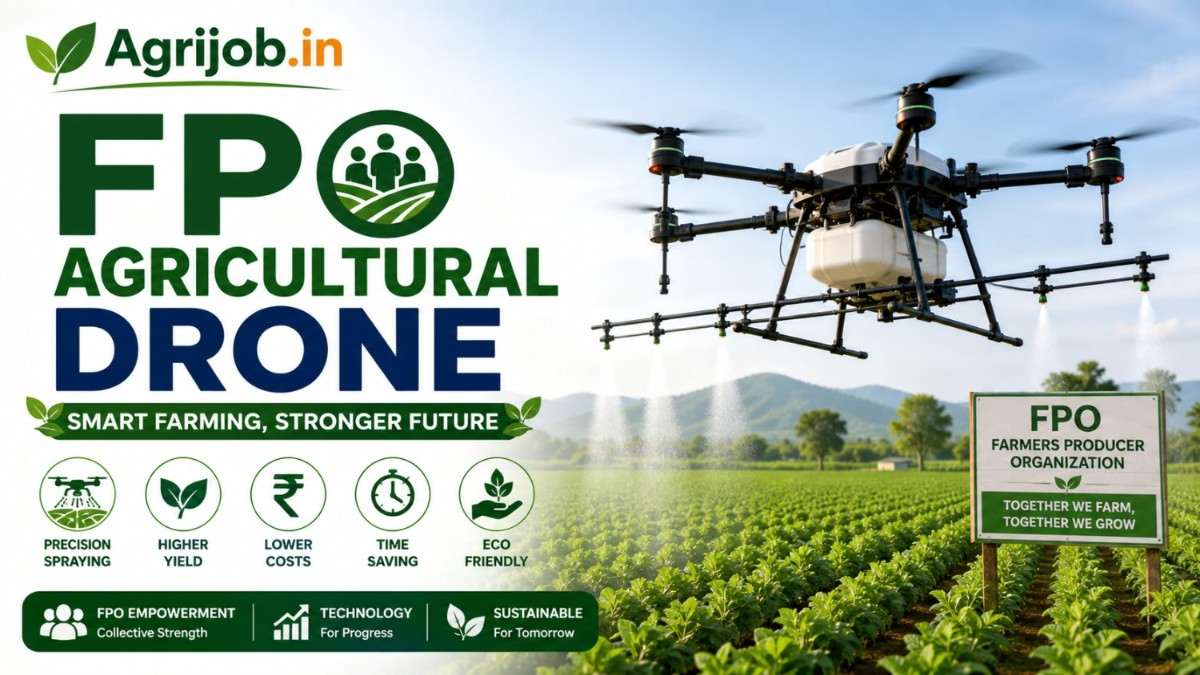
FPO agricultural drone 2026 is the most powerful low-cost farming technology upgrade available to Indian Farmer Producer Organisations right now. With the Government of India offering a 75% subsidy under SMAM, a zero-collateral NABARD term loan backed by the Rs.1,000 crore Credit Guarantee Fund, and drone prices starting at Rs.5 lakh, a group of 50 member farmers in an FPO can own a professional agricultural sprayer drone for as little as Rs.2,500–5,000 per member. This complete guide covers everything: drone prices and models, group purchase cost sharing, SMAM subsidy application, NABARD loan process, required documents, and step-by-step instructions to get your FPO drone operational in 2026.

| Who Can Apply | Registered FPOs with minimum 50 farmer members |
| SMAM Subsidy | Up to 75% of drone cost (max Rs.7.5 lakh per drone) |
| Drone Price Range | Rs.5 lakh – Rs.15 lakh (10L to 20L capacity) |
| NABARD Loan | Zero collateral; interest 7%–9% p.a. (4%–6% with AIF subvention) |
| Loan Tenure | Up to 5 years (equipment) / up to 7 years (AIF) |
| FPO Earning Potential | Rs.80,000–Rs.1.8 lakh/month via Custom Hiring Centre |
| Drone Certification | DGCA Remote Pilot Certificate mandatory for operator |
| Application Portal | agrimachinery.nic.in (SMAM DBT portal) |
📋 Table of Contents
- Why FPOs Need Agricultural Drones in 2026
- Agricultural Drone Price in India 2026 – Model-Wise Comparison
- FPO Group Purchase Model – Cost Sharing Calculator
- SMAM Subsidy 2026 – FPO Gets 75%, How to Claim
- NABARD Term Loan for FPO – Zero Collateral Process 2026
- Documents Required for FPO Drone Loan Application
- Step-by-Step: How to Apply for FPO Drone + NABARD Loan 2026
- Who Should Apply for FPO Agricultural Drone in 2026?
- FPO Group Drone vs Individual Drone vs Drone-as-a-Service
- High-Value Agri-Drone and FPO Finance Terms You Must Know
- Frequently Asked Questions (FAQ)
Why FPOs Need Agricultural Drones in 2026
Indian agriculture faces a deepening labour crisis. The cost of hiring manual spraying labour has risen to Rs.500–Rs.600 per worker per day in 2026, and most farmers need 4–5 workers to spray 10 acres, spending Rs.5,000–Rs.7,000 in labour alone before adding chemical costs. An agricultural drone covers the same 10 acres in under 2 hours at a service charge of Rs.5,000–Rs.6,000 all-inclusive — and delivers 40–55% more uniform spray coverage, reducing pesticide wastage. For an FPO managing the farming interests of 100–500 member farmers across a cluster of villages, collective ownership of even 1 drone transforms operational economics.
The Government of India has made farm drone adoption a national priority in 2026, allocating Rs.1,300 crore through NABARD for agritech and climate-smart farming. The SMAM drone scheme, the Namo Drone Didi programme, and the Agriculture Infrastructure Fund (AIF) together create an unprecedented financial support ecosystem. An FPO that acts now can own a drone for as little as Rs.1.25 lakh after subsidy — less than the cost of a single tractor tyre — and begin generating monthly revenue for its members within 30 days of purchase.

Agricultural Drone Price in India 2026 – Model-Wise Comparison
Understanding FPO agricultural drone prices in 2026 is the first step before calculating subsidy and loan requirements. Drone prices are segmented by payload capacity (tank size in litres), which determines how many acres a single battery charge can cover.
| Category | Tank Capacity | Coverage/Charge | Price (2026) | After 75% SMAM Subsidy | Best For |
|---|---|---|---|---|---|
| Entry-Level Sprayer | 10 Litres | 5–7 acres | Rs.4.5–6 lakh | Rs.1.1–1.5 lakh | Small FPOs, 50–100 members |
| Mid-Range Sprayer | 12–16 Litres | 7–10 acres | Rs.7–10 lakh | Rs.1.75–2.5 lakh | Medium FPOs, CHC model |
| Advanced Sprayer | 20 Litres | 10–14 acres | Rs.10–15 lakh | Rs.2.5–3.75 lakh | Large FPOs, 200+ acre service |
| AI-Powered Model | 25–30 Litres | 15–20 acres | Rs.15–25 lakh | Rs.3.75–6.25 lakh | Commercial CHC, multi-crop |
The sweet spot for most Indian FPOs in 2026 is the 12–16 litre mid-range sprayer priced between Rs.7–10 lakh. This capacity handles most open-field crops — paddy, wheat, cotton, soybean, mustard — in commercially viable daily output, and the after-subsidy cost of Rs.1.75–2.5 lakh is easily recoverable within a single Kharif season of operations. Popular DGCA-approved brands eligible for SMAM subsidy in 2026 include Garuda Aerospace, Marut Drones, IdeaForge, and TechEagle.
FPO Group Purchase Model – Cost Sharing Calculator
The FPO agricultural drone group purchase model works by distributing the net cost (after subsidy) across member farmers. Here is how the math works for a typical mid-size FPO with 100 members buying one 16-litre drone priced at Rs.8 lakh in 2026.
| Cost Component | Total (FPO) | Per Member (100 Farmers) | Per Member (200 Farmers) |
|---|---|---|---|
| Drone Purchase Price | Rs.8,00,000 | Rs.8,000 | Rs.4,000 |
| Less: SMAM Subsidy (75%) | – Rs.6,00,000 | – Rs.6,000 | – Rs.3,000 |
| Net Cost to FPO | Rs.2,00,000 | Rs.2,000 | Rs.1,000 |
| DGCA Pilot Training (RPC) | Rs.35,000 | Rs.350 | Rs.175 |
| Insurance (Annual) | Rs.25,000 | Rs.250 | Rs.125 |
| Spare Batteries + Nozzles | Rs.40,000 | Rs.400 | Rs.200 |
| Total First-Year Investment | Rs.3,00,000 | Rs.3,000 | Rs.1,500 |
| Annual Revenue (CHC @250 acres/month × 8 months) | Rs.10,00,000 | Shared equally as dividend | |
If the FPO finances the net Rs.2 lakh cost through a zero-collateral NABARD term loan at 7% over 3 years, the monthly EMI is approximately Rs.6,200 — easily covered from the first month of Custom Hiring Centre (CHC) operations. The remaining revenue flows back to the FPO as member dividend or is reinvested to purchase a second drone by Year 2.
SMAM Subsidy 2026 – FPO Gets 75%, How to Claim
The Sub-Mission on Agricultural Mechanization (SMAM) is the central government scheme under the Ministry of Agriculture and Farmers Welfare that provides direct benefit transfer (DBT) subsidies for agricultural machinery including drones. Under the revised SMAM guidelines, FPOs and cooperative societies receive up to 75% subsidy on the drone cost, with a maximum ceiling of Rs.7.5 lakh per drone. This is the highest subsidy available for drone purchase outside of the women-SHG-specific Namo Drone Didi scheme.
- 🏛️ Scheme Name: Sub-Mission on Agricultural Mechanization (SMAM) 2026
- 💰 FPO Subsidy Rate: 75% of drone cost (maximum Rs.7.5 lakh per drone unit)
- 🛸 Eligible Drones: Only DGCA type-certified Indian-manufactured drones (DJI and foreign brands are excluded)
- 📄 Portal: agrimachinery.nic.in (Central Agri Mechanization DBT Portal)
- ✅ FPO Minimum Requirement: Registration with SFAC or state government, minimum 1 year of active operations
- 🎓 Mandatory Condition: At least one FPO member must hold a valid DGCA Remote Pilot Certificate (RPC)
- 📦 Additional State Subsidies: Maharashtra adds 25% (effective 100%), Andhra Pradesh and Telangana offer additional support — check your state agriculture department portal for current rates
- ⏱️ Disbursement Timeline: Subsidy is paid directly to the DGCA-approved drone supplier after verification, typically within 30–60 days of approval
NABARD Term Loan for FPO – Zero Collateral Process 2026
NABARD does not lend directly to FPOs. Instead, it operates a two-tier refinance system: NABARD provides concessional refinance funds to partner banks (Regional Rural Banks, Cooperative Banks, Scheduled Commercial Banks, Small Finance Banks), which then disburse loans to FPOs. The critical breakthrough for FPOs in 2026 is the NABSanrakshan Credit Guarantee Fund — a dedicated Rs.1,000 crore fund maintained by NABARD’s subsidiary that guarantees loans to FPOs without requiring any physical collateral from the borrower.
| Loan Parameter | Standard NABARD Term Loan | AIF Loan with 3% Subvention |
|---|---|---|
| Interest Rate | 7%–9% per annum | 4%–6% effective (after subvention) |
| Loan Tenure | Up to 5 years | Up to 7 years |
| Collateral | Zero (via NABSanrakshan guarantee) | Zero (via NABSanrakshan guarantee) |
| Margin Money | 15–25% of project cost | 10–15% of project cost |
| Maximum Loan (Drone) | Rs.10–50 lakh (equipment category) | Up to Rs.2 crore |
| Repayment Mode | Monthly/Quarterly EMI | Flexible; linked to CHC revenue |
| FPO Eligibility | Min. 50 members, 1-year operational history | Min. 50 members, registered FPC preferred |
| Processing Bank | RRB, CCB, Commercial Banks | Scheduled Commercial Banks, SFBs |
For FPOs purchasing drones specifically to operate a Custom Hiring Centre (CHC), the Agriculture Infrastructure Fund (AIF) route is recommended. AIF offers a 3% interest subvention, longer tenure up to 7 years, and a maximum loan of Rs.2 crore, making it ideal for FPOs planning to buy 2–3 drones simultaneously. Contact your nearest NABARD District Development Manager (DDM) or apply through the AIF portal at agriinfra.dac.gov.in for AIF routing.
Documents Required for FPO Drone Loan Application
Getting your documentation right the first time saves weeks of delay. Banks processing NABARD-refinanced FPO loans under the credit guarantee scheme require both KYC documents and a credible Detailed Project Report (DPR). Here is the complete document checklist for 2026.
- 📋 FPO Registration Certificate — issued by Registrar of Companies (RoC) under Companies Act or under the Societies Registration Act, as applicable
- 🏦 FPO Bank Account Statement — last 12 months showing regular member transactions
- 📊 Audited Financial Statements — last 2 years (Balance Sheet, P&L, Cash Flow)
- 👥 Member List with Aadhaar Details — minimum 50 farmer members with land holding details
- 📑 Detailed Project Report (DPR) — covering drone model, cost, CHC revenue projections, repayment schedule, and breakeven analysis
- 🛸 Drone Quotation — from a DGCA type-certified manufacturer (proforma invoice with GST number)
- 🎓 DGCA Remote Pilot Certificate (RPC) — of the designated FPO drone pilot
- 📍 Land Use Agreement / Village Map — showing the operational area covered by the FPO
- 🏛️ SFAC Registration (if applicable) — Small Farmers Agribusiness Consortium registration for enhanced subsidy access
- 🖊️ Board Resolution — authorising the FPO chairman / CEO to execute the loan agreement
- 📸 KYC of Directors/CEO — Aadhaar, PAN of all board members
- 📝 SMAM Application Acknowledgement — reference number from agrimachinery.nic.in (submit subsidy application first, then apply for loan)
Step-by-Step: How to Apply for FPO Drone + NABARD Loan 2026
The FPO agricultural drone application for 2026 runs on two parallel tracks — the SMAM subsidy application and the NABARD term loan application — which must be initiated simultaneously to avoid delays.
- ✅ SFAC Registration (if not done): Register your FPO on the SFAC portal (sfacindia.com) to unlock the highest subsidy tier and credit guarantee coverage. This takes 15–30 days.
- 🎓 Get DGCA Remote Pilot Certificate (RPC): At least one FPO member must complete a DGCA-approved Remote Pilot Training (RPTO) course. Fee: Rs.25,000–Rs.50,000. Duration: 5–7 days of classroom + flight training. Find approved RPTOs on the Digital Sky Platform at digitalsky.dgca.gov.in.
- 🛸 Select DGCA-Approved Drone: Choose a drone model from a DGCA type-certified manufacturer. Collect the proforma invoice. Confirm the drone qualifies for SMAM subsidy by checking the manufacturer’s approval certificate. Do NOT select DJI or any imported brand.
- 📝 Apply for SMAM Subsidy Online: Visit agrimachinery.nic.in. Register as an FPO under the appropriate category. Upload all required documents including FPO registration, member list, drone quotation, and RPC. Submit. Note your Application Reference ID for tracking.
- 🔍 District Agriculture Officer Verification: The District Agriculture Officer (DAO) will verify your application and may visit your FPO for physical verification. Cooperate fully and keep all original documents ready.
- 🏦 Approach Partner Bank for NABARD Loan: Simultaneously, submit your DPR and loan application to the nearest Regional Rural Bank (RRB) or cooperative bank that is a NABARD partner. Request that the loan be structured under the NABSanrakshan Credit Guarantee Scheme for FPOs for zero-collateral processing.
- 📋 Bank Sanction and Loan Disbursement: The bank appraises your DPR, verifies FPO financials, and issues a sanction letter. Typical processing time: 21–45 days. On sanction, the bank disburses the margin money portion and holds the subsidy-covered amount pending government disbursement.
- 🛒 Purchase Drone from Approved Supplier: After receiving loan disbursement and SMAM approval, purchase the drone from the DGCA-approved manufacturer. The SMAM subsidy amount is paid directly by the government to the supplier via DBT — you pay only the remaining amount (25% of cost minus any margin money).
- ✈️ Register Drone on Digital Sky Platform: Register the purchased drone on the DGCA’s Digital Sky Platform (digitalsky.dgca.gov.in) and obtain the Unmanned Aircraft Operator Permit (UAOP). This is mandatory before any commercial spraying operation.
- 💼 Launch Custom Hiring Centre (CHC) Operations: Advertise drone spraying services to farmers in your FPO’s cluster at Rs.400–Rs.600 per acre. Track all spraying jobs, generate member invoices, and maintain a revenue ledger for loan repayment and audit purposes.
Who Should Apply for FPO Agricultural Drone in 2026?
The FPO agricultural drone group purchase model is not one-size-fits-all. Here are the 8 specific FPO profiles for whom this is the ideal investment in 2026.
- 🌾 FPOs with Paddy, Cotton, or Soybean Clusters: These three crops require 4–6 spray cycles per season. At Rs.500/acre × 500 acres under the FPO, that is Rs.10–15 lakh in drone service revenue per crop cycle — enough to recover the entire investment in one Kharif season.
- 👩🌾 Women-Led FPOs and SHGs: These organisations are eligible for the enhanced Namo Drone Didi subsidy of 80% (up to Rs.8 lakh), which is even higher than the standard SMAM FPO subsidy. A Rs.10 lakh drone costs the women’s group only Rs.2 lakh, and trained women pilots earn Rs.80,000–Rs.1.2 lakh/month.
- 🏔️ FPOs in Hilly or Remote Terrains: Manual labour is expensive and scarce in hilly districts. Agricultural drones eliminate the physical access problem entirely — they fly over uneven terrain where tractors and human workers cannot operate efficiently.
- 🌱 FPOs Operating Custom Hiring Centres (CHCs): An existing CHC that already rents out tractors and threshers can add drone spraying as a high-margin new service line with minimal additional infrastructure.
- 🏛️ FPOs Registered with SFAC: SFAC-registered FPCs (Farmer Producer Companies) have priority access to NABARD credit guarantee coverage and can unlock both the subsidy and the zero-collateral loan simultaneously.
- 📱 Tech-Forward FPOs Using Agritech Apps: FPOs already using crop monitoring apps (like those from Farmonaut or government’s Krishi Decision Support System) can integrate drone multispectral data to offer premium precision farming advisory to member farmers at additional fees.
- 🌏 FPOs in AP, Telangana, Punjab, Maharashtra, Haryana: These states have the highest density of DGCA-certified drone pilots, approved training centres, and active state-level additional subsidies. FPOs here face the shortest approval timelines.
- 🆕 Newly Formed FPOs (1–2 Years Old): The NABARD Credit Guarantee Scheme specifically targets young FPOs that lack the asset base for collateral. A new FPO with 50+ members, a DPR, and an SFAC registration can access a zero-collateral drone loan even without land documents.
FPO Group Drone vs Individual Drone vs Drone-as-a-Service
Before committing to the FPO agricultural drone group purchase model, consider how it stacks up against the alternatives available to farmers in 2026.
| Parameter | FPO Group Purchase | Individual Farmer Purchase | Drone-as-a-Service (DaaS) |
|---|---|---|---|
| Upfront Cost | Rs.2,000–5,000 per member | Rs.1.25–4 lakh | Rs.0 (pay per use) |
| Subsidy Available | 75% SMAM (max Rs.7.5L) | 40–50% SMAM (max Rs.5L) | N/A |
| NABARD Loan Eligible | Yes – Zero Collateral | Difficult – collateral needed | N/A |
| Revenue Generation | Yes – FPO CHC earnings | Yes – solo CHC | No asset, no returns |
| Best For | 50–500 member FPOs | Large farmers (50+ acres) | Farmers under 3 acres |
| Risk Level | Low – shared cost | Medium – individual risk | Zero financial risk |
| Asset Ownership | FPO (collective) | Individual | Service provider |
| Long-Term Value | High – asset + revenue | High – if utilised well | Low – no ownership |
| Maintenance Responsibility | Shared via FPO | Individual bears full cost | Provider handles |
High-Value Agri-Drone and FPO Finance Terms You Must Know
Understanding these 10 key terms will help your FPO navigate the application, financing, and operational process for agricultural drones in 2026.
- 📌 SMAM (Sub-Mission on Agricultural Mechanization): The central government’s flagship scheme for subsidising agricultural machinery including drones. FPOs receive 75% subsidy under SMAM 2026, making a Rs.10 lakh drone available for Rs.2.5 lakh.
- 📌 DGCA Remote Pilot Certificate (RPC): The mandatory DGCA-issued licence that qualifies an individual to fly a commercial agricultural drone in India. Obtaining it requires completing a DGCA-approved RPTO course and costs Rs.25,000–Rs.50,000.
- 📌 NABSanrakshan Credit Guarantee: NABARD’s subsidiary that operates the Rs.1,000 crore Credit Guarantee Fund for FPOs. It covers the lending bank’s credit risk, enabling zero-collateral loans to FPOs that would otherwise not qualify for equipment finance.
- 📌 Agriculture Infrastructure Fund (AIF): A central government loan scheme with a 3% interest subvention for agri-infrastructure investment including CHCs. AIF loans of up to Rs.2 crore are available to FPOs at an effective 4%–6% interest rate with 7-year tenure.
- 📌 Custom Hiring Centre (CHC): A government-recognised centre (operated by an FPO or entrepreneur) that rents agricultural machinery and drone services to farmers on a per-acre or per-hour basis. CHC status gives access to 40–50% additional equipment subsidies beyond the base drone subsidy.
- 📌 SFAC (Small Farmers Agribusiness Consortium): The central government body responsible for promoting and registering FPOs. SFAC-registered FPOs get priority access to equity grants (up to Rs.18 lakh per FPO), credit guarantees, and scheme linkages through the Equity Grant and Credit Guarantee Fund Scheme.
- 📌 Namo Drone Didi Scheme: A dedicated scheme providing up to 80% subsidy (maximum Rs.8 lakh) to women-led SHGs for drone purchase, including pilot training. Government targets 15,000 SHGs with drones by 2026.
- 📌 Digital Sky Platform: DGCA’s online platform (digitalsky.dgca.gov.in) for drone registration, Unmanned Aircraft Operator Permits (UAOP), and airspace map. Every commercially operated agricultural drone must be registered here before operations.
- 📌 KCC (Kisan Credit Card): While primarily for crop loans up to Rs.3 lakh at 4% effective rate, KCC can also fund small drone accessories and working capital for FPO-level drone operations. KCC refinance rates from NABARD are at 8–8.3% in 2026.
- 📌 RTK GPS Drone: Real-Time Kinematic GPS-equipped agricultural drone that delivers centimetre-level positioning accuracy, enabling ultra-precise spray mapping on FPO member fields. RTK models cost Rs.8–15 lakh but reduce chemical overlap wastage by up to 30%.
Frequently Asked Questions (FAQ)
What is the FPO agricultural drone group purchase model?
In the FPO agricultural drone group purchase model, a registered Farmer Producer Organisation pools contributions from its member farmers to collectively buy one or more agricultural drones. The total cost after subsidy, plus loan repayment, is divided proportionally among all members — reducing individual per-farmer cost to as little as Rs.2,000–5,000 in 2026. The FPO then operates the drone as a Custom Hiring Centre, generating revenue to repay the NABARD term loan automatically.
What subsidy does an FPO get on agricultural drone purchase in 2026?
Under SMAM 2026, FPOs receive up to 75% subsidy on the agricultural drone cost, capped at Rs.7.5 lakh per drone. States like Maharashtra offer an additional 25% state-level subsidy on top, bringing the effective out-of-pocket cost to near zero. For women-led FPOs and SHGs, the Namo Drone Didi scheme provides 80% assistance (max Rs.8 lakh) including pilot training.
Can an FPO get a zero-collateral NABARD loan for a drone?
Yes. The NABARD Credit Guarantee Scheme for FPOs, operated through NABSanrakshan Trustee Private Limited, provides collateral-free lending coverage to banks that lend to registered FPOs. This means a qualifying FPO does not need to pledge land or property to secure a term loan for drone purchase. The credit guarantee fund of Rs.1,000 crore underwrites the lender’s risk in place of physical collateral.
What is the interest rate on a NABARD FPO term loan in 2026?
NABARD-refinanced FPO term loans carry interest between 7%–9% per annum in 2026. For FPOs applying under the Agriculture Infrastructure Fund (AIF) route — which is available for CHC-purpose drone purchases — a 3% interest subvention reduces the effective rate to 4%–6%. Prompt repayment can attract an additional 3% incentive rebate under some state bank schemes, lowering the effective rate further.
Which DGCA-approved drone brands are eligible for SMAM subsidy in 2026?
Only drones manufactured by DGCA type-certified Indian companies qualify for SMAM subsidy in 2026. Eligible brands include Garuda Aerospace, Marut Drones, IdeaForge, TechEagle, and Bharat Skytech, among others. All foreign-manufactured drones — including DJI — are excluded from the subsidy scheme, and their commercial import for agriculture use is restricted under current regulations. Always verify the manufacturer’s type certification on the Digital Sky platform before purchasing.
How much does an agricultural drone cost for an FPO after SMAM subsidy?
A standard 10-litre agricultural drone costs Rs.5–8 lakh before subsidy. After the 75% SMAM subsidy (maximum Rs.7.5 lakh), the FPO’s effective cost falls to Rs.1.25–2.5 lakh. A mid-range 16-litre drone at Rs.10 lakh costs the FPO just Rs.2.5 lakh post-subsidy. In Maharashtra, the additional 25% state subsidy can bring this figure to zero. The remaining amount (if any) is financeable through the zero-collateral NABARD loan.
What documents are required for an FPO to apply for a drone loan?
Key documents include the FPO registration certificate, audited financials for 2 years, a list of member farmers with Aadhaar details, a Detailed Project Report (DPR) covering the CHC business model and repayment plan, a quotation from a DGCA-approved drone manufacturer, and a DGCA Remote Pilot Certificate (RPC) for the designated pilot. A board resolution authorising the CEO to sign loan documents and an active SMAM application acknowledgement are also required by most banks.
How much can an FPO earn by running a drone Custom Hiring Centre?
An FPO operating a drone CHC can charge Rs.400–Rs.600 per acre for pesticide spraying and Rs.500–Rs.700 per acre for fertiliser application. Operating 20 days per month and covering 200–300 acres generates monthly revenue of Rs.80,000–Rs.1.8 lakh. Over 8 cropping months per year, total CHC revenue reaches Rs.6.4–Rs.14.4 lakh, comfortably repaying the NABARD loan in 18–24 months with significant surplus for member distribution.
For the latest updates on SMAM drone subsidy notifications, FPO registration, and NABARD lending schemes, refer to the official sources: Central Agri Mechanization DBT Portal (agrimachinery.nic.in), the NABARD official website (nabard.org), the SFAC FPO portal (sfacindia.com), and the DGCA Digital Sky Platform (digitalsky.dgca.gov.in) for drone registration and pilot certification.
This guide is regularly reviewed and updated for accuracy. Bookmark this page for the latest 2026 FPO drone subsidy and NABARD loan notifications.
Last Updated: June 2026
]]>