

CRISPR in Indian Agriculture 2026 – Gene Editing Guide
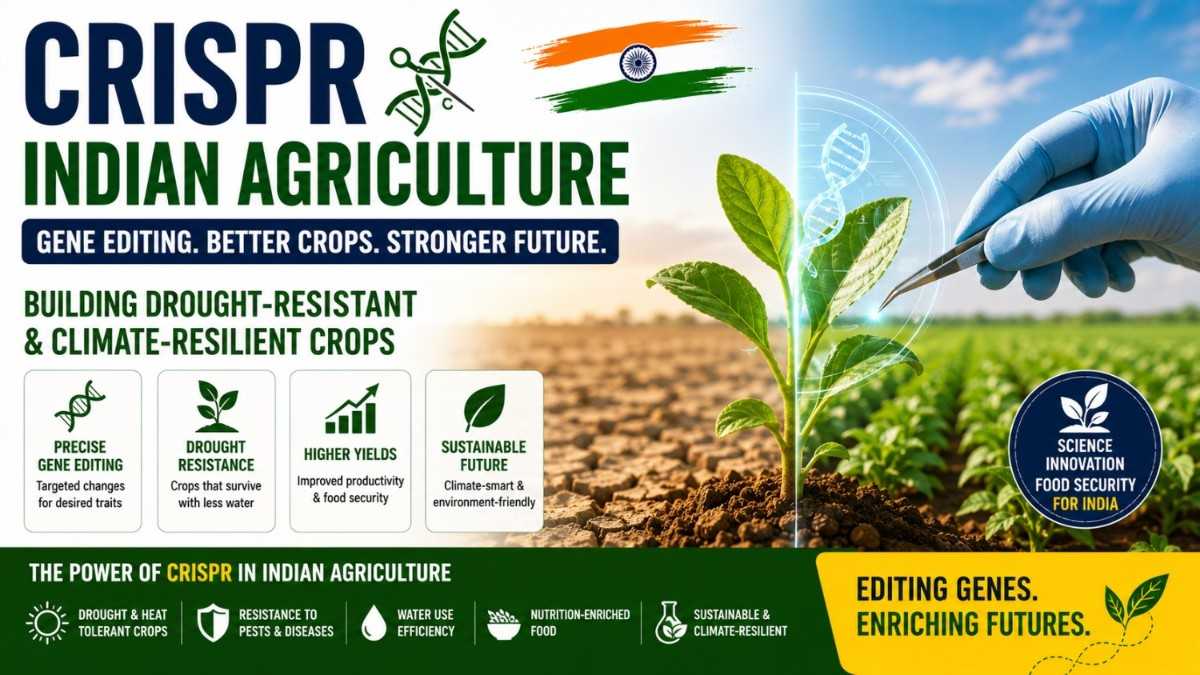
CRISPR gene editing in Indian agriculture is no longer a future concept — in 2026, it is an approved, field-tested reality that is reshaping how India grows food, manages drought, and creates high-paying research careers. If you are a science graduate, agri-biotech student, or a fresher looking for government research jobs in India, understanding CRISPR and its agricultural applications is critical for your career. India became one of the first countries in South Asia to officially approve CRISPR-edited crop varieties in 2025, with 2 revolutionary rice varieties — Pusa DST Rice 1 and DRR Dhan 100 — already released by ICAR. This complete guide covers everything: what CRISPR is, how it creates drought-resistant crops, which institutes are hiring, what salaries are on offer, eligibility for research fellowships, and how to build a career in agricultural biotechnology in India.

📋 Table of Contents
- What Is CRISPR Gene Editing in Agriculture? (2026 Update)
- CRISPR Gene Editing for Drought-Resistant Crops in India
- ICAR-Approved CRISPR Rice Varieties: Pusa DST Rice 1 & DRR Dhan 100
- Career & Salary in Gene Editing Agriculture Research Jobs India
- Eligibility & Qualifications for Agricultural Biotechnology Jobs
- How to Apply for ICAR IARI Gene Editing Research Jobs 2026
- Who Should Pursue a Career in CRISPR Agriculture Research?
- CRISPR Crops vs Traditional Breeding vs GMO – Comparison Table
- High-Value Agricultural Biotechnology Terms You Must Know
- Frequently Asked Questions – CRISPR Gene Editing India 2026
What Is CRISPR Gene Editing in Agriculture? (2026 Update)
CRISPR gene editing in agriculture stands for Clustered Regularly Interspaced Short Palindromic Repeats — a precise molecular scissors technology that allows scientists to cut and modify specific sections of a crop plant’s DNA with pinpoint accuracy. Unlike traditional plant breeding, which can take 10–15 years to develop a new variety, CRISPR gene editing can produce improved crop varieties in just 2–3 years.

The technology was co-invented by Nobel laureate Jennifer Doudna and Emmanuelle Charpentier. In agriculture, CRISPR-Cas9 is the most widely used system. The “Cas9” is a protein that acts as the scissors, guided by a short RNA sequence to the exact location in the plant genome that needs to be modified. Scientists can then switch off genes that cause weakness (like susceptibility to drought), or enhance genes that improve productivity.
- 🔬 Precision editing: CRISPR targets only the desired gene — no random mutations across the genome like older technologies such as chemical mutagenesis.
- 🌱 No foreign DNA: SDN-1 and SDN-2 type CRISPR edits do not insert genes from other species, making these crops legally distinct from GMOs in India.
- ⚡ Speed: CRISPR reduces variety development from 15 years (traditional breeding) to just 2–3 years, which is critical for addressing climate change threats.
- 💰 Cost-effective: CRISPR tools cost significantly less than older transgenic crop development, making them viable even for India’s publicly funded ICAR research system.
- 🌍 Global recognition: As of 2026, countries including the USA, UK, Japan, and Australia have all created simplified regulatory pathways for CRISPR-edited crops — and India has joined this progressive list.
For Indian students and researchers, CRISPR gene editing in agriculture represents one of the most exciting and well-funded career pathways in the government science sector today. The Indian Council of Agricultural Research (ICAR) has invested crores of rupees in gene editing research since 2018, and the career opportunities for qualified graduates are expanding rapidly in 2026.
CRISPR Gene Editing for Drought-Resistant Crops in India
India faces a severe agricultural water crisis. More than 68% of India’s net sown area is rainfed, meaning crops depend entirely on monsoon rainfall. With climate change causing irregular monsoons, droughts now threaten crop yields across 15+ states every year. CRISPR gene editing for drought-resistant crops offers the most promising scientific solution to this national food security challenge.
The mechanism by which CRISPR creates drought resistance in crops involves targeting specific genes that control water loss. In rice, for example, genes like DST (Drought and Salt Tolerance) and OsPYL9 regulate how the plant manages water stress. By precisely editing these genes using CRISPR-Cas9, scientists at ICAR-IARI achieved plants with reduced stomatal density — meaning the leaves lose less water through transpiration. This single genetic modification translated to measurable field benefits:
- 💧 Up to 30% water saving per crop cycle compared to standard varieties, directly reducing irrigation costs for farmers.
- 📈 9–19% higher grain yield under drought stress conditions in field trials across multiple agro-climatic zones.
- 🌾 Salt tolerance improvement as a secondary benefit — the same gene edits that confer drought tolerance also improve performance on saline soils.
- 🌡️ Heat stress resilience — ongoing CRISPR research in India is targeting wheat and sorghum for combined heat-drought tolerance by 2027.
- 🌽 Multiple crop coverage: Current CRISPR research at ICAR covers rice, wheat, mustard, soybean, chickpea, groundnut, and banana — all strategically important crops for Indian farmers’ income.
The ICAR Genome Editing Research Programme initiated in 2018 under the National Agricultural Science Fund has now delivered tangible results. In February 2025, the Innovative Genomics Institute (IGI) — the institute founded by Nobel laureate Jennifer Doudna — conducted advanced CRISPR training for Indian scientists at IARI. ICAR has also trained 9 scientists in leading institutions across the USA, Europe, Australia, and CIMMYT (Mexico) as part of building India’s genome-editing workforce for the future.
ICAR-Approved CRISPR Rice Varieties: Pusa DST Rice 1 & DRR Dhan 100
India made history in 2025 when Agriculture Minister Shivraj Singh Chouhan officially announced 2 CRISPR-Cas9-edited rice varieties developed entirely by Indian public sector scientists — without any foreign DNA. These are India’s first approved genome-edited food crop varieties and mark a watershed moment for agricultural biotechnology in the country.
| Feature | Pusa DST Rice 1 | DRR Dhan 100 (Kamla) |
|---|---|---|
| Developed by | ICAR-IARI, New Delhi | ICAR-IIRR, Hyderabad |
| Base Variety | MTU 1010 | Samba Mahsuri |
| Gene Edited | DST gene (knocked out) | OsCKX2 (cytokinin oxidase gene) |
| Drought Tolerance | Significantly improved | Improved (secondary benefit) |
| Salt Tolerance | Yes — improved | Moderate improvement |
| Yield Increase | 9–30% under stress conditions | Up to 19% higher grain yield |
| Foreign DNA | None — non-GMO | None — non-GMO |
| Regulatory Status | Approved 2025 (SDN-1) | Approved 2025 (SDN-1) |
| Target States | Andhra Pradesh, Telangana, Maharashtra | Odisha, West Bengal, Tamil Nadu |
| Water Use Efficiency | Reduced stomatal density = less water loss | Improved tillering and grain set |
Both varieties were developed under ICAR’s National Agricultural Science Fund project initiated in 2018. Their approval under India’s biosafety regulations — specifically the SDN-1 and SDN-2 genome editing categories cleared by the Ministry of Environment, Forest and Climate Change — represents a policy milestone. India now has one of Asia’s most progressive and science-backed gene editing regulatory frameworks for crop improvement.
Career & Salary in Gene Editing Agriculture Research Jobs India
One of the most exciting aspects of CRISPR gene editing growth in Indian agriculture is the career boom it is creating for science graduates. ICAR, DBT (Department of Biotechnology), and affiliated institutes are actively recruiting JRFs, SRFs, Young Professionals, and Research Associates for genome editing projects across India in 2026. Here is a complete salary breakdown:
| Position | Monthly Stipend / Salary | Annual Earning | Qualification Required | Key Employer |
|---|---|---|---|---|
| Young Professional (YP-I) | Rs. 25,000/month | Rs. 3,00,000/year | B.Sc. Agriculture / Biotechnology | ICAR-IARI |
| Young Professional (YP-II) | Rs. 35,000/month | Rs. 4,20,000/year | M.Sc. Plant Sciences / Biotechnology | ICAR, DBT Institutes |
| Junior Research Fellow (JRF) | Rs. 37,000/month + HRA | Rs. 4,44,000/year + HRA | M.Sc. + NET/GATE preferred | ICAR-IARI, NABARD funded |
| Senior Research Fellow (SRF) | Rs. 42,000/month + HRA | Rs. 5,04,000/year + HRA | M.Sc. + 2 years research experience | ICAR, DBT, DST Projects |
| Research Associate (RA) | Rs. 54,000/month + HRA | Rs. 6,48,000/year + HRA | Ph.D. in Plant Sciences/Biotechnology | ICAR-IARI, NABI, DBT Labs |
| Scientist B (ARS) | Rs. 67,700–Rs. 1,08,000/month | Rs. 8,12,400+/year | Ph.D. + ASRB NET | ICAR All India Service |
💡 Pro Tip: ICAR research fellowship positions (JRF/SRF) also provide HRA (House Rent Allowance) as per Central Government rates, medical benefits under CGHS, and access to world-class laboratory infrastructure at institutes like IARI (New Delhi), IIRR (Hyderabad), and NABI (Mohali). These positions are contractual but serve as the fastest gateway to a permanent Scientist career via the ASRB Agricultural Research Service examination. Always apply through the official IARI official website and set email alerts for new notifications.
Eligibility & Qualifications for Agricultural Biotechnology Jobs
Eligibility criteria for CRISPR gene editing and agricultural biotechnology research jobs in India vary by position level. Here is the complete eligibility breakdown for 2026 recruitments:
| Category | Educational Qualification | Age Limit | Age Relaxation |
|---|---|---|---|
| General / UR | B.Sc./M.Sc./Ph.D. as per post | Up to 35 years (SRF/RA) | None |
| OBC (Non-Creamy Layer) | Same as above | Up to 38 years | 3 years relaxation |
| SC / ST | Same as above | Up to 40 years | 5 years relaxation |
| PwBD (Divyangjan) | Same as above | Up to 40–45 years | 10 years (UR), 13 years (OBC), 15 years (SC/ST) |
| Women Candidates | Same as above | As per general norms | State-specific relaxation may apply |
Application Fee: Most ICAR project-based recruitment notifications for JRF/SRF/RA/YP positions carry zero application fee — there is no registration charge. For ASRB (Agricultural Scientists Recruitment Board) examinations for permanent Scientist posts, fees apply:
| Category | ASRB Exam Application Fee |
|---|---|
| General / OBC / EWS | Rs. 500–Rs. 1,000 (varies by exam) |
| SC / ST / PwBD | Rs. 0 (Nil / Exempt) |
| Women (all categories) | Rs. 0 in many ICAR notifications |
- 🎓 For JRF/SRF positions: M.Sc. in Plant Biotechnology, Molecular Biology, Genetics, Agricultural Biotechnology, Biochemistry, or Life Sciences from a UGC-recognised university is required. NET/GATE qualification is strongly preferred.
- 🧬 For Research Associate (RA): Ph.D. in Plant Sciences, Biotechnology, or Molecular Biology is mandatory. Post-doctoral experience is an added advantage.
- 💻 Skills in demand: Proficiency in PCR, gel electrophoresis, plant tissue culture, bioinformatics tools (BLAST, SnapGene), CRISPR vector construction, and next-generation sequencing data analysis.
- 📜 ASRB NET: To become a permanent ICAR Scientist, candidates must clear the Agricultural Research Service (ARS) / NET examination conducted by the Agricultural Scientists Recruitment Board.
How to Apply for ICAR IARI Gene Editing Research Jobs 2026
Applying for CRISPR-related agricultural biotechnology research jobs at ICAR institutes follows a clear process. Here is a step-by-step guide for freshers and experienced candidates:
- 📢 Find the official notification: Visit IARI official jobs page or ICAR main website regularly. Also check Agrijob.in for alerts on new ICAR/DBT biotech recruitments updated daily.
- 📋 Read eligibility carefully: Note the project name, PI (Principal Investigator) name, number of posts, qualification required, and age limit. Apply only if you meet all criteria — applications not meeting cut-off eligibility are rejected at screening stage.
- 📄 Prepare required documents: Gather self-attested copies of: all marksheets (10th to M.Sc./Ph.D.), degree certificates, NET/GATE score card, age proof (Aadhaar/PAN), category certificate (SC/ST/OBC/EWS if applicable), experience certificates, and publications list if any.
- 📧 Submit application by email: Most ICAR project recruitment requires sending a filled application proforma (downloadable from the notification) as a single PDF to the designated project email address. Include your full name and post applied for in the subject line.
- 📝 Fill Google Form (if required): Many recent IARI notifications require candidates to also fill an online Google Form link given in the notification — do not miss this step or your application will be considered incomplete.
- 🗓️ Await shortlisting: Only shortlisted candidates are called for online or in-person interview. Shortlisting is based on merit of academic record, research experience, and publications.
- 🎤 Interview: Interviews for ICAR project positions are typically conducted online via video call. Prepare to present your M.Sc./Ph.D. research work, knowledge of CRISPR methodology, and understanding of crop improvement goals.
- ✅ Joining and document verification: After selection, original documents are verified before joining. Joining date is typically within 30 days of the interview result announcement.
Who Should Pursue a Career in CRISPR Agriculture Research?
A career in CRISPR gene editing and agricultural biotechnology in India is ideal for a specific set of candidates. Here are 8 candidate profiles who should seriously consider this path:
- 🌱 Agriculture science graduates (B.Sc./M.Sc.): Candidates with specialisation in plant breeding, genetics, or agronomy from any UGC-recognised agricultural university who want to transition into cutting-edge research rather than routine extension work.
- 🔬 Life science and biotechnology graduates: M.Sc. holders in Biotechnology, Molecular Biology, Biochemistry, or Microbiology who are passionate about applying molecular tools to solve real-world food security problems.
- 👩🔬 Women researchers: Government biotech research jobs provide safe, structured, and well-paid working environments with maternity benefits. Women are especially encouraged to apply; many ICAR notifications offer age relaxation for women candidates.
- 📚 NET/GATE qualified candidates: Students who have cleared CSIR-UGC NET in Life Sciences or GATE in Biotechnology/Agricultural Engineering have a strong advantage in JRF and SRF recruitment at ICAR institutes and can command higher stipends.
- 🌾 SC/ST candidates from rural backgrounds: Reserved category candidates with 5-year age relaxation and zero application fee for most ASRB exams — this is one of the best government science career pathways for rural SC/ST youth with science education.
- 🧪 Ph.D. scholars in plant sciences: Doctoral researchers in plant molecular biology, genomics, or crop improvement who want to continue in the government research ecosystem as Research Associates or future ICAR Scientists (ARS).
- 💡 UPSC/IFS aspirants with science background: Candidates preparing for competitive government exams who want a stipend-earning bridge period can use ICAR JRF/SRF positions as a funded research gap year.
- 🌐 Agritech and biotech startup-aspirants: Young entrepreneurs and innovators who want deep hands-on CRISPR research experience before launching their own agritech ventures in India’s growing Rs.50,000 crore agriculture technology sector.
CRISPR Crops vs Traditional Breeding vs GMO – Comparison Table
Understanding the key differences between CRISPR gene editing, traditional plant breeding, and GMO technology is essential for students, policy advocates, and farmers. Here is a comprehensive 9-point comparison:
| Parameter | CRISPR Gene Editing | Traditional Breeding | GMO Technology |
|---|---|---|---|
| Development Time | 2–3 years | 10–15 years | 7–10 years |
| Foreign DNA inserted? | No (SDN-1/SDN-2) | No | Yes |
| Regulatory complexity in India | Simplified (GEAC fast-track) | Standard variety release | Complex — full GEAC GMO review |
| Precision of genetic change | Very high — specific gene | Low — genome-wide | High — specific gene (with insertion) |
| Consumer acceptance | High (not perceived as GMO) | Very high | Low in India currently |
| Development cost | Moderate (Rs.2–10 crore) | Low (Rs.50 lakh–2 crore) | High (Rs.50–200 crore) |
| IP/patent issues | Fewer for public sector | Minimal | Significant — often held by MNCs |
| Drought tolerance achievable? | Yes — proven in India (Pusa DST Rice 1) | Yes — but slow | Yes — with Bt/Ht trait stacking |
| Best for Indian context? | ✅ Yes — fast, affordable, non-GMO | ✅ Suitable for stable crops | ❌ Political and social resistance |
🏆 Expert Verdict: For India’s specific context — a vast smallholder farming base, water stress, climate uncertainty, and strong public sector research infrastructure — CRISPR gene editing is the clear winner among the 3 crop improvement approaches. It combines the speed of biotechnology with the safety profile of traditional breeding, and India’s progressive 2025 regulatory approval has already put the technology on a fast track to reach farmers’ fields by 2026–2027. Students and researchers who build CRISPR skills now are positioning themselves at the forefront of India’s next agricultural revolution.
High-Value Agricultural Biotechnology Terms You Must Know
Whether you are preparing for ICAR exams, biotech interviews, or writing about agricultural technology, these 10 high-value terms will demonstrate your expert knowledge of CRISPR gene editing in Indian agriculture:
- 🧬 CRISPR-Cas9: The most widely used gene editing system in agriculture; Cas9 is a protein derived from bacteria that cuts DNA at a precise location guided by a short RNA sequence. India’s approved rice varieties (Pusa DST Rice 1 and DRR Dhan 100) were developed using CRISPR-Cas9.
- 🌾 SDN-1 and SDN-2: Site-Directed Nuclease categories — SDN-1 involves gene knockout (no foreign DNA), SDN-2 involves repair-template-based editing. Both are approved under India’s 2022 revised Genome Editing Guidelines by GEAC, making them faster to commercialise than GMO (SDN-3) crops.
- 💧 DST Gene (Drought and Salt Tolerance): A key regulatory gene in rice that, when knocked out using CRISPR, leads to reduced stomatal density and improved water use efficiency — the molecular mechanism behind Pusa DST Rice 1’s drought tolerance. Salary relevance: Scientists specialising in stress-tolerance gene research earn Rs.54,000–Rs.1,08,000/month at ICAR.
- 🔍 Genome Editing vs Genetic Modification: A regulatory and scientific distinction critical for Indian policy. Genome editing (SDN-1/SDN-2) modifies the plant’s own genes; genetic modification (GMO/SDN-3) introduces foreign DNA. India’s 2022 Environment Protection Act amendment exempts SDN-1 and SDN-2 crops from stringent GMO rules.
- 🧪 GEAC (Genetic Engineering Appraisal Committee): India’s apex regulatory body under the Ministry of Environment that reviews and approves all biotech crop releases. Understanding GEAC processes is essential for anyone pursuing a career in agricultural biotechnology policy or regulatory affairs in India.
- 🌱 ICAR-NASF (National Agricultural Science Fund): The primary government funding mechanism for cutting-edge agricultural research in India with an annual budget exceeding Rs.100 crore. Most CRISPR crop research projects in India are funded under NASF, creating hundreds of JRF/SRF positions annually.
- 🔬 NGT (New Genomic Techniques): An internationally used term (especially by the EU and FAO) for CRISPR and related gene editing technologies. Familiarity with NGT is essential for Indian researchers seeking international collaborations or publishing in global journals.
- 💡 Base Editing and Prime Editing: Next-generation CRISPR tools that allow even more precise single-letter DNA changes without creating double-strand breaks. India’s ICAR collaboration with IGI (Innovative Genomics Institute) includes access to GeoCas9 and CasLambda — tools that represent the frontier of precision plant editing in 2026.
- 🌍 Climate-Resilient Agriculture (CRA): A policy framework adopted by India under its NDC (Nationally Determined Contribution) commitments to the Paris Agreement. CRISPR gene editing is considered a key tool for achieving India’s CRA targets of feeding 1.4 billion people under increasingly erratic climate conditions by 2030.
- 📊 Agri-Biotech Sector Market Size: India’s agricultural biotechnology sector is valued at over Rs.35,000 crore and growing at 10% CAGR. CRISPR-related products, services, and research represent the fastest-growing subsegment — creating demand for thousands of trained molecular biologists, plant breeders, and bioinformaticians across government, private, and international research organisations in India.
Frequently Asked Questions – CRISPR Gene Editing India 2026
What is CRISPR gene editing in agriculture?
CRISPR gene editing in agriculture is a precision biotechnology tool that allows scientists to make targeted changes to a crop plant’s own DNA — without adding foreign genes. ICAR scientists in India used CRISPR-Cas9 to develop Pusa DST Rice 1 and DRR Dhan 100 (Kamla), both approved in 2025, which show up to 30% higher yield under drought and saline stress conditions compared to conventional varieties.
Which CRISPR-edited crops are approved in India in 2026?
India has approved 2 genome-edited rice varieties as of 2025–2026: Pusa DST Rice 1 (developed by ICAR-IARI, New Delhi) and DRR Dhan 100 also called Kamla (developed by ICAR-IIRR, Hyderabad). Both were created using CRISPR-Cas9 and are free of foreign DNA, making them distinct from GMO crops. They offer improved drought tolerance, salt tolerance, and higher grain yield for Indian farmers.
Is CRISPR gene editing legal in India?
Yes, CRISPR gene editing of SDN-1 and SDN-2 type modifications is legally approved under India’s biosafety regulations for general crops. The Genetic Engineering Appraisal Committee (GEAC) under the Ministry of Environment has cleared these categories. Unlike GMO crops, CRISPR-edited varieties that do not contain foreign DNA face a simplified regulatory pathway, making India one of the few developing countries with a progressive gene-editing policy as of 2026.
What salary can I earn in CRISPR agriculture research jobs in India?
CRISPR gene editing research positions in India offer competitive fellowships. ICAR-IARI recruitment in 2026 offers Young Professional roles with Rs.25,000–Rs.35,000/month, Junior Research Fellow (JRF) positions at Rs.37,000/month, and Senior Research Fellow (SRF) roles at Rs.42,000/month plus HRA. Senior Scientist posts at ICAR under ARS can reach Rs.67,700 to Rs.2,08,700/month in the Level 11–13 pay matrix — some of the highest government science salaries in India.
What qualifications are needed for gene editing agriculture jobs in India?
For CRISPR gene editing agriculture research jobs in India, you typically need a B.Sc. in Agriculture, Botany, Biotechnology, or Life Sciences for Young Professional roles, and an M.Sc. in Plant Biotechnology, Genetics, Molecular Biology, or Agricultural Biotechnology for JRF/SRF positions. A Ph.D. in plant sciences is required for Scientist and Research Associate positions at ICAR and IARI. NET/GATE qualification is often preferred or mandatory for fellowship roles.
How does CRISPR help develop drought-resistant crops in India?
CRISPR gene editing helps develop drought-resistant crops in India by precisely knocking out or modifying specific stress-suppressor genes. For example, ICAR-IARI edited the DST (Drought and Salt Tolerance) gene in the MTU 1010 rice variety to create Pusa DST Rice 1, which has reduced stomatal density and improved water-use efficiency. This allows the crop to retain more moisture during water stress, potentially boosting yields by 9–30% in drought-prone regions across India.
How is CRISPR different from GMO crops in India?
CRISPR gene editing differs from GMO technology in one critical way: CRISPR does not insert foreign DNA from another species into the plant. Instead, it makes precise edits to the plant’s own existing genes, similar to accelerated natural mutation. India’s regulatory framework treats CRISPR-edited SDN-1 and SDN-2 crops under a simpler approval pathway than GMOs, which face stringent GEAC scrutiny — making CRISPR-edited crops faster and cheaper to develop and commercialise.
Which government institutes in India are working on CRISPR crop research?
The leading government institutes working on CRISPR gene editing in Indian agriculture include ICAR-IARI (New Delhi), ICAR-IIRR (Hyderabad), National Agri-Food Biotechnology Institute or NABI (Mohali), Sher-e-Kashmir University of Agricultural Sciences and Technology (Jammu), and the Department of Biotechnology (DBT) under the Ministry of Science. ICAR has also collaborated with the Innovative Genomics Institute (IGI) founded by Nobel laureate Jennifer Doudna for advanced CRISPR training sessions conducted in India in 2025.
📌 Key Facts at a Glance – CRISPR Gene Editing in Indian Agriculture 2026
| First CRISPR Crop Approvals | 2025 – Pusa DST Rice 1 & DRR Dhan 100 (Kamla) |
| Technology Used | CRISPR-Cas9 (SDN-1 category) |
| Regulatory Body | GEAC, Ministry of Environment |
| Key Research Institutes | ICAR-IARI (Delhi), ICAR-IIRR (Hyderabad), NABI (Mohali) |
| Yield Improvement | 9–30% under drought/saline stress |
| JRF Stipend (2026) | Rs. 37,000/month + HRA |
| SRF Stipend (2026) | Rs. 42,000/month + HRA |
| Application Fee (JRF/SRF) | Zero (most ICAR project posts) |
| Crops Under Research | Rice, wheat, mustard, soybean, chickpea, banana |
| Foreign DNA? | No — non-GMO, precision editing only |
This guide is regularly reviewed and updated for accuracy. Bookmark this page for the latest CRISPR agriculture research jobs, ICAR notifications, and gene editing policy updates from India. For the latest agri-biotech government jobs, visit Agrijob.in — India’s most trusted agriculture job portal.
Last Updated: May 2026