

Aquaponics Farming Business 2026 – Rs.8 Lakh Profit Guide
Aquaponics farming business India is one of the most profitable and sustainable agri-business ideas of 2026 — combining fish cultivation and vegetable growing in a single closed-loop system that generates dual income of Rs.6–8 lakh per year from a medium-scale unit. If you are a farmer, agripreneur, or job seeker looking for a high-return rural business that needs minimal land and 80% less water than traditional farming, this complete guide is for you. In this 2026 updated guide, we cover everything: setup cost, best fish species, top vegetables, government subsidy eligibility, step-by-step system setup, profit calculation, comparison with other farming models, and FAQs.

- What Is Aquaponics Farming Business in India? (2026)
- Aquaponics Farming Profit & Income Potential
- Setup Cost & Investment Breakdown
- Eligibility & Government Subsidy for Aquaponics
- Best Fish Species for Aquaponics Farming India
- Top Vegetables Grown in Aquaponics System
- How to Start Aquaponics Farming – Step-by-Step Process
- Who Should Start Aquaponics Farming Business?
- Aquaponics vs Traditional Farming vs Hydroponics
- High-Value Agri Business Terms You Must Know
- Frequently Asked Questions (FAQ)
| Business Type | Integrated Fish + Vegetable Farming |
| Minimum Land Required | 150 sq ft (backyard) to 1,000 sq ft (commercial) |
| Setup Cost (Small) | Rs.60,000 – Rs.65,000 |
| Setup Cost (Medium) | Rs.3 lakh – Rs.5 lakh |
| Annual Income (Medium Unit) | Rs.6 lakh – Rs.8 lakh |
| Govt Subsidy Available | 20%–50% via NABARD, NHB, PMMSY |
| Water Saving | Up to 80% vs traditional farming |
| Best Fish Species | Tilapia, Catfish, Rohu, Common Carp |
| Break-Even Period | 18–24 months |
What Is Aquaponics Farming Business in India? (2026)
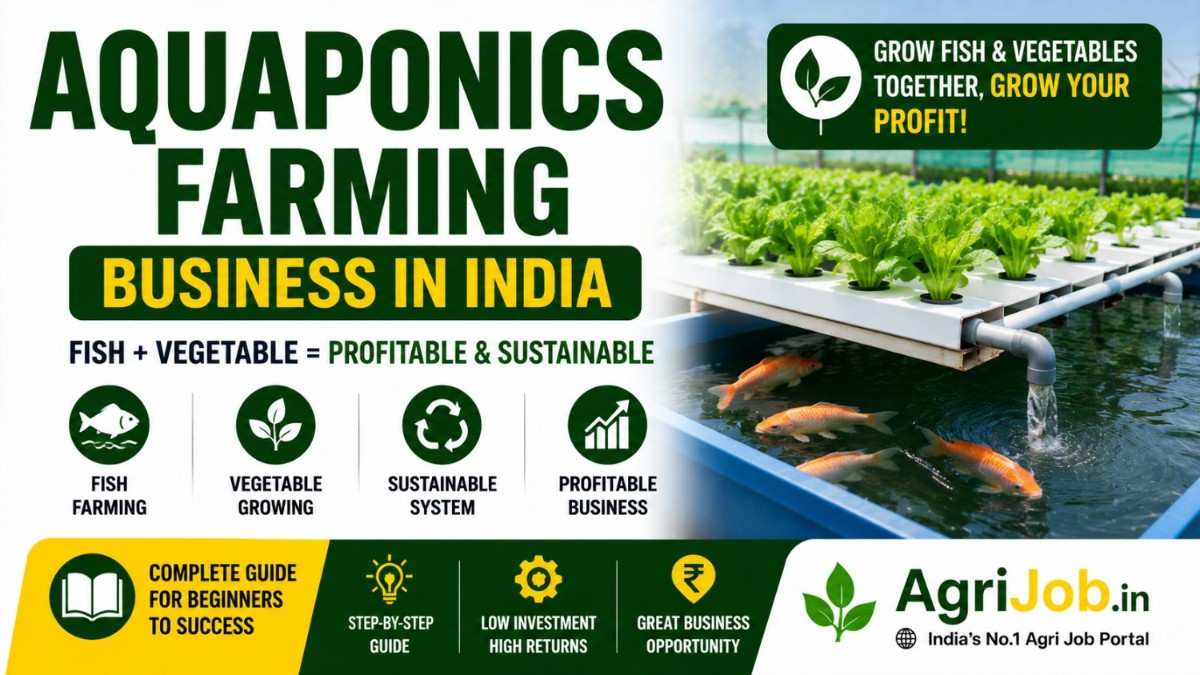
Aquaponics farming business India is an innovative, soil-free agricultural system that combines aquaculture (fish rearing in controlled tanks) with hydroponics (growing plants in nutrient-rich water) in a single closed-loop ecosystem. In this integrated system, fish produce ammonia-rich waste, which beneficial bacteria convert into nitrates — the natural fertiliser that feeds your vegetable plants. The plants absorb these nutrients and purify the water, which then cycles back clean into the fish tanks. The result is a self-sustaining, chemical-free food production system that runs year-round.
In India, aquaponics is gaining rapid momentum in 2026 due to 3 key national pressures: rising water scarcity affecting traditional farms, increasing demand for organic and chemical-free vegetables in urban markets, and government push for sustainable agriculture under schemes like PMMSY (Pradhan Mantri Matsya Sampada Yojana) and the National Fisheries Policy. Entrepreneurs and farmers across Maharashtra, Tamil Nadu, Kerala, Haryana, and UP are already running profitable aquaponics units generating Rs.5–10 lakh annually.

There are 3 main production techniques used in aquaponics farming in India:
- 🪣 Deep Water Culture (DWC): Plants float on Styrofoam rafts with roots submerged in nutrient water. Best for leafy greens like lettuce and spinach. Simple to manage and highly popular for beginners.
- 🌊 Nutrient Film Technique (NFT): A thin stream of nutrient-rich water flows through channels where plant roots are suspended. Requires a slight slope and is ideal for herbs and smaller crops.
- 🪨 Media Bed System: Grow beds filled with gravel or clay pebbles act as both the plant root support and the biological filter. Best for fruiting vegetables like tomatoes and capsicum. Most versatile for Indian conditions.
Aquaponics Farming Profit & Income Potential in India
The aquaponics farming business India model generates income from 2 simultaneous revenue streams — fish sales and premium vegetable sales — making it one of the highest-return agriculture businesses per square foot. Here is a detailed profit breakdown by scale:
| Scale | Area | Setup Cost | Annual Revenue | Annual Profit |
|---|---|---|---|---|
| Backyard / Home | 150–300 sq ft | Rs.60,000–Rs.1 lakh | Rs.1–1.5 lakh | Rs.50,000–Rs.80,000 |
| Small Commercial | 500–1,000 sq ft | Rs.1.5–3 lakh | Rs.3–4.5 lakh | Rs.1.5–2.5 lakh |
| Medium Commercial | 1,000–5,000 sq ft | Rs.3–5 lakh | Rs.8–12 lakh | Rs.5–8 lakh |
| Large / 1 Acre | 1 acre+ | Rs.80 lakh–Rs.1.5 crore | Rs.30–50 lakh | Rs.12–20 lakh |
Revenue from premium herbs fetches Rs.150–300 per 100g in urban retail and restaurant supply chains. Standard leafy greens sell at Rs.80–150 per head, and bulk produce moves at Rs.40–80 per kg in wholesale markets. Fish like Tilapia sell at Rs.150–250 per kg live weight in most Indian markets. A well-managed 1,000 sq ft aquaponics unit harvesting both fish and vegetables can generate a combined annual revenue of Rs.8–12 lakh.
Aquaponics Farming Setup Cost & Investment Breakdown
Understanding the setup cost of aquaponics farming in India is critical before investing. The cost varies significantly based on scale, automation level, materials used, and location. Here is a detailed component-wise breakdown for a medium commercial unit (1,000–2,000 sq ft):
| Component | Specification | Estimated Cost |
|---|---|---|
| Fish Tanks (FRP/HDPE) | 3,000–5,000 litre capacity | Rs.30,000–Rs.60,000 |
| Grow Beds / DWC Rafts | PVC / Fibreglass grow beds | Rs.25,000–Rs.50,000 |
| Water Pumps & Pipes | Submersible + air pumps | Rs.15,000–Rs.25,000 |
| Bio-Filter Media | Gravel, clay pebbles, bio-balls | Rs.8,000–Rs.15,000 |
| Shade Net / Polyhouse | 50% shade net or low-cost polyhouse | Rs.20,000–Rs.50,000 |
| Fish Fingerlings (Stock) | 500–1,000 fingerlings | Rs.5,000–Rs.10,000 |
| Seeds / Seedlings | Vegetables and herbs | Rs.3,000–Rs.6,000 |
| Water Testing Kit | pH, ammonia, nitrate, DO meter | Rs.5,000–Rs.10,000 |
| Electrical & Miscellaneous | Wiring, lighting, fittings | Rs.10,000–Rs.20,000 |
| Total Estimated Cost | Medium Unit (1,000–2,000 sq ft) | Rs.1.2 lakh – Rs.2.5 lakh |
For a small backyard system of 150 sq ft, the total investment is approximately Rs.60,000–Rs.65,000 covering a 500–1,000 litre fish tank (Rs.5,000–Rs.15,000), grow beds, pump, and piping. A 1-acre commercial-grade aquaponics farm requires Rs.80 lakh–Rs.1.5 crore total investment including infrastructure, automation, and certified inputs.
Eligibility & Government Subsidy for Aquaponics Farming
The Government of India actively supports aquaponics farming through multiple subsidy and loan schemes in 2026. Here is the complete eligibility and financial support structure:
| Scheme | Nodal Body | Subsidy % | Max Limit | Category Benefit |
|---|---|---|---|---|
| PMMSY – Fish Farming | DOFPR / State Fisheries Dept. | 40% (Gen) / 60% (SC/ST/Women) | Rs.25 lakh | Extra 20% for SC/ST/Women |
| NHB Credit-Linked Subsidy | National Horticulture Board | 20%–25% | Rs.50 lakh | Higher in NE/Hilly regions |
| NHM Protected Cultivation | State Horticulture Dept. | 50% | State-specific | SC/ST priority |
| NABARD Fish Farming Loan | NABARD / Commercial Banks | 20% pond subsidy | Rs.3 lakh (pond) | 60–70% feed cost subsidy |
| ACABC Scheme | MANAGE / ICAR | Grant for Agripreneurs | Rs.5 lakh grant | Graduates / trained farmers |
- ✅ General Eligibility: Indian citizen aged 18 years and above; valid land ownership or lease agreement; no prior loan default with any scheduled bank.
- ✅ Educational Qualification: No minimum qualification required for PMMSY; graduates preferred for ACABC scheme; training certificate from any KVK/ICAR centre is beneficial.
- ✅ Category Benefits: SC/ST farmers receive additional 10–20% subsidy in most schemes; women farmers get priority processing in PMMSY and NHM.
- ✅ Application Mode: Online through pmmsy.dof.gov.in (PMMSY), nhb.gov.in (NHB), and nabard.org (NABARD loans).
- ✅ Documents Required: Aadhaar card, land documents / lease deed, bank passbook, passport-size photos, project report (DPR), caste certificate (if applicable).
Best Fish Species for Aquaponics Farming in India
Choosing the right fish species is the single most important decision in your aquaponics farming business India setup. The fish must be hardy, fast-growing, and produce sufficient waste to fertilise your plants efficiently. Here are the top 6 fish species recommended for Indian conditions:
- 🐟 Tilapia (Oreochromis niloticus): The #1 aquaponics fish in India. Grows from fingerling to 500g market size in just 6 months. Highly tolerant of water quality fluctuations. Market price Rs.150–200/kg. Best for all regions of India.
- 🐠 Catfish / Magur (Clarias batrachus): Extremely hardy and popular in North and East India. Grows fast in warm water (25–30°C). Market price Rs.200–280/kg. High local demand across UP, Bihar, Bengal, and Assam.
- 🐡 Rohu (Labeo rohita): Most widely consumed freshwater fish in India. Fetches Rs.120–180/kg. Grows best in medium-large tanks. Excellent for rural markets and wholesale trade.
- 🎣 Common Carp (Cyprinus carpio): Very affordable fingerlings (Rs.2–4 each), fast growth, tolerates a wide pH range of 6.5–9.0. Good for beginner aquaponics farmers.
- 🐟 Singhi / Stinging Catfish: Premium fish commanding Rs.300–400/kg in local markets. Highly drought-resistant and ideal for small tank aquaponics systems in Bihar, Jharkhand, and Odisha.
- 🦈 Pangas (Pangasianodon hypophthalmus): High growth rate, market-ready in 5–6 months at 600g+, export-quality fish with Rs.100–160/kg farm gate price. Best for large-scale commercial units.
Top Vegetables Grown in Aquaponics System India
The vegetable component of your aquaponics farming business India is where the highest profit-per-square-foot is generated. Choosing high-demand, fast-turnover crops maximises your annual revenue significantly. Here are the top 10 crops recommended for Indian aquaponics systems in 2026:
- 🥬 Lettuce & Salad Greens: Ready in 4–6 weeks, sells at Rs.80–150 per head in supermarkets and restaurants. Best crop for DWC systems. Multiple harvests per year.
- 🌿 Basil & Herbs (Tulsi, Mint, Coriander): Premium herbs fetch Rs.150–300 per 100g. Fast-growing, high-frequency harvest. Massive demand from restaurants, hotels, and online grocery platforms.
- 🍅 Tomatoes: High value crop at Rs.40–80/kg wholesale. Requires media bed system. 3–4 harvests annually possible in a well-managed aquaponics unit.
- 🫑 Capsicum (Bell Pepper): Coloured bell peppers sell at Rs.80–150/kg in retail markets. High profit margin and growing urban demand.
- 🥦 Spinach & Methi (Fenugreek): Ready in 3–4 weeks. Extremely high local demand across all Indian cities. Multiple crops per month possible.
- 🥒 Cucumber: Fast-growing fruiting vegetable that performs well in aquaponics media beds. Sells at Rs.20–40/kg in bulk.
- 🍓 Strawberries: Premium product fetching Rs.200–400/kg. Ideal for urban and peri-urban aquaponics farms in Maharashtra, Himachal Pradesh, and Uttarakhand.
- 🧄 Kale & Chard: Exported to international markets, premium pricing in Tier-1 city organic stores. Rs.100–200/kg retail.
How to Start Aquaponics Farming – Step-by-Step Process
Starting an aquaponics farming business in India requires a systematic approach. Follow this 10-step process to launch your unit successfully in 2026:
- Assess Your Land & Water Source: Identify a minimum 150 sq ft covered area (terrace, shed, or greenhouse). Ensure access to borewell, municipal, or rainwater harvesting source. Test water pH (ideal 6.8–7.2) and hardness before finalising location.
- Choose Your Scale & System Type: Decide between backyard (Rs.60,000 investment), small commercial (Rs.1.5–3 lakh), or medium commercial (Rs.3–5 lakh) scale. Select DWC, NFT, or Media Bed system based on target crops.
- Get Training from KVK / ICAR: Attend a 5–7 day aquaponics training programme at your nearest ICAR Krishi Vigyan Kendra (KVK) or private aquaponics training centre. Training costs Rs.3,000–Rs.8,000 and significantly reduces costly early mistakes.
- Prepare a Detailed Project Report (DPR): Create a business plan covering investment, projected income, break-even period, and marketing plan. A DPR is mandatory for applying for government subsidies and bank loans.
- Apply for Government Subsidy: Apply online at pmmsy.dof.gov.in or nhb.gov.in. Submit Aadhaar, land documents, project report, and bank details. Processing takes 30–90 days. Avail NABARD-linked bank loan simultaneously.
- Procure and Install Infrastructure: Purchase FRP/HDPE fish tanks, grow beds, submersible pumps, air pumps, bio-filter media (gravel/clay pebbles), PVC piping, and shade net or polyhouse covering.
- Cycle the System (Nitrogen Cycle): Before stocking fish, run the system for 4–6 weeks to establish beneficial bacteria colonies in the bio-filter. Add ammonia source (small amount of fish food) to kickstart bacterial growth. Test ammonia, nitrite, and nitrate levels daily.
- Stock Fish Fingerlings: Purchase certified fingerlings from a registered hatchery. Recommended stocking density: 20–30 kg of fish per 1,000 litres of water. Begin with Tilapia or Catfish for easiest management.
- Plant Your Vegetables: 2–4 weeks after fish stocking, transplant seedlings into grow beds. Start with fast-growing leafy greens (lettuce, spinach, methi) for quick first harvest and early cash flow within 6–8 weeks.
- Harvest, Market & Scale: Harvest vegetables every 4–8 weeks and fish every 6–8 months. Sell through local vegetable markets, restaurants, hotel supply contracts, online platforms (Jiomart, Swiggy Instamart), and direct to consumers via WhatsApp groups. Reinvest profits to scale up tank and grow bed capacity.
Who Should Start Aquaponics Farming Business?
Aquaponics farming business India is not just for traditional farmers. In 2026, this business model is perfect for a wide range of entrepreneurs and individuals. Here is who should seriously consider it:
- 🌾 Small and Marginal Farmers: With as little as 150 sq ft of covered space, farmers with limited land can earn Rs.50,000–Rs.80,000 additional annual income without competing for irrigation water.
- 👩 Rural Women Entrepreneurs: Aquaponics is ideal for women running home-based agri-businesses. PMMSY provides 60% subsidy for women, and the work is not physically strenuous. Over 3,000 women-led aquaponics units are active across India in 2026.
- 🎓 Agriculture / Science Graduates: BSc Agriculture, BSc Biology, or any science graduate can leverage their educational background to operate a tech-enabled aquaponics unit and qualify for ACABC scheme grants up to Rs.5 lakh.
- 🏙️ Urban Agripreneurs (Terrace Farmers): Residents of Tier-1 and Tier-2 cities with terrace access (minimum 200 sq ft) can start a profitable home aquaponics unit selling premium herbs and fish to local restaurants and organic stores.
- 📉 Unemployed / Job Seekers: Youth aged 20–35 looking for self-employment opportunities can start with a Rs.60,000–Rs.1 lakh investment and build a viable full-time income of Rs.4–6 lakh within 2 years.
- 🏫 School / College Institutions: Educational institutions can set up demo aquaponics units for student training, skill development, and supplementary income through food production.
- 👴 Retired Government Employees: Individuals with lump-sum retirement benefits looking for a low-labour, high-return investment can invest in a medium aquaponics unit as a pension income supplement.
- 🌏 SC/ST Entrepreneurs: The additional 20% government subsidy under PMMSY and NHM makes aquaponics farming one of the most financially accessible agri-business models for SC/ST communities in India.
Aquaponics vs Traditional Farming vs Hydroponics India
| Parameter | Aquaponics Farming | Traditional Soil Farming | Hydroponics Only |
|---|---|---|---|
| Water Usage | 80% less water | High water usage | 70% less water |
| Land Required | 150 sq ft minimum | 1 acre+ recommended | 100 sq ft minimum |
| Revenue Streams | Fish + Vegetables (dual) | Single crop | Vegetables only |
| Chemical Input | Zero chemicals needed | High fertiliser/pesticide | Nutrient solutions needed |
| Setup Cost (Medium) | Rs.3–5 lakh | Rs.50,000–Rs.2 lakh | Rs.5–10 lakh |
| Annual Profit (Medium) | Rs.5–8 lakh | Rs.1–3 lakh/acre | Rs.4–7 lakh |
| Govt Subsidy | 40–60% (PMMSY + NHB) | PM-Kisan, crop insurance | 20–50% (NHB, NHM) |
| Year-Round Production | Yes – all seasons | Seasonal limitations | Yes – all seasons |
| Best For | Dual income entrepreneurs | Large land farmers | Urban/peri-urban veg only |
High-Value Agri Business Terms You Must Know
If you are planning to build a serious aquaponics farming business in India, knowing these high-value industry terms will help you access subsidies, connect with buyers, and position your business professionally:
- 💰 Integrated Farming System (IFS): A farming model combining multiple agricultural activities — crops, fish, livestock — to maximise income from the same land area. Aquaponics is a modern form of IFS. Govt. of India provides special grants for IFS under the NMSA scheme.
- 🐟 PMMSY – Pradhan Mantri Matsya Sampada Yojana: India’s flagship fisheries development scheme with Rs.20,050 crore budget. Provides 40–60% subsidy for fish farming infrastructure including aquaponics tanks and recirculating systems.
- 🌿 Controlled Environment Agriculture (CEA): Technology-driven farming using greenhouses, polyhouses, or indoor grow lights to control temperature, humidity, and light. Aquaponics under CEA achieves 300% higher yield than open field farming.
- 🔄 Recirculating Aquaculture System (RAS): Advanced closed-loop fish farming system that recycles 95%+ of water. Aquaponics is a plant-integrated form of RAS. RAS unit setup cost: Rs.5–25 lakh for commercial scale.
- 🏢 Agri-Clinics & Agri-Business Centres (ACABC): ICAR and MANAGE-supported scheme providing grants up to Rs.5 lakh and training for agriculture graduates starting agri-business ventures, including aquaponics farms.
- 📜 Organic Certification (India Organic / NPOP): Chemical-free aquaponics produce can be certified organic under NPOP (National Programme for Organic Production), unlocking premium pricing of 30–100% above standard market rates.
- 🌾 KVK – Krishi Vigyan Kendra: ICAR’s farm science centres present in every district of India. Provide free technical guidance, low-cost training (Rs.3,000–8,000), and demonstration units for aquaponics and other modern farming systems.
- 🏦 NABARD – National Bank for Agriculture and Rural Development: India’s apex agricultural finance institution. Provides refinanced loans through commercial banks at subsidised interest rates (7–9% per annum) for fish farming and horticulture projects including aquaponics.
Frequently Asked Questions – Aquaponics Farming Business India
What is aquaponics farming business in India?
Aquaponics farming business India is a closed-loop integrated system combining fish cultivation and vegetable growing where fish waste provides natural fertiliser for plants and plants filter the water for fish. The system generates dual income from both fish and vegetable sales, uses 80% less water than conventional farming, and can generate Rs.6–8 lakh annual profit from a medium-scale unit of 1,000–2,000 sq ft.
How much does it cost to start aquaponics farming in India?
The setup cost for aquaponics farming in India starts from Rs.60,000–Rs.65,000 for a small 150 sq ft backyard system. A small commercial unit (500–1,000 sq ft) costs Rs.1.5–3 lakh, while a medium commercial unit (1,000–5,000 sq ft) requires Rs.3–5 lakh. A full 1-acre commercial aquaponics farm requires Rs.80 lakh–Rs.1.5 crore investment. Government subsidies of 20–60% can significantly reduce net investment.
Is aquaponics farming profitable in India?
Yes, aquaponics farming is highly profitable in India in 2026. A medium-scale aquaponics unit of 1,000–2,000 sq ft generates Rs.6–8 lakh annual revenue from dual sources — fish (Rs.150–280/kg) and premium vegetables (Rs.80–300 per unit). Profit margins of 30–50% are sustainable after the initial 18–24 month break-even period. Urban markets, restaurants, and organic grocery chains offer the best premium pricing.
Which fish is best for aquaponics farming in India?
Tilapia is the best fish for aquaponics farming in India for most regions due to its fast growth (500g in 6 months), hardiness, and Rs.150–200/kg market price. Catfish (Magur) is preferred in North and East India at Rs.200–280/kg. Rohu, Common Carp, and Singhi Catfish are excellent alternatives depending on your local market demand and regional water temperature conditions.
Does the government provide subsidy for aquaponics farming?
Yes, multiple government schemes provide financial support for aquaponics farming business in India. PMMSY (Pradhan Mantri Matsya Sampada Yojana) provides 40% subsidy for general category and 60% for SC/ST/Women. NHB provides 20–25% credit-linked subsidy up to Rs.50 lakh. NABARD offers subsidised loans for fish farming components. Apply at pmmsy.dof.gov.in or through your state fisheries department.
What vegetables can be grown in aquaponics system in India?
Aquaponics farming in India supports a wide range of vegetables and herbs including lettuce, spinach, methi (fenugreek), basil, coriander, mint, tomatoes, capsicum (bell pepper), cucumber, kale, strawberries, and chard. Leafy greens grow fastest (4–6 weeks to harvest) and are most profitable for beginners. Premium herbs like basil fetch Rs.150–300 per 100g in urban markets and restaurants.
How much land is required for aquaponics farming business?
Aquaponics farming business can start on as little as 150 sq ft of covered space — a terrace, shed, or greenhouse — making it ideal for urban and peri-urban entrepreneurs with no farmland. A small commercial unit needs 500–1,000 sq ft, a medium profitable unit needs 1,000–5,000 sq ft, and a large commercial farm operates on 1 acre or more. Unlike traditional farming, aquaponics does not require soil-based agricultural land.
How long does it take to get profit from aquaponics farming in India?
An aquaponics farming business in India starts generating first vegetable income within 6–8 weeks of planting. Fish reach harvestable weight in 6–8 months. Full business break-even typically occurs in 18–24 months for medium-scale investment. After break-even, the business generates consistent 30–50% annual profit margins with minimal additional investment since the closed-loop system is largely self-sustaining. Bookmark this page for the latest 2026 updates and scheme notifications.
For more information on government schemes for sustainable farming, visit the official Department of Fisheries, Govt. of India (dof.gov.in), the National Horticulture Board (nhb.gov.in), and ICAR Krishi Vigyan Kendra portal (icar.org.in) for district-wise training and technical support. You can also explore related guides on profitable farming business ideas in India and NABARD subsidy schemes for farmers 2026 on Agrijob.in.
This guide is regularly reviewed and updated for accuracy. Bookmark this page for the latest aquaponics farming business India notifications, subsidy updates, and 2026 scheme changes.
Last Updated: May 2026