

Agriculture MBA vs MSc Agriculture – ROI, Salary, Jobs & Which to Choose 2026
Agriculture MBA vs MSc Agriculture is the single most important career decision facing Indian BSc Agriculture graduates in 2026. Both degrees unlock genuinely high-paying careers — but they serve completely different ambitions. An MBA Agribusiness from a premier institute like IIM-A FABM or IRMA opens corporate management roles paying Rs.14–21 LPA on day one. An MSc Agriculture from IARI or PAU opens ICAR Scientist and NABARD Officer roles paying Rs.80,000–Rs.1.2 lakh/month in government service, plus a Rs.12,640/month ICAR PG Scholarship that makes the degree nearly free. This complete 2026 guide compares ROI, salary, fees, government job eligibility, private sector scope, top colleges, and admission process — so you can make the right choice for your career goal, financial situation, and long-term income ambitions.

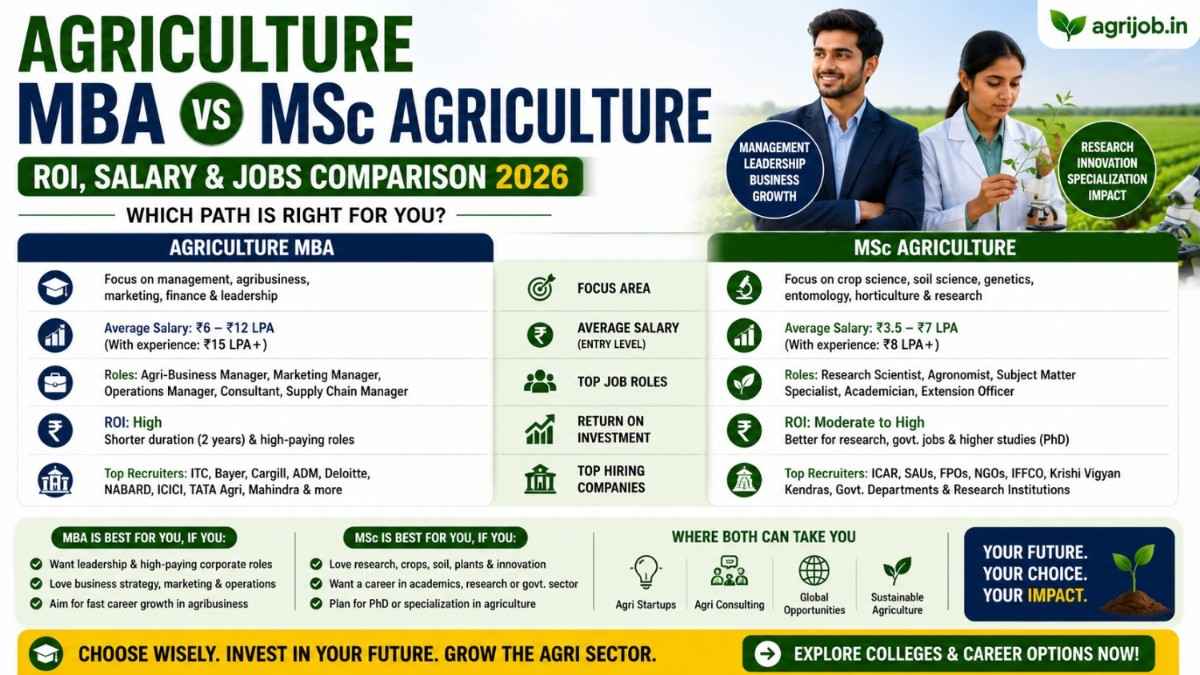
🎓 MSc Agriculture Fees: Rs.1,180 – Rs.3 lakh (2 years total, ICAR universities)
💼 MBA Agribusiness Fees: Rs.2.5 lakh (BHU) to Rs.28 lakh (IIM-A FABM)
💰 MSc Average Fresher Salary: Rs.4.5 – Rs.9 LPA (Govt); Rs.5–12 LPA (Private)
📈 MBA Average Placement: Rs.6–12 LPA (mid-tier); Rs.14–21 LPA (premier institutes)
🏛️ ICAR PG Scholarship (MSc): Rs.12,640/month for 2 years
🏆 IIM-A FABM Avg Placement: Rs.21 LPA | Highest: Rs.41.83 LPA
🌱 IRMA Avg Placement 2026: Rs.14.14 LPA | Highest: Rs.31.16 LPA
📅 Key Exams: ICAR AIEEA PG (July 2026), CAT (Nov 2026), SNAP, MAT
- Agriculture MBA vs MSc Agriculture – Core Difference
- Fees and ROI – Which Degree Pays Back Faster?
- Salary Comparison – MBA Agribusiness vs MSc Agriculture 2026
- Government Jobs – Which Degree Opens More Doors?
- Private Sector Jobs & Top Recruiters 2026
- Top MBA Agribusiness Colleges in India – Fees & Placements
- Top MSc Agriculture Universities in India 2026
- Who Should Choose MBA vs MSc Agriculture?
- Agriculture MBA vs MSc Agriculture – Full 9-Point Comparison
- High-Value Agribusiness Career Terms You Must Know
- How to Get Admission – Step-by-Step Process
- Frequently Asked Questions
Agriculture MBA vs MSc Agriculture – Core Difference in 2026
Before comparing salaries and ROI, it is essential to understand the fundamental difference in what each degree actually trains you for. Agriculture MBA vs MSc Agriculture is not simply about one degree being “better” — they are designed for entirely different career trajectories.
| Feature | MSc Agriculture | MBA Agribusiness |
|---|---|---|
| Degree Type | Master of Science — technical/research degree | Master of Business Administration — management degree |
| Focus | Deep science: crop physiology, soil science, genetics, plant pathology | Business strategy: agri-finance, rural marketing, supply chain, food policy |
| Duration | 2 years | 2 years |
| Ideal For | Research, PhD, ICAR Scientist, government agriculture officer | Corporate management, agri-tech leadership, food company GM roles |
| Key Entrance Exam | ICAR AIEEA PG, State CET, CUET-PG | CAT, XAT, SNAP, MAT, RMAT (IRMA) |
| ICAR Scientist Eligibility | Yes — ASRB NET, JRF, ARS | No |
| PhD Pathway | Direct — ICAR JRF Rs.31,000/month stipend | No direct PhD pathway |
| Government Exam Eligibility | ASRB NET, NABARD, IBPS AFO, State ADO, FCI | NABARD, IBPS AFO only |
| Private Sector Ceiling | Rs.15–20 LPA (10 years) | Rs.25–35 LPA (10 years) |
In simple terms: MSc Agriculture builds agricultural scientists; MBA Agribusiness builds agricultural managers. Both are valuable — the right choice depends on which career gives you more satisfaction and financial security over 20 years, not just the next 2–3 years.

Fees and ROI – Which Degree Pays Back Faster in 2026?
The ROI calculation for Agriculture MBA vs MSc Agriculture in 2026 is one of the most striking comparisons in Indian higher education. The fee difference between an ICAR national university MSc and an IIM FABM is enormous — yet the payback timeline converges faster than you might expect for MBA graduates from premier institutes.
| Degree & Institution | Total Fees (2 Years) | ICAR Scholarship / TA | Net Cost | Entry Salary | Fee Payback Period |
|---|---|---|---|---|---|
| MSc Agriculture – IARI / PAU (ICAR) | Rs.10,000–Rs.50,000 | Rs.12,640/month × 24 = Rs.3.03 lakh | Effectively Rs.0 (scholarship exceeds fees) | Rs.8–15 LPA (Govt/MNC) | < 1 month |
| MSc Agriculture – State Agri University (SAU) | Rs.30,000–Rs.80,000 | Partial scholarship available | Rs.30,000–Rs.80,000 | Rs.5–9 LPA | 1–2 months |
| MSc Agriculture – Private (ICAR Accredited) | Rs.1–Rs.3.5 lakh | None | Rs.1–Rs.3.5 lakh | Rs.4–8 LPA | 3–6 months |
| MBA Agribusiness – BHU / MANAGE | Rs.2.5–Rs.3.5 lakh | None | Rs.2.5–Rs.3.5 lakh | Rs.6–10 LPA | 4–7 months |
| MBA Agribusiness – IRMA Anand | Rs.13–Rs.16 lakh | Merit scholarships available | Rs.13–16 lakh | Rs.14.14 LPA (avg) | 11–14 months |
| MBA Agribusiness – SIIB Pune | Rs.12.7 lakh | Merit scholarships available | Rs.12.7 lakh | Rs.11–16 LPA (avg) | 10–14 months |
| MBA (FABM) – IIM Ahmedabad | Rs.27.5–Rs.28 lakh | Corporate scholarships (Rs.2–5 lakh) | Rs.22–26 lakh | Rs.21 LPA (avg) | 12–15 months |
| MBA Agribusiness – IIM Lucknow (ABM) | Rs.20.75 lakh | Merit-based | Rs.18–20 lakh | Rs.22 LPA (avg IIM-L) | 11–13 months |
Key ROI insight for 2026: MSc Agriculture from an ICAR national university has an unbeatable ROI — the ICAR PG Scholarship of Rs.3.03 lakh over 2 years often exceeds the total fees, making it a funded degree with a near-zero net cost. An MBA from IIM-A FABM costs Rs.22–26 lakh net but recovers within 12–15 months at Rs.21 LPA average placement. Mid-tier MBA colleges (Rs.8–15 lakh fees, Rs.6–9 LPA placements) offer the worst ROI in this comparison and should be chosen only after careful research of actual placement records.
Salary Comparison – MBA Agribusiness vs MSc Agriculture 2026
The Agriculture MBA vs MSc Agriculture salary comparison reveals a nuanced picture: government job salaries are institution-neutral and exam-determined, while private sector salaries are strongly shaped by your degree type and college brand. Here is the complete 2026 salary trajectory for both degrees across all major career stages.
| Career Stage | MSc Agriculture Salary (Govt Route) | MSc Agriculture Salary (Private Route) | MBA Agribusiness Salary (Premier) | MBA Agribusiness Salary (Mid-Tier) |
|---|---|---|---|---|
| Entry Level (0–1 year) | Rs.5.8–14.4 LPA (IBPS AFO to ICAR Scientist) | Rs.4–8 LPA (Agri MNC / startup fresher) | Rs.14–21 LPA (IIM-A, IRMA, IIM-L) | Rs.5–9 LPA (MANAGE, mid-tier) |
| Mid-Level (3–5 years) | Rs.8–14 LPA (Govt increment + promotion) | Rs.8–15 LPA (Sr. Agronomist, R&D Manager) | Rs.18–28 LPA (Product/Brand Manager, Supply Chain Head) | Rs.8–14 LPA (Senior Executive, Area Manager) |
| Senior Level (8–10 years) | Rs.14–20 LPA (Sr. Scientist, KVK Head, Prof.) | Rs.15–25 LPA (R&D Head, Plant Biotech Lead) | Rs.25–40 LPA (GM, VP Agribusiness, Consultant) | Rs.14–22 LPA (Regional Head, Business Manager) |
| Peak Career (15+ years) | Rs.20–30 LPA (Director ICAR, VC Agri Univ.) | Rs.20–35 LPA (CTO / Chief Scientist, MNC India) | Rs.35–60 LPA (MD, Country Head, Agri-VC Partner) | Rs.20–35 LPA (Zonal Director, DGM) |
The clearest salary advantage of MBA Agribusiness over MSc Agriculture appears between years 5–15 — senior MBA Agribusiness graduates from premier institutes earn Rs.25–40 LPA, while senior MSc Agriculture graduates in the private sector plateau at Rs.15–25 LPA without additional management qualifications. However, in the government route, a senior ICAR Scientist or Principal Scientist can earn Rs.20–30 LPA with full pension, medical, and accommodation benefits — a total compensation package that is difficult to match in the private sector at equivalent career stages.
Government Jobs – Which Degree Opens More Doors in 2026?
For Indian agriculture graduates targeting government employment in 2026, the Agriculture MBA vs MSc Agriculture choice has a clear answer: MSc Agriculture unlocks significantly more government job categories, including the highest-paying ICAR Scientist positions that MBA graduates cannot apply for under any circumstances.
| Government Job | Salary (Monthly in-hand) | MSc Agriculture Eligible? | MBA Agribusiness Eligible? |
|---|---|---|---|
| ICAR Scientist / ARS (ASRB NET) | Rs.80,000–Rs.1,20,000 | ✅ Yes | ❌ No |
| KVK Subject Matter Specialist (SMS) | Rs.70,000–Rs.1,00,000 | ✅ Yes | ❌ No |
| NABARD Grade A Officer | Rs.85,000–Rs.1,05,000 | ✅ Yes | ✅ Yes |
| IBPS AFO (Agriculture Field Officer) | Rs.48,000–Rs.55,000 | ✅ Yes | ✅ Yes |
| State Agriculture Officer (ADO) | Rs.35,000–Rs.55,000 | ✅ Yes | ⚠️ Varies by state |
| FCI Technical Manager / AGT | Rs.40,000–Rs.65,000 | ✅ Yes | ⚠️ Partial (management posts) |
| Assistant Professor (Agri University) | Rs.57,700–Rs.90,000 | ✅ Yes (with NET) | ❌ No (science subject required) |
| ICAR JRF / SRF (PhD Fellowship) | Rs.31,000–Rs.35,000 + HRA | ✅ Yes | ❌ No |
The verdict on government jobs is unambiguous. MSc Agriculture graduates can apply for 8 out of 8 major government agriculture job categories, while MBA Agribusiness graduates are eligible for only 2–3. If government employment is your primary career goal, an MSc Agriculture is the only logical path. Visit the ICAR official website and ASRB official portal for the latest Scientist recruitment notifications.
Private Sector Jobs & Top Recruiters – MBA vs MSc Agriculture 2026
In the private sector, the Agriculture MBA vs MSc Agriculture dynamic reverses — MBA graduates consistently access higher-paying management and leadership roles, while MSc graduates dominate R&D, agronomy, and technical specialist positions. Both profiles are actively hired; the role type and salary ceiling differ significantly.
| Job Role | Suited For | Fresher Salary | Top Recruiters |
|---|---|---|---|
| Agribusiness Manager / Category Manager | MBA Agribusiness | Rs.8–15 LPA | ITC, Amul, Cargill, Godrej Agrovet |
| Supply Chain Manager / Procurement Head | MBA Agribusiness | Rs.8–14 LPA | Nestle, PepsiCo, Mahindra Agri, BigBasket |
| Agri-Finance / Rural Banking Manager | MBA Agribusiness | Rs.7–12 LPA | NABARD, ICICI Bank, Kotak, SIDBI |
| Agri-Consultant / Business Analyst | MBA Agribusiness (premier) | Rs.12–20 LPA | McKinsey, Accenture, KPMG Agri Practice |
| R&D Scientist / Plant Breeder | MSc Agriculture | Rs.6–12 LPA | Bayer, Syngenta, Mahyco, Corteva, BASF |
| Agronomist / Technical Sales Manager | MSc Agriculture | Rs.5–9 LPA | UPL, Rallis India, PI Industries, Coromandel |
| Food Technologist / Quality Analyst | MSc Agriculture (Food Sci) | Rs.5–9 LPA | Nestle, Britannia, HUL, Patanjali, ITC Foods |
| Agri-Data Scientist / Precision Agri Analyst | MSc Agri + Data Skills | Rs.7–13 LPA | DeHaat, CropIn, AgroStar, Climate Corp |
| Product Manager – Agri-Tech | MBA Agribusiness | Rs.12–18 LPA (mid-level) | Ninjacart, DeHaat, Jio Agri, AgroStar |
Top MBA Agribusiness Colleges in India – Fees & Placements 2026
Choosing the right MBA Agribusiness college is the most critical factor in determining your post-MBA salary. Here are the 8 best MBA Agribusiness colleges in India for 2026, ranked by placement quality and ROI.
| College | Program | Total Fees | Avg Placement | Highest Package | Key Entrance Exam |
|---|---|---|---|---|---|
| IIM Ahmedabad | PGP-FABM (2 years) | Rs.27.5–28 lakh | Rs.21 LPA | Rs.41.83 LPA | CAT (high percentile) |
| IIM Lucknow | PGP-ABM (2 years) | Rs.20.75 lakh | Rs.22 LPA (IIM-L avg) | Rs.50+ LPA | CAT |
| IRMA Anand | PGDM (Rural Management) | Rs.13–16 lakh | Rs.14.14 LPA | Rs.31.16 LPA | RMAT / CAT / XAT |
| SIIB Pune | MBA Agri Business Mgmt | Rs.12.7 lakh | Rs.11–16 LPA | Rs.25+ LPA | SNAP |
| MANAGE Hyderabad | PGDM Agribusiness (120 seats) | Rs.2–4 lakh | Rs.7–12 LPA | Rs.18 LPA | No CAT required; Agriculture degree |
| TISS Mumbai | PGDM Agri Business Mgmt | Rs.1.7 lakh | Rs.8–12 LPA | Rs.18 LPA | TISS-NET |
| BHU (Banaras Hindu University) | MBA Agribusiness | Rs.2.5 lakh | Rs.6–10 LPA | Rs.15 LPA | CUET-PG / BHU PET |
| XIMB Bhubaneswar | MBA Rural Management | Rs.17–19 lakh | Rs.12–16 LPA | Rs.24 LPA | XAT / GMAT |
Pro insight for 2026 MBA applicants: MANAGE Hyderabad and TISS Mumbai offer the best ROI among all MBA Agribusiness colleges in India — very low fees (Rs.1.7–4 lakh) combined with Rs.7–12 LPA average placements at top agribusiness companies. MANAGE requires a Bachelor’s degree in Agriculture with 60% marks — no CAT score needed. Apply at MANAGE official portal for PGDM Agribusiness admission 2026.
Top MSc Agriculture Universities in India 2026
For the MSc Agriculture route, choosing an ICAR-accredited national or state agricultural university gives maximum government exam eligibility plus ICAR PG Scholarship access. Here are the 8 best MSc Agriculture universities in India for 2026.
| University | NIRF Ranking (Agri) | Total Fees (2 Yrs) | ICAR PG Scholarship | Key Specialisations |
|---|---|---|---|---|
| IARI, New Delhi | #1 | Rs.10,000–Rs.30,000 | ✅ Rs.12,640/month | Genetics, Plant Breeding, Agronomy, Soil Science |
| Punjab Agricultural University (PAU) | #2 | Rs.20,000–Rs.50,000 | ✅ Rs.12,640/month | Plant Pathology, Agri Economics, Horticulture |
| GBPUAT, Uttarakhand | #9 | Rs.15,000–Rs.40,000 | ✅ Rs.12,640/month | Agronomy, Soil Science, Agricultural Engineering |
| TNAU, Coimbatore | #4 | Rs.25,000–Rs.60,000 | ✅ Via State exam | Biotechnology, Food Science, Agronomy |
| UAS Dharwad (Karnataka) | #7 | Rs.20,000–Rs.50,000 | ✅ Via State exam | Plant Pathology, Horticulture, Soil Science |
| BHU, Varanasi | #5 | Rs.10,000–Rs.25,000 | ✅ Rs.12,640/month | Agronomy, Genetics, Agricultural Botany |
| ANGRAU, Andhra Pradesh | #6 | Rs.15,000–Rs.40,000 | ✅ Via State exam | Entomology, Crop Physiology, Agri Extension |
| LPU, Punjab (ICAR-accredited private) | Top 10 Private | Rs.1–Rs.2 lakh | ❌ Not via ICAR AIEEA | Agronomy, Horticulture, Food Technology |
Who Should Choose Agriculture MBA vs MSc Agriculture in 2026?
The Agriculture MBA vs MSc Agriculture decision ultimately comes down to 8 specific career and life profiles. Here is a clear matching guide for every type of BSc Agriculture graduate in 2026.
- 🔬 Research & Science Lovers → Choose MSc Agriculture: If you enjoy laboratory work, field experiments, reading research journals, and contributing to crop science or soil health knowledge, MSc Agriculture is the natural fit. ICAR Scientist roles and university faculty positions await — with ICAR PG Scholarship making the degree effectively free.
- 💼 Corporate Management Aspirants → Choose MBA Agribusiness: If you are energised by leadership, negotiation, marketing strategy, and P&L responsibility — and can clear CAT, XAT, or SNAP for a premier college — MBA Agribusiness from IIM-A FABM, IIM Lucknow, or IRMA will unlock Rs.14–21 LPA placements on day one.
- 🏛️ Government Job Seekers → Choose MSc Agriculture: For ASRB NET (ICAR Scientist), State ADO, ICAR JRF, and Assistant Professor roles, MSc Agriculture is the mandatory qualification. MBA graduates cannot apply for these positions. If a government career is your goal, MSc is the only path.
- 💰 High Private Salary with Low Risk Tolerance → Choose MBA from MANAGE or TISS: If you want good private sector salary without the Rs.20+ lakh fee risk of an IIM, MANAGE Hyderabad (fees Rs.2–4 lakh, avg placement Rs.7–12 LPA) or TISS Mumbai (fees Rs.1.7 lakh, avg Rs.8–12 LPA) offer outstanding ROI with low financial risk.
- 🌾 Agri-Tech Career Aspirants → Choose MBA + Data Skills: If your goal is Product Manager or Business Analyst roles at DeHaat, Ninjacart, or CropIn (Rs.12–18 LPA), an MBA Agribusiness + Python/data analytics skills is the most direct path. MSc Agriculture graduates can also reach these roles but typically take 2–3 more years.
- 📚 PhD and Academia Track → Choose MSc Agriculture: ICAR JRF (Rs.31,000/month) and SRF (Rs.35,000/month) PhD fellowships are available only to MSc Agriculture graduates who clear ICAR JRF exam. These are the most financially viable funded research paths in Indian agriculture.
- 🌍 International Career Aspirants → Consider Both + Foreign PG: An MSc from IARI or PAU combined with a subsequent MS from a US or European university (Cornell, Wageningen) creates the strongest global agriculture research profile. An MBA from IIM-A FABM or IRMA with strong agribusiness consulting exposure is excellent for FAO, World Bank, and international agribusiness firms.
- 💡 Undecided / Wants Both → Do MSc First, MBA Later: The MSc Agriculture + MBA Agribusiness dual-degree path (4 years total) is the gold standard combination in Indian agriculture careers. An MSc from IARI followed by IRMA or SIIB Pune opens Rs.15–25 LPA roles in agribusiness leadership while retaining government exam eligibility for the first 3–5 years post-MSc.
Agriculture MBA vs MSc Agriculture – Full 9-Point Comparison 2026
Here is the definitive side-by-side comparison of every factor that matters for the Agriculture MBA vs MSc Agriculture decision in 2026 — from fees and salary to government eligibility and long-term career ceiling.
| Parameter | MSc Agriculture | MBA Agribusiness (Premier) | MBA Agribusiness (Mid-Tier) |
|---|---|---|---|
| Total Fees | Rs.10,000–Rs.3.5 lakh | Rs.13–28 lakh | Rs.2.5–8 lakh |
| ICAR Scholarship | Rs.12,640/month (24 months) ✅ | ❌ | ❌ |
| Entry Salary Range | Rs.4.5–15 LPA | Rs.14–21 LPA | Rs.5–9 LPA |
| ICAR Scientist Eligibility | ✅ Yes | ❌ No | ❌ No |
| NABARD Grade A Eligibility | ✅ Yes | ✅ Yes | ✅ Yes |
| Private Sector Salary Ceiling (10 yr) | Rs.20–30 LPA | Rs.35–60 LPA | Rs.18–28 LPA |
| PhD / JRF Pathway | ✅ ICAR JRF Rs.31,000/month | ❌ | ❌ |
| Fee Payback Period | <1 month (ICAR university) | 12–15 months (IIM-A FABM) | 8–18 months (varies) |
| Best For | Research, Govt scientist, PhD, Teaching | Corporate leadership, agri-consulting, MNC GM | Mid-level agribusiness, private sector entry |
There is no universally “better” degree — both are excellent for the right candidate.
✅ Choose MSc Agriculture if: You want government employment, research, PhD, or ICAR Scientist career. The ICAR PG Scholarship makes IARI/PAU MSc effectively free, the government salary is Rs.80,000–1.2 lakh/month after ASRB NET, and job security is unmatched in India.
✅ Choose MBA Agribusiness if: You want corporate leadership roles, agri-consulting, or agri-tech management careers paying Rs.14–21 LPA from Day 1 (IIM-A, IRMA). The fee is high but payback is 12–15 months — after which the compounding salary advantage over MSc is permanent.
✅ Best of both worlds: MSc Agriculture (ICAR funded, 2 years) → MBA Agribusiness MANAGE/IRMA (2 years). Total investment Rs.15–18 lakh. Total outcome: full government exam eligibility + Rs.14 LPA+ average corporate placement + ICAR Scientist option permanently open. This 4-year dual path is the most powerful career architecture for an Indian agriculture graduate in 2026.
High-Value Agribusiness Career Terms You Must Know in 2026
Whether you choose Agriculture MBA or MSc Agriculture, understanding these 10 high-value career terms will help you navigate salary negotiations, exam eligibility, and career choices with clarity in 2026.
- 🌾 ASRB NET (Agricultural Scientists Recruitment Board – National Eligibility Test): The premier ICAR Scientist recruitment exam — open only to MSc Agriculture graduates. Starting pay Level-10: Rs.56,100/month basic. Gross salary with allowances: Rs.80,000–1.2 lakh/month. The highest-prestige government agriculture job in India after IFS.
- 🏦 NABARD Grade A Officer: Open to both MSc and MBA graduates. Highest entry-level government salary for agriculture graduates — Rs.85,000–1,05,000/month. NABARD funds Rs.18 lakh crore in rural credit annually and offers one of the most impactful agriculture finance careers.
- 📊 PGP-FABM (Post Graduate Programme – Food and Agri-Business Management): IIM Ahmedabad’s flagship agribusiness MBA — ranked #1 globally in agribusiness management by Eduniversal for multiple years. Average placement Rs.21 LPA; fees Rs.27.5 lakh; 2 years; CAT-based admission with agriculture stream preference.
- 🌱 PGDM Rural Management – IRMA Anand: The most respected rural and agribusiness management diploma in India outside IIMs. Average placement Rs.14.14 LPA; highest Rs.31.16 LPA. Entrance via RMAT, CAT, or XAT. Strong cooperative sector, FMCG, and development finance placement record.
- 🎓 ICAR PG Scholarship: Rs.12,640/month for 2 years (Rs.3.03 lakh total) — available to MSc Agriculture students admitted through ICAR AIEEA PG exam. The most financially beneficial scholarship in Indian agricultural higher education — it often exceeds total degree fees at ICAR national universities.
- 💰 Agribusiness Consultant: The highest-paid private sector agriculture role in India — Rs.12–20 LPA at entry level from IIM-A FABM or IRMA, reaching Rs.35–60 LPA at senior levels at McKinsey Agri Practice, Accenture Strategy, or boutique agri-consulting firms. MBA Agribusiness from a premier institute is the required qualification.
- 🤖 Commodity Trader / Agri-Commodity Analyst: Commodity trading roles at NCDEX, MCX, and agri-commodity companies offer Rs.8–20 LPA for MBA Agribusiness graduates with finance and market intelligence skills. High-performance traders in agri-commodity desks earn Rs.25–40 LPA in 5–7 years.
- 📋 MANAGE Hyderabad (National Institute of Agricultural Extension Management): Offers PGDM in Agribusiness with 120 seats. Fees just Rs.2–4 lakh. No CAT required — only a BSc Agriculture with 60% marks. Average placement Rs.7–12 LPA at companies like ITC, Amul, Nestle, and state cooperative banks. India’s best ROI MBA Agribusiness college.
- 🌍 ICAR JRF / SRF (PhD Fellowship): Junior Research Fellowship (Rs.31,000/month) and Senior Research Fellowship (Rs.35,000/month + HRA) funded by ICAR for MSc Agriculture graduates pursuing PhD. Unavailable to MBA graduates. The most financially sound funded PhD path in Indian agricultural science.
- 🏢 Agri Supply Chain Manager: One of the fastest-growing high-paying roles in Indian agriculture — Rs.8–14 LPA at entry level for MBA graduates at BigBasket, Ninjacart, Cargill, and ITC. Senior supply chain heads at large agri-corporates earn Rs.20–35 LPA. MBA Agribusiness with supply chain specialisation is the direct qualification pathway.
How to Get Admission – Step-by-Step Process for Both Degrees
Here is the complete 8-step admission process for both Agriculture MBA and MSc Agriculture in India for the 2026–27 academic year — covering key exams, timelines, and application strategy.
- 🎯 Decide Your Goal First (Now – June 2026): Use the “Who Should Choose” section above to determine whether MSc Agriculture or MBA Agribusiness aligns better with your 10-year career vision. Do not select based on peer pressure or parental expectation alone — salary trajectories diverge significantly based on personal fit with the degree type.
- 📝 For MSc Agriculture — Register for ICAR AIEEA PG (by June 2026): The ICAR AIEEA PG exam is expected in July 2026 (conducted by NTA). Registration opens on the NTA portal. This exam is mandatory for ICAR national universities (IARI, PAU, GBPUAT) and ICAR PG Scholarship eligibility. Also register for state CET exams (UPCATET, MCAER CET, KCET) simultaneously for broader options.
- 📝 For MBA Agribusiness — Register for CAT / SNAP / XAT / RMAT (Aug–Oct 2026): CAT 2026 notification is expected in July–August with the exam in November. SNAP for SIIB Pune is in December. IRMA’s RMAT is conducted separately — check the MANAGE Hyderabad portal for their direct agriculture graduate admission process (no CAT required).
- 📚 Prepare Subject Matter for Exam (3–4 months intensive): For ICAR AIEEA PG, prepare 10th–BSc level agriculture subjects in your chosen specialisation. For CAT/XAT, prepare Quant, VARC, and DILR sections. Both exams require 3–4 months of structured daily preparation (2–3 hours minimum).
- 🏫 Research and Shortlist 8–12 Colleges (Oct–Nov 2026): For MSc, shortlist based on specialisation availability, ICAR accreditation, scholarship access, and research lab quality. For MBA, shortlist based on actual placement records (not brochure claims), industry connections, and recruiter diversity. Visit ICAR’s accredited institution list for MSc verification.
- ✉️ Write Strong SOP / Application Essays (Nov–Dec 2026): For MSc Agriculture, write a focused Statement of Purpose (700–1,000 words) mentioning specific research areas and faculty at your target university. For MBA Agribusiness, prepare impactful essays covering your agriculture background as a differentiated strength — most MBA applicants are non-agriculture graduates, making your BSc Agriculture a genuine advantage.
- 🤝 Appear for GD-PI Rounds (Jan–March 2027): Most MBA Agribusiness colleges conduct Group Discussion (GD) and Personal Interview (PI) rounds in January–March. Prepare agriculture sector knowledge, current affairs on agri policy, and your career narrative. ICAR national university MSc admissions are merit-based — no separate GD-PI for most programs.
- ✅ Confirm Admission and Apply for Scholarship (April–June 2027): For MSc at ICAR universities, apply for ICAR PG Scholarship through your institution’s scholarship cell immediately after seat confirmation. For MBA, apply for institute merit scholarships (IRMA, SIIB, TISS all offer merit-based aid of Rs.1–5 lakh) within 30 days of the offer letter.
Ask yourself this one question: “In 10 years, do I want to be known as an expert scientist solving agricultural problems — or as an effective manager leading an agribusiness organisation?”
If your answer is “scientist / researcher / government expert” → choose MSc Agriculture from IARI or PAU with ICAR PG Scholarship (free degree + Rs.8–15 LPA career).
If your answer is “business leader / manager / entrepreneur” → choose MBA Agribusiness from IIM-A FABM, IRMA, or MANAGE (Rs.14–21 LPA career from premier colleges).
Both paths are genuinely excellent in 2026. The mistake is choosing the wrong path for your personality and then spending 10 years feeling misaligned with your work.
Frequently Asked Questions – Agriculture MBA vs MSc Agriculture 2026
Which is better after BSc Agriculture — MBA Agribusiness or MSc Agriculture?
The choice between Agriculture MBA vs MSc Agriculture after BSc depends on your career goal. MSc Agriculture is better for government scientist roles (ASRB NET: Rs.80,000–1.2 lakh/month), research, PhD, and teaching. MBA Agribusiness is better for private sector management, agri-tech leadership, and supply chain roles — with premier institutes like IIM-A FABM delivering Rs.21 LPA average placement. If you want the stability and prestige of an ICAR government career, choose MSc. If you want faster private sector salary growth, choose MBA from a premier institute.
What is the average salary after MBA Agribusiness in India in 2026?
The average salary after MBA Agribusiness in India in 2026 ranges from Rs.6–12 LPA at mid-tier colleges (MANAGE, BHU) to Rs.14–21 LPA at premier institutes. IRMA Anand’s 2026 batch achieved an average CTC of Rs.14.14 LPA and highest of Rs.31.16 LPA. IIM-A FABM’s average placement is Rs.21 LPA. Mid-tier MBA Agribusiness college freshers at companies like ITC, Amul, and Godrej Agrovet typically start at Rs.7–10 LPA.
What is the ROI of Agriculture MBA vs MSc Agriculture in India?
The ROI of MSc Agriculture is superior on a net cost basis — ICAR national universities offer the degree effectively free through the Rs.12,640/month PG Scholarship while delivering Rs.8–15 LPA careers. An IIM-A FABM costs Rs.22–26 lakh but its Rs.21 LPA average placement recovers fees within 12–15 months. Mid-tier MBA colleges (Rs.8–15 lakh fees, Rs.6–9 LPA placements) offer the weakest ROI and require 18–36 months to recover investment. Always compare actual placement records — not brochure promises — before choosing an MBA college.
Can I do both MSc Agriculture and MBA Agribusiness?
Yes, pursuing MSc Agriculture first and then MBA Agribusiness is actually the gold standard dual-degree path in Indian agriculture in 2026. The combination of MSc from IARI or PAU (ICAR-funded, 2 years) followed by MBA from IRMA or SIIB Pune (2 years) opens doors to Rs.14–20 LPA roles in agribusiness leadership while keeping government exam eligibility (ICAR Scientist, NABARD) permanently intact. Total investment is Rs.15–20 lakh over 4 years — with a career ceiling of Rs.25–40 LPA in 10 years.
What are the top colleges for MBA Agribusiness in India in 2026?
The top MBA Agribusiness colleges in India for 2026 are IIM Ahmedabad FABM (avg Rs.21 LPA, fees Rs.27.5 lakh), IIM Lucknow ABM, IRMA Anand (avg Rs.14.14 LPA, highest Rs.31.16 LPA), SIIB Pune (fees Rs.12.7 lakh), MANAGE Hyderabad (best ROI — fees Rs.2–4 lakh, no CAT needed), TISS Mumbai (fees Rs.1.7 lakh), and XIMB Bhubaneswar. For agriculture graduates specifically, MANAGE Hyderabad and IRMA Anand are the most agriculture-specialised and highest-ROI choices.
Is MSc Agriculture eligible for NABARD and IBPS AFO exams?
Yes, MSc Agriculture graduates are fully eligible for both NABARD Grade A Officer (Rs.85,000–1,05,000/month) and IBPS AFO — Agriculture Field Officer (Rs.48,000–55,000/month) exams in 2026. Additionally, MSc Agriculture is the mandatory qualification for ASRB NET (ICAR Scientist) and ICAR JRF — positions that MBA graduates cannot apply for. For maximum government job eligibility, MSc Agriculture is unequivocally the better degree.
What entrance exams are needed for MBA Agribusiness in 2026?
The entrance exams for MBA Agribusiness in 2026 are CAT (for IIM-A FABM, IIM Lucknow ABM), XAT (for XIMB), SNAP (for SIIB Pune), IRMA’s own RMAT exam, and TISS-NET. MANAGE Hyderabad is unique in not requiring CAT — a BSc Agriculture degree with 60% marks is sufficient for PGDM Agribusiness admission there. Most agribusiness MBA programs accept CAT scores in the 60–80 percentile range for agriculture specialisations, which is significantly easier to achieve than general MBA programs.
Which degree is better for government jobs — MBA or MSc Agriculture?
MSc Agriculture is significantly better for government jobs in 2026. It opens 8 major government agriculture job categories including ICAR Scientist (Rs.80,000–1.2 lakh/month via ASRB NET), ICAR JRF, State ADO, FCI Technical Manager, and Assistant Professor roles — none of which are accessible to MBA graduates. MBA Agribusiness graduates can apply for NABARD Grade A and IBPS AFO only. If a government career is your primary goal, MSc Agriculture from an ICAR-accredited university is the only logical choice.
This guide is regularly reviewed and updated for accuracy. Bookmark this page for the latest Agriculture MBA vs MSc Agriculture salary and admission data. Last Updated: May 2026.