
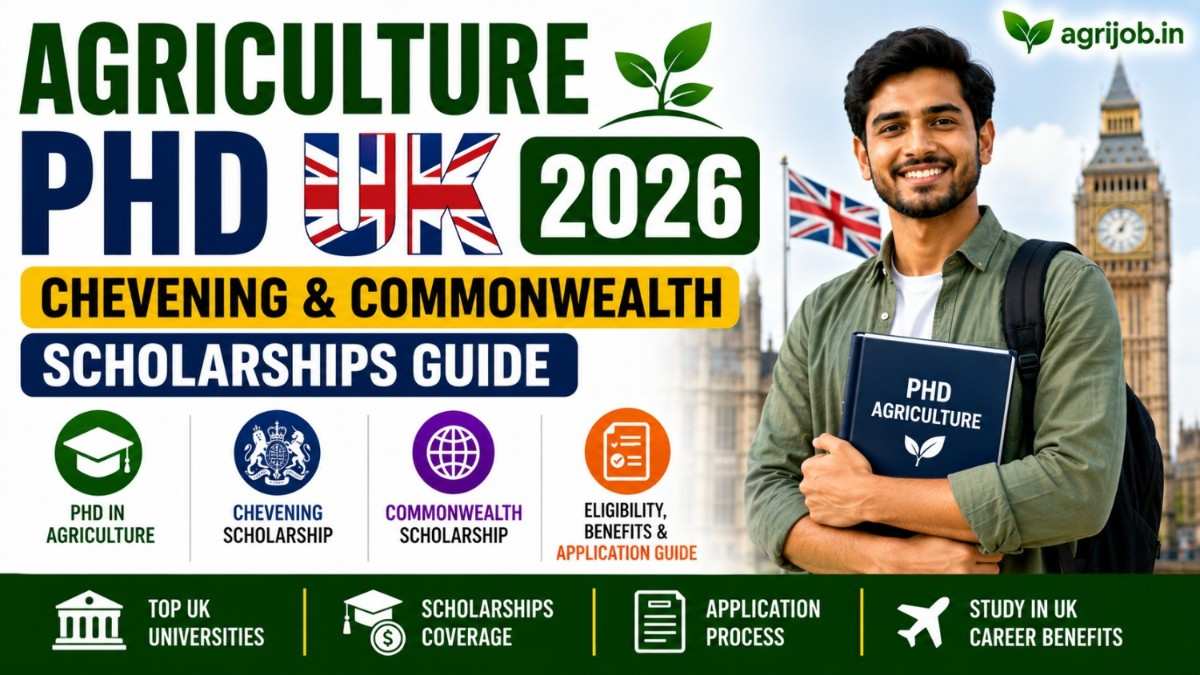
Agriculture PhD in UK 2026 – Cost, Chevening & Commonwealth Guide
Pursuing an Agriculture PhD in UK 2026 is the highest-impact postgraduate decision an Indian agriculture researcher can make — combining 3-year doctoral completion (shorter than anywhere else in the world), access to institutions like Rothamsted Research, University of Reading, and Harper Adams, and fully funded scholarship routes worth £1.378 lakh–£1.69 lakh per month in living stipend alone. With over 185,000 Indian students currently enrolled in UK universities — the highest number ever recorded — and the UKRI stipend rising to £21,805 per year from October 2026, Indian agriculture research scholars have more funding pathways than ever before. This complete 2026 guide covers everything: top UK agriculture PhD universities and their fees, the Chevening and Commonwealth scholarship details, UKRI doctoral funding, eligibility requirements, a step-by-step application process, UK Student Visa guidance, and career outcomes after a UK agriculture doctorate.

| Degree | Doctor of Philosophy (PhD) in Agriculture & Allied Sciences |
| Duration | 3 to 4 Years Full-Time |
| Annual Tuition (International) | £12,000–£26,000 (Rs.15.5 lakh–Rs.33.5 lakh) |
| Annual Living Cost | £9,000–£13,500 (Rs.11.6 lakh–Rs.17.4 lakh) |
| UKRI Stipend 2026-27 | £21,805/year (Rs.28.1 lakh/year) |
| Commonwealth Stipend | £1,378/month outside London; £1,690/month London |
| Chevening | Masters only (up to £30,000 total value); Fellowships for short research stays |
| IELTS Requirement | 6.5–7.0 UKVI-approved; 7.0+ for Russell Group |
| Academic Minimum | Master’s degree with 60%+ (2:1 UK equivalent) |
| Post-PhD Work Visa | Graduate Route — 3 years (longer than MSc 2 years) |
| UK Student Visa Fee | £363 + £1,035/year IHS (Immigration Health Surcharge) |
| Part-Time Work Allowed | 20 hours/week during term; full-time during holidays |
- Why Choose Agriculture PhD in UK in 2026?
- Top 8 UK Universities for Agriculture PhD 2026
- Agriculture PhD UK 2026 – Complete Cost Breakdown
- Eligibility & Admission Requirements for Indian Students
- Chevening Scholarship 2026 – What Agriculture Students Must Know
- Commonwealth Scholarship for Agriculture PhD UK 2026
- UKRI & University-Funded Agriculture PhD Studentships
- How to Apply for Agriculture PhD in UK – Step by Step
- Who Should Apply for Agriculture PhD in UK 2026?
- Agriculture PhD UK vs USA vs India – Comparison
- High-Value Agriculture Research Career Terms to Know
- Frequently Asked Questions (FAQ)
Why Choose Agriculture PhD in UK in 2026?
The UK’s position as a global leader in agricultural and food systems research makes an Agriculture PhD in UK one of the most strategically valuable doctoral programmes for Indian researchers in 2026. The UK is home to Rothamsted Research — the world’s longest-running agricultural research station (established 1843) — and institutions like the University of Reading, ranked among the global top 10 for Agriculture and Forestry. Here is why 2026 is particularly favourable for Indian agriculture doctoral candidates:
- ⏱️ Shorter PhD Duration: A UK Agriculture PhD takes just 3–4 years full-time — significantly shorter than a US PhD (typically 5–6 years) or an Australian PhD (3.5–4.5 years). This translates to lower total cost, faster career entry, and less time away from family for Indian researchers.
- 💷 UKRI Stipend Rising to £21,805 in 2026: The UK Research and Innovation annual doctoral stipend rises to £21,805 from October 2026 (approximately Rs.28.1 lakh/year), making UKRI-funded studentships among the most financially attractive doctoral positions globally for agriculture researchers.
- 🎓 3 Years Post-PhD Work Rights: Agriculture PhD graduates qualify for 3 years of UK post-study work through the Graduate Route visa — one year longer than MSc graduates. This extended window provides Indian researchers exceptional opportunities to gain international work experience, build global networks, and explore H1B or Skilled Worker visa pathways.
- 🌍 Commonwealth & UK Government Scholarship Priority: Both the Commonwealth Scholarship Commission and the British Council explicitly prioritise agricultural sciences, food security, and climate-resilient farming research as development-aligned priority sectors — giving Indian agriculture PhD applicants a structural advantage over candidates from non-priority disciplines.
- 🔬 World-Class Research Ecosystem: UK agriculture research institutions have pioneered precision farming, crop genomics, soil carbon sequestration, agroecology, and sustainable food systems research — disciplines directly relevant to India’s agricultural transformation agenda and in high demand globally.
- 🤝 UK–India Agricultural Research Collaboration: The UK–India partnership under the UK–India Technology Partnership and Newton Fund has channelled over £200 million into bilateral science and innovation projects — creating direct funding pipelines and co-supervised PhD opportunities between UK and Indian agricultural universities.
Top 8 UK Universities for Agriculture PhD 2026
The following institutions are the most highly regarded for Agriculture PhD in UK 2026, based on QS World Rankings, research output, UKRI funding volume, and placement outcomes for international PhD graduates:

| # | University | Location | Annual Int’l Fee (Approx.) | Key Strength |
|---|---|---|---|---|
| 1 | University of Reading | Reading, England | £20,000–£26,000 | Global #1 in Agriculture & Forestry (QS); Rothamsted Research links |
| 2 | University of Nottingham | Nottingham, England | £22,000–£28,000 | Plant genomics, food security, precision agriculture |
| 3 | Harper Adams University | Newport, Shropshire | £14,000–£20,000 | Agri-tech, precision farming, rural enterprise research |
| 4 | Cranfield University | Cranfield, England | £18,000–£24,000 | Soil science, water management, sustainable food systems |
| 5 | University of Edinburgh | Edinburgh, Scotland | £23,000–£30,000 | Animal sciences, plant biology, agroecology, climate adaptation |
| 6 | Newcastle University | Newcastle, England | £19,000–£25,000 | Rural economy, land management, food & drink innovation |
| 7 | University of Aberdeen | Aberdeen, Scotland | £17,500–£22,000 | Environmental plant science, ecology, sustainable agriculture |
| 8 | Bangor University | Bangor, Wales | £15,000–£19,500 | Agroforestry, organic farming, sustainable land use |
Strategic tip for Indian students: Harper Adams University and Bangor University offer the most accessible fee structures for self-funded students. The University of Reading and University of Nottingham offer the highest volume of UKRI-funded and BBSRC-funded Agriculture PhD studentships — making them the top targets for candidates seeking fully funded positions. Always check the UKRI doctoral studentship finder for open agriculture PhD positions before applying directly.
Agriculture PhD UK 2026 – Complete Cost Breakdown
The total cost of an Agriculture PhD in UK 2026 varies substantially depending on institution, location, and funding status. Here is a complete annual and full 3-year breakdown for self-funded Indian students, alongside what funded scholars actually receive:
| Cost Component | Per Year (Low) | Per Year (High) | 3-Year Total (Mid) |
|---|---|---|---|
| Tuition Fees | £12,000 (Rs.15.5 lakh) | £26,000 (Rs.33.5 lakh) | Rs.73 lakh |
| Living Expenses | £9,000 (Rs.11.6 lakh) | £13,500 (Rs.17.4 lakh) | Rs.43 lakh |
| Immigration Health Surcharge (IHS) | £1,035/year | £1,035/year | Rs.4 lakh (3 yrs) |
| UK Student Visa Fee | £363 (one-time) | £363 (one-time) | Rs.47,000 (one-time) |
| Research Materials & Travel | £1,000 (Rs.1.3 lakh) | £3,000 (Rs.3.9 lakh) | Rs.7.8 lakh |
| Flights India–UK (Return) | Rs.65,000 | Rs.1,20,000 | Rs.90,000 (one-time) |
| Total (Self-Funded, 3 Years) | ~Rs.30 lakh/year | ~Rs.56 lakh/year | ~Rs.1.3 crore (3 yrs) |
Visa funds requirement: For a UK Student Visa, Indian applicants must demonstrate maintenance funds of £1,529/month for London or £1,171/month outside London (capped at 9 months) plus any outstanding tuition balance. These funds must be held continuously in a bank account for 28 consecutive days before the visa application date — the most common reason for UK student visa refusal for Indian PhD applicants. A single large deposit on day 25 will not be accepted; funds must be consistently present throughout the 28-day window.
Agriculture PhD UK 2026 – Eligibility & Admission Requirements
Academic Eligibility for Agriculture PhD in UK 2026
- 🎓 Master’s Degree (Mandatory): A relevant M.Sc. Agriculture, M.Sc. Agricultural Sciences, M.Sc. Environmental Science, M.Sc. Animal Science, or equivalent from a UGC-recognised Indian university. The minimum requirement is 60% marks overall, equivalent to a UK upper-second-class (2:1) honours degree. Russell Group universities — including Edinburgh and Nottingham — informally require 65–70% or a Distinction grade at Master’s level.
- 📝 Research Proposal: A well-developed 1,500–2,500 word research proposal is mandatory for all Agriculture PhD applications in the UK. The proposal must outline the research question, literature review, methodology, timeline, and expected contribution. This is the single most critical element of your application — stronger than your grades or test scores.
- 👨🏫 PhD Supervisor Confirmation: Most UK universities require you to identify and make contact with a potential supervisor before submitting a formal PhD application. Email shortlisted faculty members with your CV and a brief research interest statement — a supervisor who agrees to take you on dramatically improves admission chances and funding eligibility.
- 🗣️ English Proficiency: UKVI-approved IELTS minimum 6.5 overall (no band below 6.0) or TOEFL iBT 90+. Universities like Edinburgh and Nottingham typically require IELTS 7.0 or TOEFL 100+. Note: only UKVI-approved IELTS scores (not Academic IELTS) are accepted for UK Student Visa applications.
- 📄 Academic References: 2–3 academic or professional letters of recommendation from professors or research supervisors. References from ICAR scientists, NABARD research supervisors, or internationally published faculty carry strong weight with UK admissions panels.
Eligibility Summary Table
| Requirement | Minimum | Recommended / Russell Group |
|---|---|---|
| Master’s Degree | M.Sc. Agriculture or equivalent; 60%+ | 65–70%+ / Distinction |
| IELTS (UKVI-approved) | 6.5 overall | 7.0–7.5 for top universities |
| TOEFL iBT | 90 | 100+ |
| Research Proposal | 1,500 words minimum | 2,000–2,500 words; supervisor-aligned |
| Supervisor Confirmation | Recommended | Mandatory for funded studentships |
| Application Fee | £0–£75 per university | Apply to 4–6 universities maximum |
Chevening Scholarship 2026 – What Agriculture PhD Students Must Know
The Chevening Scholarship is the UK government’s flagship international award, funded by the Foreign, Commonwealth & Development Office (FCDO). It is critical that Indian agriculture students understand exactly what Chevening covers — and what it does not — before building their UK funding strategy.
Chevening: Masters vs PhD — Key Distinction
Chevening awards are designed for one-year Master’s degrees only — they do not directly fund Agriculture PhD in UK programmes. However, Chevening Fellowships (a separate strand) support mid-career agricultural professionals for short research visits of typically 3–6 months at UK universities. Indian students planning an Agriculture PhD in UK 2026 should target Chevening for their MSc as a stepping stone, then apply for Commonwealth or UKRI funding for the PhD. The total Chevening scholarship value is approximately £30,000 for a one-year Masters, covering:
- ✅ Tuition Fees: Up to £24,000 per academic year (2026 rate). If your chosen programme’s tuition exceeds this, you are responsible for the difference — most UK agriculture MSc programmes for international students cost £18,000–£30,000/year, so Chevening typically covers the majority.
- ✅ Monthly Living Stipend: Approximately £1,200–£1,400 per month (outside London) or £1,781 per month (London) — adjusted annually.
- ✅ Return Airfare: Economy class return flight from India to the UK covered.
- ✅ Visa Application Fee: Covered by the scholarship.
- ✅ Arrival & Departure Allowances: One-time resettlement allowance at start and end of studies.
- ✅ Study Travel Grant: For academic travel within the UK relevant to your course.
Chevening Eligibility for Indian Students 2026
- 🇮🇳 Indian citizenship (India is one of 164 eligible Chevening countries)
- 🎓 Bachelor’s degree equivalent to a UK 2:1 (upper-second-class) honours or above
- 💼 Minimum 2 years of work experience (2,800 hours total — can include internships, part-time, voluntary work)
- 🔄 Commitment to return to India for at least 2 years after scholarship ends
- 📝 Apply to 3 different UK universities and receive an unconditional offer from at least one
- 📊 Approximately 50–110 Chevening scholarships are awarded to Indian students annually; the global acceptance rate is 2–3%, making it highly competitive
Applications for Chevening Scholarship 2026-27 intake typically open in August and close in November. India is one of the largest Chevening recipients globally, with over 3,300 Indian scholars funded since 1983. Apply via the official Chevening website: www.chevening.org.
Commonwealth Scholarship for Agriculture PhD UK 2026
The Commonwealth Scholarship is the primary fully funded route for Indian students pursuing an Agriculture PhD in UK 2026. Administered by the Commonwealth Scholarship Commission (CSC) and backed partly by UK government funding and partly by host universities, it is explicitly designed for development-country researchers whose work directly contributes to national development goals — making Indian agriculture PhD candidates an ideal fit.
What the Commonwealth Scholarship Covers — Agriculture PhD 2026
| Benefit Component | Amount / Detail | INR Equivalent (Approx.) |
|---|---|---|
| Tuition Fees | 100% covered (direct CSC–university agreement) | Rs.20–34 lakh/year saved |
| Monthly Stipend (Outside London) | £1,378/month | Rs.1.78 lakh/month |
| Monthly Stipend (London Area) | £1,690/month | Rs.2.18 lakh/month |
| Return Airfare | Economy class India–UK–India covered | Rs.80,000–1.2 lakh saved |
| Arrival Allowance | One-time on arrival | Setup costs covered |
| Thesis Allowance | For printing/binding costs | Included |
| PhD Duration Covered | 36 months (3 years) | Total stipend value: Rs.64–78 lakh over 3 years |
Commonwealth Scholarship Eligibility — Agriculture PhD 2026
- 🇮🇳 Must be an Indian citizen (Commonwealth country national)
- 🎓 Master’s degree in relevant agriculture or allied science discipline with strong academic record
- 💰 Must demonstrate financial need — applicants must sign a declaration confirming inability to fund UK PhD study independently
- 🌱 Research must demonstrably contribute to India’s national development goals (food security, climate resilience, rural poverty, agricultural productivity are all priority areas)
- 📋 Indian applicants apply through the Sakshat Portal (operated by the Association of Indian Universities, AIU) — not directly to the CSC
- 📅 Application deadline typically falls in October each year (October 2025 for 2026-27 intake). The 2026-27 applications closed 14 October 2025 per British Council
India typically receives 15–20 residential Commonwealth PhD awards annually across all disciplines — with agricultural sciences, food security, environmental engineering, and water resources among the most competitive priority fields. Applications are reviewed for academic merit, research impact potential, and alignment with development goals. More information at: British Council Commonwealth Scholarships page.
UKRI & University-Funded Agriculture PhD Studentships 2026
Beyond Chevening and the Commonwealth Scholarship, Indian students pursuing Agriculture PhD in UK 2026 have 3 additional major funding pathways that are often overlooked:
- 🔬 UKRI Doctoral Training Partnerships (DTPs) and Centres for Doctoral Training (CDTs): The UK Research and Innovation body funds Doctoral Training Partnerships across agriculture-related research councils including BBSRC (Biotechnology and Biological Sciences Research Council) and NERC (Natural Environment Research Council). UKRI-funded studentships cover full international tuition plus the doctoral stipend of £21,805/year from October 2026 (approximately Rs.28.1 lakh/year). These are competitive and typically advertised on the UKRI website and university graduate school portals.
- 🏛️ University-Funded PhD Studentships: Many UK universities directly fund PhD positions through internal research funding. These studentships are typically linked to a specific funded project and advertised with the supervisor’s name and research topic. Universities like the University of Reading, Nottingham, and Harper Adams frequently advertise funded agriculture PhD positions open to international students. Check each university’s postgraduate research pages monthly throughout the year as new positions are added on a rolling basis.
- 🌾 ICAR Overseas Scholarship (India-Funded): The Indian Council of Agricultural Research (icar.org.in) offers overseas scholarship schemes for ICAR scientists and eligible Indian agriculture researchers to pursue PhD study at accredited UK universities. The scholarship covers tuition and a maintenance allowance. Check the ICAR website annually for the latest notification and eligibility criteria as these vary by cycle.
- 🤝 Commonwealth Shared Scholarships (CSC–University Partnerships): Several UK universities including Queen’s University Belfast offer Commonwealth Shared Scholarships for postgraduate taught programmes (Masters level) in partnership with the CSC. The stipend is £1,452/month outside London. Applications for 2026-27 closed December 2025 — bookmark for 2027-28 intake planning.
How to Apply for Agriculture PhD in UK 2026 – Step by Step
The application process for an Agriculture PhD in UK 2026 requires coordinated planning across both university admission and scholarship applications — often running on different timelines. Here is the complete 8-step process for Indian students:
- Identify Research Area and Target Universities (15–18 months before intake): Define your specific agriculture research focus — precision farming, food security, crop genomics, soil carbon, animal nutrition, agroforestry, or rural economics. Identify 4–6 UK universities with active faculty research groups matching your area. Use findaphd.com and UKRI studentship portal to search for funded positions before self-funding options.
- Contact Potential PhD Supervisors (12–15 months before): Email 2–3 potential supervisors at each target university. Keep your email to 250 words: briefly introduce yourself, describe your M.Sc. research and ICAR/NABARD experience, attach a 1-page CV, and ask about PhD openings in their lab. A positive supervisor response is the single most critical step in the entire UK PhD application process.
- Prepare Research Proposal (10–12 months before): Develop a 1,500–2,500 word research proposal aligned with your chosen supervisor’s work. Include: research background, gap identification, objectives, proposed methodology, timeline, and expected outcomes. Have it reviewed by your current supervisor or a published researcher in your field before submission.
- Take IELTS (UKVI-approved) or TOEFL (10–12 months before): Book your UKVI IELTS exam — note that only UKVI-approved IELTS scores are valid for the UK Student Visa application. Target IELTS 7.0+ for competitive universities. TOEFL iBT 100+ is also accepted at most institutions.
- Submit University PhD Applications (9–12 months before intake): UK PhD applications can typically be submitted year-round, but most funded studentships have January–March deadlines for September intake. Submit your application with: research proposal, CV, academic transcripts, IELTS/TOEFL scores, personal statement, and 2–3 reference letters. Apply to 4–6 universities to maximise chances.
- Apply for Scholarships Simultaneously: Commonwealth Scholarship applications (via Sakshat Portal for Indian students) typically open in July–August and close in October. UKRI studentship applications are tied to individual advertised positions with their own deadlines. Do not wait for an admission offer before starting scholarship applications — they are separate processes with independent timelines.
- Receive Conditional/Unconditional Offer and CAS Number: Upon admission, your university issues a Confirmation of Acceptance for Studies (CAS) number — this is mandatory for your UK Student Visa application. Accept the offer, pay any required deposit, and request your CAS from the university’s international student office.
- Apply for UK Student Visa (3–4 months before programme start): With your CAS number, apply for the UK Student Visa (Tier 4 / Student Route) online. Pay the £363 visa fee and £1,035/year Immigration Health Surcharge. Ensure your bank account shows the required maintenance funds for 28 consecutive days before applying. Book a biometric appointment at your nearest VFS Global centre in India (available in New Delhi, Mumbai, Chennai, Hyderabad, Kolkata, and Bengaluru).
The 3 biggest mistakes Indian agriculture PhD applicants make: (1) submitting a generic research proposal not tailored to the specific supervisor’s published work — always read their last 5 papers before writing your proposal; (2) applying only to universities without checking for open funded UKRI or BBSRC studentship positions — funded positions eliminate the entire cost burden; (3) leaving the 28-day bank funds rule too late — begin preparing your financial documentation at least 2 months before your intended visa application date. The Commonwealth Scholarship is the most valuable fully funded route for Indian agriculture PhD students, but it requires applications through the Sakshat Portal in October — plan your M.Sc. completion and supervisor contact 18 months in advance to hit this window.
Who Should Apply for Agriculture PhD in UK 2026?
An Agriculture PhD in UK 2026 is best suited for the following 8 candidate profiles — those who will derive maximum research, career, and financial value from the UK doctoral pathway:
- 🔬 M.Sc. Agriculture Graduates with Research Publications: Students from IARI, BHU, PAU, TNAU, NDRI, or GBPUAT who have published in peer-reviewed journals, presented at national conferences, or contributed to ICAR-funded projects are ideally positioned to compete for UKRI or Commonwealth-funded Agriculture PhD positions in the UK.
- 🌱 ICAR Scientists and Research Associates: Serving ICAR scientists applying for overseas scholarships, or ICAR research associates seeking to strengthen their PhD profiles with international credentials, will find UK Agriculture PhD programmes particularly aligned with ICAR’s current priority research areas including climate-smart agriculture, precision nutrient management, and genomic selection.
- 👩🔬 Women Agriculture Researchers: The British Council actively promotes gender equity in UK research programmes through dedicated GREAT Scholarships for women in STEM. Women agriculture researchers from India also have access to the Commonwealth Gender and Equality scholarship stream. Female Indian agriculture PhD candidates are disproportionately competitive for these awards.
- 🌍 Climate and Sustainability Researchers: Indian researchers working on climate-resilient agriculture, agroforestry, soil carbon, water use efficiency, or sustainable food systems will find the UK — particularly institutions like Cranfield, Reading, and Edinburgh — to be among the world’s best environments for doctoral research in these high-priority interdisciplinary fields.
- 🏛️ Aspiring ICAR Scientist (Senior Scale) Candidates: An overseas PhD from a QS-ranked UK university attracts significant academic credit in ICAR direct recruitment and promotion processes, particularly for positions in plant sciences, animal nutrition, soil science, and agricultural economics — giving UK PhD holders a measurable edge over domestic PhD candidates in competitive ASRB assessments.
- 📊 Agricultural Economics and Policy Researchers: Students interested in rural poverty, farm income analysis, agricultural value chains, FPO governance, or food policy will find the UK’s strengths in development economics (LSE, Oxford, Reading, Newcastle) directly aligned with India’s most pressing agricultural research questions — and directly relevant to careers at NABARD, World Bank, IFPRI, and FAO.
- 🤖 Agri-Tech and Precision Farming Innovators: Harper Adams University’s National Centre for Precision Farming is globally recognised for drone-based agronomy, autonomous farm vehicles, and digital agriculture research. Indian researchers working at the intersection of agriculture and technology will find Harper Adams uniquely positioned for a career-defining UK PhD.
- 🌾 Split-Site PhD Researchers (India + UK Combined): The Commonwealth Split-Site PhD Scholarship allows Indian researchers already registered at an Indian university to spend 12 months at a UK partner university. This is less disruptive to career and family, maintains Indian salary or fellowship, and is an excellent route for researchers mid-PhD who want international research exposure without a full 3-year UK commitment.
Agriculture PhD UK vs USA vs India – Key Comparison
| Parameter | Agriculture PhD UK 2026 | Agriculture PhD USA | PhD Agriculture India (ICAR/SAU) |
|---|---|---|---|
| Duration | 3–4 Years | 5–6 Years | 3–5 Years |
| Annual Cost (Self-Funded) | Rs.30–56 lakh/year | Rs.25–58 lakh/year | Rs.50,000–2 lakh/year |
| Funded Stipend (Best Option) | £21,805/yr UKRI; £1,378–1,690/mo Commonwealth | $18,000–$30,000/year RA/TA | Rs.31,000/month ICAR JRF |
| Post-PhD Work Rights | 3 years Graduate Route | 12 months OPT + 24 months STEM OPT | Indian job market direct entry |
| Global Credential Value | Top-tier; Commonwealth, FAO, CGIAR preferred | Top-tier; USDA, agri-tech sector preferred | Strong in India; limited globally |
| Top Scholarship | Commonwealth Scholarship (fully funded) | Fulbright-Nehru (fully funded) | ICAR-JRF / SRF |
| Coursework Required | Minimal — research-focused from Day 1 | Extensive (2 years coursework + research) | Moderate coursework + thesis |
| Best For | Research-focused career, faster completion, Commonwealth network | Agri-tech industry, USDA, broader US career | ICAR, SAU faculty, state Agri services |
For Indian agriculture researchers whose primary goal is an academic or international research career — at CGIAR, FAO, World Bank, IFPRI, international NGOs, or a leading Indian institution — the Agriculture PhD in UK 2026 is the optimal route: shorter duration (3 years vs 5–6 in USA), fully funded via the Commonwealth Scholarship or UKRI (eliminating the cost entirely), 3 years of post-PhD work rights, and a globally recognised credential from institutions like Reading, Nottingham, or Edinburgh. The USA is better for agri-tech industry and USDA-adjacent careers. A domestic Indian PhD (ICAR/SAU with JRF) remains the strongest path for careers within India’s government agricultural services — ICAR Scientist, state agriculture officer, or SAU faculty — at a fraction of the cost. Choose your destination based on your career destination, not your scholarship value alone.
High-Value Agriculture Research Career Terms to Know in 2026
These high-search-volume career terms are essential for Indian students planning an Agriculture PhD in UK and building a global research career in 2026:
- 📌 BBSRC (Biotechnology and Biological Sciences Research Council): The UK’s primary government funder for agricultural and biological sciences research — BBSRC-funded PhD studentships cover full international tuition plus the UKRI stipend of £21,805/year for 2026-27. Most top UK agriculture PhD opportunities originate from BBSRC Doctoral Training Partnerships. Details at ukri.org/councils/bbsrc.
- 📌 Rothamsted Research: The world’s oldest and most respected agricultural research institution (Harpenden, Hertfordshire) — Rothamsted runs collaborative PhD programmes with the University of Reading and other UK universities. A Rothamsted-affiliated Agriculture PhD carries exceptional global recognition.
- 📌 Split-Site PhD (Commonwealth): A Commonwealth Scholarship variant allowing Indian researchers to complete their PhD partly in India and partly (12 months) at a UK university. Ideal for ICAR scientists who cannot take 3-year leave for a full UK PhD but want international research exposure and a UK-affiliated credential.
- 📌 Graduate Route Visa (Post-Study Work): The UK Graduate Route allows Agriculture PhD graduates to live and work anywhere in the UK for 3 years after completing their doctorate — vs only 2 years for MSc graduates. UK minimum wage from April 2026 is £11.44/hour. This extended period gives Indian agriculture PhD holders 3 years to secure research or industry positions before transitioning to a Skilled Worker visa.
- 📌 ICAR-JRF/SRF (India): The Indian Council of Agricultural Research Junior and Senior Research Fellowship — providing Rs.31,000–35,000/month to Indian PhD students in agriculture. Many Chevening and Commonwealth scholars are former ICAR fellows; holding an ICAR JRF is viewed positively in UK scholarship applications as evidence of prior research funding and academic merit.
- 📌 CGIAR Centres: The 15 international agricultural research centres under the Consultative Group on International Agricultural Research — including CIMMYT, IRRI, ICRISAT, and IFPRI — preferentially recruit researchers with UK or US Agriculture PhD credentials. Entry salaries range from $40,000–$80,000/year with benefits.
- 📌 Skilled Worker Visa (UK): After completing 3 years of Graduate Route post-study work, Agriculture PhD graduates who secure employment above the salary threshold (£38,700 for 2026 or at going rate for the role) can apply for a Skilled Worker visa — the long-term pathway to Indefinite Leave to Remain and eventual UK settlement.
- 📌 GREAT Scholarship: UK government scholarships targeting specific countries including India, offering a minimum of £10,000 towards tuition at participating UK universities for postgraduate study in selected disciplines including agriculture and food sciences. Available at select UK institutions for the 2026-27 intake.
- 📌 NERC (Natural Environment Research Council): A UKRI research council funding environment, Earth, and ecological science PhDs — including those at the intersection of agriculture, climate change, land use, and biodiversity. Several leading UK agriculture universities run NERC Doctoral Training Programmes relevant to Indian researchers in environmental agriculture.
- 📌 Sakshat Portal (India): The Indian government’s online portal through which Indian students must submit applications for Commonwealth Scholarships — operated by the Association of Indian Universities (AIU). All Indian applicants for Commonwealth PhD Scholarships must apply through Sakshat, not directly to the CSC.
Frequently Asked Questions – Agriculture PhD in UK 2026
What is the cost of Agriculture PhD in UK 2026?
Annual tuition for an Agriculture PhD in UK 2026 ranges from £12,000 to £26,000 for international students (Rs.15.5 lakh–Rs.33.5 lakh/year). Adding living costs of £9,000–£13,500/year, the total annual cost is approximately Rs.27 lakh to Rs.56 lakh. Over a 3-year doctorate, self-funded Indian students should budget Rs.80 lakh to Rs.1.5 crore total. Fully funded options via Commonwealth Scholarship, UKRI doctoral studentships, or BBSRC DTPs completely eliminate tuition and provide a living stipend, making the net cost zero for successful scholarship recipients.
Does Chevening Scholarship fund Agriculture PhD in UK 2026?
No — the Chevening Scholarship funds one-year Master’s degrees only, not Agriculture PhD in UK programmes. Its total value is approximately £30,000 covering tuition, monthly stipend (£1,200–£1,781/month), airfare, and visa costs. For Agriculture PhD in UK 2026, the primary fully funded scholarship route is the Commonwealth Scholarship, followed by UKRI doctoral studentships and university-funded BBSRC positions. Mid-career professionals can apply for Chevening Fellowships for short research visits to UK agriculture institutions.
What is the Commonwealth Scholarship stipend for Agriculture PhD UK?
The Commonwealth Scholarship for Agriculture PhD in UK 2026 pays a monthly living stipend of £1,378 outside London (approximately Rs.1.78 lakh/month) or £1,690 per month in London (approximately Rs.2.18 lakh/month). Full tuition is also covered at no cost to the scholar through a direct CSC–university agreement. Return airfare from India, a thesis allowance, and an arrival grant are additionally provided. Over 3 years, the total Commonwealth stipend value for an Agriculture PhD outside London is approximately Rs.64 lakh — making it one of the most financially generous doctoral scholarships available to Indian students globally.
Which are the best UK universities for Agriculture PhD 2026?
The best universities for Agriculture PhD in UK 2026 include the University of Reading (global #1 in Agriculture & Forestry per QS rankings), University of Nottingham (plant genomics, food security), Harper Adams University (agri-tech, precision farming), Cranfield University (soil science, water management), University of Edinburgh (animal sciences, agroecology), and Newcastle University (rural economy, food innovation). The University of Reading and University of Nottingham offer the highest volume of BBSRC and UKRI-funded Agriculture PhD studentships open to international students.
What is the eligibility for Agriculture PhD in UK 2026?
Indian students need a relevant Master’s degree with at least 60% marks (UK 2:1 equivalent) to apply for an Agriculture PhD in UK 2026. Russell Group universities informally expect 65–70% or a Distinction. UKVI-approved IELTS 6.5–7.0 (7.0+ for top universities) or TOEFL iBT 90–100+ is required. A detailed research proposal (1,500–2,500 words) and a confirmed PhD supervisor contact at the university are also required — the supervisor relationship is the most critical factor for funded studentship selection.
How long does Agriculture PhD in UK take?
An Agriculture PhD in UK typically takes 3 to 4 years full-time — significantly shorter than a US PhD (5–6 years) or Australian PhD (3.5–4.5 years). The Commonwealth Scholarship covers 36 months (3 years) of full-time research. After completing the doctorate, Agriculture PhD graduates from UK universities qualify for 3 years of post-study work rights through the Graduate Route visa — one full year longer than MSc graduates receive.
What is the UKRI stipend for Agriculture PhD in UK 2026-27?
The UKRI doctoral stipend for 2026-27 rises to £21,805 per year (approximately Rs.28.1 lakh/year) from October 2026, up from £20,780 in 2025-26. UKRI-funded Agriculture PhD in UK studentships through BBSRC Doctoral Training Partnerships and Centres for Doctoral Training cover full international tuition plus this annual stipend — making them effectively zero-cost for selected candidates. These are competitive positions advertised on the UKRI studentship finder and individual university graduate school portals.
Can Indian students work during Agriculture PhD in UK 2026?
Yes. Indian students on a UK Student Visa during their Agriculture PhD in UK 2026 are permitted to work up to 20 hours per week during term time and full-time during university holidays. The UK minimum wage from April 2026 is £11.44/hour, allowing part-time PhD students to earn approximately £800–£900/month to supplement their stipend. After completing the doctorate, Agriculture PhD graduates can remain in the UK for 3 years under the Graduate Route visa, working in any role for any employer before transitioning to a Skilled Worker visa.
🔗 Commonwealth Scholarship Commission (CSC): cscuk.fcdo.gov.uk
🔗 British Council Commonwealth Scholarships: British Council UK
🔗 Chevening Scholarship Official Website: www.chevening.org
🔗 UKRI Doctoral Studentship Finder: UKRI Studentship Finder
🔗 BBSRC (Biotechnology & Biological Sciences Research Council): BBSRC / UKRI
🔗 Sakshat Portal (Commonwealth Scholarship India Applications): sakshat.ac.in
🔗 ICAR Overseas Scholarship: icar.org.in
⚠️ Disclaimer: Agrijob.in is an independent agricultural careers and information portal, not affiliated with the UK government, FCDO, CSC, UKRI, or any UK university. All scholarship values, stipend amounts, visa fees, and tuition figures are based on publicly available sources as of June 2026 and are subject to change. Exchange rate used: Rs.129 per GBP (approximate). Candidates must verify all details from official scholarship and university websites before applying. Bookmark this page for the latest updates.
🗓️ Last Updated: June 2026 | This guide is regularly reviewed and updated for accuracy.