
Agriculture in USA for Indian Students 2026 – MS, OPT & H1B Jobs
Agriculture in USA for Indian students is one of the most rewarding yet underexplored international study and career paths in 2026. If you hold a B.Sc. or B.Tech in Agriculture, Horticulture, Food Technology, or Environmental Science, the United States offers world-class MS programs, a 3-year OPT work visa, and salaries ranging from $70,000 to $130,000 per year in agri-tech, food science, agricultural engineering, and precision farming roles. This complete guide covers top MS programs, university fees, eligibility, the OPT and H1B visa pathway, career scope, salary tables, and a step-by-step application process — everything an Indian student needs to make the right decision.

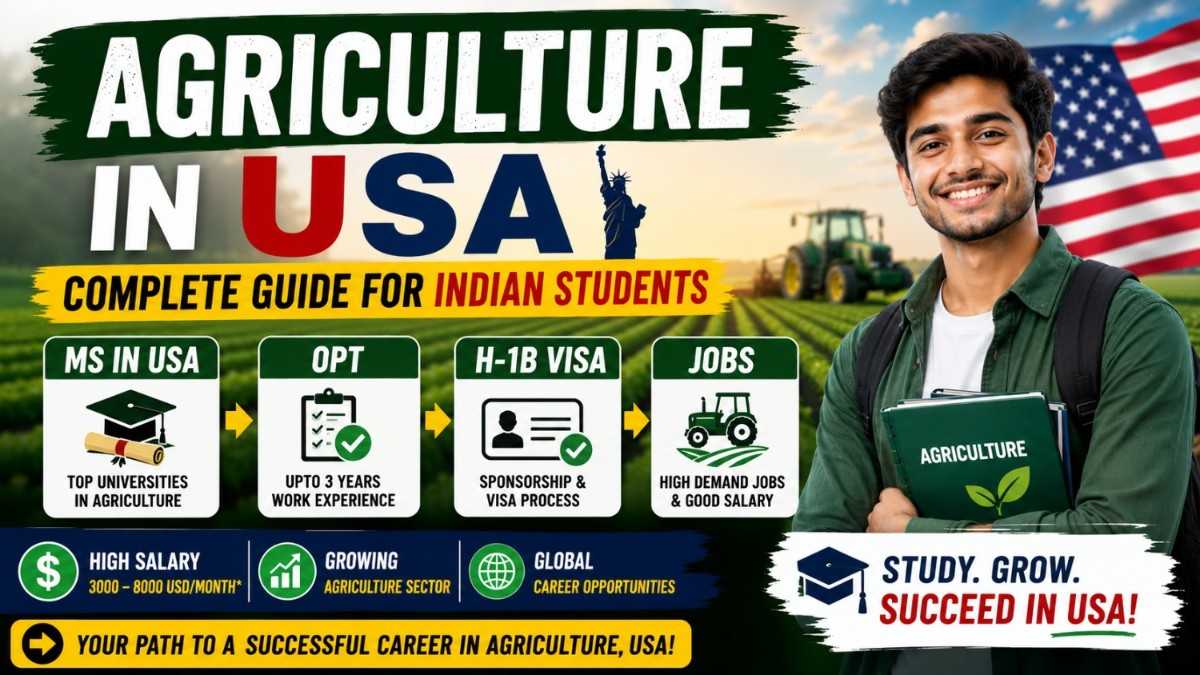
🏫 Top Universities: Cornell, UC Davis, Purdue, Texas A&M, Illinois Urbana-Champaign
💰 MS Tuition: $20,000 – $65,000 per year
🎓 Duration: 1.5 – 2 years
📋 OPT Work Rights: 36 months (STEM OPT eligible)
💵 Starting Salary: $70,000 – $130,000/year
🌱 Top Specialisations: Agronomy, Food Science, Agricultural Engineering, Ag-Data Science
🛂 Visa Path: F-1 → OPT → STEM-OPT → H1B
📅 Application Season: Fall 2026 (Deadline: Dec 2025 – Feb 2026)
- Why Choose Agriculture in USA in 2026?
- Top MS Agriculture Programs in USA for Indian Students
- MS Agriculture USA – Tuition Fees & Cost Breakdown
- Eligibility Criteria for MS Agriculture in USA
- Agriculture Jobs in USA – Salary & Career Scope 2026
- OPT & STEM-OPT for Agriculture Indian Students Explained
- H1B Visa for Agriculture Jobs in USA – Complete Pathway
- Who Should Study MS Agriculture in USA?
- MS Agriculture USA vs MS Agriculture in Canada – Comparison
- High-Value Agriculture Career Terms You Must Know
- How to Apply for MS Agriculture in USA – Step by Step
- Frequently Asked Questions
Why Choose Agriculture in USA in 2026?
The United States is the world’s largest agricultural exporter, with the sector contributing over $1.4 trillion to GDP annually through crops, livestock, food processing, and agri-technology. For Indian students, pursuing agriculture in USA in 2026 offers 4 distinct advantages that no other country can match simultaneously.
- 🌾 World-Class Research Infrastructure: US universities like Cornell, UC Davis, and Purdue invest hundreds of millions of dollars annually in agricultural R&D — giving students access to precision farming labs, biotech research centres, and USDA-funded projects.
- 📊 STEM-Eligible Degrees: Most MS agriculture programs in the USA carry STEM designation, which means Indian students get 3 full years of OPT work authorisation — compared to only 1 year in the UK and 1.5 years in Germany.
- 💵 High Earning Potential: Agricultural engineers, food scientists, and agri-data scientists in the USA earn $70,000–$130,000 per year as starting salaries — equivalent to Rs.58 lakh to Rs.1.07 crore annually at current exchange rates.
- 🤝 Strong Indian Student Community: Over 3,63,019 Indian students studied in the USA in 2024-25 (Open Doors 2025 Report, IIE), making adjustment to campus life significantly easier.
- 🔬 Agri-Tech Boom: Precision agriculture, food biotech, sustainable farming, and climate-smart agriculture are creating thousands of new high-paying roles every year — and US universities are training graduates specifically for these roles.
- 🎓 TA/RA Funding: Many top agriculture departments offer Teaching Assistantships and Research Assistantships worth $15,000–$25,000/yr that substantially reduce the cost of your MS degree.
Top MS Agriculture Programs in USA for Indian Students
Choosing the right university is the most critical decision for agriculture in USA for Indian students. Below are the 8 best universities ranked by QS Agriculture rankings, research output, and placement records in 2026.

| University | QS Agri Rank 2026 | State | Annual Tuition (USD) | Key Specialisations | TA/RA Available |
|---|---|---|---|---|---|
| Cornell University | #3 | New York | $71,300 | Plant Science, Food Science, Animal Science | Yes |
| UC Davis | #7 | California | $45,000–$55,000 | Agronomy, Environmental Science, Viticulture | Yes |
| Purdue University | #6 | Indiana | $31,100 | Agricultural Engineering, Agribusiness, Horticulture | Yes |
| Texas A&M University | #12 | Texas | $28,000–$38,000 | Soil Science, Agricultural Economics, Crop Science | Yes |
| UI Urbana-Champaign | #22 | Illinois | $46,900 | Agricultural Communications, Food Technology, Ag Policy | Yes |
| Penn State University | #39 | Pennsylvania | $45,900 | Agricultural Science, Plant Pathology, Dairy Science | Yes |
| Iowa State University | #45 | Iowa | $26,000–$34,000 | Agronomy, Genetics, Sustainable Agriculture | Yes |
| University of Georgia | #55 | Georgia | $28,000–$36,000 | Crop Science, Agricultural Education, Food Safety | Yes |
All 8 universities above are accredited by their regional bodies and recognised by USDA (United States Department of Agriculture) for research partnerships. Cornell and UC Davis consistently rank among the top 10 global agriculture universities in QS World University Rankings 2026.
MS Agriculture USA – Tuition Fees & Cost Breakdown
Understanding the complete cost of studying agriculture in USA is essential before applying. Here is a realistic 2-year budget for Indian students in 2026, covering tuition, living, visa, and pre-departure expenses.
| Expense Head | Per Year (USD) | 2-Year Total (USD) | 2-Year Total (INR approx.) |
|---|---|---|---|
| Tuition (mid-tier public university) | $28,000–$46,900 | $56,000–$93,800 | Rs.46–77 lakh |
| Living Expenses (rent + food) | $14,000–$22,000 | $28,000–$44,000 | Rs.23–36 lakh |
| Health Insurance | $1,500–$3,000 | $3,000–$6,000 | Rs.2.5–5 lakh |
| Books & Supplies | $800–$1,500 | $1,600–$3,000 | Rs.1.3–2.5 lakh |
| Pre-departure (GRE, TOEFL, Visa) | One-time | $2,000–$3,500 | Rs.1.7–3 lakh |
| Total (before TA/RA deduction) | — | $90,600–$1,50,300 | Rs.74–1.24 crore |
| TA/RA Stipend (if awarded) | -$15,000 to -$25,000 | -$30,000 to -$50,000 | -Rs.25–41 lakh |
| Net Cost (with TA/RA) | — | $50,000–$1,10,000 | Rs.41–90 lakh |
The F-1 student visa for the USA costs $160 MRV fee + $185 SEVIS fee = $345 total. Students must show proof of liquid funds matching their I-20 figure (typically 1 year of tuition + living) in their bank statements at the time of the visa interview.
Eligibility Criteria for MS Agriculture in USA
To pursue agriculture in USA for Indian students at the MS level, you must meet academic, language, and standardised test benchmarks set by US universities. Below is a consolidated eligibility table for 2026 admissions.
| Eligibility Parameter | Minimum Requirement | Competitive Target |
|---|---|---|
| Bachelor’s Degree | B.Sc. / B.Tech in Agriculture, Horticulture, Food Tech, Botany, Biochemistry, Environmental Science | 60%+ aggregate / 3.0 GPA |
| GRE Score | 300+ (now optional at many universities) | 315–320 for top 20 universities |
| TOEFL iBT | 80–90 | 100+ for Cornell, UC Davis |
| IELTS | 6.5 | 7.0+ for top universities |
| SOP (Statement of Purpose) | Required at all universities | Research-aligned, specific to lab/professor |
| LOR (Letters of Recommendation) | 2–3 letters | At least 1 from research supervisor |
| Work / Research Experience | Not mandatory | 1–2 years preferred for top schools |
| Age Limit | No upper age limit in the USA | Most applicants are 22–28 years old |
| Application Fee | $50–$125 per university | Apply to 8–12 universities |
Note: GRE is now waived or optional at MIT, Stanford, CMU, and UC Berkeley for 2026 admissions. Always check the individual program page on the university’s official website for the latest requirements.
Agriculture Jobs in USA – Salary & Career Scope 2026
The career scope of agriculture in USA for Indian students has expanded dramatically due to the agri-tech revolution. In 2026, the US agricultural sector needs professionals not just in traditional farming but in data science, biotechnology, food safety, supply chain, and policy roles.
| Job Role | Average Annual Salary (USD) | Annual Salary (INR approx.) | Top Employers |
|---|---|---|---|
| Agricultural Engineer | $85,000–$110,000 | Rs.70–91 lakh | John Deere, USDA, CNH Industrial |
| Food Scientist / Technologist | $75,000–$105,000 | Rs.62–87 lakh | Cargill, Archer Daniels, Nestlé, Kraft Heinz |
| Agri-Data Scientist | $100,000–$130,000 | Rs.82–1.07 crore | Bayer CropScience, Corteva, Climate Corp |
| Plant Scientist / Agronomist | $70,000–$95,000 | Rs.58–78 lakh | Syngenta, Pioneer, BASF, USDA-ARS |
| Agricultural Economist | $80,000–$120,000 | Rs.66–99 lakh | World Bank, USDA ERS, FAO USA |
| Environmental Resource Manager | $72,000–$98,000 | Rs.59–81 lakh | EPA, State Environment Agencies, NGOs |
| Food Safety Analyst | $68,000–$90,000 | Rs.56–74 lakh | FDA, Tyson Foods, Perdue Farms |
| Precision Agriculture Specialist | $78,000–$115,000 | Rs.64–95 lakh | Climate Corporation, Trimble, AgLeader |
California, Washington, and Massachusetts lead all US states for agriculture-related graduate employment, with average annual salaries exceeding $114,000 in tech-linked agri roles. The US Bureau of Labor Statistics projects a 7% growth rate for agricultural and food scientist roles through 2032 — faster than the national average.
OPT & STEM-OPT for Agriculture Indian Students Explained
One of the biggest advantages of pursuing agriculture in USA for Indian students is the 3-year OPT work authorisation — the longest post-study work right available in any English-speaking country. Here is how it works in detail.
- 🎓 Complete Your MS Agriculture Program (2 years): Complete your degree at a STEM-designated university. Most agronomy, food science, and agricultural engineering programs in the USA are STEM-eligible under CIP codes recognised by DHS.
- 📝 Apply for OPT 90 Days Before Graduation: Apply for OPT via Form I-765 with USCIS at least 90 days before your program completion date. Processing takes 3–5 months, so apply early.
- ✅ OPT Approval – 12 Months Work Authorisation: Once approved, you receive an EAD (Employment Authorisation Document) valid for 12 months. You can work full-time anywhere in the USA without needing an employer to sponsor a visa.
- 🔄 Apply for STEM-OPT Extension – 24 More Months: Before your standard OPT expires, apply for the STEM-OPT extension using Form I-765. You must have a qualifying E-Verify employer and submit Form I-983 (Training Plan). This gives 24 additional months of work authorisation.
- 🏢 Total OPT Window = 36 Months: The combined 12 + 24 = 36 months provides enough runway for 3 H1B lottery attempts (filed every April for October start). Agriculture companies like Driscoll’s have filed an average salary of $136,602 per H1B application according to USCIS LCA data.
Apply for OPT at least 90 days before your graduation date — do not wait until after you get your degree. USCIS processing can take 3–5 months. Also, email professors about TA/RA positions at the time of application, not after your admit letter arrives — most funded slots go quickly. Check the USCIS OPT official guide for all current requirements.
H1B Visa for Agriculture Jobs in USA – Complete Pathway
Securing a permanent work visa is the long-term goal for Indian students exploring agriculture in USA. Here is the complete F-1 to H1B pathway, including timelines and key application points.
| Stage | Visa / Status | Duration | Key Action |
|---|---|---|---|
| Stage 1 | F-1 Student Visa | 2 years (MS duration) | Study, 20 hrs/week on-campus work allowed |
| Stage 2 | OPT (Standard) | 12 months | Apply I-765, receive EAD, work full-time in agriculture role |
| Stage 3 | STEM-OPT Extension | 24 months | E-Verify employer required, submit I-983 Training Plan |
| Stage 4 | H1B Lottery | Applied every April | Employer files H1B petition; 85,000 cap; lottery in April |
| Stage 5 | H1B Approval | 3 years (extendable to 6) | Employer-sponsored, stay and work legally |
| Stage 6 | Green Card (EB-2/EB-3) | 50–150 year backlog for Indians | EB-2 NIW possible for researchers; parallel Canada PR recommended |
Top agriculture H1B sponsors in the USA include Driscoll’s (avg salary $136,602), Cargill, Bayer CropScience, Corteva Agriscience, Syngenta, USDA Research Labs, and John Deere. You can verify H1B filings by employer at MyVisaJobs.com — a free tool that shows past LCA filings, salaries, and approval rates by company.
Who Should Study MS Agriculture in USA?
Not every Indian student is the right fit for an MS agriculture program in USA. Here are 8 specific candidate profiles for whom studying agriculture in USA in 2026 makes exceptional sense.
- 🌾 B.Sc. / B.Tech Agriculture Freshers (22–26 years): Students who have just completed a UGC-recognised agriculture degree and want to move into high-paying agri-tech or food science careers internationally.
- 🔬 Research-Oriented Graduates: Those who want to pursue PhD eventually — an MS at Cornell, UC Davis, or Purdue creates the strongest research profile for PhD applications in the USA.
- 💻 Data Science + Agriculture Aspirants: Students with programming skills (Python, R) and agricultural background who want to enter precision farming, crop analytics, or agri-AI roles earning $100,000–$130,000/yr.
- 🏭 Food Technology Graduates: B.Tech Food Technology graduates who want to work at global FMCG companies like Cargill, Nestlé, and Kraft Heinz in the USA — an MS Food Science from a US university is the fastest path.
- 👩🌾 Women Agricultural Scientists: The US heavily funds diversity in STEM agriculture research — women graduates have access to dedicated fellowships and RA positions at most land-grant universities.
- 🌿 Environmental Science Graduates: Students with B.Sc. Environmental Science who want to work in EPA-regulated roles, climate-smart agriculture, or environmental resource management in the USA.
- 📈 Agribusiness & Policy Aspirants: Those interested in agricultural economics, trade policy, rural development, or working with organisations like USDA, World Bank, and FAO.
- 🏆 Scholarship & TA/RA Seekers: Motivated students with a strong academic record (CGPA 8.0+) who want to fund their MS through Teaching or Research Assistantships — land-grant universities offer excellent TA support in agriculture departments.
MS Agriculture USA vs MS Agriculture in Canada – Comparison
Many Indian students compare studying agriculture in USA vs Canada. Here is an 8-point comparison to help you decide which country suits your goals better in 2026.
| Parameter | MS Agriculture USA | MS Agriculture Canada |
|---|---|---|
| Top Universities | Cornell, UC Davis, Purdue, Texas A&M | UBC, McGill, University of Guelph |
| Annual Tuition | $28,000–$71,000 | CAD $18,000–$35,000 |
| Post-Study Work Rights | 36 months (STEM OPT) | Up to 3 years (PGWP) |
| Starting Salary | $70,000–$130,000/yr | CAD $55,000–$85,000/yr |
| Permanent Residency Path | H1B → Green Card (50–150 yr backlog for Indians) | Express Entry CRS ~450–500 points |
| TA/RA Availability | Excellent (land-grant universities) | Good (NSERC-funded labs) |
| Research Funding | USDA, NSF, NIH – very large budgets | NSERC, AAFC – moderate |
| Best For | High salary, agri-tech, research careers | Faster PR, lower cost, stable immigration |
High-Value Agriculture Career Terms You Must Know
These are the high-value keywords and career terms that Indian agriculture graduates searching for jobs in the USA must understand. Knowing these terms will help you write better resumes, target the right employers, and understand visa eligibility.
- 🌱 STEM OPT Extension: A 24-month work authorisation extension available only to graduates of STEM-designated US degree programs. Agriculture, food science, agronomy, and agricultural engineering qualify. This gives Indian students 36 months total work rights post-graduation.
- 🛂 H1B Visa Agriculture: An employer-sponsored work visa valid for 3 years (extendable to 6) for speciality occupation roles. Driscoll’s, Cargill, and Bayer CropScience are top H1B agriculture sponsors with salaries averaging $100,000–$136,000/yr.
- 📊 Precision Agriculture: The use of GPS, sensors, drones, and big data to optimise farm management. Precision agriculture specialists earn $78,000–$115,000/yr in the USA and are in high demand at companies like Climate Corporation and Trimble Agriculture.
- 🧬 Agricultural Biotechnology: The application of genetic engineering, CRISPR, and molecular biology to improve crop yields and disease resistance. Biotech agri-scientists at Bayer, Syngenta, and Corteva earn $90,000–$125,000/yr.
- 🍽️ Food Science MS USA: One of the highest-ROI agriculture MS programs. Food scientists at Nestlé, Kraft Heinz, and Cargill earn $75,000–$105,000/yr with strong H1B sponsorship histories.
- 🌾 USDA Research Assistantship: Funded research positions within USDA Agricultural Research Service (USDA-ARS) or at land-grant universities through USDA grants. These provide stipends of $18,000–$30,000/yr plus tuition waiver.
- 🌍 Agricultural Economist USA: Works on farm policy, trade, rural development, and food systems. Earns $80,000–$120,000/yr at USDA Economic Research Service, World Bank, or academic institutions.
- 🤖 Agri-Data Scientist: Combines agricultural domain knowledge with machine learning and data analytics. The most in-demand hybrid role in 2026 — salaries reach $100,000–$130,000/yr with H1B sponsorship from agri-tech firms.
- 🌊 Sustainable Agriculture Specialist: Focuses on climate-smart farming, water management, and carbon farming. Growing rapidly due to USDA’s Inflation Reduction Act climate investment commitments. Entry salaries: $72,000–$95,000/yr.
- 📜 EB-2 NIW (National Interest Waiver): A Green Card pathway that waives the job offer requirement for individuals whose work is in the national interest of the USA. Agricultural researchers specialising in food security or climate resilience can potentially qualify.
How to Apply for MS Agriculture in USA – Step by Step
The application process for MS agriculture programs in the USA follows a structured timeline. Indian students should start preparing at least 12–15 months before the intended intake. Here is the complete 8-step process for Fall 2026 and Fall 2027 applications.
- 📚 Research Programs and Professors (15 months before intake): Identify 8–12 universities with MS agriculture programs matching your specialisation interest. On each university’s department page, identify 3–5 faculty members whose current research aligns with your background. Read their 2024–2026 publications.
- ✉️ Email Potential Advisors (12–14 months before): Send a concise, personalised 200-word email to target professors expressing specific interest in their research. Attach a 1-page CV and mention your undergraduate thesis or relevant project. This step dramatically improves admission and TA/RA chances.
- 📝 Prepare for GRE and English Tests (12 months before): If required, prepare for GRE (target 315+) and TOEFL iBT (target 100+) or IELTS (target 7.0). Note: GRE is now optional at many top universities including UC Davis and Purdue for 2026 admissions.
- 📄 Draft Your Statement of Purpose (10 months before): Write a 700–1,000 word SOP that clearly outlines your research interests, how your undergraduate work prepared you, and why your target university is the right fit. Mention specific faculty members and labs by name.
- 🤝 Secure Letters of Recommendation (9 months before): Request 3 LORs — ideally 2 from academic supervisors and 1 from a professional reference. Give recommenders at least 6–8 weeks to write and submit their letters through the university portal.
- 💻 Submit Applications (Dec–Feb, 8–11 months before intake): Most US university agriculture MS deadlines fall between December 1 and February 15. Submit all components: SOP, LORs, transcripts, GRE/TOEFL scores, and application fee ($50–$125). Apply to a mix of reach, target, and safety schools.
- 🛂 Apply for F-1 Student Visa After Admit (4–6 months before): After receiving your I-20 from the chosen university, pay the SEVIS fee ($185), schedule your visa interview at the US consulate (Chennai, Mumbai, New Delhi, Hyderabad, or Kolkata), and prepare your financial documentation.
- ✈️ Arrive in the USA and Plan OPT Early (from Day 1): Attend your DSO (Designated School Official) orientation in the first week. Ask about OPT timelines, STEM designation status of your program, and TA/RA opportunities in your department from semester 1 itself.
Frequently Asked Questions – Agriculture in USA for Indian Students
What is the scope of agriculture in USA for Indian students in 2026?
The scope of agriculture in USA for Indian students is outstanding in 2026. The US agricultural sector accounts for $1.4 trillion in GDP and is increasingly driven by agri-tech, food biotech, and precision farming. Indian MS graduates are being hired in roles earning $70,000–$130,000 per year by companies like Bayer CropScience, Cargill, USDA, and Corteva Agriscience. The 3-year STEM OPT further strengthens the career pathway significantly.
Which are the best universities for MS agriculture in USA for Indian students?
The best universities for MS agriculture in USA for Indian students in 2026 are Cornell University (QS #3 in Agriculture), Purdue University (QS #6), UC Davis (QS #7), Texas A&M University (QS #12), and University of Illinois Urbana-Champaign (QS #22). All 5 offer TA/RA positions, STEM-eligible degrees, and strong industry placement support in agriculture-related careers.
Is MS agriculture in USA STEM-eligible for OPT?
Yes, most MS agriculture programs in the USA are STEM-designated under DHS CIP codes, qualifying Indian graduates for the 36-month OPT window (12 months standard + 24 months STEM extension). Programs in agricultural engineering, food science, agronomy, environmental science, and plant biology are all typically STEM-eligible. Always verify the STEM designation status with your university’s DSO before enrolling.
What is the average salary for agriculture jobs in USA after MS?
The average salary for agriculture jobs in USA after an MS degree ranges from $70,000 to $130,000 per year depending on specialisation. Agri-data scientists earn the highest at $100,000–$130,000/yr, followed by agricultural engineers at $85,000–$110,000/yr, food scientists at $75,000–$105,000/yr, and agronomists at $70,000–$95,000/yr. California, Washington, and Massachusetts offer the highest salaries.
What is the total cost of MS agriculture in USA for Indian students?
The total 2-year cost of MS agriculture in the USA ranges from Rs.74 lakh to Rs.1.24 crore (before TA/RA funding). Mid-tier public universities like Purdue, Iowa State, and Texas A&M are significantly more affordable at $28,000–$38,000/yr in tuition. Students who secure TA or RA positions can reduce net costs by Rs.25–41 lakh over 2 years, making the investment substantially more manageable.
How does the H1B process work for agriculture students after OPT?
After completing OPT and STEM-OPT (total 36 months), Indian agriculture graduates typically apply for the H1B visa through their employer. The H1B lottery opens every April with 85,000 visas available annually. Agriculture companies like Driscoll’s, Cargill, and Bayer CropScience are consistent H1B sponsors in the agriculture sector. With 36 months of OPT, students get 3 lottery attempts before H1B status is needed.
Can Indian students get scholarships for MS agriculture in USA?
Yes, Indian students pursuing agriculture in USA can access several funding sources. Key options include USDA National Needs Graduate Fellowships, university Teaching Assistantships (worth $15,000–$25,000/yr plus tuition waiver), Research Assistantships from USDA-funded labs, Fulbright-Nehru Fellowships for Indian nationals, and merit scholarships of $5,000–$25,000 from Cornell, Purdue, and UC Davis. Emailing target professors about RA availability at the time of application is the most effective strategy.
Which agriculture specialisations have the best H1B sponsorship in USA?
Agriculture specialisations with the strongest H1B sponsorship records in the USA include food science and technology, agricultural engineering, agri-data science, agricultural biotechnology, and plant science. Companies like Bayer CropScience, Corteva Agriscience, Syngenta, Cargill, and Driscoll’s (avg H1B salary $136,602) are the most active H1B sponsors in the agriculture sector. You can verify sponsorship history at MyVisaJobs.com.
This guide is regularly reviewed and updated for accuracy. Bookmark this page for the latest updates on agriculture in USA for Indian students. Last Updated: May 2026.