
NDDB schemes 2026 cover every stage of India’s dairy value chain — from village-level milk chilling to national breed improvement — and directly benefit the 8 crore dairy farming families who depend on this sector. India produced 247 million tonnes of milk in 2024-25, the highest in the world, and the National Dairy Development Board’s programmes are the institutional backbone behind that achievement. If you are a dairy farmer, cooperative member, FPO, or milk union looking for subsidies, working capital support, or infrastructure funding in 2026, this guide covers every active scheme, its benefits, and how to access it.

NDDB schemes 2026 include 8 major programmes — NPDD, RGM, DIDF, SDCFPO, National Dairy Plan, IDDP, Revitalising POIs, and Training programmes — with a combined government outlay exceeding Rs.15,000 crore. Dairy farmers, cooperatives, FPOs, and milk unions are eligible depending on the scheme. The largest subsidy available is 50% of project cost (up to Rs.2 crore) under Rashtriya Gokul Mission’s Breed Multiplication Farm component, implemented through NDDB.
- Organisation: National Dairy Development Board (NDDB), Anand, Gujarat
- Statutory Status: Institution of National Importance (Act of 1987)
- Ministry: Department of Animal Husbandry and Dairying (DAHD), GoI
- India Milk Production 2024-25: 247 Million Tonnes (World No. 1)
- DIDF Total Outlay: Rs.11,184 crore (2018-19 to 2030-31)
- RGM Budget 2026-27: Rs.800 crore (Administrative Approval, April 2026)
- RGM Max Subsidy: 50% of project cost up to Rs.2 crore per BMF unit
- NPDD Fund Sharing: 50-100% Central assistance depending on state category
- SDCFPO Interest Subvention: 2% p.a. on working capital loans to milk unions
- Active Dairy Farmers Benefited: 8 crore+ across India
- Official Website: nddb.coop | Portal: eoi.nddb.coop
- What Is NDDB and Why Do Its Schemes Matter in 2026?
- Who Should Read This Guide?
- Complete List of NDDB Schemes 2026
- National Programme for Dairy Development (NPDD)
- Rashtriya Gokul Mission (RGM) — NDDB’s Role
- Dairy Processing and Infrastructure Development Fund (DIDF)
- Supporting Dairy Cooperatives and FPOs (SDCFPO)
- Other NDDB Programmes: POI Revival, Training, NDP
- Who Is Eligible — Category-wise Breakdown
- How to Apply for NDDB Schemes 2026 — Step-by-Step
- NDDB Schemes vs NABARD Dairy Schemes — Key Differences
- Advantages and Disadvantages of NDDB Schemes
- Important Terms Related to NDDB Dairy Programmes
- Important Links
- Conclusion
- Key Takeaways
- Frequently Asked Questions
What Is NDDB and Why Do Its Schemes Matter in 2026?
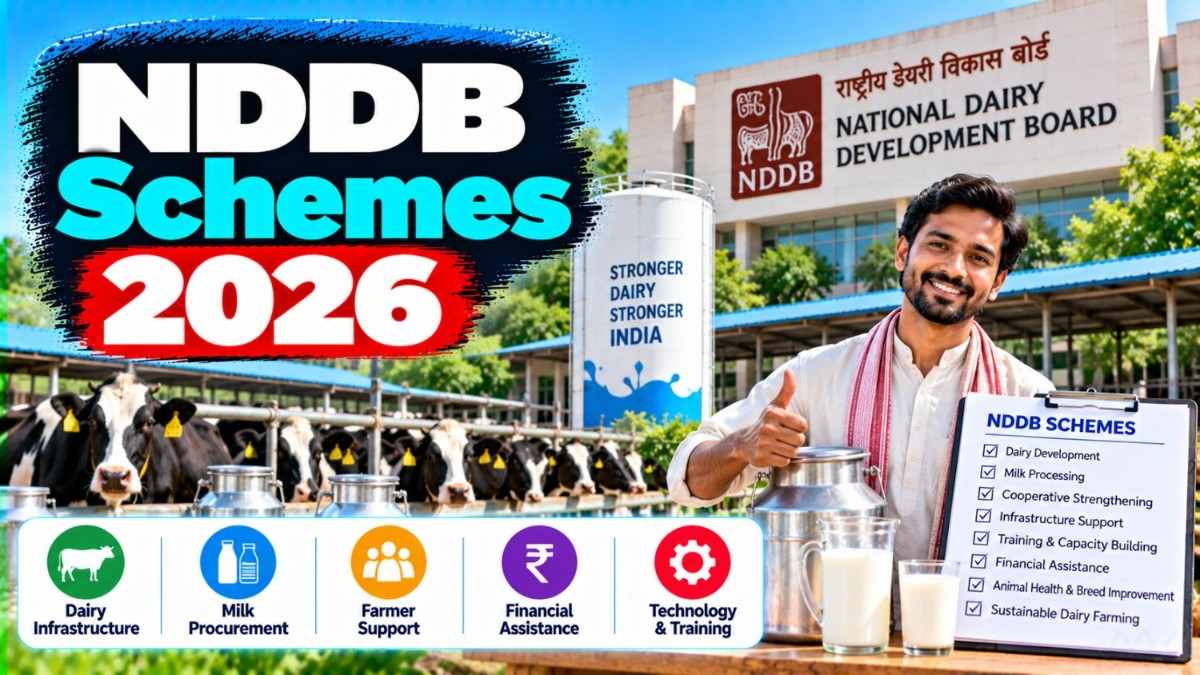
The National Dairy Development Board (NDDB) is India’s premier statutory dairy organisation, established in 1965 under the leadership of Dr. Verghese Kurien and headquartered in Anand, Gujarat. NDDB was declared an institution of national importance under the NDDB Act, 1987 (effective 12 July 1989). Its core mission is to promote, plan, and implement programmes that increase milk production, strengthen dairy cooperatives, modernise dairy infrastructure, and ensure remunerative prices for India’s dairy farming families.
In 2026, NDDB schemes matter more than ever. India’s dairy sector contributes 65% of total livestock output within a sector valued at Rs.17.25 lakh crore, and supports 46.1% of the country’s population. Milk production grew from 146 million tonnes in 2014-15 to 247 million tonnes in 2024-25 — a 69.4% increase in a decade — and NITI Aayog projects demand to reach 480-606 million tonnes by 2047. Bridging that gap requires the kind of structured, funded, and cooperative-centric approach that NDDB programmes provide.
Who Should Read This Guide?
- 🐄 Small and marginal dairy farmers with 2–20 milch animals looking for breed improvement subsidies under RGM
- 🏘️ Dairy cooperative members at village-level DCS who want to understand how NPDD funds their chilling and testing infrastructure
- 🏭 Milk union officers and state dairy federation managers seeking DIDF loans for processing plant modernisation
- 🌾 Farmer Producer Organisations (FPOs) engaged in dairy activities wanting to access NPDD or SDCFPO working capital support
- 👩🌾 Women SHG members in rural areas connected to SRLM-linked dairy cooperatives eligible under NPDD Component A
- 🎓 Agriculture graduates and veterinary professionals working as MAITRIs or AI technicians under Rashtriya Gokul Mission
- 📊 Entrepreneurs and investors planning to establish breed multiplication farms or value-added dairy product facilities
- 💼 State government animal husbandry officials who need to understand fund-sharing patterns and central assistance norms
Complete List of NDDB Schemes and Programmes 2026
NDDB implements schemes in two broad categories: Central Sector Schemes funded by the Government of India (through DAHD) and programmes run from NDDB’s own resources. The table below gives you a complete overview of all active schemes as of October 2026.
| Scheme Name | Type | Total Outlay / Corpus | Primary Beneficiary | Key Benefit |
|---|---|---|---|---|
| National Programme for Dairy Development (NPDD) | Central Sector | Part of Rs.6,190 crore combined RGM+NPDD | Dairy federations, milk unions, FPOs, SHGs | 50-100% central grant for infrastructure |
| Rashtriya Gokul Mission (RGM) — BMF Component | Central Sector | Rs.800 crore (2026-27 allocation) | Individual dairy farmers, SLDBs | 50% subsidy up to Rs.2 crore per BMF unit |
| Dairy Processing and Infrastructure Development Fund (DIDF) | Central Sector | Rs.11,184 crore (2018-19 to 2030-31) | Milk unions, dairy federations, NDDB subsidiaries | Low-interest NABARD loans at 2.5% subvention |
| Supporting Dairy Cooperatives and FPOs (SDCFPO) | Central Sector | Rs.500 crore (2021-22 to 2025-26) | 64 milk unions nationwide | 2% p.a. interest subvention on working capital |
| National Dairy Plan (NDP) | NDDB Own Resources + World Bank | Multi-phase (Phase I: Rs.2,242 crore) | Cooperatives in 14 major milk-producing states | AI services, semen stations, cattle feed plants |
| Revitalising Producers’ Owned Institutions (POI) | NDDB Own Resources | Rs.9,600 lakh (2022-23 to 2026-27) | Struggling dairy cooperatives and producer-owned bodies | Revival support, management assistance |
| Integrated Dairy Development Programme (IDDP) | Central Sector (historical/ongoing) | Scheme-specific allocations | Non-Operation Flood districts | Cooperative infrastructure, breed improvement |
| Training and Capacity Building Programmes | NDDB Own Resources | Annual allocation | Cooperative staff, AI technicians, board members | Free/subsidised 3-5 day residential training |
National Programme for Dairy Development (NPDD) 2026 — Details and Benefits
The National Programme for Dairy Development (NPDD), running from 2021-22 to 2025-26, is one of the most comprehensive central sector dairy schemes in India. It aims to enhance the quality of milk and milk products and increase the share of organised milk procurement, processing, value addition, and marketing. NPDD has two components that address different parts of the dairy supply chain.
Component A focuses on creating and strengthening infrastructure for quality milk testing equipment and primary chilling facilities. This includes setting up Bulk Milk Coolers (BMCs), milk quality testing laboratories, and cold-chain infrastructure at the village level. For milk unions and federations in the North Eastern Region, Hilly Areas, and Union Territories, the central assistance is 100%. For cooperatives in other states, the central assistance covers 50-75% of project cost depending on the activity.
Component B (Dairying Through Cooperatives) is an externally aided project funded through Japan International Cooperation Agency (JICA) assistance. It was implemented on a pilot basis in Uttar Pradesh and Bihar, focusing on creating dairy infrastructure at the village level and strengthening stakeholder institutions from village to state level.
| Activity Under NPDD | NER/Hilly/UT States | Other States |
|---|---|---|
| Milk Procurement (DCS), Bulk Milk Coolers | 75% central assistance | 50% central assistance |
| Milk Testing Lab, Certification, Accreditation | 70% central assistance | 50% central assistance |
| Milk Processing and Value Addition (NER/Hilly only) | 100% central assistance | Not applicable |
| Research and Development Projects | 35% (max Rs.1 crore) | 35% (max Rs.1 crore) |
| Establishment of Milk Producer Company | 35% (max Rs.15 crore) | 35% (max Rs.15 crore) |
Rashtriya Gokul Mission 2026 — NDDB’s Role and Farmer Benefits
Rashtriya Gokul Mission (RGM) was launched in December 2014 for the development and conservation of indigenous bovine breeds. NDDB serves as one of the two Central Nodal Agencies (CNAs) for RGM implementation alongside State Livestock Development Boards. In April 2026, the Government of India issued Administrative Approval for Revised RGM implementation during 2026-27 with a fresh allocation of Rs.800 crore. The combined outlay for RGM and NPDD was enhanced to Rs.6,190 crore following Union Cabinet approval in March 2025.
The most direct farmer-facing benefit under RGM through NDDB is the Breed Multiplication Farm (BMF) scheme. Eligible dairy farmers receive a one-time capital subsidy of 50% of project cost, limited to Rs.2 crore, for construction of cattle sheds, equipment purchase, and procurement of elite bull mothers. For farmers in North Eastern and Hilly States, the assistance is up to Rs.50 lakh at 50% of project cost. The subsidy is released directly to the beneficiary’s loan account through NDDB. Applications were accepted via the portal eoi.nddb.coop (note: verify current status on the official portal as fresh rounds open periodically).
NDDB releases RGM BMF subsidy in two instalments: 75% is released upfront to begin construction, and the remaining 25% is released only after the implementing agency confirms that 10% of calves have been born at the farm. Plan your working capital accordingly. Apply through the official NDDB portal at eoi.nddb.coop when the next round opens.
Dairy Processing and Infrastructure Development Fund (DIDF) 2026
The Dairy Processing and Infrastructure Development Fund (DIDF) is a corpus-based lending scheme announced in Union Budget 2017-18. DIDF has a total outlay of Rs.11,184 crore running from 2018-19 to 2030-31 (with spillover to Q1 FY 2031-32). The fund is administered through NABARD and flows from NABARD to NDDB/NCDC, and then to eligible end borrowers — primarily milk unions, state dairy federations, multi-state cooperatives, and NDDB subsidiaries.
A key update in 2026: the Cabinet Committee on Economic Affairs (CCEA) approved an upward revision of interest subvention from 2% to 2.5% per annum, making DIDF loans significantly cheaper for dairy cooperatives. DIDF supports modernisation of milk processing plants, creation of new processing capacity, installation of electronic milk adulteration testing equipment, cold chain expansion, value-added product manufacturing, and installation of Bulk Milk Coolers. It is estimated to have created direct employment for about 40,000 people through its project activities.
| DIDF Fund Allocation | Amount (Rs. Crore) | Source |
|---|---|---|
| NABARD Corpus Loan (to NDDB/NCDC) | 8,004 | NABARD |
| End Borrowers’ Contribution | 2,001 | Milk Unions / Federations |
| NDDB / NCDC Share | 12 | NDDB / NCDC |
| DAHD Interest Subvention | 1,167 | Government of India |
| Total Outlay | 11,184 | Combined |
Supporting Dairy Cooperatives and FPOs (SDCFPO) — Working Capital Relief
The SDCFPO scheme was launched in 2017-18 to provide soft working capital loans to dairy cooperatives and Farmer Producer Organisations (FPOs) during periods of market stress or natural calamity. Its latest phase runs from 2021-22 to 2025-26 with an outlay of Rs.500 crore (Rs.100 crore per year). NDDB implements this scheme on behalf of DAHD. As of 31 January 2026, NDDB had conveyed sanction of interest subvention amounting to Rs.937.53 crore by leveraging working capital loans of Rs.80,047.93 crore at 2% per annum for 64 milk unions across the country. A total of Rs.693.21 crore has been released (Rs.370.82 crore as regular interest subvention and Rs.322.39 crore as additional interest subvention).
Other NDDB Programmes: POI Revival, NDP, and Training
Beyond the four main central sector schemes, NDDB runs several important programmes from its own resources. The Revitalising Promising Producers’ Owned Institutions (POI) scheme, active from 2022-23 to 2026-27 with an approved budget of Rs.9,600 lakh, targets struggling dairy cooperatives and producer-owned bodies that have potential but face operational difficulties. NDDB provides management expertise, financial restructuring guidance, and technical support to revitalise these institutions.
The National Dairy Plan (NDP), implemented in phases with World Bank support, targeted 40,000 villages across 14 major milk-producing states. NDP created a network of artificial insemination services, improved semen stations, and cattle feed plants that continue to benefit farmers. NDDB’s Training and Capacity Building Programmes at its training centres in Anand and at SRDTC Erode offer residential programmes ranging from 3 to 5 days for dairy cooperative board members, AI technicians, veterinary officers, bulk milk cooler operators, and cooperative staff — all at subsidised or no cost.
Who Is Eligible for NDDB Schemes 2026 — Category-wise Breakdown
| Scheme | Eligible Entities | Not Eligible | Key Condition |
|---|---|---|---|
| NPDD Component A | State dairy federations, district milk unions, FPOs (via NDDB), SHGs (via SRLM), MPCs | Individual farmers directly | Must be farmer-owned cooperative structure |
| RGM BMF Subsidy | Individual dairy farmers aged 18+, with land ownership proof | Corporate entities | Must be an active dairy farmer; apply via eoi.nddb.coop |
| DIDF | Milk unions, state dairy federations, multi-state dairy cooperatives, MPCs, NDDB subsidiaries | Individual farmers, private limited companies | Must meet NDDB/NCDC net worth and profitability eligibility criteria |
| SDCFPO | State cooperative societies, dairy federations, FPOs engaged in dairy activities | Individuals, private sector dairy firms | Working capital loan from NDDB-approved bank required |
| Training Programmes | Board members, staff, AI technicians, BMC operators of dairy cooperatives | General public without dairy cooperative affiliation | Nomination through dairy cooperative or union |
How to Apply for NDDB Schemes 2026 — Step-by-Step Process
- Identify the right scheme: Determine whether you are an individual farmer (RGM BMF), a cooperative/union (NPDD/DIDF/SDCFPO), or an FPO (NPDD/SDCFPO). Use the eligibility table above to confirm your category before proceeding.
- Visit the official NDDB portal: Go to nddb.coop for general scheme information. For RGM BMF applications specifically, use eoi.nddb.coop. Verify that the application window for your target scheme is currently open.
- Prepare required documents: Typically needed are — land ownership/lease documents, bank account details in the applicant’s name, Aadhaar/PAN, proof of dairy cooperative/FPO registration (for institutional applicants), and project proposal/DPR for infrastructure-linked schemes like DIDF and NPDD.
- Register and submit the proposal: Individual farmers register on the NDDB portal and submit the BMF proposal online. Cooperatives and milk unions submit through their State Dairy Federation or directly to NDDB’s regional office, depending on scheme guidelines.
- Technical and financial appraisal: NDDB’s implementing agency reviews the project proposal. For DIDF, NABARD conducts a separate financial appraisal of the end borrower’s creditworthiness before sanctioning the loan.
- Sanction and agreement signing: Upon approval, NDDB issues a sanction letter. The beneficiary signs a project agreement specifying timelines, fund utilisation conditions, and reporting requirements.
- Fund release in instalments: Funds are released in phased instalments tied to project milestones. For RGM BMF, 75% upfront and 25% after verified calf births. For DIDF, loan disbursement is linked to verified expenditure on approved activities.
- Reporting and compliance: Beneficiaries must submit utilisation certificates and progress reports as per the schedule in the agreement. Non-compliance or misuse of funds can result in recovery of the released amount.
NDDB Schemes vs NABARD Dairy Schemes 2026 — Which Is Better?
| Parameter | NDDB Schemes (NPDD / RGM / DIDF) | NABARD Dairy Schemes (DEDS / AHIDF) |
|---|---|---|
| Primary Target | Dairy cooperatives, milk unions, FPOs, select individual farmers (RGM BMF) | Individual farmers, MSMEs, private entrepreneurs |
| Maximum Subsidy | 50% of project cost up to Rs.2 crore (RGM BMF) | 25-33% of project cost (DEDS) / up to Rs.10 crore (AHIDF) |
| Type of Support | Capital subsidy + low-interest infrastructure loans | Back-ended capital subsidy + bank loan |
| Cooperative Focus | Very high — most schemes are cooperative-centric | Low — primarily individual/private entity focused |
| Infrastructure Scale | Village to state level (processing plants, BMCs, labs) | Farm level (animal units, sheds, milking equipment) |
| Interest Subvention | 2-2.5% p.a. (DIDF and SDCFPO) | No direct interest subvention; KCC at 4% available |
| Implementing Agency | NDDB (Central Nodal Agency) | NABARD (via commercial banks and RRBs) |
| Can They Be Combined? | Yes — in many cases, NDDB and NABARD dairy benefits can complement each other (verify with NDDB/NABARD for specific scheme stacking rules) | |
| Best For | Cooperatives, milk unions, FPOs, and large-scale breed improvement | Individual farmers setting up new dairy units, MSMEs in processing |
If you are a dairy cooperative, milk union, or FPO, NDDB schemes are your primary and most powerful source of dairy development funding in 2026 — especially NPDD for infrastructure and SDCFPO for working capital relief. If you are an individual dairy farmer wanting to expand your herd or set up a value-added dairy unit, NABARD DEDS or AHIDF is more accessible. For breed improvement farms at scale, RGM BMF through NDDB offers the single largest subsidy available in India’s dairy sector today.
Advantages and Disadvantages of NDDB Schemes 2026
Advantages of NDDB Schemes:
- ✅ Large-scale funding: Combined government outlay across all NDDB-administered schemes exceeds Rs.15,000 crore, providing substantial support for the sector
- ✅ Highest subsidy in dairy sector: RGM BMF offers 50% capital subsidy up to Rs.2 crore — the most generous single-unit dairy subsidy from the central government
- ✅ Cooperative strengthening: NDDB programmes are explicitly designed to strengthen farmer-owned institutions, not to benefit private intermediaries
- ✅ Integrated value chain coverage: From village BMCs to state-level processing plants, NDDB schemes cover the entire milk supply chain
- ✅ Interest subvention reduces borrowing cost: DIDF at 2.5% subvention and SDCFPO at 2% make institutional dairy finance significantly cheaper than commercial borrowing
Disadvantages and Limitations:
- ❌ Limited individual farmer access: Most NDDB central sector schemes are accessible only through cooperative institutions, not directly by individual farmers
- ❌ Complex application process: DIDF and NPDD require detailed project reports, net worth assessments, and multi-level approval — a process that small unions may find difficult to navigate
- ❌ RGM BMF portal availability: The NDDB BMF portal (eoi.nddb.coop) periodically closes for new applications; farmers must track when new rounds open
Important Terms Related to NDDB Dairy Programmes
- BMC (Bulk Milk Cooler): A stainless steel tank installed at village-level DCS that chills raw milk immediately after procurement to 4°C, extending shelf life and preventing adulteration. DIDF and NPDD funds are frequently used for BMC installation.
- DCS (Dairy Cooperative Society): The village-level primary institution through which individual farmers pool milk for collective chilling, testing, and sale to the district union. The foundational building block of the Amul cooperative model replicated nationally by NDDB.
- Breed Multiplication Farm (BMF): A large-scale breeding facility that produces high-genetic-merit heifers of indigenous breeds like Gir, Sahiwal, and Murrah buffalo. Funded at 50% by RGM through NDDB.
- MAITRI (Multi-purpose AI Technician): A trained artificial insemination worker deployed under Rashtriya Gokul Mission to deliver AI services at the doorstep of farmers. Equipped and trained by NDDB.
- Interest Subvention: A government payment that reduces the effective interest rate for the borrower. Under DIDF, the GoI pays 2.5% of the interest to NABARD on behalf of end borrowers, making the loan cheaper.
- FPO (Farmer Producer Organisation): A registered collective of farmers operating under the Companies Act or Cooperative Act. FPOs engaged in dairy activities can access NPDD and SDCFPO benefits through NDDB.
- AMCS (Automatic Milk Collection System): A digital system introduced by NDDB that weighs milk, tests fat content, and directly credits payment to the farmer’s account — replacing manual records and eliminating payment delays.
- i-DIS (Internet-based Dairy Information System): NDDB’s enterprise resource planning system for dairy cooperatives, enabling real-time tracking of milk procurement, livestock data, and financial transactions.
- Progeny Testing: A scientific breeding programme under NDDB where semen from genetically evaluated bulls is used for AI, and offspring performance is monitored to validate genetic worth before the bull is declared a proven sire.
- Gopal Ratna Award: A national recognition given by DAHD and NDDB to the best dairy farmer rearing indigenous breeds, best AI technician, and best dairy cooperative — carrying cash prizes and certificates.
Important Links for NDDB Schemes 2026
| Link Name | URL |
|---|---|
| NDDB Official Website | nddb.coop |
| RGM BMF Application Portal | eoi.nddb.coop |
| DAHD Official Schemes Page | dahd.gov.in/schemes |
| NPDD Official Guidelines (DAHD) | monitor.dahd.gov.in/npdd |
| SDCFPO Scheme Details (DAHD) | dahd.gov.in/sdcfpo |
| NABARD Dairy Farm Loan 2026 Guide | Agrijob.in — NABARD Dairy Loan 2026 |
| PM Dairy Schemes Complete Guide | Agrijob.in — PM Dairy Loan Yojana 2026 |
Conclusion — Which NDDB Scheme Is Right for You in 2026?
NDDB schemes 2026 form the most comprehensive and best-funded dairy development framework available to Indian dairy stakeholders today. Whether you are a small farmer seeking breed improvement support under RGM, a milk union needing DIDF loans to modernise your processing plant, or an FPO looking for working capital relief through SDCFPO, there is a structured pathway available through NDDB. The key is identifying your entity type, confirming the current application window on the official NDDB portal, and preparing the required documentation in advance.
Bookmark this page — we update it every time NDDB or DAHD releases new guidelines, fresh funding rounds, or portal notifications. For the most current official data, always verify at nddb.coop and dahd.gov.in.
- NDDB operates 8 major schemes in 2026 with a combined government outlay exceeding Rs.15,000 crore across DIDF, RGM, NPDD, and SDCFPO
- The largest dairy subsidy available is 50% of project cost up to Rs.2 crore under RGM Breed Multiplication Farm, implemented exclusively through NDDB
- Dairy cooperatives, milk unions, and FPOs are the primary beneficiaries of most NDDB schemes — individual farmers can access RGM BMF directly
- DIDF offers NABARD corpus loans at 2.5% interest subvention for cooperative processing plant modernisation until 2030-31 with a total outlay of Rs.11,184 crore
- As of January 2026, NDDB’s SDCFPO scheme had sanctioned Rs.937.53 crore in interest subvention for 64 milk unions across India
- Apply via nddb.coop or eoi.nddb.coop; always cross-verify current scheme guidelines on the official DAHD portal before submitting any application
Frequently Asked Questions About NDDB Schemes 2026
What is NDDB and what does it do?
The National Dairy Development Board (NDDB) is a statutory institution of national importance established by the Government of India in 1965 and headquartered in Anand, Gujarat. It promotes, plans, and implements dairy development programmes to increase milk production, strengthen dairy cooperatives, modernise infrastructure, and ensure fair prices for India’s 8 crore dairy farming families. NDDB implements central sector schemes on behalf of the Department of Animal Husbandry and Dairying (DAHD) and also runs programmes from its own resources.
How many schemes does NDDB implement in 2026?
As of October 2026, NDDB implements or is involved in at least 8 major dairy programmes: NPDD (National Programme for Dairy Development), Rashtriya Gokul Mission, DIDF (Dairy Processing and Infrastructure Development Fund), SDCFPO (Supporting Dairy Cooperatives and FPOs), National Dairy Plan, Revitalising Producers’ Owned Institutions, Integrated Dairy Development Programme, and Training and Capacity Building programmes. Additional digital and breed improvement initiatives such as Bharat Pashudhan (NDLM) also run under NDDB’s umbrella.
Can individual dairy farmers apply directly for NDDB schemes?
Individual dairy farmers can apply directly for the RGM Breed Multiplication Farm subsidy through the NDDB portal at eoi.nddb.coop when application rounds are open. Most other NDDB schemes — including NPDD, DIDF, and SDCFPO — are designed for institutional beneficiaries like milk unions, dairy cooperatives, state federations, and FPOs. Individual farmers typically benefit indirectly through their membership in these cooperatives.
What is the maximum subsidy available under NDDB schemes?
The maximum direct subsidy available through NDDB-implemented schemes is 50% of the project cost, limited to Rs.2 crore per unit, under the Rashtriya Gokul Mission Breed Multiplication Farm component. For North Eastern and Hilly State farmers, the limit is Rs.50 lakh at 50% of project cost. For cooperatives under NPDD, central assistance covers 50-100% of specific infrastructure costs depending on the activity and the state’s category.
What is the DIDF scheme and who can benefit from it?
The Dairy Processing and Infrastructure Development Fund (DIDF) is a Rs.11,184 crore corpus-based lending programme running from 2018-19 to 2030-31. Loans flow from NABARD to NDDB/NCDC and then to eligible end borrowers — milk unions, state dairy federations, multi-state cooperatives, milk producer companies, and NDDB subsidiaries. The government provides 2.5% interest subvention, making DIDF loans significantly cheaper than commercial dairy finance. Individual farmers and private dairy companies are not directly eligible.
How much has NDDB disbursed under the SDCFPO scheme?
As of 31 January 2026, NDDB sanctioned interest subvention of Rs.937.53 crore on working capital loans of Rs.80,047.93 crore at 2% per annum for 64 milk unions across India under the SDCFPO scheme. Total releases stood at Rs.693.21 crore, comprising Rs.370.82 crore as regular interest subvention and Rs.322.39 crore as additional interest subvention for cooperatives facing acute financial stress.
What is the Rashtriya Gokul Mission budget for 2026-27?
The Government of India issued Administrative Approval in April 2026 for implementation of the Revised Rashtriya Gokul Mission during 2026-27 with an allocation of Rs.800 crore. The revised RGM is implemented as a Central Sector Scheme with NDDB and State Livestock Development Boards as Central Nodal Agencies. The combined enhanced outlay for both RGM and NPDD was set at Rs.6,190 crore following Union Cabinet approval in March 2025.
Is NDDB the same as NABARD for dairy purposes?
No. NDDB (National Dairy Development Board) and NABARD (National Bank for Agriculture and Rural Development) are distinct institutions. NDDB is a cooperative-development organisation focused exclusively on the dairy sector; it implements dairy schemes and provides technical and institutional support to cooperatives. NABARD is a development finance institution that provides credit and refinancing across all agricultural and rural sectors. For dairy, NABARD primarily provides loans and refinancing to commercial banks for individual farmer units, while NDDB channels government schemes to dairy cooperatives and milk unions.
What documents are needed to apply for an NDDB scheme?
Requirements vary by scheme. For RGM BMF (individual farmer): land ownership documents, Aadhaar/PAN, bank account details, proof of being an active dairy farmer, and a completed project proposal. For institutional schemes like NPDD and DIDF (cooperatives/milk unions): registration certificate of the cooperative, audited balance sheets (last 3 years), project DPR (Detailed Project Report), board resolution authorising application, and state government endorsement in some cases. Always check the current scheme guidelines on nddb.coop for the exact document checklist before applying.
Disclaimer: This article is for informational purposes only. NDDB scheme guidelines, budgets, and application windows are subject to change by the Government of India and NDDB. Always verify the latest details on the official NDDB website (nddb.coop) and DAHD portal (dahd.gov.in) before applying. This is not financial or legal advice.
Last Updated: October 2026 | This guide is reviewed and updated regularly for accuracy. Bookmark this page for the latest NDDB scheme information.