
HPSC Safety Officer Syllabus 2026 covers 9 subjects including Engineering Mechanics, Electrical Science, Thermal Science, Electronics, Civil, and Skill Development topics. The Subject Knowledge Test is subjective, carries 150 marks in 3 hours, and has 87.5% weightage in the final merit — with 35% minimum marks required to qualify for the interview. Salary is Rs. 53,100 – Rs. 1,67,800 (FPL-9).
HPSC Safety Officer Syllabus 2026 has been officially released by the Haryana Public Service Commission (HPSC) on 28 September 2026 for Advertisement No. 05/2025 — the post of Safety Officer in HPGCL, Power Department, Haryana. This guide is for engineering graduates aged 18–42 who want to crack the Safety Officer exam and secure a government job paying Rs. 53,100 – Rs. 1,67,800 per month. Here you will find the complete exam pattern, all 9 subject-wise topics as published in the official PDF at hpsc.gov.in, previous cut-off trends, category-wise analysis, and a proven preparation strategy for 2026.

- Organisation: Haryana Public Service Commission (HPSC), Panchkula
- Post: Safety Officer, HPGCL, Power Department, Haryana
- Advertisement No.: 05/2025 (published 26 June 2025)
- Syllabus Released: 28 September 2026
- Total Vacancies: 01 Post
- Salary: Rs. 53,100 – Rs. 1,67,800 (FPL-9, Pay Band-2)
- Age Limit: 18 to 42 years
- Exam Type: Subjective (Descriptive)
- Test Marks: 150 Marks | 3 Hours | English Medium
- Test Weightage: 87.5% | Interview: 12.5%
- Minimum Qualifying Marks: 35% in Subject Knowledge Test
- Official Website: hpsc.gov.in
📋 Table of Contents
- What Is HPSC Safety Officer Syllabus 2026?
- Who Should Apply for HPSC Safety Officer 2026?
- Salary and Pay Scale Details
- Eligibility Criteria and Qualifications
- HPSC Safety Officer Exam Pattern 2026
- Complete Subject-wise Syllabus (All 9 Sections)
- Cut-off Marks – Category and Post Wise Analysis
- Safety Officer vs Other HPSC Posts
- Pros and Cons of HPSC Safety Officer Post
- Important Terms Related to HPSC Safety Officer Exam
- Important Dates and Timeline
- Important Links
- Conclusion
- Key Takeaways
- Frequently Asked Questions
What Is HPSC Safety Officer Syllabus 2026?
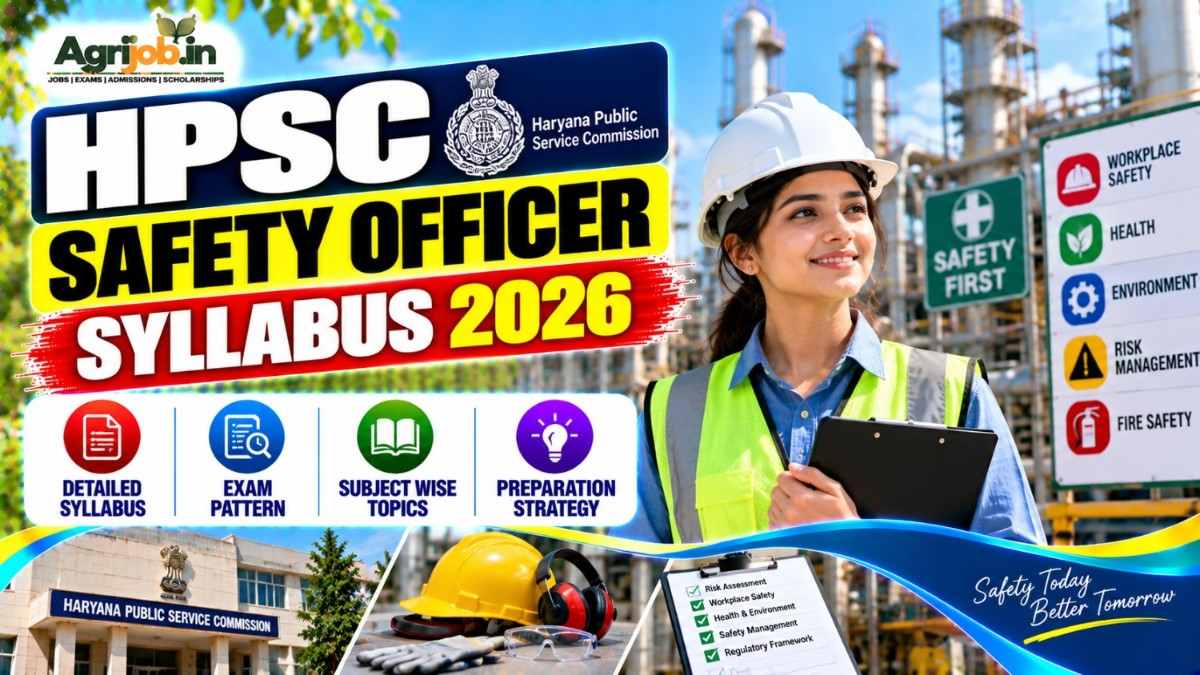
HPSC Safety Officer Syllabus 2026 is the official list of topics published by the Haryana Public Service Commission for the Subject Knowledge Test of Safety Officer (Advertisement No. 05/2025) in HPGCL, Power Department, Haryana. The syllabus contains 9 engineering and technical sections — covering Skill Development, Engineering Mechanics, Thermal Science, Workshop Science, Electrical Science, Electronics, Civil Engineering, and more — tested through a 3-hour subjective written paper of 150 marks.
The exam is conducted in English medium only. There is no negative marking since the paper is descriptive. Candidates who score at least 35% marks (52.5 out of 150) are shortlisted for the Interview round. The final merit list is prepared by combining the Subject Knowledge Test marks (87.5% weightage) and Interview marks (12.5% weightage).

This is a Group-A equivalent technical post in the Haryana state government’s power sector. The post is one of the most respected engineering government jobs in Haryana, with direct placement at HPGCL’s thermal and hydro power plants.
Who Should Apply for HPSC Safety Officer 2026?
- 🎓 Engineering Graduates (B.E./B.Tech) in Mechanical, Electrical, Civil, or any branch with at least 2 years of supervisory factory experience
- 🔬 Physics or Chemistry Graduates (B.Sc.) with at least 5 years of supervisory factory experience in a registered factory
- 🏭 Diploma holders in Industrial Safety who also hold a degree or diploma in engineering or technology
- ⚡ Candidates from the Power/Energy sector who already work in plant safety, maintenance, or supervision roles at government utilities
- 👨💼 ITI and Diploma engineers who have cleared Class 10 with Hindi or Sanskrit as a subject and have the required work experience
- 📋 Haryana domicile candidates targeting permanent government job in the state’s power department with Grade Pay FPL-9
- 🎯 Candidates from General, SC, BC-A, BC-B, EWS categories aged 18 to 42 years who are looking for a high-paying Haryana government job
- 🔄 Working professionals in private manufacturing units looking for job security, pension, and government perks under the HPGCL service rules
HPSC Safety Officer Salary and Pay Scale 2026
The HPSC Safety Officer post carries an attractive pay scale of FPL-9 (Rs. 53,100 – Rs. 1,67,800) under Pay Band-2 of the Haryana Government. This makes it one of the highest-paying engineering safety posts available through HPSC in 2026.
| Pay Component | Details |
|---|---|
| Pay Level | FPL-9 (Pay Band-2) |
| Minimum Basic Pay | Rs. 53,100 per month |
| Maximum Basic Pay | Rs. 1,67,800 per month |
| Dearness Allowance (DA) | As per Haryana Government rules (revised periodically) |
| House Rent Allowance (HRA) | As per city category under Haryana Govt norms |
| Medical Allowance | As applicable under HPGCL service rules |
| Estimated Gross Salary (Starting) | Approx. Rs. 65,000 – Rs. 75,000 per month (with allowances) |
| Pension | NPS (National Pension System) as per state rules |
| Job Security | Permanent government post under HPGCL |
In addition to the basic pay, the Safety Officer is entitled to annual increments, Leave Travel Concession (LTC), and other benefits applicable to Haryana state government employees. The gross in-hand salary at the starting grade typically works out to approximately Rs. 65,000 – Rs. 75,000 per month when DA and HRA are added at current rates.
Eligibility Criteria for HPSC Safety Officer 2026
Candidates must fulfil the following eligibility conditions as per the official HPSC Advertisement No. 05/2025 to appear in the Subject Knowledge Test:
- Educational Qualification (Option 1): A degree in any branch of Engineering or Technology from a recognised university plus at least 2 years of experience as a supervisor in a factory registered under the Factories Act
- Educational Qualification (Option 2): A degree in Physics or Chemistry from a recognised university plus at least 5 years of supervisory factory experience
- Educational Qualification (Option 3): A degree or diploma in Industrial Safety from a recognised institution
- Language Requirement: Must have passed Hindi/Sanskrit in Matriculation (Class 10), or Hindi as a subject in higher secondary or graduation
- Nationality: Indian citizen (or as per HPSC nationality clause in the notification)
- Age Limit: Minimum 18 years and maximum 42 years as on the cut-off date (20 July 2025 for this advertisement)
| Category | Age Relaxation |
|---|---|
| General / Unreserved | 18 – 42 years (no relaxation) |
| SC / BC-A / BC-B (Haryana domicile) | Age relaxation as per Haryana Govt rules |
| Ex-Servicemen | Relaxation as per service rules |
| Persons with Disability (PwD) | As per Haryana Govt PwD norms |
| Maximum age cap for all categories | 52 years (per HPSC rules) |
HPSC Safety Officer Exam Pattern 2026
The HPSC Safety Officer selection consists of two stages: Stage 1 is the Subject Knowledge Test (written) and Stage 2 is the Interview (Viva-Voce). Here is the complete official exam pattern as published by HPSC on 28 September 2026:
| Parameter | Stage 1: Subject Knowledge Test | Stage 2: Interview |
|---|---|---|
| Type of Paper | Subjective (Descriptive) | Verbal / Viva-Voce |
| Total Marks | 150 Marks | Not specified (12.5% of overall) |
| Duration | 3 Hours (180 Minutes) | As scheduled by HPSC |
| Medium | English only | English / Hindi |
| Negative Marking | None | N/A |
| Minimum Qualifying Marks | 35% (i.e. 52.5 out of 150) | N/A |
| Weightage in Final Merit | 87.5% | 12.5% |
| Candidates Called for Interview | 3 times the advertised posts (including bracketed candidates) | |
| Attendance | Mandatory at every stage | |
Key point: Since the Subject Knowledge Test carries 87.5% weightage in the final merit, your written exam performance is the decisive factor. Candidates who score well above 35% — ideally 60%+ (90 out of 150) — have a significantly higher chance of making the final merit list, especially given that only 3× the number of posts are called for interview (i.e., only 3 candidates will be shortlisted for interview for 1 vacancy).
Since only 3 candidates are called for interview per vacancy and the test carries 87.5% weightage, aim to score 100+ out of 150 in the Subject Knowledge Test. Even a 5-mark lead over your competition at the test stage translates to a decisive edge, because interview scores vary only slightly (typically 8–15 marks out of the total). Use the 3-hour exam duration wisely — allocate time section-wise based on your strongest subjects.
HPSC Safety Officer Syllabus 2026 – All 9 Sections (Subject-wise)
The official HPSC Safety Officer Syllabus 2026 PDF (released 28 September 2026 at hpsc.gov.in) contains 9 subject sections. Below is the complete subject-wise breakdown as published in the official notification. Note that the published syllabus does not include a dedicated Industrial Safety or Factories Act section — prepare strictly from these 9 topics.
Section 1 – National and International Scenario of Skill Development
- Vocational Education System in India
- Current National Policy on Skill Development in India
- Objective and need for skill development in India
- Recommendations of various committees on vocational education
- Scope of skill development in national and international context
Section 2 – Academic and Administrative Management
- Organisation structure of Government ITIs
- Reporting systems, reporting authorities, and general administration
- SWOT analysis, vision and mission, goals, strategic planning
- Internal and external environment management, resource mobilisation, library management, maintenance of academic facilities
- Problem-solving techniques, personal management, value analysis, faculty norms
Section 3 – Skill Development Schemes
- Craftsmen Training Scheme (CTS) — Central and State Government
- Pradhan Mantri Kaushal Vikas Yojana (PMKVY)
- National Skill Qualification Framework (NSQF)
- State skilling schemes of Haryana
- Crafts Instructor Training Schemes (CITS)
- National Apprentice Promotion Scheme (NAPS)
- SANKALP Scheme and STRIVE Scheme
Section 4 – Engineering Mechanics and Engineering Drawing
- Force and system of forces, equilibrium of rigid bodies, free body diagram, Lami’s theorem
- Laws of Coulomb friction, equilibrium of bodies involving dry friction, belt friction
- Centre of gravity and moment of inertia
- Stress and strain: simple stresses (tensile, compressive, shear, bending and torsion), stress-strain curves, elastic constants
- Engineering graphics: drawing equipment and instruments, conventions, dimensioning, scales
- Theory of projection of planes and solids, orthographic projection
Section 5 – Fundamentals of Thermal Science
- Introduction to thermodynamics, properties, forms of energy, thermodynamic systems, steady flow systems
- Types of work, thermodynamic processes, laws of thermodynamics, Carnot theorem
- Concept of enthalpy and entropy
- I.C. engines: two-stroke and four-stroke S.I. and C.I. engines, Otto cycle, Diesel cycle
- Basic idea of refrigeration and air conditioning cycle
Section 6 – Basic Knowledge of Workshop Science
- Measuring instruments and gauges, introduction to manufacturing processes, basic terminology
- Engineering materials: properties, nomenclature, basics of heat treatment
- Fitting: tools, measuring and marking, sawing, filing, tapping and die, introduction to drills
- Welding: electric arc and gas welding processes, soldering and brazing; types of sheets (ferrous and non-ferrous), standard sheet sizes, sheet metal tools
- Metal cutting: classification of machine tools, basic operations on lathe, drilling, shaper, milling; cutting tool materials, work-holding devices, cutting parameters (speed, feed, depth of cut)
- Casting: pattern types, moulding sand and its properties, casting process and defects
Section 7 – Basic Electrical Science
- Network laws and theorems: Kirchhoff’s laws, network elements, superposition theorem, Thevenin’s and Norton’s theorems, maximum power transfer theorem
- Single-phase A.C. circuits: EMF generation, form factor, peak factor, rms and average value, phasor diagram, resistive / inductive / capacitive circuits, series and parallel circuits, RLC series circuits, resonance, Q factor
- Three-phase A.C. circuits — general relations
- Magnetic circuits and transformers: analogy between electric and magnetic circuits, B-H curve, hysteresis loop, inductances, hysteresis and eddy current losses
- Transformers: construction, EMF equation, rating, phasor diagram (no-load and loaded)
- Electrical machines and instruments: three-phase induction motors (construction, working, applications); moving iron, PMMC, dynamometer and induction type instruments, dynamometer type wattmeter
Section 8 – Basic Electronics and Communication Science
- Electronic instruments: CRO, CRT; semiconductor diodes — PN junction, V-I characteristics, ideal diodes, LED, tunnel diode, photodiode
- Half-wave, full-wave and bridge rectifiers; passive filters, regulators, Zener diode as voltage regulator, SMPS concept; BJT, FET, MOSFET
- Operational amplifiers: summing amplifier, differentiator and integrator
- Digital electronics: number systems, logic gates, NAND and NOR as universal gates, SR and JK flip-flops
- Introduction to computers: generations, characteristics and classification, components, types of memory, software types, operating system, algorithm and flow chart
- Computer networks: LAN, MAN, WAN, network topologies, modes of data communication, internet safeguards, router, switches, hub, bridges
Section 9 – Civil Engineering Fundamentals
- Surveying instruments and uses, civil engineering surveys, building by-laws
- Properties and tests on construction materials: bricks, cement, coarse aggregate, steel reinforcement
- Units of fluid properties, types of fluid and flow, flow measurement
- Construction management techniques: bar chart, milestone, CPM/PERT network, construction equipment, NIT, administrative approval, technical sanction, specification
- Tests on water and waste water; Environment Protection Act; sources of air pollution; National Clean Air Programme
- Types of dams and canals, rainfall measurement, safe bearing capacity of soil, methods of building estimates, forms used in Public Works Department
Cut-off Marks – Category-wise and Post-wise Analysis 2026
No previous cut-off marks have been officially published by HPSC specifically for the Safety Officer post (this is a fresh recruitment with 1 vacancy under Advt. No. 05/2025). However, based on HPSC’s general pattern for technical posts and the qualifying threshold set at 35%, the following analysis gives you a realistic target:
| Category | Minimum Qualifying Marks (35%) | Recommended Target Score | Safe Score for Interview Call |
|---|---|---|---|
| General / Unreserved | 52.5 / 150 | 90 – 100 / 150 | 105+ / 150 |
| BC-A | 52.5 / 150 | 85 – 95 / 150 | 100+ / 150 |
| BC-B | 52.5 / 150 | 85 – 95 / 150 | 100+ / 150 |
| SC | 52.5 / 150 | 80 – 90 / 150 | 95+ / 150 |
| EWS | 52.5 / 150 | 88 – 98 / 150 | 100+ / 150 |
| Ex-Servicemen | 52.5 / 150 | 75 – 85 / 150 | 90+ / 150 |
| PwD | 52.5 / 150 | 70 – 80 / 150 | 85+ / 150 |
Important note: Since only 3 candidates are shortlisted per vacancy, competition at the interview stage will be very tight. Even a few marks difference in the Subject Knowledge Test can determine who appears in the final merit list. Aim for the highest possible marks rather than just the qualifying 35%.
For reference, HPSC’s general technical posts have seen cut-offs (for 150-mark tests) ranging from 65 – 90 marks for General category and 55 – 80 marks for reserved categories, based on difficulty and competition. Given that this is a single vacancy with a highly technical subjective test, candidates with strong engineering fundamentals and clear written expression will have the biggest advantage.
HPSC Safety Officer vs Other HPSC Technical Posts 2026
| Parameter | Safety Officer (HPGCL) | Assistant Engineer (Civil/Elec) | HCS Executive Branch |
|---|---|---|---|
| Pay Level | FPL-9 (Rs. 53,100 – 1,67,800) | FPL-10 (Rs. 56,100+) | HCS pay (Rs. 56,100+) |
| Exam Type | Subjective (150 marks) | Objective + Subjective | Objective Prelims + Mains |
| Total Marks | 150 (Test) + Interview | Screening + 150 (Test) | 200 (Prelims) + 600 (Mains) |
| Negative Marking | No | Yes (Objective stage) | Yes (Prelims — 0.25 per wrong) |
| Stages | 2 (Test + Interview) | 2–3 stages | 3 (Prelims + Mains + Interview) |
| Language of Test | English only | English / Hindi | English + Hindi papers |
| Competition Level | Very Low (1 vacancy) | Moderate-High | Very High (100+ vacancies) |
| Work Location | HPGCL Power Plants, Haryana | Haryana PWD / Irrigation | Any district of Haryana |
| Best For | Engineering grads with factory experience | Civil/Electrical engineers | Generalist graduates and upward |
For candidates with an engineering degree and 2+ years of factory/plant experience, the HPSC Safety Officer 2026 post offers an outstanding opportunity. With only 1 vacancy and no objective-stage negative marking, the entire exam hinges on your written technical expression over 3 hours. The salary of Rs. 53,100 – Rs. 1,67,800 (FPL-9) places this post at a comparable level to many Class-I state government technical posts. If your engineering fundamentals across Electrical, Mechanical, Civil, and Electronics are strong, this exam is one of the most straightforward HPSC technical selections.
Advantages and Disadvantages of HPSC Safety Officer Post
Pros:
- ✅ High salary — Rs. 53,100 – Rs. 1,67,800 (FPL-9), one of the best in HPSC technical cadre
- ✅ Permanent government job with job security, pension benefits under NPS
- ✅ No negative marking in the Subject Knowledge Test — reduces exam-day risk
- ✅ Subjective paper favours candidates with deep knowledge over those who rely on guessing
- ✅ Low vacancy means very limited competition in the final interview shortlist (only 3 candidates)
- ✅ Multi-domain syllabus — candidates strong in 2–3 sections can compensate for weaker areas
Cons:
- ❌ Only 1 vacancy — extremely competitive at the top; a single bad answer can cost the seat
- ❌ English-medium only — Hindi-medium candidates may face disadvantage in written expression
- ❌ No section weightage published — makes strategic preparation harder since all 9 sections must be covered equally
- ❌ Syllabus does not explicitly mention Industrial Safety laws — unexpected since the post title is “Safety Officer”
Important Terms Related to HPSC Safety Officer Exam 2026
- HPGCL (Haryana Power Generation Corporation Limited): The state-owned power utility under which this Safety Officer post exists. HPGCL operates multiple thermal and hydro power plants in Haryana.
- FPL-9 (Fixed Pay Level-9): The pay matrix level corresponding to Rs. 53,100 – Rs. 1,67,800 under the revised Haryana Government Pay Matrix — equivalent to central government Level-9 (GP-5400).
- Subject Knowledge Test (SKT): The descriptive written exam of 150 marks and 3 hours that forms the core of HPSC’s technical recruitment. No objective paper is involved for this post.
- PMKVY (Pradhan Mantri Kaushal Vikas Yojana): A flagship central government scheme for skill development, administered by MSDE, forming part of Section 3 of the syllabus.
- NSQF (National Skill Qualification Framework): The competency-based framework developed by MoSDE that assigns skill levels 1–10 to vocational qualifications across all sectors.
- SANKALP: Skills Acquisition and Knowledge Awareness for Livelihood Promotion — a World Bank-assisted scheme (Rs. 1,500 crore) for district-level skilling, part of the syllabus.
- STRIVE: Skills Strengthening for Industrial Value Enhancement — a central scheme improving quality of ITI training and apprenticeships, relevant to Section 3.
- Lami’s Theorem: A theorem in Engineering Mechanics stating that if three concurrent forces are in equilibrium, each force is proportional to the sine of the angle between the other two forces — a core concept in Section 4.
- CPM/PERT: Critical Path Method / Programme Evaluation and Review Technique — project management tools for construction scheduling, covered in Section 9 (Civil).
- B-H Curve: The magnetic flux density vs magnetising force curve of a ferromagnetic material — a fundamental concept in Electrical Science (Section 7) relevant to transformer design.
Strategy to Crack HPSC Safety Officer Exam 2026
Since the HPSC Safety Officer Subject Knowledge Test is a 3-hour descriptive paper with no negative marking, the strategy is fundamentally different from MCQ-based government exams. Every mark depends on the quality of your written answers. Here is a proven section-by-section plan:
- Print the official syllabus PDF from hpsc.gov.in and mark all 9 sections. Divide your preparation into 3 months of study and 1 month of revision and practice.
- Prioritise high-scoring technical sections first — Engineering Mechanics (Section 4), Electrical Science (Section 7), and Workshop Science (Section 6) together form the bulk of a typical engineering curriculum and are likely to carry the most marks in a 150-mark descriptive paper.
- Practice long-form written answers — set a timer and write full answers without referencing notes. A descriptive exam rewards candidates who can structure answers with diagrams, equations, and clear explanation. Practise 3-hour timed mocks at least 4–5 times before the exam.
- Master Section 7 (Electrical Science) and Section 8 (Electronics) — these two combined cover transformers, AC circuits, semiconductor devices, op-amps, digital logic and computer networks. These are areas where engineering graduates can score very well with focused preparation.
- Do not neglect Sections 1–3 (Skill Development) — these are straightforward theory-based sections covering government schemes like PMKVY, NSQF, SANKALP and STRIVE. A few hours of reading official MSDE and DGET publications will secure you marks here easily.
- For Section 9 (Civil) — focus on CPM/PERT charts, construction materials testing, and environmental laws (Environment Protection Act, National Clean Air Programme). These are predictable, structured topics.
- Write in English with technical accuracy — since the paper is English-medium only, candidates should practise technical writing. Use bullet points and diagrams where possible. Avoid vague language — examiners reward specific facts, formulas, and values.
- Refer to standard engineering textbooks — R.K. Bansal for Fluid Mechanics, R.K. Rajput for Thermal Engineering, B.L. Theraja for Electrical Technology, R.K. Kanodia for Electronics. These are standard HPSC-level references.
HPSC Safety Officer 2026 – Important Dates and Timeline
| Event | Date |
|---|---|
| Official Notification (Advertisement No. 05/2025) Published | 26 June 2025 |
| Online Application Window Open | 30 June 2025 |
| Last Date to Apply Online | 20 July 2025 |
| Official Scheme and Syllabus Announced | 28 September 2026 |
| Exam Date (Subject Knowledge Test) | To be announced by HPSC at hpsc.gov.in |
| Admit Card Release | To be announced — check hpsc.gov.in |
| Interview Schedule | To be announced after written test results |
| Final Merit List / Result | To be announced at hpsc.gov.in |
Important Links – HPSC Safety Officer 2026
| Link Name | URL |
|---|---|
| Official HPSC Safety Officer Syllabus PDF 2026 | Download from hpsc.gov.in |
| HPSC Official Website | hpsc.gov.in |
| HPGCL Official Website | hpgcl.gov.in |
| MSDE – Skill Development Schemes (PMKVY, NSQF) | msde.gov.in |
| DGET – Craftsmen Training Scheme Information | dget.nic.in |
| Haryana Government – Official Portal | haryana.gov.in |
Conclusion – HPSC Safety Officer Syllabus 2026
The HPSC Safety Officer Syllabus 2026 covers 9 technical and administrative sections, tested through a 150-mark subjective paper that carries 87.5% of the final merit. With a salary of Rs. 53,100 – Rs. 1,67,800 (FPL-9) and permanent government employment under HPGCL, this is one of the best engineering government jobs available in Haryana in 2026. Since only 3 candidates are shortlisted per vacancy, your goal must be to score well above the 35% minimum — aim for 100+ marks out of 150 to stay safely ahead of the competition. Download the official syllabus PDF from hpsc.gov.in, follow a disciplined subject-wise study plan, and practise timed written answers daily. Bookmark this page — we update it whenever HPSC releases new dates or exam schedules.
- HPSC Safety Officer Syllabus 2026 was released on 28 September 2026 for Advt. No. 05/2025 (HPGCL, Power Department)
- The exam has 9 sections; the Subject Knowledge Test is 150 marks in 3 hours — subjective (descriptive), English medium only
- Minimum qualifying marks: 35% (52.5/150); only 3 candidates called per vacancy for interview
- Salary is Rs. 53,100 – Rs. 1,67,800 per month (FPL-9) — equivalent to Pay Level 9 in the central government
- Target 100+ out of 150 in the Subject Knowledge Test to safely secure your spot in the interview shortlist
- Download the official PDF from hpsc.gov.in and begin section-wise preparation with R.K. Bansal, B.L. Theraja, and R.K. Rajput standard texts
Frequently Asked Questions About HPSC Safety Officer Syllabus 2026
Is HPSC Safety Officer Syllabus 2026 officially released?
Yes. The Haryana Public Service Commission (HPSC) officially released the scheme and syllabus for Safety Officer (Advertisement No. 05/2025, HPGCL, Power Department) on 28 September 2026. The PDF is available for download directly from hpsc.gov.in.
How many subjects are in the HPSC Safety Officer Syllabus 2026?
There are 9 subject sections in the official HPSC Safety Officer Syllabus 2026: Skill Development Scenario, Academic and Administrative Management, Skill Development Schemes, Engineering Mechanics and Drawing, Thermal Science, Workshop Science, Electrical Science, Electronics and Communication, and Civil Engineering Fundamentals.
Is the HPSC Safety Officer exam objective or descriptive?
The HPSC Safety Officer Subject Knowledge Test is fully subjective (descriptive). It is a 3-hour written paper of 150 marks conducted in English only. There is no objective or multiple-choice stage. There is also no negative marking, unlike many other HPSC exams.
What is the minimum marks required to qualify for the HPSC Safety Officer interview?
Candidates must score at least 35% marks in the Subject Knowledge Test — that is a minimum of 52.5 out of 150 — to be eligible for the interview. Only 3 candidates per advertised vacancy are called for interview (including bracketed candidates), making it critical to score well above the qualifying minimum.
What is the salary of HPSC Safety Officer 2026?
The HPSC Safety Officer post carries a pay scale of FPL-9 under Pay Band-2, with a starting basic pay of Rs. 53,100 and a maximum of Rs. 1,67,800 per month. With DA, HRA, and other allowances, the gross in-hand salary at the starting stage is estimated at approximately Rs. 65,000 – Rs. 75,000 per month under current Haryana Government rates.
What are the educational qualifications for HPSC Safety Officer 2026?
Candidates need either (a) an engineering/technology degree with 2 years of supervisory factory experience, (b) a Physics or Chemistry degree with 5 years of supervisory factory experience, or (c) a degree or diploma in Industrial Safety. In addition, candidates must have Hindi or Sanskrit in Matriculation or Hindi as a subject in higher education.
Does HPSC Safety Officer syllabus include Industrial Safety laws or Factories Act?
Notably, the official HPSC Safety Officer Syllabus 2026 PDF does not include a dedicated section on Industrial Safety laws, Factories Act, or workplace safety regulations — which is unusual given that the post title is “Safety Officer.” The syllabus focuses on core engineering, skill development, and technical subjects. Candidates should prepare strictly from the 9 published sections and contact HPSC if they need clarification on whether safety laws will be tested implicitly.
How many vacancies are there for HPSC Safety Officer 2026?
There is 1 (one) vacancy for Safety Officer in HPGCL, Power Department, Haryana, under Advertisement No. 05/2025 published on 26 June 2025. This makes the post highly competitive, since only 3 candidates will be shortlisted for the interview stage from the written test.
What is the best strategy to prepare for the HPSC Safety Officer exam?
Since the test is subjective and English-medium, the best preparation strategy involves: (a) covering all 9 sections systematically using standard engineering textbooks, (b) practising full 3-hour timed written test simulations at least 5 times, (c) prioritising Engineering Mechanics, Electrical Science, and Workshop Science as high-weightage sections, (d) revising government skill development schemes (PMKVY, NSQF, SANKALP) from official MSDE publications, and (e) targeting 100+ out of 150 marks rather than just the 35% qualifying threshold.
Last Updated: October 2026 | Source: Official HPSC Syllabus Notification dated 28 September 2026, hpsc.gov.in | This page is reviewed and updated regularly for accuracy. Bookmark it for the latest HPSC Safety Officer exam updates.
Disclaimer: This article is for informational purposes only. All figures, dates, and eligibility criteria are sourced from official HPSC notifications and publicly available data as of October 2026. Readers are advised to verify all details from the official HPSC website (hpsc.gov.in) before making any decisions. Salary estimates with allowances are approximate and subject to revision as per Haryana Government rules.