

Re-Insurance in Indian Agriculture – GIC Re Guide 2026
Reinsurance in Indian agriculture is the invisible financial backbone that allows companies like ICICI Lombard, HDFC ERGO, and Agriculture Insurance Company of India to pay Rs.1.83 lakh crore in crop claims to farmers without going bankrupt. At the top of this safety chain sits GIC Re (General Insurance Corporation of India) — the world’s largest agricultural reinsurer — which absorbs catastrophic crop losses across 34 states and union territories. If you are a student, job seeker, or agri-finance enthusiast, this complete 2026 guide covers everything: how the reinsurance chain works, GIC Re’s exact role in PMFBY, obligatory cession rules, career opportunities worth Rs.85,000/month, and the key terms every informed person must know.

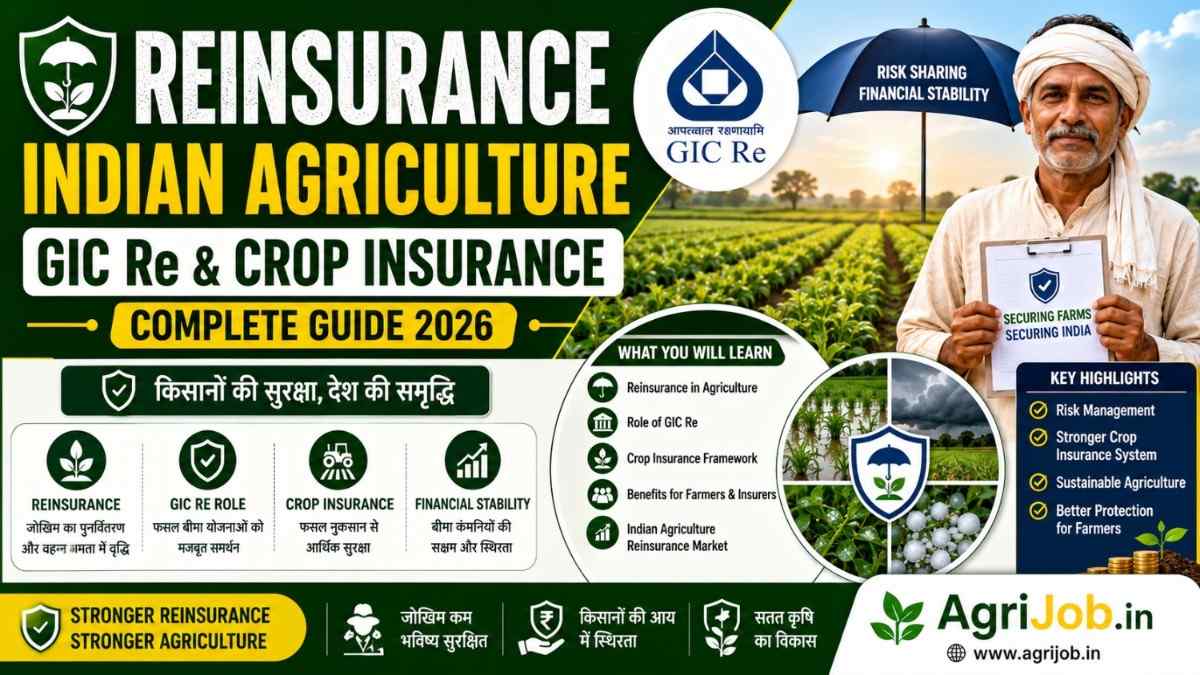
- What is Reinsurance in Indian Agriculture? (2026 Explained)
- How the Crop Reinsurance Chain Works in India
- GIC Re’s Role in PMFBY Crop Insurance 2026
- Obligatory Cession Rules for Crop Insurance (IRDAI 2026)
- Types of Agricultural Reinsurance Used in India
- Who Should Build a Career in Agricultural Reinsurance?
- Reinsurance Career India – Salary, Roles & Scope 2026
- GIC Re vs Private Reinsurers – Comparison Table
- High-Value Agricultural Insurance & Reinsurance Terms
- Frequently Asked Questions
What is Reinsurance in Indian Agriculture? (2026 Explained)
Reinsurance in Indian agriculture is the financial mechanism by which a primary crop insurer — a company that directly sells crop policies to farmers — transfers a portion of its underwriting risk and premium to a second, larger insurer called the reinsurer. In India, this reinsurer is primarily GIC Re, which operates as the national apex reinsurance body under the Ministry of Finance, Govt. of India.
To understand why this matters: India’s Pradhan Mantri Fasal Bima Yojana (PMFBY) covers over 5 crore farmers. In a severe drought year like 2023, claims across Maharashtra, Rajasthan, and Karnataka alone exceeded Rs.18,000 crore in a single Kharif season. No single insurance company can absorb that. Reinsurance in Indian agriculture solves exactly this problem: it spreads the risk so that even when millions of farmers claim simultaneously, the insurance system does not collapse.

Think of it like this: the primary insurer is a local kirana store, GIC Re is the wholesale distributor that backs it, and global reinsurers like Swiss Re and Munich Re are the international commodity exchanges that absorb extreme systemic shocks. Each layer exists to make the one below it financially solvent during catastrophic events.
| National Reinsurer | GIC Re (General Insurance Corporation of India) |
| GIC Re Status | Maharatna PSU, Govt. of India, listed on NSE/BSE |
| Crop Insurance Scheme | PMFBY — Pradhan Mantri Fasal Bima Yojana |
| Obligatory Cession (Crop) | 7.5% (IRDAI FY 2025-26) |
| Farmers Covered | 5+ crore under PMFBY annually |
| Total PMFBY Claims Paid | Rs.1.83 lakh crore (since 2016) |
| GIC Re Agriculture Rank | World’s Largest Agricultural Reinsurer |
| GIC Re Global HQ | Mumbai; Offices in London, Dubai, Moscow, Kuala Lumpur |
How the Crop Reinsurance Chain Works in India
The reinsurance chain for crop insurance in India operates across 4 layers. Each layer takes on risk from the one below it and distributes it further upward. Here is the complete chain explained step by step:
- 🌾 Farmer pays premium: A farmer in Bihar pays Rs.150 to insure 1 acre of wheat under PMFBY Rabi 2025-26. The state and central governments top up the remaining premium (up to 98.5% for Rabi wheat) through subsidies.
- 🏢 Primary insurer underwrites risk: An empanelled insurer (e.g., Agriculture Insurance Company of India — AICIL, ICICI Lombard, Reliance General) collects the full premium and is responsible for paying the farmer’s claim. These companies operate district-by-district across India, covering notified crops in notified areas.
- 🔄 Obligatory cession to GIC Re: As per IRDAI rules, every crop insurance policy must cede a mandatory 7.5% of its sum insured to GIC Re. This means GIC Re automatically receives 7.5% of all crop premiums collected nationwide, making it the reinsurer of first call for all Indian agricultural risk.
- 🌍 GIC Re retrocedes to global markets: GIC Re does not retain 100% of the risk it accepts. For very large catastrophic exposures — such as an all-India drought affecting Kharif crops in 15 states simultaneously — GIC Re further cedes portions to international reinsurers through a process called retrocession. Partners include Lloyd’s of London syndicates, Swiss Re, and Munich Re.
This 4-layer chain ensures that even if India experiences a once-in-50-years catastrophe — such as a combination of drought, flood, and cyclone in the same season — the financial system remains intact and farmers still receive their claims. The Insurance Regulatory and Development Authority of India (IRDAI) governs all cession ratios and reinsurance placement rules annually.
GIC Re’s Role in PMFBY Crop Insurance 2026
GIC Re’s relationship with PMFBY is the single most important fact about reinsurance in Indian agriculture. When PMFBY was launched on 14 January 2016, GIC Re’s agricultural reinsurance business nearly doubled within 2 years, reaching crop premium volumes of approximately USD 1.6 billion — making it the world’s largest agricultural reinsurer overnight.
In 2026, GIC Re’s core functions under PMFBY include:
- 🛡️ Mandatory first-layer absorber: GIC Re absorbs the first tranche of catastrophic losses under the PMFBY reinsurance programme, protecting primary insurers from insolvency during mass-loss events.
- 📊 Actuarial and technical support: GIC Re provides actuarial, underwriting, and technical support to smaller Indian insurers to help them price crop risks more accurately — a critical function given India’s agro-climatic diversity across 15 major soil types and 36 agro-climatic zones.
- 🔗 International risk distribution: GIC Re maintains branch offices in London, Dubai, Moscow, Kuala Lumpur, and Suva (Fiji) to place retrocession programmes with global markets, ensuring India’s agricultural risk is spread globally.
- 📋 Capacity provision: GIC Re provides reinsurance capacity to companies like Agriculture Insurance Company of India (AICIL), enabling them to take on large district-level crop insurance programmes they could not otherwise underwrite independently.
- 💼 Market stabilisation: During years with above-average losses (combined ratio above 100%), GIC Re’s capital buffers absorb the shock and prevent insurance companies from withdrawing from crop insurance markets mid-season.
Obligatory Cession Rules for Crop Insurance (IRDAI 2026)
The obligatory cession is one of the most important regulatory concepts in reinsurance in Indian agriculture. It refers to the percentage of every insurance policy that must mandatorily be ceded (transferred) to GIC Re by law. For FY 2025-26, IRDAI has retained the following cession structure:
| Insurance Category | Obligatory Cession to GIC Re | Effective Period |
|---|---|---|
| Crop Insurance (PMFBY / RWBCIS) | 7.5% | FY 2025-26 |
| Group Health Insurance | 10% | FY 2025-26 |
| Motor Third Party | Minimum 5% | FY 2025-26 |
| Oil and Energy Insurance | Minimum 5% | FY 2025-26 |
| All Other General Insurance | Minimum 15% | FY 2025-26 |
| Terrorism Premium | NIL | FY 2025-26 |
| Nuclear Pool Premium | NIL | FY 2025-26 |
This means that crop insurance has a dedicated 7.5% obligatory cession — higher than the 4% base rate for general insurance — reflecting the strategic importance of agricultural risk protection for the Indian economy. For IRDAI’s official circulars on reinsurance regulations, visit the IRDAI Reinsurance Regulations page.
Types of Agricultural Reinsurance Used in India
India uses 3 main types of reinsurance structures in its agricultural insurance ecosystem. Each type protects the primary insurer in a different way and is chosen based on the nature and scale of risk:
- 📦 Proportional Reinsurance (Quota Share): The primary insurer and GIC Re share both premiums and claims in a fixed ratio. For example, a 30% quota share means GIC Re receives 30% of premium and pays 30% of every claim. This is the most common structure used under PMFBY’s mandatory cession arrangement.
- 🔢 Non-Proportional Reinsurance (Excess of Loss – XOL): GIC Re only pays when losses exceed a pre-agreed threshold (the “attachment point”). For example, GIC Re might cover losses above Rs.500 crore in a single state in a single season. This is used for catastrophe protection and is the structure GIC Re uses for its own retrocession programmes with global reinsurers.
- 🌦️ Parametric / Index-Based Reinsurance: Payouts are triggered automatically when a specific weather index (rainfall, temperature, wind speed) crosses a pre-set threshold — without requiring individual loss assessments. This is used in Restructured Weather Based Crop Insurance Scheme (RWBCIS) and is gaining traction in 2026 due to its speed of claim settlement.
Who Should Build a Career in Agricultural Reinsurance?
A career in reinsurance in Indian agriculture is ideal for a specific set of candidates who combine technical skills with interest in rural finance and risk management. Here are 8 candidate profiles who should actively explore this sector:
- 🎓 Agriculture graduates (B.Sc / M.Sc Agri): Your understanding of crop biology, pest cycles, and agro-climatic zones is directly applicable to crop risk assessment and yield modelling — the foundation of agricultural reinsurance pricing.
- 📐 Statistics and Actuarial Science students: GIC Re and AICIL actively hire actuarial trainees and statisticians to model catastrophe risk, develop premium rate structures, and validate claim data from states.
- 💼 Commerce and Finance graduates (B.Com / MBA Finance): Reinsurance contract management, treaty negotiations, and premium accounting are core roles in this sector requiring finance backgrounds.
- ⚖️ Law graduates (LLB): Policy wording, dispute resolution between primary insurers and reinsurers, and regulatory compliance under IRDAI Reinsurance Regulations 2018 require legal expertise.
- 💻 IT and Data Science professionals: Remote sensing, satellite crop monitoring, AI-based yield estimation, and blockchain-based claim processing are 2026’s fastest-growing needs in Indian agricultural reinsurance.
- 👩🌾 Women candidates from rural backgrounds: AICIL and GIC Re have dedicated diversity mandates. Women with agriculture degrees and rural experience are particularly valued for field-level risk survey and community outreach roles.
- 📊 SC/ST candidates with reservations: GIC Re and AICIL follow Govt. of India reservation norms (SC: 15%, ST: 7.5%, OBC: 27%, EWS: 10%). All vacancies carry age relaxation of 5 years for SC/ST and 3 years for OBC candidates.
- 🔬 ICAR/NABARD research fellows: Candidates with exposure to ICAR’s crop research or NABARD’s rural finance ecosystem bring dual expertise in agronomy and rural financial systems — making them highly attractive to GIC Re’s agriculture reinsurance division.
Reinsurance Career India – Salary, Roles & Scope 2026
The career scope in reinsurance in Indian agriculture is expanding rapidly in 2026, driven by PMFBY’s scale, new IRDAI regulations, and the integration of technology into crop risk assessment. Here is a complete salary and role breakdown:
| Role / Organisation | Basic Pay | Total CTC (Approx.) | Annual Earning | Qualification |
|---|---|---|---|---|
| GIC Re Assistant Manager (Scale 1) | Rs.50,925/month | Rs.85,000/month | Rs.10.2 lakh+ | Graduation / PG + GATE |
| AICIL Agriculture Officer | Rs.36,000/month | Rs.58,000/month | Rs.6.96 lakh+ | B.Sc Agriculture |
| Reinsurance Analyst (Private) | Rs.38,000/month | Rs.46,000/month | Rs.5.5 lakh+ | Statistics / Actuarial |
| Actuarial Apprentice at GIC Re | Rs.25,000/month stipend | Rs.25,000/month | Rs.3 lakh | Actuarial Science student |
| Crop Risk Surveyor (Field) | Rs.20,000/month | Rs.22,000/month | Rs.2.64 lakh | B.Sc Agri / Diploma |
GIC Re Assistant Managers receive additional perks including: accommodation allowance up to Rs.45,000/month (Mumbai), free medical coverage, LTC (Leave Travel Concession), performance-based annual bonuses, and an opportunity for international postings to GIC Re offices in London, Dubai, and Kuala Lumpur within 5–8 years of joining.
GIC Re vs Private Reinsurers in India – Comparison 2026
India’s reinsurance market has opened to international players under IRDAI’s progressive reforms. Today, entities like Lloyd’s of London, Munich Re, Swiss Re, and several Foreign Reinsurance Branches (FRBs) are licensed to operate alongside GIC Re. Here is how GIC Re compares to private/foreign reinsurers for agricultural risk:
| Parameter | GIC Re (Government) | Private / Foreign Reinsurers |
|---|---|---|
| Ownership | 100% Govt. of India (Maharatna PSU) | Private / Foreign (Lloyd’s, Munich Re, Swiss Re) |
| Mandatory cession rights | Yes — all crop policies must cede 7.5% to GIC Re first | No mandatory share; compete for voluntary business |
| Market share (crop reinsurance) | Dominant — 30–40% of total PMFBY reinsurance | Combined 60–70% of voluntary market |
| Agricultural expertise | Deep India-specific crop data since 1972 | Global expertise but limited India district-level data |
| Job stability (career) | Permanent PSU job; pension benefits | Contract or market-linked employment |
| International presence | 5 international offices | Global operations across 50+ countries |
| Regulatory advantage | Priority placement under IRDAI rules | Secondary placement after GIC Re cession |
| Crop data access | Full access to PMFBY national portal data | Limited; relies on primary insurers for loss data |
| Best for (career seekers) | Stability, pension, PSU benefits, Govt. perks | Higher salaries, global exposure, fast growth |
High-Value Agricultural Insurance & Reinsurance Terms 2026
Understanding these 10 high-value terms will help you ace GIC Re exams, impress interviewers, and make sense of IRDAI circulars and PMFBY notifications:
- 📘 Reinsurance in Indian Agriculture: The system where primary crop insurers transfer a portion of their catastrophic risk to GIC Re or private reinsurers. Protects insurers from large-scale crop failure losses and enables low-premium crop schemes like PMFBY to function. Market size exceeds Rs.16,000 crore annually.
- 📘 Obligatory Cession: The mandatory percentage (7.5% for crop insurance in FY 2025-26) of every policy that must be placed with GIC Re. Governed by IRDAI’s annual reinsurance order under the Insurance Act, 1938.
- 📘 Retrocession: When GIC Re itself transfers a portion of its catastrophic risk to international reinsurers like Lloyd’s of London or Munich Re. This is reinsurance of reinsurance — the final safety net in India’s agricultural risk chain.
- 📘 PMFBY (Pradhan Mantri Fasal Bima Yojana): India’s flagship crop insurance scheme covering 5+ crore farmers. Premium rates: 2% (Kharif), 1.5% (Rabi), 5% (commercial crops). Since 2016, over Rs.1.83 lakh crore in claims have been paid out to Indian farmers.
- 📘 RWBCIS (Restructured Weather Based Crop Insurance Scheme): A parametric crop insurance product where claims are triggered by weather data (rainfall, temperature) rather than field surveys. GIC Re provides reinsurance capacity for RWBCIS programmes across 15+ states.
- 📘 AICIL (Agriculture Insurance Company of India Ltd.): India’s dedicated public sector crop insurer, established in 2002. It is one of the largest users of GIC Re’s agricultural reinsurance services. AICIL is an associate company of GIC Re and offers direct career opportunities for agriculture graduates.
- 📘 Quota Share Treaty: A proportional reinsurance contract where both premium and claims are shared in a fixed ratio between the insurer and GIC Re. Most PMFBY obligatory cessions operate on a quota share basis — currently at 7.5% of every crop policy’s sum insured.
- 📘 Excess of Loss (XOL): A non-proportional reinsurance contract where GIC Re only pays after losses exceed a defined attachment point. Used in catastrophe XOL programmes to protect against state-wide or national-level crop failures. GIC Re offers XOL retrocession programmes to international reinsurers annually.
- 📘 Combined Ratio: A key financial health indicator for reinsurers — Claims Paid + Expenses divided by Premiums Earned. GIC Re’s combined ratio improved from 110.46% (9M FY24) to 106.88% (9M FY25), indicating improving underwriting discipline in its crop and non-crop portfolios.
- 📘 NAC (National Apprenticeship Certificate): Relevant to candidates exploring insurance sector apprenticeships. GIC Re and AICIL occasionally offer actuarial and technical apprenticeships governed by the National Apprenticeship Portal under the Apprentices Act, 1961.
Frequently Asked Questions – Reinsurance in Indian Agriculture 2026
What is reinsurance in Indian agriculture?
Reinsurance in Indian agriculture is the financial arrangement where primary crop insurers (who sell PMFBY policies to farmers) transfer a portion of their catastrophic risk and premium to a reinsurer, primarily GIC Re. Without this mechanism, a severe drought or flood affecting millions of farmers in multiple states simultaneously would make insurance companies insolvent. Reinsurance in Indian agriculture has existed in its modern form since GIC Re’s establishment in 1972, and became globally significant after PMFBY launched in 2016.
What is the role of GIC Re in crop insurance?
GIC Re is India’s sole national reinsurer and the world’s largest agricultural reinsurer by crop premium volume. Under PMFBY, GIC Re holds a mandatory 7.5% obligatory cession on all crop insurance policies. It absorbs catastrophic losses, provides actuarial support to smaller insurers, and retrocedes extreme risks to global markets. GIC Re’s participation is what allows private companies to offer crop insurance at subsidised premiums of just 2% (Kharif) to Indian farmers.
What is obligatory cession for crop insurance in India 2026?
For FY 2025-26, IRDAI mandates a 7.5% obligatory cession for crop insurance — meaning every insurer selling crop policies must transfer 7.5% of the risk and premium to GIC Re compulsorily. This rule has been in place for 3 consecutive years, reflecting IRDAI’s strategy of ensuring GIC Re remains adequately capitalised to absorb large-scale agricultural losses across India’s 34 states and union territories.
How does PMFBY reinsurance work step by step?
Under PMFBY, the reinsurance process works in 4 steps: (1) Farmers pay a small premium (2% for Kharif) and governments top up the subsidy. (2) Primary insurers collect premiums and underwrite crop risk district-wise. (3) Under obligatory cession rules, 7.5% of crop risk is transferred to GIC Re. (4) GIC Re further distributes extreme catastrophe exposure to international reinsurers (Swiss Re, Lloyd’s, Munich Re) through retrocession programmes. This 4-layer chain has successfully paid out Rs.1.83 lakh crore to Indian farmers since 2016.
What is the GIC Assistant Manager salary in 2026?
The GIC Re Assistant Manager basic pay is Rs.50,925/month on the pay scale of Rs.50,925–96,765. With DA, HRA, CCA, and accommodation allowance (up to Rs.45,000 in Mumbai), the total in-hand salary reaches approximately Rs.85,000/month or Rs.10.2 lakh+ annually. This is one of the highest entry-level salaries in India’s public sector insurance industry, making GIC Re Assistant Manager one of the most sought-after government jobs in the insurance sector.
What is retrocession in agriculture reinsurance?
Retrocession is the process where a reinsurer (GIC Re) transfers a portion of its own reinsurance risk to international reinsurers — it is essentially reinsurance of the reinsurer. GIC Re uses retrocession programmes for its Non-Marine Foreign Cat XOL and Combined Marine and Energy Retrocession Programs with global partners. In agriculture, retrocession protects GIC Re from scenarios like an all-India crop failure year, where domestic premium income alone could not absorb the combined claims from 5 crore+ PMFBY farmers.
Who can apply for a career in agricultural reinsurance in India?
Candidates with degrees in Agriculture Science, Statistics, Actuarial Science, Finance, Law, IT, or Engineering can apply for GIC Re Assistant Manager positions. GATE scores are accepted for technical streams. SC/ST candidates receive 5 years of age relaxation; OBC candidates receive 3 years. Agriculture Science graduates are specifically recruited by GIC Re for its agricultural risk underwriting and crop risk assessment functions — making this one of the few government jobs where a B.Sc Agriculture degree directly qualifies you for a Rs.85,000/month role.
Is GIC Re a government or private company?
GIC Re is a fully government-owned Maharatna Public Sector Undertaking (PSU) under the Ministry of Finance, Govt. of India. It was incorporated in 1972 under the Companies Act and became India’s sole national reinsurer. GIC Re is listed on NSE and BSE. With annual gross written premium exceeding Rs.30,000 crore and offices in 5 international locations, it is India’s largest and most prestigious reinsurance employer — comparable in career value to an RBI Grade B or NABARD Grade A position.