

NMMS Scholarship 2026 provides Rs.12,000 per year — disbursed as Rs.1,000 per month — to meritorious students from economically weaker sections studying in Classes 9 to 12 in government and government-aided schools across India. The National Means-cum-Merit Scholarship Scheme (NMMSS), launched in May 2008 by the Ministry of Education, Government of India, awards 1 lakh fresh scholarships every academic year through a state-level competitive examination. This guide is for Class 8 students in government schools and their parents who want to apply for NMMS 2026-27, understand the eligibility rules, prepare for the MAT and SAT papers, and complete the NSP application process correctly. You will find scholarship amount details, eligibility criteria, exam pattern, step-by-step application process, important dates, renewal rules, and a complete FAQ covering everything from how to register on NSP to what happens after selection.

The NMMS Scholarship 2026 awards Rs.12,000 per year (Rs.1,000 per month) to Class 9–12 students studying in government or government-aided schools whose annual family income does not exceed Rs.3,50,000. Students must qualify a state-level exam (MAT + SAT) conducted by the respective SCERT in Class 8. NSP applications for the 2026-27 session opened on June 1, 2026, with the extended nationwide deadline on September 30, 2026.
- Scheme Name: National Means-cum-Merit Scholarship Scheme (NMMSS)
- Launched By: Ministry of Education, Government of India (May 2008)
- Scholarship Amount: Rs.12,000 per year (Rs.1,000 per month)
- Total 4-Year Benefit: Rs.48,000 (Class 9 to Class 12)
- Total Scholarships Per Year: 1,00,000 (One Lakh) nationally
- Eligibility Class: Class 8 (exam); scholarship received from Class 9 to 12
- Income Limit: Annual parental income not exceeding Rs.3,50,000
- Minimum Marks (Class 7): 55% (50% for SC/ST/PwD)
- Selection Exam: MAT + SAT (state-level, offline mode)
- NSP Application Start: June 1, 2026
- Extended Last Date: September 30, 2026
- Delhi Exam Date: December 5, 2026
- Disbursement Mode: Direct Benefit Transfer (DBT) to Aadhaar-linked bank account
- Official Portal: scholarships.gov.in (NSP)
📋 Table of Contents
- What Is NMMS Scholarship 2026?
- Who Should Apply for NMMS Scholarship?
- NMMS Scholarship Amount 2026 — Full Breakdown
- NMMS Eligibility Criteria 2026
- How to Apply for NMMS Scholarship 2026 — Step-by-Step
- NMMS Exam Pattern — MAT and SAT Details
- NMMS vs NTSE — Key Differences
- Advantages and Disadvantages of NMMS Scholarship
- Important Terms Related to NMMS Scholarship
- NMMS Scholarship 2026 — Important Dates
- Important Links
- Conclusion
- Key Takeaways
- Frequently Asked Questions
What Is NMMS Scholarship 2026?
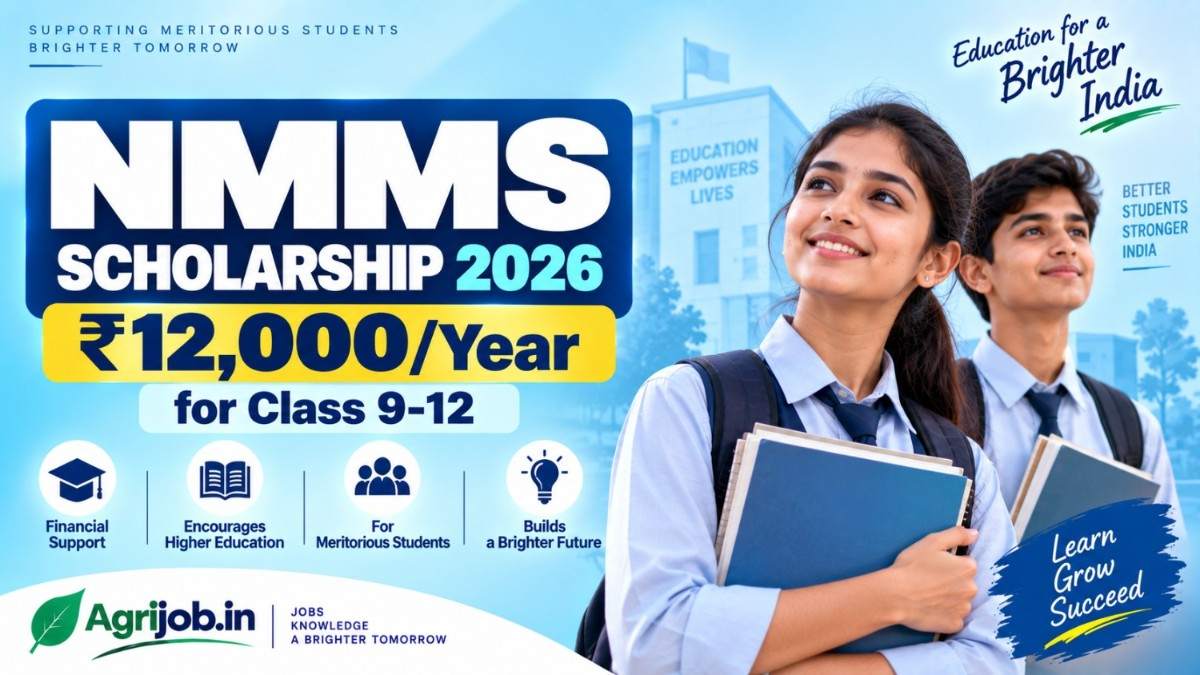
The National Means-cum-Merit Scholarship (NMMS) 2026 is a centrally sponsored scheme administered by the Ministry of Education, Government of India, specifically designed to reduce the dropout rate among students transitioning from Class 8 to secondary education. The scheme targets meritorious students from economically weaker sections who might otherwise discontinue their studies due to financial hardship. Under NMMS 2026, one lakh fresh scholarships are awarded every academic year through state-level competitive examinations conducted by the respective State Councils of Educational Research and Training (SCERTs). Scholarship funds are disbursed directly to the student’s bank account via Direct Benefit Transfer (DBT) through the National Scholarship Portal at scholarships.gov.in.
The scheme covers students from Class 9 through Class 12 — a maximum benefit period of four years. Students appearing for the exam are in Class 8, but the scholarship is received starting Class 9. Continuation depends on meeting annual academic benchmarks: students must be promoted to the next class and score at least 60% in the Class 10 Board examination (55% for SC/ST) to continue receiving the scholarship in Classes 11 and 12. The scheme operates in all states and union territories, with each state receiving an allocation proportional to its Class 7 and 8 enrolment in government schools.

For the 2026-27 academic cycle, NSP registration opened on June 1, 2026. The application deadline has been extended to September 30, 2026. The Delhi NMMS exam is scheduled for December 5, 2026, with Odisha’s exam on December 6, 2026. Most other states will conduct exams between November 2026 and February 2027.
Who Should Apply for NMMS Scholarship 2026?
The NMMS Scholarship 2026 is specifically designed for a defined category of students. You qualify for this scholarship if you match the profiles listed below.
- 🎓 Class 8 students in government schools — currently enrolled in a government, government-aided, or local body school, preparing to move to Class 9
- 💰 Students from low-income families — whose annual parental income from all sources does not exceed Rs.3,50,000
- 📝 Academic scorers in Class 7 — who secured at least 55% marks (50% for SC/ST/PwD) in the Class 7 final examination
- 🏫 Regular day-school students — enrolled as regular students (not in residential schools where board and lodging are provided free by the government)
- 📊 SC/ST students seeking relaxation — eligible with 50% in Class 7 and 32% qualifying marks in MAT and SAT combined
- 🌾 Students in rural and semi-urban areas — from states like Bihar, UP, Rajasthan, MP, and Odisha where government school enrolment is high and district-wise quota allocation provides good opportunity
- 👧 Girl students from economically weaker sections — who need financial support to continue education beyond Class 8 and avoid early dropout
- ♿ PwD (Persons with Disabilities) candidates — who receive a 5% relaxation in academic qualifying marks alongside SC/ST students
Students NOT eligible for NMMS: Those enrolled in Kendriya Vidyalayas (KVs), Jawahar Navodaya Vidyalayas (JNVs), Sainik Schools, private unaided schools, or government residential schools providing free board and lodging (such as SC/ST hostels under state government) are not eligible to appear for the NMMS examination.
NMMS Scholarship Amount 2026 — Full Breakdown
The NMMS scholarship amount is Rs.12,000 per year, disbursed at Rs.1,000 per month directly to the student’s Aadhaar-linked bank account via DBT. The scholarship is awarded from Class 9 through Class 12, meaning a student who receives NMMS from Class 9 and maintains the required academic performance each year stands to receive a total of Rs.48,000 over four years. Students must open a bank account — preferably with a public sector bank like SBI — and ensure it is Aadhaar-linked and NPCI-mapped for DBT to work correctly.
| Class | Duration | Monthly Amount | Annual Amount | Cumulative Total |
|---|---|---|---|---|
| Class 9 (Fresh) | 12 months | Rs.1,000 | Rs.12,000 | Rs.12,000 |
| Class 10 (Renewal) | 12 months | Rs.1,000 | Rs.12,000 | Rs.24,000 |
| Class 11 (Renewal) | 12 months | Rs.1,000 | Rs.12,000 | Rs.36,000 |
| Class 12 (Renewal) | 12 months | Rs.1,000 | Rs.12,000 | Rs.48,000 |
Key conditions for continued payment: The scholarship is not automatic after the first year. Students must apply for renewal every year on the NSP portal before the deadline. For Class 11 onwards, students must have scored at least 60% marks in the Class 10 Board examination (55% for SC/ST). Failure to renew on time or failure to meet academic benchmarks results in suspension of the scholarship. Renewal is separate from the fresh application — existing awardees must use their previous year’s Application ID to log in under the Renewal section on NSP.
NMMS Eligibility Criteria 2026
Understanding the NMMS 2026 eligibility criteria thoroughly before applying prevents rejection at the verification stage. The eligibility rules cover school type, class, academic performance, and family income.
- Class: The student must currently be studying in Class 8 as a regular student
- School Type: Only government schools, government-aided schools, and local body schools are eligible. Private unaided schools, KVs, JNVs, Sainik Schools, and residential schools providing free board, lodging, and education are excluded
- Academic Marks (Class 7): Minimum 55% marks in the Class 7 final/annual examination. SC/ST/PwD students require minimum 50%
- Family Income: Annual parental income from all sources must not exceed Rs.3,50,000. An income certificate from a competent authority must be submitted
- Nationality: Only Indian citizens are eligible
- Other Scholarships: Students already receiving any other Central Government scholarship are not eligible for NMMS simultaneously
- Renewal Conditions: Must be promoted to the next class each year; must score 60% in Class 10 Board exam (55% for SC/ST) to continue in Classes 11 and 12; must not be studying in an institution that falls outside eligible school categories
| Category | Class 7 Minimum Marks | MAT + SAT Qualifying % | Class 10 Board (for Class 11-12) |
|---|---|---|---|
| General / OBC | 55% | 40% | 60% |
| SC / ST | 50% | 32% | 55% |
| PwD | 50% | 32% (relaxed) | 55% (check state notification) |
Do not assume that qualifying the MAT and SAT exam guarantees a scholarship. Selection is district-wise and category-wise. A student from a large district with more Class 7-8 enrolment may face a higher effective cut-off. Always check your district’s specific quota and past cut-off marks from your state SCERT website before estimating your chances.
How to Apply for NMMS Scholarship 2026 — Step-by-Step
The NMMS 2026 application process involves two distinct phases: the state-level exam registration (through your school or SCERT) and the NSP scholarship registration (after selection). Here is the complete step-by-step process for both.
- Check your state SCERT notification: Visit your state’s SCERT or education department website to find the NMMS 2026-27 exam notification, application dates, and the official application link or form for Class 8 exam registration
- Complete OTR on NSP (Mandatory): Go to scholarships.gov.in and complete One-Time Registration (OTR) using your Aadhaar number or Aadhaar Enrolment ID. This generates a 14-digit unique OTR number that is required for all NSP scholarship applications
- Register through your school for the exam: Submit your exam application through the school headmaster or directly on the state SCERT portal, as per your state’s process. Attach income certificate, Class 7 marksheet, school bonafide certificate, and Aadhaar copy
- Download your NMMS admit card: Once registered, download the admit card from your state SCERT or exam portal when released, typically 2-3 weeks before the exam date
- Appear for the MAT and SAT exam: Sit for both the Mental Ability Test (MAT) and Scholastic Aptitude Test (SAT) on the scheduled exam day in offline mode using OMR sheets. Both papers are 90 minutes each
- Check your NMMS result and merit list: Results are declared state-wise between January and May of the following year. Check your state SCERT website for the merit list PDF or login-based result portal
- Apply for fresh scholarship on NSP (Class 9 students): After selection, log in to scholarships.gov.in using your OTR number. Click on “Fresh Application,” select the NMMS scheme, and fill in your personal, academic, and bank details carefully. Upload all required documents
- Submit hard copy to school for verification: After online submission, take a printout of the application and submit it to your school for the institute-level verification required on NSP
- Track application status: Log in to NSP and check the “Check Your Status” section to track institute verification, district nodal officer verification, and state-level sanctioning
Documents required for NSP application: Aadhaar card (student), income certificate (competent authority), Class 7 marksheet, NMMS selection letter / merit list, bank account passbook (front page showing account number and IFSC), school bonafide certificate, caste certificate (SC/ST/OBC if applicable), and two recent passport-size photographs.
NMMS Exam Pattern — MAT and SAT Details
The NMMS selection examination consists of two papers conducted on the same day in offline (pen and paper) mode using OMR answer sheets. There is no negative marking, so students should attempt all questions. The syllabus broadly follows the Class 7 and Class 8 curriculum prescribed by the respective state board, though there is no single nationally prescribed syllabus.
| Paper | Full Name | Questions | Duration | Subjects | Type |
|---|---|---|---|---|---|
| Paper 1 | Mental Ability Test (MAT) | 90 MCQs | 90 minutes | Reasoning, Analogy, Pattern Recognition, Hidden Figures, Series | No academic knowledge required |
| Paper 2 | Scholastic Aptitude Test (SAT) | 90 MCQs | 90 minutes | Science (35 Qs) + Social Science (35 Qs) + Mathematics (20 Qs) | Class 7 and 8 syllabus |
Qualifying marks: General and OBC candidates must score a minimum aggregate of 40% in MAT and SAT combined (approximately 72 out of 180). SC/ST and PwD candidates need a minimum of 32% (approximately 58 out of 180). Both papers must be attempted; absence from either paper results in disqualification. The exam is offered in multiple languages in most states — including Hindi, English, and regional languages — so students should select their preferred medium when registering. No separate answer key or scorecard is issued nationally; states declare results via merit lists.
NMMS vs NTSE — Key Differences
Students often confuse the NMMS and NTSE (National Talent Search Examination), as both are national-level school scholarship schemes. However, they differ significantly in target audience, eligibility, amount, and scope.
| Feature | NMMS Scholarship 2026 | NTSE Scholarship |
|---|---|---|
| Nodal Agency | Ministry of Education, GoI (via SCERTs) | NCERT (National level) |
| Target Students | Economically weaker sections (income ≤ Rs.3.5 lakh) | All students — merit-based, no income limit |
| Eligible Class (Exam) | Class 8 | Class 10 |
| Scholarship Duration | Class 9 to Class 12 (4 years) | Class 11 onwards, up to PhD level |
| Annual Amount | Rs.12,000 | Rs.1,250/month (Class 11-12); Rs.2,000/month (UG/PG); Rs.2,000/month (PhD) |
| School Type | Government and government-aided only | All recognized schools |
| Exam Mode | Offline (state-level, SCERT) | Offline (Stage 1 state; Stage 2 national) |
| No. of Awards | 1,00,000 per year | 2,000 per year |
| Income Criterion | Yes — Rs.3,50,000 max | No income limit |
| Best For | Government school students from low-income families | High achievers from any school targeting higher education funding |
For government school students from families earning below Rs.3,50,000 per year, NMMS is the more accessible and higher-quantity scholarship — 1 lakh seats versus NTSE’s 2,000 seats. NMMS has the explicit goal of reducing Class 8 dropouts, making it a welfare-first scheme. Students who qualify NMMS in Class 8 can still appear for NTSE in Class 10 — the two are not mutually exclusive. If you are in a government school with a family income below Rs.3.5 lakh, NMMS should be your immediate priority this academic year.
Advantages and Disadvantages of NMMS Scholarship 2026
Before applying, students and parents should understand both the benefits and the limitations of the NMMS scheme to set realistic expectations.
Advantages of NMMS Scholarship
- ✅ Direct cash transfer: Rs.12,000 per year goes directly to the student’s bank account, ensuring no intermediary deduction
- ✅ Long-term support: Up to Rs.48,000 over four years (Class 9 to 12), providing sustained financial relief throughout secondary education
- ✅ Large seat pool: 1 lakh scholarships per year means significantly more opportunities compared to other national schemes
- ✅ Socially inclusive: Relaxation of 5% in qualifying marks for SC/ST and PwD students, with reserved seats in state quotas
- ✅ Reduces dropout: Directly addresses the financial gap that causes Class 8 to Class 9 transition dropout in government schools
- ✅ Applicable in all states: All 29 states and 7 UTs participate, with state-specific exam and regional language options
Disadvantages and Limitations of NMMS
- ❌ Not available after Class 12: NMMS terminates at Class 12, leaving no support for undergraduate or higher education
- ❌ Amount is modest: Rs.1,000 per month may not cover full educational or living expenses in many parts of India
- ❌ Renewal is manual and mandatory: Students must apply for renewal every year on NSP; missing the deadline stops the scholarship even for eligible students
- ❌ Not available in private schools: Excludes a large section of students enrolled in unaided private schools, even if economically weaker
Important Terms Related to NMMS Scholarship 2026
Understanding these key terms will help you navigate the application, exam, and disbursement process without confusion.
- NMMSS: National Means-cum-Merit Scholarship Scheme — the full official name of the NMMS scheme under the Ministry of Education, Government of India
- MAT (Mental Ability Test): Paper 1 of the NMMS exam consisting of 90 MCQs testing reasoning, analogies, series, and pattern recognition — no academic subject knowledge is required
- SAT (Scholastic Aptitude Test): Paper 2 of the NMMS exam with 90 MCQs covering Science (35), Social Science (35), and Mathematics (20) based on Class 7-8 syllabus
- SCERT: State Council of Educational Research and Training — the state-level body that conducts the NMMS selection examination in each state and union territory
- NSP (National Scholarship Portal): The official government portal at scholarships.gov.in where students apply for and manage NMMS and other central scholarship schemes
- OTR (One-Time Registration): A mandatory 14-digit unique registration number generated using Aadhaar on NSP, required for all fresh and renewal scholarship applications from the 2024-25 session onwards
- DBT (Direct Benefit Transfer): The government’s payment mechanism that transfers scholarship funds directly to the student’s Aadhaar-linked bank account, eliminating intermediaries
- Fresh Application: The first-time scholarship application submitted by Class 9 students who have qualified and been selected through the NMMS state exam
- Renewal Application: Annual reapplication on NSP by existing NMMS awardees in Classes 10, 11, and 12 to continue receiving the scholarship
- District-wise Merit List: State SCERT prepares category-wise merit lists at the district level — not just state level — meaning selection depends on your district quota and local competition
NMMS Scholarship 2026 — Important Dates
| Event | Date / Timeframe |
|---|---|
| NSP Application Opens (Fresh + Renewal) | June 1, 2026 |
| Extended NSP Application Deadline | September 30, 2026 |
| Delhi Exam Registration (School Level) | September 9 – October 5, 2026 |
| Andhra Pradesh Application Date Released | September 11, 2026 |
| Delhi NMMS Exam Date | December 5, 2026 |
| Odisha NMMS Exam Date | December 6, 2026 |
| Most State Exams (Expected) | November 2026 – February 2027 |
| Maharashtra Exam (Expected) | December 2026 (as per prior year trend) |
| NMMS Results (Most States) | February – May 2027 |
| NSP Renewal Last Date (Most Scholarships) | October 31, 2026 |
Note: NMMS application and exam dates vary state-by-state. The dates above are based on official announcements and prior-year trends. Always verify the exact dates from your state SCERT or education department website before applying. Check the official NSP portal at scholarships.gov.in for the most current information.
Important Links — NMMS Scholarship 2026
| Link Name | URL |
|---|---|
| Official NSP Portal (Apply Online) | scholarships.gov.in |
| Ministry of Education — NMMSS Scheme Page | dsel.education.gov.in |
| NCERT (Scheme Guidelines Reference) | ncert.nic.in |
| PIB — Official Government Press Releases | pib.gov.in |
| Odisha NMMS Official Portal | nmms.odisha.gov.in |
| Kerala NMMS Portal | nmmse.kerala.gov.in |
| Agrijob.in — Government Scholarship Guides | agrijob.in |
Conclusion — NMMS Scholarship 2026
The NMMS Scholarship 2026 remains one of the most important financial assistance programmes for Class 8 students in government schools across India, offering Rs.12,000 per year for four years — a total benefit of Rs.48,000 from Class 9 to Class 12. With 1 lakh scholarships awarded annually and a family income cap of Rs.3,50,000, the scheme directly targets students most at risk of dropping out after Class 8 due to financial constraints. If you are currently in Class 8, scored 55% or above in Class 7, and study in a government or government-aided school, you should apply immediately through your school and register on the National Scholarship Portal at scholarships.gov.in before September 30, 2026. Do not miss the extended deadline — this opportunity can fund your entire secondary education.
- NMMS Scholarship 2026 provides Rs.12,000/year (Rs.1,000/month) to selected students from Class 9 to 12, totalling Rs.48,000 over four years
- Only Class 8 students in government, government-aided, or local body schools with family income below Rs.3,50,000 per year are eligible
- Minimum 55% marks in Class 7 are required to appear for the selection exam (50% for SC/ST/PwD)
- The NMMS selection exam has two papers: MAT (90 questions, reasoning) and SAT (90 questions, Science + Social Science + Math); both are 90 minutes each in offline mode
- NSP applications are open on scholarships.gov.in; the extended last date is September 30, 2026 — apply now through your school and the NSP portal
- Scholarship is not automatic — renewal on NSP is mandatory every year from Class 10 to 12; students must score 60% in Class 10 Board (55% for SC/ST) to continue in Class 11
Frequently Asked Questions About NMMS Scholarship 2026
What is the NMMS Scholarship 2026 and who is it for?
The National Means-cum-Merit Scholarship (NMMS) 2026 is a centrally sponsored scheme by the Ministry of Education, Government of India. It awards Rs.12,000 per year (Rs.1,000 per month) to meritorious students from economically weaker sections studying in government and government-aided schools. The scholarship is for students in Classes 9 to 12, selected through a state-level competitive exam (MAT + SAT) conducted in Class 8. One lakh scholarships are awarded nationally each year, distributed state-wise and district-wise.
How much is the NMMS scholarship amount in 2026?
The NMMS scholarship amount is Rs.12,000 per academic year, disbursed monthly at Rs.1,000 directly to the student’s Aadhaar-linked bank account via DBT. The scholarship runs from Class 9 to Class 12, giving a maximum total benefit of Rs.48,000 over four years, provided the student meets the annual renewal conditions and academic benchmarks each year.
What is the income limit for NMMS Scholarship 2026?
The annual parental income from all sources must not exceed Rs.3,50,000 (Rupees Three Lakh Fifty Thousand) to be eligible for NMMS. This income limit applies to the combined income of both parents from all sources including salary, business, agriculture, and property. An income certificate from a competent authority (such as a Tehsildar or District Magistrate) must be submitted as proof during the application process.
Can students in KV, JNV, or private schools apply for NMMS?
No. Students enrolled in Kendriya Vidyalayas (KVs), Jawahar Navodaya Vidyalayas (JNVs), Sainik Schools, and private unaided schools are not eligible for the NMMS Scholarship. Students in government residential schools where the state provides free board, lodging, and education are also excluded. Only students enrolled as regular students in government schools, government-aided schools, or local body schools are eligible to appear for the NMMS exam.
What is the last date to apply for NMMS Scholarship 2026?
The NMMS Scholarship 2026-27 application opened on June 1, 2026 on the National Scholarship Portal (NSP) at scholarships.gov.in. The nationwide application deadline has been extended to September 30, 2026. However, state-specific exam registration deadlines vary — the Delhi exam registration, for example, was open from September 9 to October 5, 2026. Always check your state’s SCERT website for the exact state-level deadline.
What is the NMMS exam pattern for 2026-27?
The NMMS exam consists of two papers conducted on the same day in offline (OMR-based) mode. Paper 1 is the Mental Ability Test (MAT) with 90 multiple-choice questions testing reasoning, analogies, patterns, and logical thinking — 90 minutes duration. Paper 2 is the Scholastic Aptitude Test (SAT) with 90 MCQs covering Science (35 questions), Social Science (35 questions), and Mathematics (20 questions) based on the Class 7 and 8 syllabus — 90 minutes duration. There is no negative marking. Minimum qualifying marks: 40% aggregate for General/OBC; 32% for SC/ST/PwD.
How is NMMS scholarship renewed every year?
NMMS renewal is mandatory every year from Class 10 to Class 12. Selected students must log in to the National Scholarship Portal (scholarships.gov.in) using their Application ID from the previous year, select the “Renewal” option for NMMS, update academic and bank details, upload the latest marksheet and bonafide certificate, and submit before the renewal deadline (typically October 31 each year). The scholarship does not continue automatically — failure to renew on time means the payment for that year is suspended, and it may not be recovered retroactively.
What documents are required for NMMS scholarship application?
The documents required for the NMMS NSP application include: Aadhaar card of the student, Class 7 marksheet showing at least 55% marks, NMMS selection letter or merit list from the state SCERT, income certificate from a competent authority (issued not more than 1 year prior), school bonafide certificate, bank account passbook front page showing account number, IFSC code, and branch details (account must be Aadhaar-linked), caste certificate (for SC/ST/OBC applicants), and two recent passport-size photographs. Students must complete OTR (One-Time Registration) on NSP before the application is submitted.
Is NMMS and NTSE the same scholarship?
No. NMMS (National Means-cum-Merit Scholarship) and NTSE (National Talent Search Examination) are two different scholarship schemes. NMMS targets Class 8 students from government schools with family income below Rs.3.5 lakh and offers Rs.12,000 per year for Classes 9 to 12 only. NTSE, conducted by NCERT, is open to all Class 10 students regardless of school type or income, and the scholarship continues through undergraduate, postgraduate, and PhD levels. NMMS has 1 lakh seats versus NTSE’s 2,000 seats. A student can apply for both — they are not mutually exclusive.
How is the NMMS scholarship disbursed to the student?
The NMMS scholarship is disbursed through Direct Benefit Transfer (DBT) directly to the student’s Aadhaar-linked bank account. Students are required to open a bank account — preferably with a public sector bank like SBI, PNB, or Bank of Baroda — and ensure the account is mapped on the NPCI (National Payments Corporation of India) for DBT to work. The Rs.12,000 annual amount is typically released in instalments, and delays can occur if bank details are incorrect or Aadhaar is not seeded to the account. Any change in bank details must be updated immediately on the NSP portal.
What happens to NMMS scholarship if a student fails or gets low marks?
If an NMMS awardee fails to be promoted to the next class, the scholarship for that year is discontinued. For students moving from Class 10 to Class 11, a minimum score of 60% in the Class 10 Board examination (55% for SC/ST) is mandatory to continue receiving the NMMS scholarship in Class 11 and 12. Additionally, students must continue studying in an eligible government or government-aided school. If a student transfers to a private unaided school, they lose eligibility for NMMS even if they had previously been awarded the scholarship.
Last Updated: September 2026 | This guide is reviewed and updated regularly for accuracy. Bookmark this page for the latest NMMS Scholarship 2026 information. Always verify final dates and details from the official NSP portal at scholarships.gov.in or your state SCERT website before applying.
Disclaimer: This article compiles NMMS Scholarship 2026-27 information from the Ministry of Education, National Scholarship Portal, and official SCERT sources. Application windows, cut-off marks, exam dates, and document requirements can vary by state. Always cross-verify the exact details against your state’s official notification before applying. Agrijob.in is an independent education and career information platform and is not affiliated with any government department.