
The DAAD Scholarship Germany 2026 for agriculture students from India is one of the most prestigious and fully funded international study opportunities available to BSc, MSc, and PhD graduates in agronomy, food science, horticulture, forestry, and allied disciplines. Every year the Deutscher Akademischer Austauschdienst — Germany’s official academic exchange agency — awards over 100,000 scholarships globally, and India consistently ranks among the top 3 source countries. Indian enrolments in German universities rose by 15.1% in the last academic year. If you hold an agriculture degree and dream of pursuing world-class research in Germany without paying any tuition fees, this complete guide covers everything: eligible DAAD programs, monthly stipend in Indian rupees, full eligibility criteria, required documents checklist, step-by-step application process, top German universities, comparison with other scholarships, and answers to the 8 most frequently asked questions by Indian agriculture students.

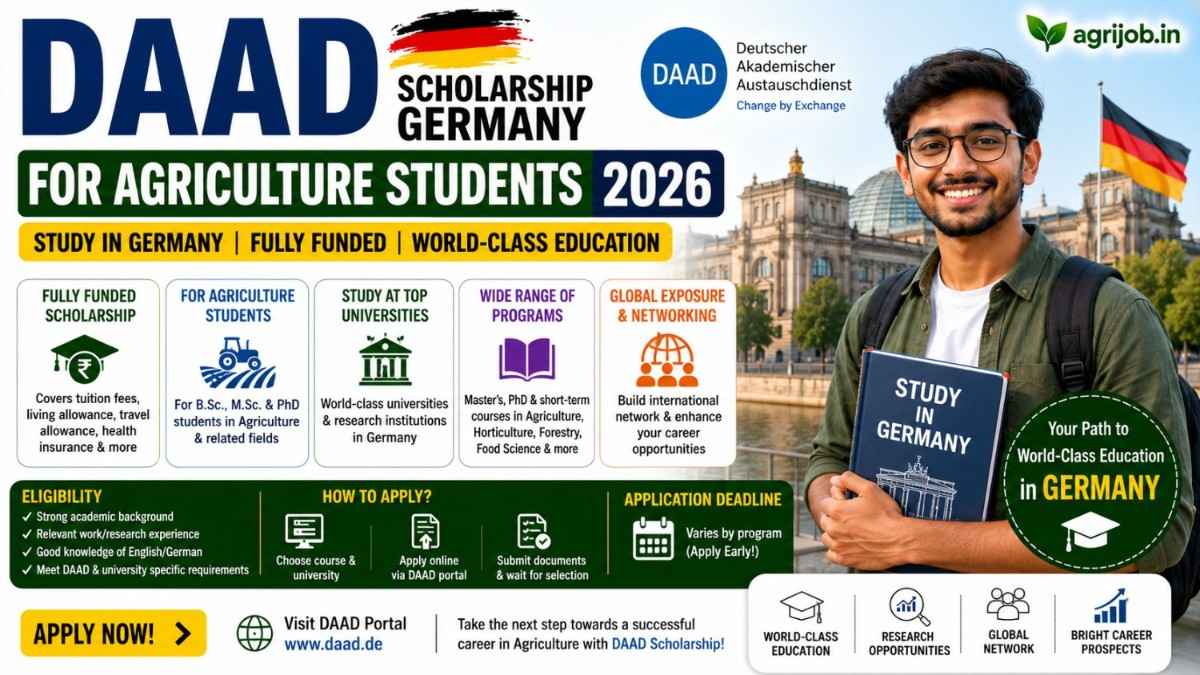
| Scholarship Name | DAAD Scholarships 2026 (EPOS / IAESTE / Research Grants / WISE) |
| Offered By | German Academic Exchange Service (DAAD), Germany |
| Eligible Fields | Agriculture, Agronomy, Food Science, Horticulture, Forestry, Environmental Sciences |
| Monthly Stipend (Master’s) | Rs.1,08,000/month (EUR 992) |
| Monthly Stipend (PhD) | Rs.1,52,000/month (EUR 1,400) |
| Total Package Value | Rs.27–30 lakh (2-year Master’s program) |
| Tuition Fee | Zero – German public universities charge no tuition |
| Duration | 12–24 months (Master’s) | 36–48 months (PhD) |
| Application Mode | Online via portal.daad.de + Physical copy by post to New Delhi |
| Application Deadline | October 15–31 (varies by program; check daad.in annually) |
| DAAD India Offices | New Delhi (Regional), Bangalore, Chennai, Pune (Info Centres) |
- What is the DAAD Scholarship for Agriculture Students 2026?
- DAAD Scholarship Types for Indian Agriculture Students
- Monthly Stipend & Total Financial Package 2026
- DAAD Scholarship Eligibility for Indian Agriculture Students
- Documents Required for DAAD Scholarship 2026
- How to Apply for DAAD Scholarship from India – Step by Step
- Who Should Apply for DAAD Scholarship Germany 2026?
- DAAD Scholarship vs Other Study Abroad Options
- Top German Universities for Agriculture Students 2026
- High-Value International Agriculture Scholarship Terms
- FAQ – DAAD Scholarship Germany Agriculture 2026
What is the DAAD Scholarship for Agriculture Students 2026?
The DAAD (Deutscher Akademischer Austauschdienst), translated as the German Academic Exchange Service, is the world’s largest funding organisation for international academic exchange. Founded in 1925 and funded directly by the Federal Republic of Germany through the Federal Foreign Office and the Federal Ministry of Education and Research, DAAD manages over 215 scholarship programs for students, researchers, and academics from every country. India is among its most significant partner countries — DAAD has been operating its Regional Office in New Delhi since 1960, making it one of the oldest and most active DAAD offices outside Germany. DAAD India also has 3 Information Centres in Bangalore, Chennai, and Pune — an unmatched regional presence that no other country enjoys.
For Indian agriculture students specifically, DAAD offers multiple highly relevant programs. The EPOS (Development-Related Postgraduate Courses) program covers agriculture, food security, environmental management, and rural development at selected German universities. The IAESTE program (International Association for Exchange of Students for Technical Experience) is exclusively open to students in natural sciences, engineering, agriculture, and forestry and offers paid internship placements in German agri-research institutes. Research Grants are designed for PhD and postdoctoral agriculture researchers pursuing advanced academic work. Unlike many competitive scholarships worldwide, DAAD does not require a confirmed German university admission at the time of application for most programs — making it accessible even for students in the early stages of their study abroad journey.

DAAD Scholarship Types for Indian Agriculture Students
Indian agriculture graduates can access 5 core DAAD programs most relevant to their academic level and career goals. Each program has different funding levels, duration, and eligibility requirements. The table below helps you identify the right DAAD program for your profile before starting your 2026 application.
| DAAD Program | Who It Is For | Duration | Stipend/Month | Agriculture Relevance |
|---|---|---|---|---|
| EPOS – Development Postgraduate Courses | Graduates with 2+ years work experience | 12–24 months | EUR 992 (Rs.1,08,000) | Agri, food systems, rural development, environment |
| IAESTE Internship | Currently enrolled BSc/MSc/PhD in agri or forestry | 2 weeks–6 months | Up to EUR 10,000 total | Practical internship in German agri-research institutes |
| Research Grants – PhD | PhD applicants in agricultural sciences | 36–48 months | EUR 1,400 (Rs.1,52,000) | Full research scholarship at German universities |
| DAAD WISE Program | Currently enrolled BSc/MSc students (no work exp needed) | 2–3 months summer | EUR 650 + allowances | Research internship; perfect first step for undergrads |
| Bilateral Program (India–Germany) | MSc students; higher success rate due to India-only competition | 12–24 months | EUR 910–1,030/month | Strong focus on STEM and sustainable development |
Monthly Stipend & Total Financial Package 2026
The DAAD scholarship 2026 financial package for Indian agriculture students goes far beyond just a monthly stipend. When you add up all benefits — monthly stipend, travel allowance, study allowance, health insurance, and possible rent and family subsidies — the total value of a 2-year Master’s DAAD scholarship exceeds Rs.27–30 lakh (EUR 25,000–28,000). This makes Germany’s already zero-tuition public university system completely free for selected scholars. The table below breaks down the confirmed 2026 stipend amounts in both euros and Indian rupees at the current conversion rate of 1 EUR = Rs.109.14.
| Academic Level | Monthly Stipend (EUR) | Monthly Stipend (Rs.) | Key Add-on Benefits | Total 2-Year Value (Rs.) |
|---|---|---|---|---|
| Master’s Students | EUR 992/month | Rs.1,08,268/month | Travel allowance (Rs.98,226 one-time) + Annual study allowance (Rs.50,204) + Full insurance | Rs.27–30 lakh |
| PhD Candidates | EUR 1,400/month | Rs.1,52,796/month | Travel + Study allowance + Family allowance if applicable (EUR 276/month for spouse) | Rs.65–70 lakh (4 yrs) |
| DAAD WISE Interns | EUR 650/month | Rs.70,941/month | Travel support included; short 2–3 month duration | Rs.1.5–2 lakh total |
| Rent Subsidy (High-Cost Cities) | Variable | Up to Rs.30,000/month extra | Available in Munich, Frankfurt, Hamburg on request | Additional benefit |
| Family Allowance | EUR 276 (spouse) + EUR 500 (child/month) | Rs.30,000–55,000/month | Only if family accompanies scholar to Germany | Additional benefit |
Germany’s public universities typically charge zero tuition fees for international students — only a semester contribution of EUR 300–400 for administrative costs and a public transport semester pass. This means DAAD Master’s students in agriculture effectively study tuition-free while receiving a monthly living stipend of over Rs.1 lakh, making Germany one of the most financially rewarding destinations for Indian agriculture graduates pursuing higher education abroad.
DAAD Scholarship Eligibility for Indian Agriculture Students
Before applying for the DAAD scholarship Germany agriculture 2026, Indian graduates must carefully review the eligibility criteria for their chosen program. While specific requirements vary by program type, the following table covers the essential criteria applicable to the most popular EPOS, Research Grants, and WISE programs. Importantly, there is no upper age limit for most DAAD programs, and candidates from all social categories — General, OBC, SC, ST, EWS — are fully eligible to apply at no cost.
| Eligibility Criteria | EPOS (Master’s) | Research Grants (PhD) | DAAD WISE (Internship) |
|---|---|---|---|
| Educational Qualification | 4-year Bachelor’s in agri/allied fields | Master’s in agri/allied fields | Currently enrolled BSc/MSc |
| Minimum Academic Score | CGPA 7.5/10 or 75% aggregate | CGPA 7.5/10 or 75% aggregate | Good academic standing |
| Work Experience | Minimum 2 years in agri-sector (mandatory) | 2+ years research experience | Not required |
| Degree Recency Rule | Completed within last 6 years | Completed within last 6 years | Currently enrolled (active) |
| English Proficiency | IELTS 6.0–6.5 or TOEFL iBT 80–92 | IELTS 6.0–6.5 or TOEFL iBT 80–92 | IELTS 6.0 or TOEFL 80 |
| German Language | Not mandatory for English-medium programs | TestDaF TDN-4 if German-medium | B1 German for some programs |
| Social Category | All categories — General, OBC, SC, ST, EWS | All categories welcome | All categories welcome |
| Application Fee | Rs.0 (No fee) | Rs.0 (No fee) | Rs.0 (No fee) |
Important note on the 2-year work experience rule: For EPOS, professional experience is calculated from your graduation date to the proposed DAAD scholarship start date — not the application date. Agriculture graduates who completed their degree before June 2024 and have since worked in ICAR institutes, state agricultural universities, NABARD projects, agri-NGOs, government agriculture departments, or private agribusiness firms are well-positioned to meet this criterion. Research work, internships, and fieldwork can also count toward this requirement if properly documented.
Documents Required for DAAD Scholarship 2026
Missing even one document is the most common reason Indian agriculture students’ DAAD applications are rejected at the preliminary screening stage. Prepare all documents at least 6–8 weeks before the deadline — especially the 2 recommendation letters, which require your university professor’s time and use a specific DAAD format downloaded from the portal. Here is the complete document checklist for the DAAD scholarship 2026 application from India:
- 📄 Completed DAAD Online Application Form — generated via portal.daad.de; your name must match your passport exactly across all documents
- 🎓 Bachelor’s Degree Certificate and All Semester Marksheets — attested copies; include a CGPA to percentage conversion certificate from your university registrar if your transcript uses a CGPA scale
- 📝 Curriculum Vitae (CV) in Europass Format — maximum 2 pages; highlight all agri-related research, fieldwork, internships, and academic achievements prominently
- ✍️ Motivation Letter / Letter of Intent — 1,000–1,500 words; must specifically mention your agriculture specialisation background, why Germany and not another country, the exact German university and program you are targeting, and your post-scholarship career plan in Indian agriculture
- 🔬 Research Proposal or Study Plan — mandatory for PhD and Research Grant applications; 3–5 pages; should align with your chosen German host professor’s current research focus
- 📬 2 Academic Recommendation Letters — must be on official university letterhead using the DAAD’s own recommendation form downloaded from the portal; ask recommenders from your agriculture department at least 6 weeks before the deadline
- 🌍 Language Proficiency Certificate — IELTS score card (minimum 6.0 to 6.5 band) or TOEFL iBT score (minimum 80 to 92); must not be older than 2 years at time of application
- 🛂 Valid Passport Copy — first and last page with photograph and signature; passport validity must extend well beyond your proposed study end date in Germany
- 💼 Work or Research Experience Certificates — mandatory for EPOS applicants; must clearly show your role, duration, and organisation; letters from ICAR, SAUs, government ag departments, or registered agri-companies are all accepted
- 📋 Application Summary PDF — automatically generated by portal.daad.de immediately after you submit your online application; print this and include it in your physical postal package to the DAAD New Delhi office
How to Apply for DAAD Scholarship from India 2026 – Step by Step
The DAAD scholarship 2026 application for Indian agriculture students involves two parallel stages: an online submission through the DAAD portal and a physical document package sent by registered post to the DAAD New Delhi office. Both stages must be completed before the program deadline. Here is the complete 10-step process:
- Identify Your Program on DAAD India’s Portal — Visit the official DAAD India scholarship database at daad.in and filter by your academic level (Graduate or Doctoral) and subject area (Agriculture, Natural Sciences, Environmental Studies). Read the full Call for Applications PDF for each program under consideration — eligibility sections differ across programs and some programs are only offered in alternate years.
- Check Program-Specific Eligibility Carefully — Confirm you meet the degree recency rule (completed within last 6 years for EPOS), work experience requirement (minimum 2 years for EPOS), CGPA threshold (7.5/10 or 75%), and language proficiency requirement (IELTS 6.0–6.5). For IAESTE internships, confirm your current enrollment status in an agriculture program at an Indian university.
- Shortlist German Universities and Programs in Parallel — For EPOS, consult DAAD’s official approved course catalogue to find eligible Master’s programs in agriculture, agri-environment, food systems, or rural development. Apply to 3–5 German universities simultaneously with your DAAD application. Top choices for agriculture include University of Hohenheim, TU Munich, University of Göttingen, and University of Bonn.
- Write a Specific and Compelling Motivation Letter — This is the single most important document in your DAAD application. State your specific agriculture background in India, name the exact research challenge or agricultural problem you want to address, explain precisely why Germany (not Australia, UK, or USA) is the right place for your studies, and describe your post-scholarship career plans in Indian agriculture or rural development. Generic motivation letters are cited as the primary reason Indian applicants are rejected by DAAD evaluators.
- Request Recommendation Letters Well in Advance — Download the DAAD recommendation letter form from the portal and send it to your agriculture professor at least 6 weeks before the deadline. Your recommenders must use the official DAAD form — standard university recommendation letters are not accepted. Two letters are required, preferably from professors who supervised your research or thesis work.
- Take Your IELTS or TOEFL Test if Not Already Done — IELTS is the most commonly accepted language proof for DAAD applications from India. Aim for IELTS 6.5+ to be competitive. Your score must not be older than 2 years at the time of application submission. TOEFL iBT scores of 80 and above are also accepted by most DAAD programs.
- Register on the DAAD Portal and Complete Online Application — Go to portal.daad.de and create your applicant account approximately 6 weeks before the program deadline when the portal opens. Select your specific DAAD program, fill in the complete online application form, upload your CV, marksheets, motivation letter, language certificate, and passport copy. Ensure your name matches your passport exactly across all fields.
- Submit Online and Download Your Application Summary PDF — After submitting, immediately download the Application Summary PDF generated by the portal. This document must be printed and included in your physical postal package. Keep a copy of the submission confirmation email for your records.
- Send Physical Document Package by Registered Post — Print and post all required documents (application summary, degree certificates, marksheets, CV, motivation letter, passport copy, work experience letters) to: DAAD Regional Office, DLTA Complex, R.K. Khanna Stadium, 1 Africa Avenue, New Delhi 110029 (Phone: +91-11-66465500). Send by registered or speed post and keep the receipt as proof of timely dispatch.
- Open a Blocked Account (Sperrkonto) After Selection — Once selected, you must open a German blocked account containing a minimum of EUR 11,904 (approximately Rs.13 lakh) as a mandatory prerequisite for your German student visa — even though DAAD funding covers your actual living costs. Use services such as Expatrio or Deutsche Bank India. Also book your appointment at VFS Global for the German student visa application.
Who Should Apply for DAAD Scholarship Germany 2026?
The DAAD scholarship Germany 2026 is best suited for a specific type of Indian agriculture graduate. If you match any of the following 8 candidate profiles, you are a strong potential applicant who should begin preparing your application immediately:
- 🌾 BSc or MSc Agriculture graduates with 75%+ marks who want fully funded postgraduate education in Germany without taking an education loan or EMI burden — DAAD’s Rs.1,08,000/month stipend eliminates the need for any additional financing
- 🔬 Agri-research professionals with 2+ years of experience working in ICAR institutes, state agricultural universities, NABARD projects, Krishi Vigyan Kendras, or agri-NGOs who want to upgrade to a German Master’s degree for career advancement
- 🌱 Food Technology and Agro-processing graduates aiming to study Germany’s globally renowned food systems science, precision agriculture technology, or sustainable food production methods at a German technical university
- 👩🌾 Women agriculture graduates from India looking for an international career pathway — Germany’s inclusive public universities, DAAD’s equal opportunity mandate, and the country’s strong gender equality policies make this an excellent route for women in STEM agriculture
- 🌿 Environment, Horticulture, and Agroforestry students wanting to work on climate-smart agriculture, sustainable land use planning, carbon sequestration in farming systems, or agroforestry research at German research institutes like the Thünen Institute
- 📊 Agricultural Economics and Rural Development graduates interested in development economics, rural finance, food policy, agri-market systems, or international development management at German universities with DAAD EPOS eligible courses
- 🐄 Animal Husbandry, Fisheries, and Veterinary Science graduates with research experience who want to pursue PhD-level work in livestock production systems, animal nutrition science, or aquaculture technology in Germany
- 🎓 Final-year BSc or MSc Agriculture students currently enrolled who can apply for the DAAD WISE summer internship program to gain 2–3 months of hands-on German laboratory and field research experience before applying for a full postgraduate DAAD scholarship
DAAD Scholarship vs Other Study Abroad Options for Agriculture Students
Indian agriculture graduates often compare the DAAD scholarship with other major international funding options including Erasmus+, Commonwealth Scholarship, and Fulbright. The comparison table below covers 8 key parameters to help you make a fully informed decision for your international agriculture career.
| Parameter | DAAD Scholarship 2026 (Germany) | Erasmus+ (EU) | Commonwealth Scholarship (UK) | Fulbright (USA) |
|---|---|---|---|---|
| Monthly Stipend | Rs.1,08,000 (Master’s) / Rs.1,52,000 (PhD) | EUR 800–1,200 (varies by country pair) | GBP 1,347/month approx. | USD 1,500–2,500/month |
| Tuition Fee | Zero at German public universities | Waived at partner universities only | Fully covered by scholarship | Fully covered by scholarship |
| Work Experience Required | 2 years for EPOS (0 for WISE) | Not required in most cases | 2+ years recommended | 2 years recommended |
| Agriculture Specialisation | Excellent — EPOS, IAESTE, Research Grants all cover agri | Good — limited agri-specific programs | Good — few seats for agri students | Limited agriculture focus |
| Acceptance Rate | ~10% overall; 25–30% for strong applicants | Very competitive — EU-wide competition | Very high competition — pan-Commonwealth | Highly competitive — USA-focus |
| Duration | 12–24 months (Master’s); 36–48 months (PhD) | 6–12 months mobility only | 12–36 months | 9–12 months typically |
| Post-Study Work Rights | 18-month Job Seeker Visa in Germany after graduation | Possible EU work rights depending on host | UK Graduate Route Visa (2 years) | US OPT possible if enrolled in US program |
| Best For | Research-oriented agri-graduates seeking long-term European career or advanced degree | Short exchange; academic mobility experience | Commonwealth connections; UK-focused career | USA-focused researchers and academics |
Top German Universities for Agriculture Students Under DAAD 2026
Choosing the right German university is as critical as winning the DAAD scholarship itself. For EPOS applicants, only programs listed in the official DAAD EPOS course catalogue at daad.de are eligible — always verify your chosen program is listed in the current intake cycle. Below are the 6 most targeted German institutions by Indian agriculture students applying under the DAAD scholarship 2026:
| University | Location | Top Agriculture Programs Available | Global Ranking (Agriculture) |
|---|---|---|---|
| University of Hohenheim | Stuttgart, Baden-Württemberg | Agricultural Sciences, Food Science, Agribusiness Management | Top 50 globally |
| Technical University of Munich (TUM) | Munich, Bavaria | Agricultural Sciences, Life Science Engineering, Sustainable Resource Management | Top 30 globally |
| Humboldt University of Berlin | Berlin | Agricultural and Horticultural Sciences, Rural Planning, Agricultural Economics | Top 100 globally |
| University of Göttingen | Lower Saxony | Agricultural Sciences, Tropical and International Agriculture, Agricultural Biotechnology | Top 100 globally |
| Justus Liebig University Giessen (JLU) | Giessen, Hesse | Agriculture, Agricultural Policy, Food and Nutritional Sciences | Top 150 globally |
| University of Bonn | Bonn, NRW | Agricultural Economics, Crop Science, Development Research, Geodesy | Top 100 globally |
All 6 universities above have English-medium programs specifically designed for international students. Admission to these programs is free of application fee for most courses. Indian agriculture students are also encouraged to connect with Indian alumni studying at these universities via DAAD’s alumni network and LinkedIn groups before applying, to get firsthand insights on living conditions, academic environment, and research opportunities.
High-Value International Agriculture Scholarship Terms You Must Know
Familiarising yourself with these 10 key terms will help you navigate the DAAD scholarship 2026 application process with confidence, write a stronger motivation letter and research proposal, and understand what evaluators are looking for in competitive Indian candidates:
- 🌐 DAAD (Deutscher Akademischer Austauschdienst) — The German Academic Exchange Service; the world’s largest scholarship organisation managing 215+ programs and supporting over 100,000 scholars annually; India is consistently among the top 3 recipient countries globally, with strong representation from agriculture and STEM disciplines.
- 📚 EPOS Program — Development-Related Postgraduate Courses; the most applied-to DAAD program by Indian Master’s students; specifically funds agriculture, food systems, water management, rural development, and environmental management programs at selected German universities; India qualifies as an OECD DAC eligible country.
- 🔬 IAESTE — International Association for the Exchange of Students for Technical Experience; the DAAD program specifically designed for BSc, MSc, and PhD students in natural sciences, engineering, agriculture, and forestry; places students in paid internships at German agri-research institutes for 2 weeks to 6 months with up to EUR 10,000 total support.
- 💶 Stipendium (Monthly Stipend) — The monthly financial support paid to DAAD scholarship holders; EUR 992/month (Rs.1,08,000) for Master’s students and EUR 1,400/month (Rs.1,52,000) for PhD candidates as confirmed for 2026 intakes; this amount is specifically calibrated to cover the full monthly living cost in Germany which is EUR 850–950.
- 🏦 Sperrkonto (Blocked Account) — A mandatory German bank account containing a minimum of EUR 11,904 (approximately Rs.13 lakh) required for processing the German student visa; even DAAD scholarship holders must open this account to demonstrate financial capacity to German immigration authorities before visa issuance.
- 📋 Motivation Letter (Motivationsschreiben) — The single most important document in the DAAD application; must detail your specific agriculture research background in India, the named research topic you want to pursue in Germany, precisely why Germany and your chosen university are the right fit, and your detailed plan to apply the knowledge gained back in India after returning.
- 🌍 OECD DAC List Countries — The Organisation for Economic Cooperation and Development’s Development Assistance Committee list of countries eligible for development-focused DAAD programs like EPOS; India is included on this list, making all Indian agriculture graduates automatically eligible for the EPOS program’s country eligibility criterion.
- 🎓 Postdoctoral Research Fellowship — DAAD also offers postdoctoral grants of EUR 2,400/month (approximately Rs.2.6 lakh/month) for experienced agricultural researchers who hold a PhD and want to conduct advanced research at German institutions; one of the highest-paying DAAD programs available to senior Indian agri-scientists.
- 🏛️ DWIH New Delhi — The German Centre for Research and Innovation in New Delhi, managed by DAAD India at the R.K. Khanna Stadium complex; regularly hosts free information sessions, application workshops, and alumni networking events for Indian students planning to study agriculture and other disciplines in Germany under DAAD.
- 📅 Winter Semester (Wintersemester) — The primary intake for DAAD-funded agricultural programs in Germany; begins in October each year; the corresponding DAAD application deadline is typically October 15–31 of the previous year, requiring Indian applicants to begin their preparation a full 12–14 months in advance to have a competitive application.
FAQ – DAAD Scholarship Germany for Agriculture Students 2026
What is the DAAD Scholarship for agriculture students in Germany?
The DAAD Scholarship (German Academic Exchange Service) is a fully funded study scholarship awarded by the German government for international students including Indian agriculture graduates. Under the DAAD EPOS and IAESTE programs, BSc, MSc, and PhD students in agriculture, agronomy, food science, horticulture, and allied fields can pursue postgraduate studies or funded research at leading German universities. The DAAD scholarship 2026 provides a monthly stipend of Rs.1,08,000 (EUR 992) to Master’s scholars, covers full health and accident insurance, and includes a travel allowance — making it one of the most comprehensive and prestigious fully funded scholarships available to Indian agriculture students seeking international education.
How much stipend does DAAD give Indian agriculture students per month in 2026?
The DAAD scholarship 2026 stipend is EUR 992 per month (approximately Rs.1,08,268/month) for Master’s students and EUR 1,400 per month (approximately Rs.1,52,796/month) for PhD candidates — these amounts have been confirmed from official DAAD sources as of April 2026. In addition, scholars receive a one-time travel allowance of approximately EUR 900 (Rs.98,226), an annual study allowance of EUR 460 (Rs.50,204), and full health, accident, and personal liability insurance coverage. The combined total value of a 2-year DAAD Master’s scholarship for Indian agriculture students exceeds Rs.27–30 lakh.
What is the eligibility for DAAD scholarship for agriculture students from India?
To apply for the DAAD scholarship Germany agriculture 2026 as an Indian student, you need: a 4-year Bachelor’s degree in agriculture, agronomy, horticulture, food science, forestry, or an allied field from a UGC-recognised Indian university; a minimum CGPA of 7.5 out of 10 or 75% aggregate marks; at least 2 years of relevant professional or research experience in the agri-sector for the EPOS program; English language proficiency demonstrated through IELTS 6.0–6.5 or TOEFL 80–92; and your qualifying degree must have been awarded within the last 6 years from the date of scholarship commencement. There is no upper age limit for DAAD programs, and candidates from all social categories are equally eligible.
How can Indian agriculture graduates apply for DAAD scholarship 2026?
Indian agriculture graduates can apply for the DAAD scholarship 2026 in 2 stages. First, register on the online portal at portal.daad.de, identify your eligible program on daad.in, fill the complete online application form, and upload all required documents. Second, print your Application Summary PDF generated after online submission and send it by registered post along with physical copies of all documents to the DAAD Regional Office, DLTA Complex, R.K. Khanna Stadium, 1 Africa Avenue, New Delhi 110029 (Tel: +91-11-66465500). Deadlines for most programs fall between October 15–31 each year for the following winter semester intake.
Is the DAAD scholarship fully funded for Indian agriculture students?
Yes, the DAAD scholarship is fully funded for selected Indian agriculture students. The monthly stipend of EUR 992 (Rs.1,08,000) is specifically calibrated to cover all living expenses in Germany, and since most German public universities charge zero tuition fees for international students, successful DAAD scholars can study agriculture in Germany completely free of cost. DAAD additionally covers health and accident insurance, travel allowance of EUR 900, and an annual study allowance of EUR 460 — making the total annual scholarship value exceed Rs.13–14 lakh per year and the full 2-year Master’s package worth Rs.27–30 lakh.
Which German universities offer agriculture programs under DAAD scholarship?
The top German universities offering agriculture programs eligible under the DAAD scholarship 2026 include: the University of Hohenheim in Stuttgart (ranked globally in top 50 for agricultural sciences), Technical University of Munich (TUM) (top 30 globally), University of Göttingen (renowned for tropical agriculture research), Humboldt University of Berlin, Justus Liebig University Giessen, and University of Bonn. For EPOS applicants, only programs listed in the annually updated DAAD EPOS course catalogue are eligible — always verify your chosen program and university are included before applying at the official DAAD Germany website daad.de.
What documents are required to apply for DAAD scholarship from India?
The key documents required for the DAAD scholarship 2026 application from India are: completed DAAD online application form from portal.daad.de; Bachelor’s or Master’s degree certificate and all semester marksheets; Europass-format CV (maximum 2 pages); motivation letter of 1,000–1,500 words with specific reference to your agriculture background and German university choice; research proposal or study plan (essential for PhD applicants); 2 academic recommendation letters using the official DAAD recommendation form; IELTS score card (minimum 6.0 band) or TOEFL iBT score (minimum 80); valid passport copy; and work or research experience certificates (mandatory for EPOS). Both online portal submission and physical document posting to the DAAD New Delhi office are required within the deadline.
Can OBC, SC, or ST students from India apply for the DAAD scholarship 2026?
Yes, OBC, SC, ST, and EWS students from India are fully and equally eligible to apply for the DAAD scholarship 2026. DAAD operates as a purely merit-based equal opportunity scholarship — there is no reservation quota system, but there is also no barrier for any social category. Indian students from any background who meet the academic performance threshold, language proficiency requirement, and work experience criteria are encouraged to apply. Additionally, the Indian government’s National Overseas Scholarship (NOS) Scheme run by the Ministry of Social Justice and Empowerment specifically supports SC and ST students pursuing studies abroad and can in some cases complement DAAD scholarship funding — check the current NOS notifications on socialjustice.gov.in for eligibility and deadlines.
The DAAD Scholarship Germany 2026 for agriculture students from India remains one of the most rewarding and accessible fully funded international scholarship opportunities for Indian agriculture graduates. With a monthly stipend of Rs.1,08,000, zero tuition fees at German public universities, world-class agricultural research infrastructure, and a 18-month post-graduation job seeker visa, DAAD offers a complete pathway to an internationally recognised career in agricultural science and development. Start your preparation today — visit Agrijob.in Agriculture Scholarship section for more fully funded scholarship opportunities for Indian agriculture graduates, and bookmark this page for regular updates on DAAD 2026 deadlines and notifications.
⏱️ Last Updated: June 2026. This guide is regularly reviewed and updated for accuracy. Always verify the latest DAAD application deadlines, stipend amounts, and program eligibility criteria on the official DAAD India website at daad.in before submitting your application. Bookmark this page for the latest DAAD scholarship notifications for Indian agriculture students.