

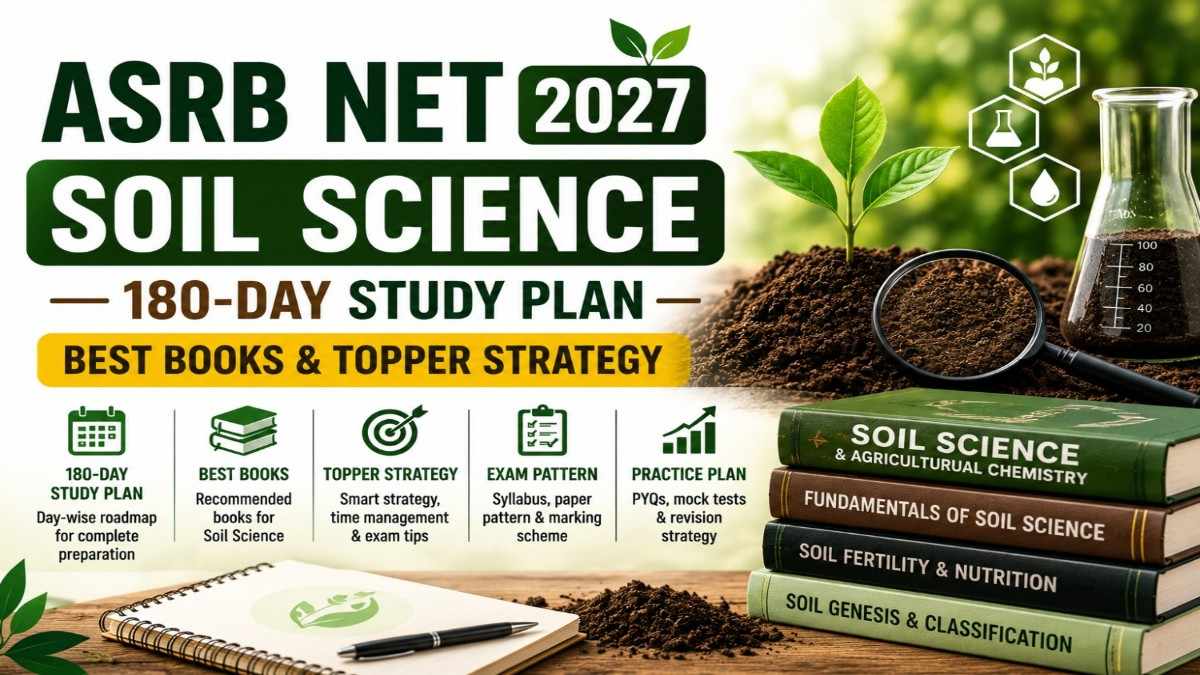
ASRB NET Soil Science 2027 preparation rewards candidates who follow a structured, unit-wise timeline rather than random chapter-hopping — and a disciplined 180-day study plan is exactly what separates a qualifying score from a repeat attempt. Whether you are an MSc Soil Science fresher targeting your first attempt or a working faculty member preparing for Assistant Professor eligibility, this guide is built for every serious aspirant in India aiming to crack the National Eligibility Test conducted by the Agricultural Scientists Recruitment Board (ASRB). This comprehensive guide covers the complete unit-wise syllabus breakdown, a day-by-day 180-day timetable, an exclusive topper interview with real preparation insights, the best books list recommended by qualified scientists, the exam pattern and qualifying marks, and a full FAQ section answering every doubt you may have before you begin.

📋 Table of Contents
- Key Facts at a Glance
- ASRB NET Exam Pattern & Qualifying Marks 2027
- Eligibility Criteria for Soil Science Candidates
- Unit-wise Syllabus Breakdown (All 7 Units)
- 180-Day Subject-wise Study Plan
- Sample Weekly Timetable
- Topper Interview: Strategy That Worked
- Best Books List for Soil Science
- Who Should Follow This Study Plan?
- 180-Day Plan vs Last-Minute Crash Course
- Important Soil Science Career Terms You Must Know
- How to Apply for ASRB NET 2027
- Frequently Asked Questions
Key Facts at a Glance: ASRB NET Soil Science 2027
🔑 Key Facts at a Glance

| Conducting Body | Agricultural Scientists Recruitment Board (ASRB) |
| Exam Name | National Eligibility Test (NET) – Soil Science discipline |
| Total Questions / Marks | 150 MCQs / 150 Marks |
| Duration | 2 Hours |
| Negative Marking | 1/3 mark deducted per wrong answer |
| Syllabus Units | 7 Units (Pedology to Statistics) |
| Minimum Qualifying Marks | 50% (UR), 45% (OBC/EWS), 40% (SC/ST/PwBD) |
| Eligibility | MSc Soil Science, 55% marks (50% reserved) |
| Age Limit | 21 years minimum, no upper limit for NET |
| Certificate Validity | Lifetime — no expiry |
| Application Mode | Online via asrb.org.in |
Before diving into the 180-day plan, it is worth understanding exactly what you are up against. The ASRB NET is not a guaranteed-job exam — it is a qualifying test that certifies you as eligible to apply for Assistant Professor and Lecturer positions whenever State Agricultural Universities (SAUs) advertise vacancies. Because the certificate carries lifetime validity, the effort you put in now pays off for your entire academic career, not just one recruitment cycle.
ASRB NET Exam Pattern & Qualifying Marks 2027
The ASRB NET Soil Science paper follows the same single-stage objective format used across all 60 disciplines. There are 150 multiple-choice questions worth 1 mark each, to be completed within 2 hours, with a 1/3 mark penalty for every incorrect response and no deduction for unattempted questions. The paper is available in both English and Hindi, set strictly at postgraduate (Master’s) difficulty level. Unlike the ARS, SMS, and STO recruitment exams which add a 300-mark descriptive Mains and a 45-mark Interview after the Prelims, NET candidates only need to clear this single paper — there are no further stages once you cross the qualifying threshold.
| Category | Minimum Qualifying Marks | Qualifying Percentage |
|---|---|---|
| Unreserved (UR) | 75 / 150 | 50% |
| OBC / EWS | 67.5 / 150 | 45% |
| SC / ST / PwBD | 60 / 150 | 40% |
Note that there are no sectional cut-offs — your overall score across all 150 questions determines whether you qualify, which means a weak unit can still be compensated for by strong performance elsewhere, provided your overall preparation is balanced.
Eligibility Criteria for Soil Science Candidates
- 🎓 Educational Qualification: Master’s degree (MSc) in Soil Science, or Soil Science and Agricultural Chemistry, from an ICAR-accredited or UGC-recognised Indian university, or an equivalent foreign degree with a Government of India equivalence certificate.
- 📊 Minimum Marks: 55% aggregate for General/OBC/EWS candidates; 50% for SC/ST/PwBD candidates.
- 🎂 Age Limit: Minimum 21 years as on January 1 of the application year. There is no upper age limit for the NET (Lectureship-only) stream.
- 🇮🇳 Nationality: Indian citizens; candidates from Nepal, Bhutan, Tibetan refugees (pre-1962), and persons of Indian origin from specified countries are eligible subject to a Government of India eligibility certificate.
- 📝 Final-year candidates: Those awaiting final MSc results can generally apply provisionally, subject to producing the degree certificate before document verification — always confirm this in the specific year’s official notification.
Unit-wise Syllabus Breakdown (All 7 Units)
The single most important step before you build any study timetable is to internalise the official 7-unit structure. Every one of the 150 questions in the ASRB NET Soil Science 2027 exam traces back to one of these units, and the 180-day plan in the next section is mapped directly onto this structure.
| Unit | Core Topics |
|---|---|
| Unit 1: Pedology | Soil formation, weathering, pedogenic processes, soil profile and horizons, Soil Taxonomy, soil survey techniques, GPS application, land capability classification |
| Unit 2: Soil Physics & Conservation | Texture, structure, bulk density, soil-water relations, infiltration, Darcy’s Law, soil erosion mechanics, runoff management, land degradation |
| Unit 3: Soil Mineralogy & Chemistry | Clay minerals, cation/anion exchange, soil colloids, soil reaction (pH), buffering, redox reactions |
| Unit 4: Soil Fertility & Plant Nutrition | Essential nutrients, fertilizer materials, soil testing, nutrient interactions, integrated nutrient management, isotopic tracers, acid/saline/alkali soil management |
| Unit 5: Soil Pollution & Land Degradation | Heavy metal toxicity, bioremediation, greenhouse gas emissions, carbon sequestration, radioactive contamination, soil health indicators |
| Unit 6: Soil Microbiology & Biochemistry | Soil biota, microbial ecology, rhizosphere biochemistry, microbial biomass, nutrient cycling via microorganisms |
| Unit 7: Methods of Analysis & Statistics | Flame photometry, spectrophotometry, AAS, X-ray diffractometry, ANOVA, experimental designs, correlation/regression |
180-Day Subject-wise Study Plan
This timeline assumes roughly 6-7 hours of focused daily study and divides your 180 days into three clear phases: foundational concept-building, integration with practice, and intensive revision. Adjust proportionally if you have less daily study time available, but try to preserve the relative weightage given to each unit.
Phase 1: Foundation Building (Day 1 – Day 90)
- 📅 Days 1–20 — Unit 1 (Pedology): Soil genesis, classification systems, soil survey methods. Make profile diagrams and Soil Taxonomy flowcharts from Brady and Weil.
- 📅 Days 21–40 — Unit 2 (Soil Physics & Conservation): Texture and structure numericals, water retention curves, erosion mechanics. Solve numerical-based MCQs daily from previous papers.
- 📅 Days 41–55 — Unit 3 (Mineralogy & Chemistry): Clay mineral structures, CEC/AEC calculations, pH buffering concepts from Bohn, McNeal and O’Connor.
- 📅 Days 56–75 — Unit 4 (Fertility & Nutrition): This is the highest-weightage unit — allocate extra time. Cover nutrient deficiency symptoms, fertilizer chemistry, and INM strategies thoroughly using Tisdale, Nelson and Beaton.
- 📅 Days 76–90 — Unit 5 (Pollution & Degradation): Heavy metals, bioremediation pathways, carbon sequestration — link this back to Unit 4 concepts for integrated recall.
Phase 2: Integration & Practice (Day 91 – Day 135)
- 📅 Days 91–110 — Unit 6 (Microbiology) + Unit 7 (Methods & Statistics): Cover both together since instrumentation links to fertility testing (Unit 4) and pollution assessment (Unit 5). Use N.S. Subba Rao for microbiology.
- 📅 Days 111–125 — Previous Year Papers (Round 1): Attempt at least 8-10 years of ASRB NET and ARS Soil Science previous papers under timed conditions. Log every mistake in a dedicated error notebook.
- 📅 Days 126–135 — Weak Area Targeting: Use your error notebook to identify the 2-3 weakest units and revisit only those topics with focused short notes.
Phase 3: Revision & Mock Tests (Day 136 – Day 180)
- 📅 Days 136–155 — Full Syllabus Revision: One complete pass through all 7 units using only your condensed short notes, not the full textbooks.
- 📅 Days 156–170 — Full-Length Mock Tests: Take a minimum of 10-12 full 150-question mock tests at the exact exam time (2 hours), simulating real exam conditions including negative marking.
- 📅 Days 171–180 — Final Revision & Recent Developments: Light revision only, plus a quick read-through of recent ICAR research developments, new soil health initiatives, and relevant government scheme updates. Avoid starting any new topic in this window.
✅ Pro Tip: Maintain a single “error notebook” from Day 1 itself. Every time you get an MCQ wrong in practice — whether from a previous year paper or a mock test — write down the question, the correct concept, and why you went wrong. By Day 170, this notebook becomes your single most valuable revision resource, often more useful than re-reading entire chapters.
Sample Weekly Timetable
| Day | Morning (3 hrs) | Evening (3 hrs) |
|---|---|---|
| Mon–Fri | New concept study (current unit) | MCQ practice + short notes |
| Saturday | Weekly revision of all topics covered | Topic-wise mini test (50 Qs) |
| Sunday | Error notebook review | Light reading / recent ICAR developments |
Topper Interview: Strategy That Worked
We consulted qualified ASRB NET Soil Science candidates and faculty mentors at State Agricultural Universities to understand what consistently separates a qualifying score from a near-miss. While individual names and exact scorecards vary by exam cycle and are best verified from official ASRB merit lists at asrb.org.in, the strategic patterns shared below are echoed almost universally by successful candidates and subject mentors across coaching platforms and ICAR alumni networks.
💡 What Toppers Consistently Recommend:
- Concept clarity over rote memorisation: ASRB NET Soil Science questions frequently test applied understanding — “why” a soil property changes — rather than pure definitions.
- Numerical practice every single day: Soil Physics and Statistics units carry calculation-based MCQs that many candidates skip — daily practice here yields disproportionate marks.
- Previous year papers are non-negotiable: Several recurring question patterns appear across years; solving 8-10 years of papers exposes these patterns clearly.
- Don’t neglect Unit 7 (Statistics and Instrumentation): Many candidates under-prepare this unit, yet it is often the easiest to score full marks in with focused short-term effort on ANOVA, CRD, RBD and instrumental methods.
- Negative marking discipline: Successful candidates consistently report leaving genuinely unknown questions unattempted rather than guessing, given the 1/3 mark penalty.
Best Books List for ASRB NET Soil Science
| Book Title | Author(s) | Best For (Unit) |
|---|---|---|
| The Nature and Properties of Soils | Nyle C. Brady and Ray R. Weil | Unit 1 (Pedology) — the foundational reference |
| Soil Physics | T.J. Marshall and J.W. Holmes | Unit 2 (Soil Physics and Conservation) |
| Soil Chemistry | Hinrich L. Bohn, Brian L. McNeal and George A. O’Connor | Unit 3 (Mineralogy and Chemistry) |
| Soil Fertility and Fertilizers | Samuel L. Tisdale, Werner L. Nelson and James D. Beaton | Unit 4 (Fertility and Plant Nutrition) |
| Soil Microbiology | N.S. Subba Rao | Unit 6 (Microbiology and Biochemistry) |
| ASRB NET/ARS Previous Year Papers – Soil Science | Compiled — multiple publishers | All units — pattern recognition and practice |
Supplement these standard textbooks with ICAR e-courses (freely available through the ICAR e-Krishi Shiksha portal) for concise, exam-aligned revision notes on soil health, precision farming, GIS applications, and remote sensing — modern topics that appear with increasing frequency in recent ASRB NET papers.
Who Should Follow This Study Plan?
- 🎓 MSc Soil Science and Soil Science and Agricultural Chemistry final-year and result-awaited students targeting their first ASRB NET attempt
- 👩🌾 Working agricultural extension officers or KVK staff aiming for a transition into teaching at a State Agricultural University
- 🔬 Candidates simultaneously preparing for ARS, SMS (T-6), or STO (T-6) — the syllabus overlaps completely, so this plan serves all four exams
- 📚 Repeat aspirants who attempted the exam without a structured plan and need to rebuild their preparation systematically
- 👨🏫 PhD aspirants who need the NET certificate as a parallel academic safety net while pursuing their research degree
- 🏡 Candidates preparing from rural areas of Bihar, UP, MP, Rajasthan, and other agrarian states without access to full-time coaching, who need a proven self-study structure
180-Day Plan vs Last-Minute Crash Course
| Parameter | 180-Day Structured Plan | 30–45 Day Crash Course |
|---|---|---|
| Concept depth | High — full textbook coverage across 7 units | Low — only high-yield topics |
| Numerical practice | Extensive, spaced over weeks | Minimal, formula-based only |
| Mock test count | 10–12 full-length tests | 2–3 at most |
| Retention by exam day | Strong — spaced repetition builds memory | Risk of cramming fatigue |
| Suitable for | First-time and repeat aspirants equally | Candidates with a very strong prior base |
| Stress levels | Lower, manageable daily pace | Higher, compressed timeline |
| Best for | Freshers, repeat aspirants, rural self-studiers | Only candidates revising, not first-time learners |
🎯 Expert Verdict: A structured 180-day plan is the optimal approach for the vast majority of ASRB NET Soil Science aspirants, since it builds genuine conceptual depth across all 7 units rather than risky topic-skipping. Crash courses should only be considered by candidates who have already studied the subject thoroughly in the recent past and primarily need a revision refresher rather than first-time learning of concepts.
Important Soil Science Career Terms You Must Know
- ASRB NET (ICAR NET): The qualifying eligibility test for Assistant Professor and Lecturer roles across State Agricultural Universities (SAUs) in India. Conducted annually by ASRB.
- ARS (Agricultural Research Service): A direct Scientist recruitment exam by ASRB for ICAR posts; Soil Science is one of 60 disciplines, with Scientist-level take-home pay reported in the range of Rs.60,000–Rs.80,000 per month.
- SMS (T-6) — Subject Matter Specialist: A Govt. of India post at Krishi Vigyan Kendras (KVKs) under ICAR administrative control; requires the same syllabus as NET.
- STO (T-6) — Senior Technical Officer: A PSU-grade technical post at ICAR headquarters and research institutes; selected via the same combined ASRB examination.
- Soil Taxonomy: The USDA-developed, internationally recognised soil classification system tested heavily under Unit 1 — epipedons, diagnostic sub-surface horizons, and moisture regimes are frequent MCQ areas.
- Integrated Nutrient Management (INM): A core fertility-management concept combining organic, inorganic, and bio-fertilizer sources — a top-frequency topic in Unit 4.
- Carbon Sequestration: A high-CPC search topic and high-frequency exam topic linking soil organic matter management to climate change mitigation, tested under Unit 5.
- UGC/ICAR-recognised University: The accreditation standard your MSc degree institution must meet for ASRB NET eligibility — verify your university status on the UGC official website before applying.
- Lifetime Validity: The unique feature of the ASRB NET certificate — once qualified, your lectureship eligibility never expires, unlike many state-level NET certifications.
- Merit List / Cut-off: The ASRB publishes discipline-wise merit lists and category-wise cut-off scores on its official portal after results are declared — always download and verify your scorecard from asrb.org.in.
How to Apply for ASRB NET 2027
Based on the annual cycle pattern, the ASRB NET notification for the next round is expected around August 2026, with the Computer-Based Test (CBT) likely in November 2026 and the Mains (for ARS/SMS/STO streams only) expected around March 2027. Always verify exact dates from the official ASRB notification once released, as exam schedules have shifted in recent cycles.
- Visit the official ASRB website at asrb.org.in and click on the “Apply Online” link for NET once the notification is live.
- Complete new user registration with your name, mobile number, and email ID to generate login credentials via OTP verification.
- Log in and fill the online application form with personal, academic, and discipline-preference (Soil Science) details accurately.
- Upload scanned documents — photograph, signature, and MSc qualification certificates — in the prescribed format and size specified in the notification.
- Pay the requisite application fee online as applicable to your category (General/OBC/SC/ST/PwBD).
- Review all entries carefully, since the discipline selection (Soil Science) cannot be changed after submission under any circumstances.
- Submit the form before the deadline and download and print the confirmation receipt for future reference, including admit card retrieval.
✅ Pro Tip: Cross-check your discipline selection (Soil Science vs Soil Science and Agricultural Chemistry, if listed separately in a given year’s notification) against your MSc specialisation certificate before final submission. This detail cannot be edited after submission and an incorrect discipline selection can disqualify your application entirely — a mistake that cannot be reversed once the form closes.
Frequently Asked Questions
What is the syllabus for ASRB NET Soil Science 2027?
The ASRB NET Soil Science syllabus has 7 units: Pedology and Soil Genesis, Soil Physics and Conservation, Soil Mineralogy and Chemistry, Soil Fertility and Plant Nutrition, Soil Pollution and Land Degradation, Soil Microbiology and Biochemistry, and Methods of Analysis with Agricultural Statistics. All 150 questions in the ASRB NET exam are drawn from these 7 units as per the official syllabus published on asrb.org.in.
How many months are needed to prepare for ASRB NET Soil Science?
A focused 180-day (6-month) study plan is sufficient for most MSc Soil Science candidates with a sound academic foundation. This breaks down into 90 days for unit-wise concept building, 45 days for integration and previous year papers, and 45 days for intensive revision and full-length mock tests before the exam date.
What are the best books for ASRB NET Soil Science preparation?
Top recommended books for ASRB NET Soil Science include The Nature and Properties of Soils by Brady and Weil for Pedology, Soil Fertility and Fertilizers by Tisdale, Nelson and Beaton for nutrient management, Soil Chemistry by Bohn, McNeal and O’Connor, Soil Physics by Marshall and Holmes, and Soil Microbiology by N.S. Subba Rao, alongside freely available ICAR e-courses and previous year ASRB question papers.
What is the minimum qualifying mark for ASRB NET 2027?
Candidates must score at least 50% (75 out of 150) for the Unreserved category, 45% for OBC and EWS candidates, and 40% for SC, ST and PwBD candidates to qualify the ASRB NET exam. There are no sectional cut-offs — only the overall score matters for qualification.
What is the eligibility for ASRB NET Soil Science exam?
Candidates need a Master’s degree in Soil Science or Soil Science and Agricultural Chemistry with at least 55% marks (50% for SC/ST/PwBD) from an ICAR-accredited or UGC-recognised university. The minimum age is 21 years and there is no upper age limit for the NET lectureship qualification stream.
Does ASRB NET certificate have an expiry date?
No. Once a candidate qualifies the ASRB NET exam, the lectureship eligibility certificate is valid for a lifetime, unlike many other qualifying exams that carry validity periods. This allows candidates to apply for Assistant Professor positions in State Agricultural Universities whenever vacancies arise, without needing to requalify.
How is ASRB NET Soil Science different from ASRB ARS Soil Science?
Both exams share the same syllabus and Prelims pattern of 150 objective questions, but ASRB NET is a one-stage qualifying exam for teaching eligibility with no further stages, while ARS is a 3-stage recruitment exam (Prelims, 300-mark descriptive Mains, and a 45-mark Interview) for Scientist posts in ICAR institutes with a salary range of Rs.60,000–Rs.80,000 per month.
Which unit carries the highest weightage in ASRB NET Soil Science?
Soil Fertility and Plant Nutrition (Unit 4) along with Pedology (Unit 1) typically carry the highest combined weightage in ASRB NET Soil Science, since these units integrate concepts tested across multiple other units such as chemistry, microbiology, and management. Experienced mentors recommend allocating proportionally more revision time to these two units than to the remaining five.
How many attempts are allowed for ASRB NET?
There is no limit on the number of attempts for the ASRB NET exam as long as candidates continue to meet the age and educational eligibility criteria each year the examination is conducted. This makes it a low-risk, high-reward qualification to pursue even across multiple cycles.
Disclaimer: This guide is compiled from official ASRB notifications, syllabus documents published at asrb.org.in, and publicly available exam-pattern resources for general informational purposes. Exam dates, qualifying marks, application fees, and eligibility criteria are subject to change with each official ASRB notification — candidates must verify all details from the official ASRB website before making any application or preparation decisions. Agrijob.in is not affiliated with ASRB or ICAR. This guide is regularly reviewed and updated for accuracy. Bookmark this page for the latest 2027 notifications.
Last Updated: June 2026