

ICAR JRF 2026 — formally the All India Entrance Examination for Admission (AIEEA) PG — is India’s most competitive national gateway for agriculture graduates seeking government-funded Master’s degree admission and Rs.12,640/month scholarship at top agricultural universities. Conducted by the National Testing Agency (NTA) on behalf of the Indian Council of Agricultural Research (ICAR), the exam was held on 4 July 2026 across 122 cities in Computer Based Test (CBT) mode, filling 30% of PG seats across 75+ agricultural universities nationwide. This guide is for B.Sc. Agriculture, Horticulture, Forestry, Fisheries, and Allied Sciences graduates preparing for ICAR AIEEA PG 2026–27 or planning ahead for the next cycle. It covers every detail you need: stipend amount, eligibility, category-wise application fee, 19-subject syllabus, exam pattern, selection process, top universities, and career outcomes after qualifying.

ICAR JRF 2026 (AIEEA PG) offers a merit-based scholarship of Rs.12,640 per month plus Rs.6,000 contingency grant per year to top-ranked agriculture graduates admitted to M.Sc. programmes at ICAR-affiliated universities. The exam was conducted on 4 July 2026 by NTA in CBT mode, with 120 MCQs (480 marks) in 120 minutes, covering 20 subjects across Agriculture, Horticulture, Forestry, Veterinary, Fisheries, and Allied Sciences.
- Full Name: ICAR All India Entrance Examination for Admission – Postgraduate (AIEEA PG) 2026
- Conducting Body: National Testing Agency (NTA) on behalf of ICAR
- Exam Date: 4 July 2026 (Saturday)
- Application Window: 8 May 2026 – 10 June 2026 (Extended)
- Official Portal: exams.nta.nic.in/icar
- Mode: Computer Based Test (CBT), English medium
- Total Questions: 120 MCQs | Total Marks: 480 | Duration: 2 Hours
- Marking Scheme: +4 for correct | –1 for incorrect | 0 for unattempted
- Subjects Covered: 20 subjects (Agronomy, Horticulture, Genetics, Soil Science, Forestry, Veterinary, Fisheries and others)
- Exam Cities: 122 cities across India
- ICAR-PG Scholarship (JRF): Rs.12,640/month + Rs.6,000/year contingency
- NTS (Non-PG Scholarship): Rs.5,000/month (for out-of-state admissions)
- Participating Universities: 75 Agricultural Universities (64 SAUs + 4 ICAR-DUs + 3 CAUs + 4 CUs)
- Seats Filled via ICAR AIEEA: 30% of all PG seats in participating universities (~11,000 seats total)
- Result: Declared in August 2026 (tentative) at exams.nta.nic.in/ICAR
- What Is ICAR JRF 2026 and Why It Matters
- Who Should Apply for ICAR JRF 2026
- ICAR JRF 2026 Stipend and Scholarship Details
- Eligibility Criteria and Application Fee
- How to Apply for ICAR JRF 2026 – Step-by-Step Process
- ICAR JRF 2026 Exam Pattern
- ICAR JRF 2026 Subject-Wise Syllabus
- ICAR JRF vs ICAR AICE JRF/SRF PhD – Which Is Right for You
- Advantages and Disadvantages of ICAR JRF 2026
- Important Terms Related to ICAR JRF 2026
- Important Dates and Timeline
- Important Links
- Conclusion
- Key Takeaways
- Frequently Asked Questions
What Is ICAR JRF 2026 and Why It Matters for Agriculture Graduates
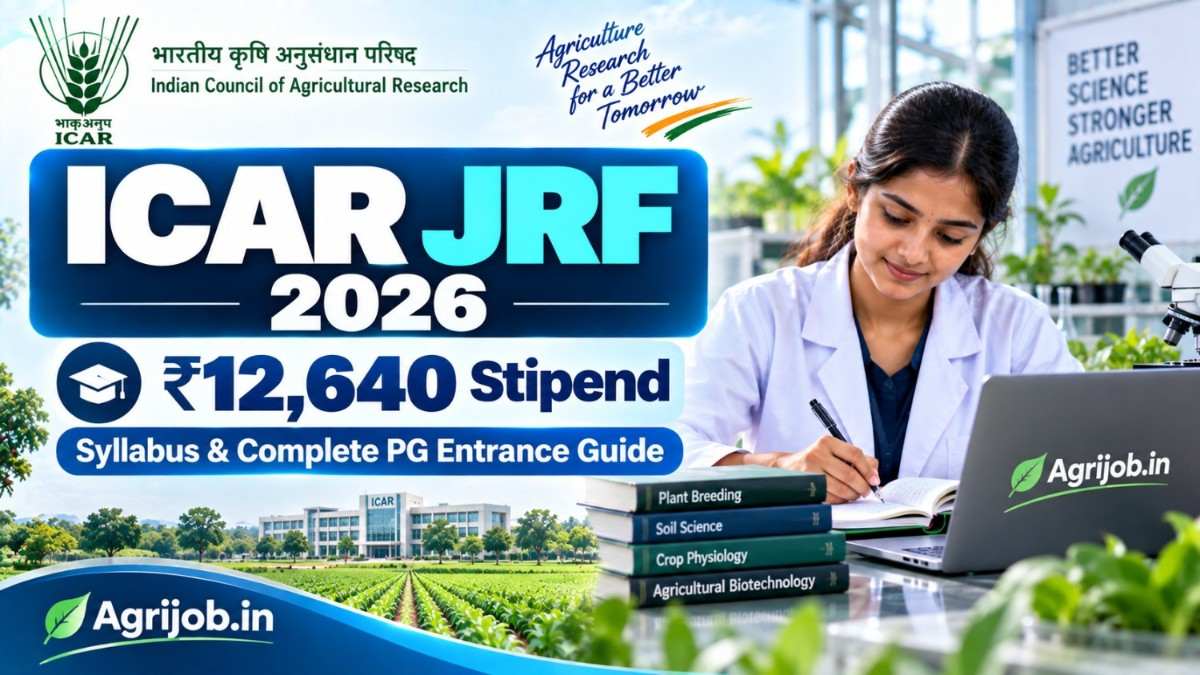
ICAR JRF 2026 refers to the ICAR All India Entrance Examination for Admission – Postgraduate (AIEEA PG), a national-level Computer Based Test conducted by NTA that allocates 30% of Master’s degree programme seats across 75 agricultural universities in India. Candidates who qualify and secure merit-based ICAR-PG Scholarship receive Rs.12,640 per month throughout their 2-year M.Sc. programme, along with Rs.6,000 per year as a contingency grant for books, chemicals, and research travel.
ICAR oversees one of the world’s largest public agricultural higher education systems, with a combined intake of over 11,000 postgraduate seats filled through this examination. The four ICAR Deemed Universities — IARI (New Delhi), IVRI (Bareilly), NDRI (Karnal), and CIFE (Mumbai) — represent the most prestigious destinations for AIEEA PG toppers. A high ICAR-AIEEA rank also unlocks access to 64 State Agricultural Universities (SAUs) and 3 Central Agricultural Universities, giving candidates nationwide flexibility in university and subject selection.

The sister examination — AICE JRF/SRF (PhD) — serves doctoral-level candidates seeking Rs.37,000–Rs.42,000/month fellowship for PhD research. Both exams are conducted on the same date, 4 July 2026, by NTA. Agriculture graduates at the M.Sc. stage should apply for AIEEA PG; M.Sc. holders eyeing PhD funding apply for AICE JRF/SRF PhD. This guide focuses entirely on the AIEEA PG (ICAR JRF) pathway.
Who Should Apply for ICAR JRF 2026
- 🎓 B.Sc. Agriculture graduates (4-year or 5-year) with 60%+ marks who want to pursue M.Sc. Agriculture at a top ICAR institution without paying full tuition burden.
- 🌿 B.Sc. Horticulture / Forestry / Fisheries / Veterinary graduates seeking master’s admission in their discipline at a State Agricultural University outside their home state.
- 💰 Merit students who need financial support — the Rs.12,640/month ICAR-PG scholarship and Rs.5,000/month NTS cover a significant portion of living and study costs.
- 🏛️ Aspirants targeting IARI, NDRI, IVRI, or CIFE — these ICAR Deemed Universities admit PG students exclusively via ICAR AIEEA counselling (no state quota).
- 🔬 Students planning a research career in agriculture — ICAR AIEEA PG is the stepping stone to ICAR ARS Scientist, Assistant Professor at SAUs, and ICAR AICE JRF/SRF PhD.
- 🌾 Candidates from reserved categories (SC/ST) — with only 50% marks required and a reduced application fee of Rs.675, the barrier to entry is lower and reserved seats are available.
- 📚 Final-year B.Sc. Agriculture students (appearing candidates) — ICAR allows candidates in the final year of their qualifying degree to apply provisionally.
- 🏗️ B.Tech Agricultural Engineering or Allied Sciences graduates looking for PG admission in their respective stream through a nationally recognised merit-based process.
ICAR JRF 2026 Stipend and Scholarship Details
The financial support under ICAR AIEEA PG is one of the strongest incentives for agriculture students to aim for a top national rank rather than settling for state-level PG admission. There are two distinct scholarship tiers available to candidates admitted through ICAR AIEEA PG counselling.
| Scholarship Type | Monthly Amount | Annual Contingency | Duration | Who Gets It |
|---|---|---|---|---|
| ICAR-PG Scholarship (JRF) | Rs.12,640/month | Rs.6,000/year | 2 years (M.Sc. duration) | Merit-ranked ICAR AIEEA PG qualifiers (limited seats) |
| National Talent Scholarship (NTS-PG) | Rs.5,000/month | Not specified separately | 2 years (M.Sc. duration) | Out-service candidates joining an AU outside their home state |
| ICAR-SRF (PhD Fellowship) | Rs.37,000–Rs.42,000/month | Included in project grant | 3–5 years (PhD duration) | AICE JRF/SRF PhD qualifiers (separate exam) |
ICAR-PG Scholarship (formerly JRF): This is the primary merit-based stipend for top rankers in AIEEA PG. The Rs.12,640/month is paid directly to scholars admitted at ICAR Deemed Universities (IARI, IVRI, NDRI, CIFE) and designated ICAR-affiliated universities. The scholarship is disbursed through the National Scholarship Portal (NSP) directly into the beneficiary’s bank account and covers the complete 2-year M.Sc. duration.
National Talent Scholarship (NTS-PG): Candidates who do not rank within the ICAR-PG Scholarship bracket but join a Master’s programme in an Agricultural University located in a different state from their state of domicile become eligible for Rs.5,000/month NTS. This incentivises academic mobility and diversifies university campuses. Both scholarships are discontinued if academic performance falls below ICAR’s required OGPA standard.
| Year of Study | ICAR-PG Monthly Stipend | Annual Contingency Grant | Estimated Total Annual Value |
|---|---|---|---|
| Year 1 (M.Sc.) | Rs.12,640 | Rs.6,000 | Rs.1,57,680 |
| Year 2 (M.Sc.) | Rs.12,640 | Rs.6,000 | Rs.1,57,680 |
| Total 2-Year Scholarship Value | Rs.3,15,360 + Rs.12,000 contingency = Rs.3,27,360 | ||
Beyond the direct stipend, qualifying ICAR AIEEA PG and joining a premier institution like IARI New Delhi or NDRI Karnal delivers significant indirect financial value: access to world-class lab infrastructure, ICAR research network connections, and dramatically stronger eligibility for the ICAR ARS Scientist exam and international agricultural research fellowships.
ICAR JRF 2026 Eligibility Criteria and Application Fee
Candidates must satisfy all four eligibility dimensions — nationality, age, educational qualification, and minimum marks — before submitting the ICAR AIEEA PG 2026 application form.
- Nationality: Indian citizen only.
- Age Limit: Minimum 19 years as on 31 August 2026. There is no upper age limit for ICAR AIEEA PG.
- Qualifying Degree: Bachelor’s degree (4-year, 5-year, or 6-year) in a relevant Agriculture or Allied Sciences subject — B.Sc. Agriculture, B.Sc. Horticulture, B.Sc. Forestry, B.Sc. Fisheries, B.V.Sc. & A.H., B.Tech. Agricultural Engineering, or equivalent.
- Minimum Marks — General/OBC-NCL/EWS/UPS: 60% aggregate marks in the qualifying degree.
- Minimum Marks — SC/ST/PwBD: 50% aggregate marks in the qualifying degree.
- Appearing Candidates: Final-year B.Sc. students can apply provisionally; degree and marks must be produced at the time of counselling/admission.
- Three-year B.Sc. holders: Generally not eligible, with limited exceptions at IARI and NDRI as per their own institutional regulations.
| Category | AIEEA PG Application Fee | AICE JRF/SRF PhD Application Fee |
|---|---|---|
| General / Unreserved | Rs.1,300 | Rs.2,000 |
| OBC-NCL / EWS / UPS | Rs.1,255 | Rs.1,955 |
| SC / ST / PwBD / Third Gender | Rs.675 | Rs.1,075 |
| Payment Mode | Credit Card / Debit Card / Net Banking / UPI (Processing charges + GST extra) | |
How to Apply for ICAR JRF 2026 – Step-by-Step Process
- Visit the Official NTA ICAR Portal: Go to exams.nta.nic.in/icar and click on the ICAR AIEEA PG 2026–27 application link.
- Complete Online Registration: Enter your name, date of birth, mobile number, and email ID. Note the system-generated Application Number — use this for all future logins.
- Fill Personal and Academic Details: Enter Class 10, Class 12, and B.Sc. marks, percentage/CGPA, institution details, state of domicile, and subject group preference for the PG entrance exam.
- Upload Scanned Documents: Upload recent passport-size photograph (JPEG, 10–200 KB), signature (JPEG, 4–30 KB), and category certificate (if applicable). Ensure photo is white-background, front-facing, and taken within 3 months.
- Pay the Application Fee: Use Credit/Debit Card, Net Banking, or UPI. Save the payment confirmation and transaction ID. Note: processing charges and GST are additional as applicable.
- Submit and Download Confirmation: After successful payment, submit the form and download the confirmation page. Print and retain it for future reference.
- Check Application Status: Log in to the NTA portal to verify your application status. If any discrepancy appears, use the correction window period to modify eligible fields.
- Download Admit Card: Hall ticket is released approximately 1–2 weeks before the exam at exams.nta.nic.in/ICAR. Carry it to the examination centre along with a valid government-issued photo ID.
Candidates from remote areas who face difficulty submitting the online form can use Common Services Centres (CSCs) under the Ministry of Electronics and Information Technology (MeitY) for guided assistance. After submitting, immediately cross-verify your name spelling, date of birth, category, and subject group — these fields cannot be corrected after the correction window closes, and errors can result in disqualification during document verification at counselling.
ICAR JRF 2026 Exam Pattern – What to Expect on 4 July
The ICAR AIEEA PG 2026 is a single-paper, subject-specific Computer Based Test. Each candidate attempts a paper for their chosen subject group. The exam does not have sections — all 120 questions are from the candidate’s selected PG subject.
| Parameter | Detail |
|---|---|
| Mode | Computer Based Test (CBT) |
| Language | English only |
| Duration | 2 Hours (120 Minutes) |
| Total Questions | 120 Multiple Choice Questions (MCQs) |
| Total Marks | 480 marks |
| Correct Answer | +4 marks |
| Wrong Answer | –1 mark (negative marking) |
| Unattempted Question | 0 marks |
| Question Type | MCQ (4 options; single correct answer) |
| Subject Groups Available | 20 subjects for PG admission |
| Score Type | NTA Percentile Score (not raw marks) |
| Tie-breaking Rule | Fewer negative marks → older candidate → higher Class 12 score |
NTA calculates an NTA Percentile Score — a relative position score among all test-takers in that subject, not the absolute raw marks. This normalisation accounts for variations in difficulty between shifts. Candidates scoring above the cutoff percentile become eligible for ICAR online counselling where they choose their preferred subject and university.
ICAR JRF 2026 Subject-Wise Syllabus – All 20 Subjects
ICAR AIEEA PG 2026 covers 20 subject groups, each corresponding to a distinct PG discipline. All question papers are based on ICAR-recommended PG-level curricula. Below is the subject-wise syllabus overview for the most popular groups.
| Subject Code | Subject Group | Key Topics Covered |
|---|---|---|
| 01 | Plant Biotechnology | Biochemistry, molecular biology, genetic engineering, tissue culture, bioinformatics, crop physiology |
| 02 | Plant Sciences | Plant breeding, plant pathology, agricultural microbiology, seed science, plant genetic resources |
| 03 | Physical Science / Soil Science | Soil physics, soil chemistry, plant nutrients, fertilizers, remote sensing, GIS |
| 04 | Entomology & Nematology | Insect morphology, pest management, nematode taxonomy, IPM, bio-control |
| 05 | Agronomy | Crop production, field crops, weed management, irrigation, nutrient management, dryland farming, soil fertility, Tea Husbandry |
| 06 | Social Sciences | Agricultural economics, extension education, farm management, rural development, agricultural statistics |
| 07 | Statistical Sciences | Agricultural statistics, computer application, bioinformatics, mathematics |
| 08 | Horticulture | Fruit science, vegetable science, floriculture, post-harvest management, plantation crops, spices, medicinal & aromatic crops |
| 09 | Forestry / Agroforestry & Silviculture | Forest production, silviculture, agroforestry, forest resource management, forest biology |
| 10 | Agricultural Engineering & Technology | Farm machinery, soil & water conservation, food engineering, irrigation systems, renewable energy |
| 11 | Water Science & Technology | Hydrology, irrigation planning, water harvesting, watershed management, drainage |
| 12 | Community Science (Home Science) | Food & nutrition, human development, resource management, textiles, extension education |
| 13 | Animal Biotechnology | Molecular genetics, reproductive biotechnology, transgenic animals, genomics |
| 14 | Veterinary Science | Anatomy, physiology, veterinary pharmacology, animal surgery, pathology |
| 15 | Animal Sciences | Animal nutrition, livestock production, poultry science, animal genetics & breeding |
| 16 | Fisheries Science | Aquaculture, fisheries management, fish biology, marine fisheries, fish processing |
| 17 | Dairy Science | Dairy microbiology, dairy chemistry, dairy farm management, cattle nutrition |
| 18 | Dairy Technology | Milk processing, dairy engineering, quality control, food safety standards |
| 19 | Food Science & Technology | Food chemistry, food microbiology, food processing, nutrition, packaging, food safety regulations |
| 20 | Sericulture | Silk worm biology, mulberry cultivation, reeling, silk production, sericultural economics |
Each paper also contains a Common General Agriculture base — questions on importance of agriculture in the national economy, basic crop production, major Indian soil types, NPK deficiency symptoms, rural development programmes, and ICAR’s research infrastructure. This base layer contributes to all 20 subject papers and is a high-ROI area to prepare regardless of your chosen discipline. Detailed unit-wise syllabi for each group are available at the ICAR official website (icar.org.in) and in the NTA Information Bulletin.
ICAR JRF (AIEEA PG) vs ICAR AICE JRF/SRF PhD – Which Is Right for You
| Comparison Point | ICAR AIEEA PG (JRF / PG Scholarship) | ICAR AICE JRF/SRF PhD |
|---|---|---|
| Target Candidate | B.Sc. Agriculture/Allied Sciences graduate | M.Sc. Agriculture/Allied Sciences holder |
| Programme Offered | Master’s degree (M.Sc.) admission | Doctoral (PhD) admission + fellowship |
| Monthly Stipend | Rs.12,640 (PG Scholarship) or Rs.5,000 (NTS) | Rs.37,000 (JRF, Years 1–2), Rs.42,000 (SRF, Year 3+) |
| Exam Structure | 120 MCQs, 1 paper, subject-specific | 120 MCQs, 3 parts (Part A GK + Part B Core Group + Part C Specialised Subject) |
| Total Marks | 480 marks | 480 marks |
| Duration | 2 Hours | 2 Hours |
| Subjects Available | 20 subject groups | 72 subjects / 19 core groups |
| Exam Cities | 122 cities | 89 cities |
| Application Fee (General) | Rs.1,300 | Rs.2,000 |
| Career Path | M.Sc. → ICAR ARS → Assistant Professor → PhD | PhD → Postdoc → Scientist / Professor / International Research |
| Conducting Body | NTA on behalf of ICAR | NTA on behalf of ICAR |
| Exam Date (2026) | 4 July 2026 | 4 July 2026 |
If you hold a B.Sc. Agriculture degree and want structured, government-supported master’s education with Rs.12,640/month stipend, ICAR AIEEA PG is your path. If you already have an M.Sc. and want to fund a PhD with Rs.37,000–42,000/month and access ICAR’s full research network at IARI, NDRI, or PAU, target ICAR AICE JRF/SRF PhD. Both exams are held the same day — candidates at M.Sc. level can apply for AIEEA PG; M.Sc. holders must apply only for AICE JRF/SRF PhD.
Advantages and Disadvantages of ICAR JRF 2026
Advantages (Pros):
- ✅ Rs.12,640/month guaranteed stipend throughout 2-year M.Sc. — covers living costs at most agricultural universities and eliminates the need for part-time work.
- ✅ National merit rank accepted at 75+ universities — one exam unlocks choice of institution across India, unlike state-level PG exams restricted to one state.
- ✅ Rs.6,000/year contingency grant for research essentials (chemicals, books, field travel) — reduces out-of-pocket research costs significantly.
- ✅ Gateway to IARI, NDRI, IVRI, CIFE — ICAR Deemed Universities that only admit PG students through ICAR AIEEA, and offer world-class agricultural research infrastructure.
- ✅ Strong career launch: ICAR AIEEA PG rank improves eligibility for ICAR ARS Scientist exam, ASRB NET, and international postdoctoral fellowships at CGIAR and FAO institutes.
Disadvantages (Cons):
- ❌ Scholarship is merit-limited: Only 600 ICAR-PG Scholarships are awarded annually — candidates below the cutoff rank receive no scholarship even if admitted through counselling.
- ❌ Application period has passed for 2026–27: The 2026 exam was held on 4 July; new applicants must wait for the 2027 cycle (expected notification in April–May 2027).
- ❌ High competition: Over 24,000+ candidates appear annually for 20 subjects; the cutoff for ICAR-PG Scholarship is intense, especially in popular disciplines like Agronomy and Genetics.
- ❌ Rs.12,640/month stipend has not been revised since years — ICAR researchers have flagged that the PG scholarship amount lags behind inflation and the revised UGC JRF stipend (Rs.37,000/month for doctoral fellows).
Important Terms Related to ICAR JRF 2026
- ICAR (Indian Council of Agricultural Research): India’s apex government body for agricultural research and education, functioning under the Department of Agricultural Research and Education (DARE), Ministry of Agriculture. ICAR manages 100+ research institutes and 75+ agricultural universities.
- NTA (National Testing Agency): The autonomous government body under MoE responsible for conducting ICAR AIEEA PG, AICE JRF/SRF PhD, JEE Main, NEET UG, and other national entrance examinations. All ICAR exams are conducted via exams.nta.nic.in/ICAR.
- AIEEA PG: All India Entrance Examination for Admission – Postgraduate. This is the official name of what is commonly called “ICAR JRF” for M.Sc. admissions.
- AICE JRF/SRF PhD: All India Competitive Examination for Junior Research Fellowship / Senior Research Fellowship (Doctor of Philosophy). Separate from AIEEA PG; targets M.Sc. holders seeking PhD funding.
- ICAR-PG Scholarship: Formerly known as JRF, this is the merit-based Rs.12,640/month stipend awarded to top-ranked AIEEA PG qualifiers. Limited to 600 awards annually across all subjects.
- NTS-PG (National Talent Scholarship – PG): Rs.5,000/month scholarship for out-service AIEEA PG candidates who join a Master’s programme in a state other than their state of domicile.
- SAU (State Agricultural University): State-level public agricultural universities affiliated with ICAR and participating in AIEEA counselling. India has 64 SAUs, including GBPUAT (Pantnagar), PAU (Ludhiana), ANGRAU (Guntur), MPKV (Rahuri), and OUAT (Bhubaneswar).
- ICAR DU (Deemed University): Four ICAR institutes with deemed university status — IARI (New Delhi), IVRI (Bareilly), NDRI (Karnal), CIFE (Mumbai). These are the most prestigious PG destinations for AIEEA toppers.
- CBT (Computer Based Test): Online exam mode where candidates read questions on a screen and mark answers using a mouse. NTA conducts ICAR AIEEA PG entirely in CBT mode at designated test centres.
- Negative Marking: The ICAR AIEEA PG exam deducts 1 mark for each wrong answer while awarding 4 marks for each correct response. Unattempted questions carry 0 marks. Accuracy strategy is essential for a high score.
ICAR JRF 2026 – Important Dates and Timeline
| Event | Date |
|---|---|
| Official Notification Released | 08 May 2026 |
| Application Form Opens | 08 May 2026 |
| Original Application Deadline | 07 June 2026 |
| Extended Application Deadline | 10 June 2026 |
| Application Form Correction Window | 09 June – 14 June 2026 |
| City Intimation Slip Released | 25 June 2026 |
| Admit Card Released | 01 July 2026 |
| ICAR AIEEA PG Exam Date | 04 July 2026 (Saturday) |
| Provisional Answer Key | Expected: July 2026 |
| Result / NTA Score Card | Expected: August 2026 (Tentative) |
| ICAR Counselling (Round 1) | After result declaration — check icar.org.in |
| Next Cycle Notification (2027) | Expected: April–May 2027 at exams.nta.nic.in/ICAR |
Important Links – ICAR JRF 2026
| Link Name | URL |
|---|---|
| Official NTA ICAR Exam Portal | exams.nta.nic.in/icar |
| ICAR Official Website | icar.org.in |
| NTA Help Desk | 011-40759000 | ican@nta.ac.in |
| National Scholarship Portal (Stipend Disbursement) | scholarships.gov.in |
| ICAR AIEEA PG & AICE JRF/SRF PhD 2026 Notification | Download from NTA Portal |
| ICAR ARS Scientist Exam (Career After JRF) | ICAR ARS 2026 – Complete Guide (Agrijob.in) |
| NABARD Research Fellowship 2026 | NABARD Fellowship – Agrijob.in |
| ICAR IARI Recruitment 2026 | iari.res.in |
Conclusion – Is ICAR JRF 2026 Worth Pursuing?
ICAR JRF 2026 (AIEEA PG) is unquestionably the most valuable national-level pathway for agriculture graduates seeking government-funded Master’s education in India. With Rs.12,640/month ICAR-PG Scholarship, access to 75+ premier universities including IARI and NDRI, and a merit rank valid across the country, the examination delivers both financial support and unmatched academic mobility to qualified candidates. While the 2026 cycle exam has been conducted on 4 July 2026 and results are expected in August 2026, aspirants planning for the 2027 cycle should begin preparation immediately — focusing on their chosen subject group’s ICAR-recommended syllabus, general agriculture, and MCQ-based CBT practice. Bookmark the official NTA ICAR portal at exams.nta.nic.in/icar and this page — we update it as soon as the 2027 notification goes live.
- ICAR JRF 2026 (AIEEA PG) was conducted on 4 July 2026 by NTA in CBT mode across 122 cities for 20 PG subjects in agriculture and allied sciences.
- The ICAR-PG Scholarship offers Rs.12,640/month + Rs.6,000/year contingency — a total 2-year value of Rs.3,27,360 for top-ranked qualifiers.
- Eligibility: 4/5/6-year B.Sc. Agriculture/Allied Sciences degree with 60% marks (50% for SC/ST/PwBD), minimum age 19 years, no upper age limit.
- Application fee: Rs.1,300 (General) | Rs.1,255 (OBC/EWS) | Rs.675 (SC/ST/PwBD) — payable online via NTA portal.
- The exam has 120 MCQs (480 marks), +4 correct, –1 wrong — accuracy-first strategy is essential given negative marking.
- Results are expected in August 2026; the 2027 notification is expected in April–May 2027 at exams.nta.nic.in/icar.
Frequently Asked Questions About ICAR JRF 2026
What is ICAR JRF 2026 and is it the same as ICAR AIEEA PG?
ICAR JRF 2026 is the common name used for the ICAR All India Entrance Examination for Admission – Postgraduate (AIEEA PG), conducted by NTA on behalf of ICAR. It is the national entrance exam for admission to Master’s degree programmes in Agriculture and Allied Sciences across 75 participating universities. Qualifying candidates are eligible for the ICAR-PG Scholarship of Rs.12,640/month. The exam was held on 4 July 2026 in CBT mode.
What is the ICAR JRF 2026 stipend amount?
The ICAR-PG Scholarship (formerly called JRF) pays Rs.12,640 per month to merit-ranked candidates admitted to M.Sc. programmes through ICAR AIEEA PG counselling. Additionally, a contingency grant of Rs.6,000 per year is provided. Candidates not in the scholarship bracket but joining an AU outside their home state may receive Rs.5,000/month as National Talent Scholarship (NTS-PG). Both scholarships are disbursed via the National Scholarship Portal (NSP).
What is the eligibility for ICAR JRF 2026?
Candidates must be Indian citizens, a minimum of 19 years old as on 31 August 2026, and hold a 4/5/6-year Bachelor’s degree in Agriculture or an Allied Sciences subject. General and OBC/EWS candidates need 60% aggregate marks; SC/ST/PwBD candidates need 50%. Final-year B.Sc. students can apply provisionally. Three-year B.Sc. degree holders are generally not eligible, with limited exceptions at IARI and NDRI.
What is the application fee for ICAR JRF 2026?
The ICAR AIEEA PG 2026 application fee is Rs.1,300 for General/Unreserved candidates, Rs.1,255 for OBC-NCL/EWS/UPS candidates, and Rs.675 for SC/ST/PwBD/Third Gender candidates. Payment is made online through Credit Card, Debit Card, Net Banking, or UPI on the NTA portal. Additional processing charges and GST apply as per the payment gateway. The AICE JRF/SRF PhD application fee is higher: Rs.2,000 (General), Rs.1,955 (OBC/EWS), Rs.1,075 (SC/ST/PwBD).
How many universities accept ICAR JRF (AIEEA PG) scores?
A total of 75 universities across India accept ICAR AIEEA PG scores for Master’s degree admissions. These include 64 State Agricultural, Horticultural, Veterinary, and Fisheries Universities (SAUs), 4 ICAR Deemed Universities (IARI New Delhi, IVRI Bareilly, NDRI Karnal, CIFE Mumbai), 3 Central Agricultural Universities (CAU Imphal, RLBCAU Jhansi, Dr. RPCAU Pusa), and 4 Central Universities with Agriculture Faculties (BHU, AMU, Visva Bharati, Nagaland University).
What is the ICAR AIEEA PG 2026 exam pattern?
The ICAR AIEEA PG 2026 exam consists of 120 multiple choice questions (MCQs) for a total of 480 marks, to be completed in 2 hours (120 minutes). Each correct answer earns +4 marks; each incorrect answer deducts –1 mark; unattempted questions carry 0. The exam is conducted in English only via Computer Based Test (CBT) mode. Each candidate attempts a single paper from their chosen subject group among 20 available PG subjects.
What is the difference between ICAR AIEEA PG and ICAR AICE JRF/SRF PhD?
ICAR AIEEA PG is for B.Sc. graduates seeking M.Sc. admission with Rs.12,640/month scholarship. ICAR AICE JRF/SRF PhD is for M.Sc. holders seeking PhD admission with Rs.37,000–42,000/month fellowship. Both are conducted on the same date (4 July 2026) but are separate examinations with different fee structures, exam structures (AICE PhD has Part A General Knowledge + Part B Core + Part C Specialised Subject), and 72 vs 20 subject choices. Check your qualification carefully before applying.
What subjects are available in ICAR JRF 2026?
ICAR AIEEA PG 2026 offers 20 subject groups: Plant Biotechnology, Plant Sciences, Soil Science, Entomology & Nematology, Agronomy, Social Sciences, Statistical Sciences, Horticulture, Forestry/Agroforestry, Agricultural Engineering, Water Science & Technology, Community Science, Animal Biotechnology, Veterinary Science, Animal Sciences, Fisheries Science, Dairy Science, Dairy Technology, Food Science & Technology, and Sericulture. Candidates select one subject group matching their B.Sc. discipline.
What is the expected ICAR AIEEA PG 2026 cutoff?
NTA releases the ICAR AIEEA PG cutoff as NTA Percentile Scores along with the result in August 2026. Based on previous year trends, candidates in popular subjects like Agronomy, Genetics & Plant Breeding, and Horticulture typically need to score above 70–75 percentile for ICAR-PG Scholarship consideration. Cutoff for university admission (without scholarship) is lower and varies by university and subject. Candidates scoring above their subject’s scholarship cutoff rank become eligible for ICAR-PG Scholarship during counselling.
What are the career options after qualifying ICAR JRF 2026?
Qualifying ICAR AIEEA PG and completing M.Sc. at a premier agricultural university opens multiple high-value career paths: ICAR ARS Scientist (Rs.56,100–Rs.1,77,500/month pay scale), Assistant Professor at State Agricultural Universities (Rs.57,700+/month), ICAR AICE JRF/SRF PhD fellowship for doctoral research (Rs.37,000–42,000/month), NABARD Grade A Officer (Rs.44,500–89,000/month), agritech R&D roles at companies like Bayer, Syngenta, and UPL, and international postdoctoral fellowships at CGIAR, FAO, and World Bank institutes.
Last Updated: September 2026. This guide is reviewed and updated regularly for accuracy. Bookmark this page for the latest ICAR JRF information, including the 2027 notification release. For official and binding information, always refer to exams.nta.nic.in/icar and icar.org.in.
Information on Agrijob.in is sourced from official government notifications, NTA advisories, and ICAR publications for reference and informational purposes only. This article is not a legal document. Verify all eligibility criteria, dates, fee amounts, and scholarship details from the official NTA ICAR portal (exams.nta.nic.in/icar) and the official ICAR website (icar.org.in) before applying. Agrijob.in is not responsible for any discrepancy between this article and the official notification.