

PMRF 2026 — the Prime Minister’s Research Fellowship — is India’s most prestigious and highest-paying PhD fellowship, offering a monthly stipend of Rs.70,000 to Rs.80,000 plus a research grant of Rs.2 lakh per year to top-performing doctoral scholars at IITs, IISc, IISERs, NITs, and select Central Universities. Launched by the Ministry of Education, Government of India, this scheme targets the brightest scientific minds in the country and funds their full PhD journey for up to five years. If you are a STEM graduate with a CGPA of 8.0 or above from a premier Indian institute, PMRF 2026 is the single most valuable research fellowship available to you — and this guide covers every detail you need.

The PMRF 2026 provides a monthly stipend of Rs.70,000 (Years 1–2), Rs.75,000 (Year 3), and Rs.80,000 (Years 4–5), plus a research grant of Rs.2 lakh per year (total Rs.10 lakh over 5 years) for PhD scholars at IITs, IISc, IISERs, NITs, and select Central Universities. Two cycles run annually — May and December. Candidates apply through institutional nomination at pmrf.in after meeting a minimum CGPA of 8.0 (Direct Entry) or 8.5 in 4 PhD courses (Lateral Entry).
- Full Name: Prime Minister’s Research Fellowship (PMRF)
- Launched By: Ministry of Education (MoE), Government of India
- National Coordinating Institute: IIT Madras (appointed by MoE)
- Official Portal: pmrf.in
- Stipend — Years 1 & 2: Rs.70,000 per month
- Stipend — Year 3: Rs.75,000 per month
- Stipend — Years 4 & 5: Rs.80,000 per month
- Research Grant: Rs.2 lakh per year (total Rs.10 lakh for 5 years)
- Fellowship Duration: Maximum 5 years (subject to annual review)
- Selection Cycles: May cycle and December cycle every year
- Entry Modes: Direct Entry and Lateral Entry
- Minimum CGPA (Direct): 8.0 on a 10-point scale
- Minimum CGPA (Lateral): 8.5 after 4 full PhD courses
- Eligible Institutes: All IITs, IISc Bangalore, all IISERs, select NITs & Central Universities
- Disciplines Covered: Science, Technology, Engineering, Mathematics (STEM) and interdisciplinary fields
- TAship Duty: 50 hours per year mandatory at non-PMRF institutions
- Annual Review: Mandatory; non-performance leads to fellowship reduction or termination
- Payment Mode: Direct Benefit Transfer (DBT) to Aadhaar-seeded bank account
- What is PMRF 2026? India’s Highest PhD Fellowship Explained
- Who Should Apply for PMRF 2026?
- PMRF 2026 Stipend — Rs.70,000 to Rs.80,000 Per Month Full Breakdown
- PMRF 2026 Eligibility Criteria — Direct Entry vs Lateral Entry
- PMRF Granting Institutes 2026 — Complete List
- How to Apply for PMRF 2026 — Step-by-Step Process
- PMRF TAship Duty — What Fellows Must Know
- PMRF Annual Review Process — How Performance Is Evaluated
- PMRF vs AICTE AIEDFP vs ICAR JRF 2026 — Comparison
- Advantages and Disadvantages of PMRF Fellowship 2026
- Important Terms Related to PMRF Fellowship
- PMRF 2026 Important Dates and Cycles
- Important Links
- Conclusion
- Key Takeaways
- Frequently Asked Questions About PMRF 2026
What is PMRF 2026? India’s Highest PhD Fellowship Explained
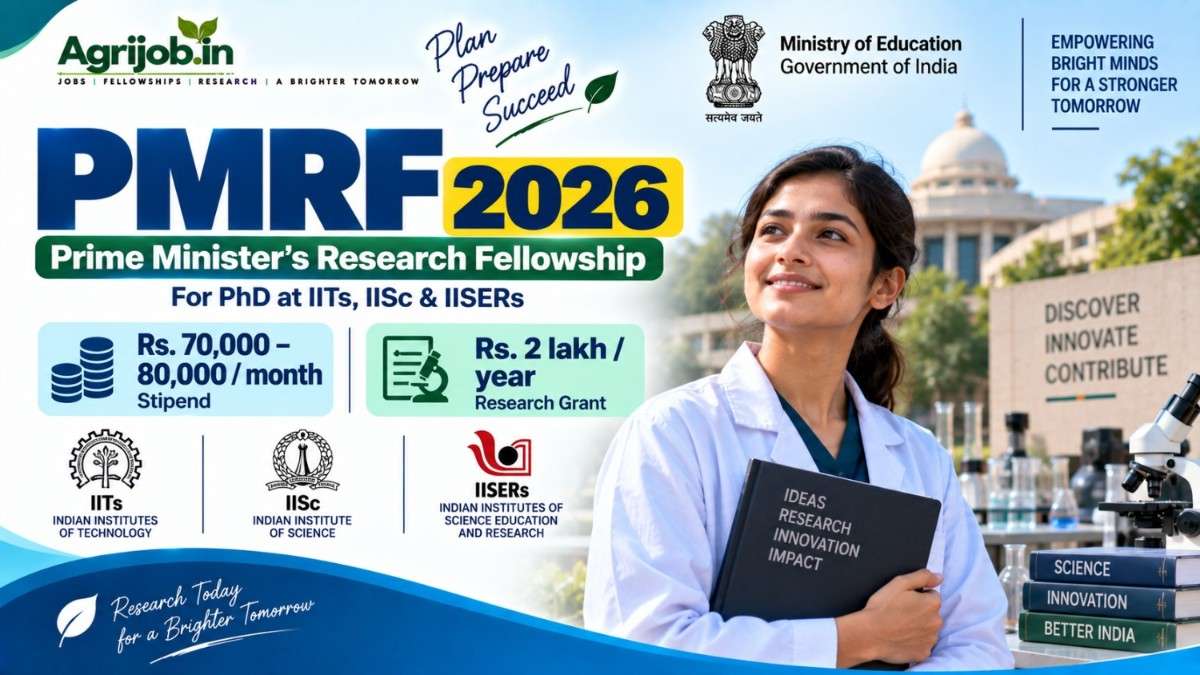
The Prime Minister’s Research Fellowship (PMRF) is a flagship doctoral fellowship scheme launched by the Government of India under the Ministry of Education to attract the brightest undergraduate and postgraduate talent into full-time PhD research at India’s premier science and technology institutions. PMRF is widely recognized as India’s most prestigious and highest-stipend PhD fellowship in the STEM domain — offering significantly more financial support than CSIR-JRF (Rs.37,000/month) or ICAR-JRF (Rs.37,000/month) or even INSPIRE (Rs.80,000/month but limited seats).
The fellowship is managed by a National Coordination Committee (NCC) and implemented through a National Coordinating Institute (NCI) — currently IIT Madras — appointed by the Ministry of Education. Each PMRF Granting Institute (GI) has an Institute Coordinator who serves as the primary point of contact for all PMRF fellows at that institution. The scheme runs two selection cycles every year — the May cycle and the December cycle — with nominations called from institutes in January/February and July/August respectively.

PMRF is not just a financial support programme. Fellows are expected to maintain a personal research webpage, complete mandatory Teaching Assistantship (TAship) of 50 hours per year outside their host institute, undergo rigorous annual reviews before a national panel, and demonstrate consistent research progress. The fellowship is designed to produce India’s next generation of world-class researchers — scholars who will lead India’s scientific ambitions at home and globally.
Who Should Apply for PMRF 2026?
PMRF targets a very specific, high-achieving profile of student. Here are the candidate types who are best positioned for this fellowship:
- 🎓 B.Tech / Integrated M.Tech graduates from IITs, NITs, IISERs, or IISc with a CGPA of 8.0 or above who are joining or have recently joined a PhD programme at a PMRF Granting Institute.
- 🔬 M.Sc graduates in Science or Technology from premier Indian institutions with CGPA 8.0+ and a GATE score of 650 or above, or a UGC/CSIR JRF rank of 100 or less, or an NBHM fellowship — and who have secured PhD admission at a PMRF-granting institute.
- 📐 M.Tech / MS by Research graduates who have qualified GATE, completed at least 4 courses with CGPA 8.0+ at a PMRF granting institute, and have been selected into the PhD programme at the same or another PMRF GI.
- 🧪 Current full-time PhD scholars at PMRF Granting Institutes who joined within the last 12–24 months (depending on entry level), have completed a minimum of 4 full PhD-level courses with CGPA 8.5+, and have not yet applied for PMRF twice under Lateral Entry.
- 🌐 Students from non-IIT/IISER institutions (other Indian universities) with CGPA 8.0+ who have also qualified GATE with a score of 650 or above in the relevant subject, or hold CSIR/UGC JRF rank within 100 — and who have secured PhD admission at a PMRF GI.
- 🏆 Students with NBHM fellowship who have completed or are pursuing a degree in Mathematics from a recognized Indian institution and have secured PhD admission at a PMRF-granting institute.
- 🌱 Interdisciplinary researchers combining STEM fields (e.g., computational biology, energy materials, data-driven agriculture, quantum computing) whose PhD research is hosted at a PMRF GI with an eligible supervisor.
- 👩🔬 Female STEM researchers — PMRF strongly encourages women’s participation in doctoral research and the scheme has no gender-based restrictions or age limits beyond academic eligibility.
PMRF 2026 Stipend — Rs.70,000 to Rs.80,000 Per Month Full Breakdown
The PMRF stipend structure is one of the most generous offered by any government-funded PhD fellowship in India. As per the official PMRF guideline document (updated 19 January 2026), the pay matrix applicable from Cycle 5 onwards is as follows:
| Year in PhD | Monthly Stipend | Annual Stipend |
|---|---|---|
| Year 1 | Rs.70,000 | Rs.8,40,000 |
| Year 2 | Rs.70,000 | Rs.8,40,000 |
| Year 3 | Rs.75,000 | Rs.9,00,000 |
| Year 4 | Rs.80,000 | Rs.9,60,000 |
| Year 5 | Rs.80,000 | Rs.9,60,000 |
| Total (5 years) | — | Rs.45,00,000 |
In addition to the monthly stipend, every PMRF scholar receives a research grant of Rs.2 lakh per year — totalling Rs.10 lakh over the full 5-year fellowship period. This research grant is intended to cover contingency expenses, laboratory materials, academic books, journal subscriptions, equipment, field visits, and conference travel. Institute overhead is charged on the research grant as per each institute’s existing norms.
The research grant can be carried forward across years. For scholars submitting their thesis on or after November 1, 2022, the research grant can be utilized right up to the date of the final Viva Voce examination or the end of the PMRF tenure, whichever is earlier. Any unspent balance must be refunded — with a 6-month post-PMRF window allowed for specific permitted expenditures such as conference costs, Q1 journal open-access publication fees, and IP protection costs.
Scholars admitted under Lateral Entry receive a tenure shorter than 5 years, depending on when they join relative to their PhD start date. Their total payable research grant varies from Rs.6 lakh to Rs.9 lakh depending on their lateral entry group. The monthly stipend values remain identical to Direct Entry (Rs.70,000–Rs.80,000) based on which year of PhD they are in at the time of PMRF selection.
PMRF 2026 Eligibility Criteria — Direct Entry vs Lateral Entry
PMRF offers two distinct entry channels — Direct Entry and Lateral Entry. Understanding which channel applies to you is the first and most critical step before applying. Both channels require different academic conditions and have different application windows.
Direct Entry Eligibility — PMRF 2026
You qualify for Direct Entry if you satisfy any ONE of the following three criteria within the preceding 3 years from the date of application submission:
- Criterion (a): Completed or pursuing final year of a 4/5-year UG, 5-year integrated M.Tech, 2-year M.Sc, or 5-year dual degree in Science & Technology from IISc, IITs, NITs, IISERs, IIEST, or centrally funded IIITs — with a CGPA of at least 8.0 (on a 10-point scale). For integrated/dual degree programmes where separate UG and PG CGPAs are awarded, only the UG portion (first 4 years) CGPA is considered. You must also have been selected into the PhD programme at a PMRF Granting Institute.
- Criterion (b): Completed or pursuing the final year of similar programmes from any other recognized Indian institution not covered in (a) — with a minimum CGPA of 8.0 AND any ONE of: GATE score of 650 or above in the relevant subject, UGC/CSIR JRF rank of 100 or less, or an NBHM fellowship. You must also have been selected into the PhD programme at a PMRF Granting Institute. (Note: Candidates with a foreign university degree are eligible under this criterion if all other conditions are met.)
- Criterion (c): Qualified GATE and currently pursuing or have completed M.Tech/MS by Research at a PMRF Granting Institute — with a minimum CGPA of 8.0 and at least 4 completed courses at the time of application. You must also have been selected into the PhD programme at a PMRF Granting Institute.
Important exclusions for Direct Entry: Candidates who converted from Masters to PhD programme are NOT eligible. Integrated PhD students completing their Masters requirement are NOT eligible for Direct Entry at that point. Candidates who deferred PhD admission are NOT eligible for Direct Entry at the time of joining.
Lateral Entry Eligibility — PMRF 2026
You qualify for Lateral Entry if you satisfy ALL of the following conditions simultaneously: