

IGIDR Post-Doctoral Fellowship 2026 is one of India’s most prestigious research fellowships for PhD holders — offering Rs.70,000 per month to conduct independent research at the Indira Gandhi Institute of Development Research (IGIDR), Mumbai, a Deemed University fully backed by the Reserve Bank of India. Applications for the 2026 cycle closed on September 4, 2026, with the fellowship commencing in August 2026. This guide covers everything you need — eligibility, stipend details, required documents, the application process, and how IGIDR compares against other top Indian post-doctoral fellowships.

The IGIDR Post-Doctoral Fellowship 2026 provides a consolidated monthly stipend of Rs.70,000 to up to 3 resident Indian PhD holders (under 40, with min. 55% in Master’s) in Economics, Public Policy, or Energy and Environment Policy, for an initial period of one year extendable to two, hosted at IGIDR’s Mumbai campus.
- Institute: Indira Gandhi Institute of Development Research (IGIDR), Mumbai
- Fellowship Type: Post-Doctoral Research Fellowship (PDF Programme)
- Number of Positions: Up to 3 per year
- Monthly Stipend: Rs.70,000 (consolidated)
- Fellowship Duration: 1 year (extendable by 1 more year)
- Contingency Grant: Up to Rs.50,000/year for research expenses
- Accommodation: Campus accommodation on sharing basis (subject to availability)
- Age Limit: Below 40 years
- Minimum Marks: 55% aggregate in Master’s degree
- Application Email: pdf@igidr.ac.in
- Official Website: www.igidr.ac.in
- Funded by: Reserve Bank of India (RBI)
📋 Table of Contents
- What Is the IGIDR Post-Doctoral Fellowship?
- Who Should Apply for IGIDR PDF 2026?
- Stipend and Financial Support Details
- Eligibility Criteria for IGIDR PDF 2026
- How to Apply for IGIDR Post-Doctoral Fellowship 2026
- IGIDR PDF vs Other Indian Post-Doctoral Fellowships
- Advantages and Disadvantages of IGIDR PDF
- Important Terms Related to Post-Doctoral Fellowships
- Important Dates and Timeline
- Important Links
- Conclusion
- Key Takeaways
- Frequently Asked Questions
What Is the IGIDR Post-Doctoral Fellowship 2026?
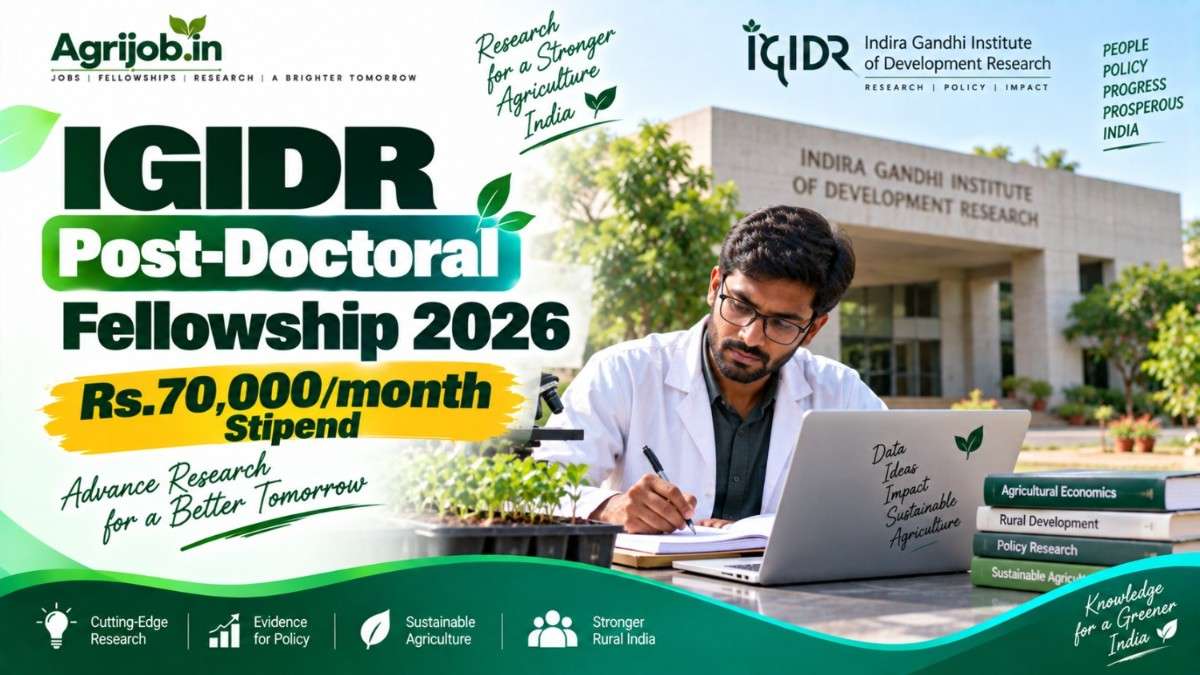
The IGIDR Post-Doctoral Fellowship (PDF) Programme is a structured advanced research opportunity offered by the Indira Gandhi Institute of Development Research, a premier economic research institution established in 1987 and recognised as a Deemed University under the UGC Act. The fellowship supports up to 3 PhD scholars per year to conduct independent research at IGIDR’s Mumbai campus, with a consolidated monthly stipend of Rs.70,000 and an additional contingency grant of up to Rs.50,000 per year for field trips, conferences, books, and research-related expenses.

IGIDR is unique in Indian academia — it is fully funded by the Reserve Bank of India (RBI), giving it unparalleled access to data, financial infrastructure, and policy networks. The institute’s faculty publishes in top global journals including the Journal of Development Economics, Economic Journal, and Journal of Environmental Economics. Fellows at IGIDR are expected to produce at least 2 working papers per year and deliver at least 2 seminars annually at the institute, contributing to a dynamic intellectual environment. The fellowship is not a faculty position — it is an independent research grant, making it ideal for researchers who want academic freedom before committing to a permanent role.
The fellowship is granted for an initial period of one year, and upon satisfactory progress review, it may be extended for a second year. Fellows receive office space, full access to the IGIDR library and computing infrastructure, and may be invited to participate in institute conferences, workshops, and limited teaching activities. This exposure to IGIDR’s broader academic community — visiting faculty, RBI economists, and international researchers — is a significant non-monetary benefit of the programme.
Who Should Apply for IGIDR Post-Doctoral Fellowship 2026?
- 🎓 Recent PhD graduates who completed their doctoral thesis in the last 6 months and want a structured research environment before applying for faculty positions.
- 📊 Economists and development researchers with a PhD in Economics or Public Policy who want to produce peer-reviewed publications in a high-credibility setting.
- 🌿 Energy and environment policy researchers with a doctoral background in environmental economics, climate change, or sustainable development studies.
- 🏛️ Junior faculty at universities or colleges who want a temporary research sabbatical with a Rs.70,000/month stipend and a chance to publish in top journals.
- 📚 Candidates with strong publication records who want to leverage IGIDR’s institutional affiliation to increase the visibility and impact of their research.
- 💡 Policy researchers interested in working on areas like financial inclusion, agricultural economics, energy policy, or India’s macroeconomic landscape — topics central to IGIDR’s research agenda.
- 🔬 Quantitative researchers skilled in econometrics, R, Stata, or Python who can contribute to data-driven development research in collaboration with IGIDR faculty.
- 🌏 Scholars under 40 who are Indian nationals and have secured at least 55% in their Master’s degree, regardless of whether their PhD was awarded from an Indian or foreign university.
Stipend and Financial Support: IGIDR PDF 2026 Salary Details
The IGIDR Post-Doctoral Fellowship 2026 stipend is Rs.70,000 per month, paid as a consolidated amount for the duration of the fellowship. This is among the highest research fellowship stipends offered by any Indian institute outside the IITs and IISc. The total package — including contingency grants and campus accommodation — makes it one of the most financially competitive post-doctoral research opportunities in India for economists and policy researchers.
| Financial Component | Amount / Details |
|---|---|
| Monthly Stipend | Rs.70,000 (consolidated) |
| Annual Stipend (Year 1) | Rs.8,40,000 |
| Contingency Grant | Up to Rs.50,000/year (against bills) |
| Total Potential Value (2 Years) | Rs.17,80,000 (stipend + contingency) |
| Campus Accommodation | Provided on sharing basis (subject to availability) |
| Junior Faculty Salary Protection | IGIDR may protect salary up to lecturer/assistant professor scale (at Director’s discretion) |
| Office Space & Infrastructure | Included — library, computing, internet, seminar access |
| Income Tax | Fellowship subject to applicable Indian income tax rules |
Fellows who are currently employed as junior faculty at academic institutions can apply with their institution’s prior approval — and IGIDR may, at the Director’s discretion, protect the fellow’s salary up to the lecturer/assistant professor pay scale if their existing salary exceeds the fellowship amount. The contingency grant of up to Rs.50,000/year can be used for field research costs, academic books, data subscriptions, conference registrations, and other research-related expenses, subject to bill submission.
Eligibility Criteria for IGIDR Post-Doctoral Fellowship 2026
To be eligible for the IGIDR Post-Doctoral Fellowship 2026, candidates must meet all of the following conditions. The PDF Committee evaluates applications holistically, giving significant weight to publication quality, research proposal strength, and dissertation supervisor recommendations.
- ✅ Nationality: Must be a resident Indian national
- ✅ Age Limit: Below 40 years of age as of the application date
- ✅ Master’s Marks: Minimum 55% aggregate marks (or equivalent grade) in the Master’s degree
- ✅ PhD Qualification: Must hold a PhD degree in the broad areas of Economics, Public Policy, or Energy and Environment Policy
- ✅ Thesis Submission: Candidates who submitted their PhD thesis by July 31, 2026 are also eligible to apply (awaiting award)
- ✅ Junior Faculty: Researchers currently employed as junior faculty at academic institutions are eligible — but applications must be routed through their institution via proper channel
- ✅ Priority Candidates: Those who completed their PhD thesis within the last 6 months, or have a strong publication record, are given preference in selection
| Eligibility Parameter | Requirement |
|---|---|
| Nationality | Resident Indian |
| Age Limit | Below 40 years |
| Master’s Degree Marks | Minimum 55% aggregate (or equivalent) |
| Doctoral Degree | PhD in Economics / Public Policy / Energy & Environment Policy |
| Thesis Submission Cut-off | July 31, 2026 (for thesis-submitted candidates) |
| Junior Faculty Eligibility | Yes — with institutional routing |
| Publication Preference | Strong publication record preferred |
| Number of Positions | Up to 3 per year |
How to Apply for IGIDR Post-Doctoral Fellowship 2026 — Step-by-Step
Applications for the IGIDR PDF Programme are accepted via email and post. The process requires assembly of a detailed application dossier that includes your academic record, research proposal, writing samples, and letters of recommendation. Incomplete applications are typically not considered.
- Visit the official IGIDR website at www.igidr.ac.in and navigate to the ‘Post-Doctoral Fellowship’ or ‘Fellowships’ section to download the latest notification and application guidelines.
- Prepare your Curriculum Vitae (CV) with your complete academic history, all publications (journal articles, conference papers, working papers), awards, and research experience. Include the list of publications with full citation details.
- Write your research proposal — a concise document of not more than 3 pages describing your proposed plan of post-doctoral work at IGIDR, the research questions you intend to address, the methodology, and expected outputs.
- Prepare a PhD synopsis — a brief summary of your doctoral dissertation. If specifically requested by the committee, be prepared to submit a full copy of your thesis.
- Select one Writing Sample — this should be an article, scholarly paper published or presented in an academic journal or conference, or an extract from your past academic work that best demonstrates your research quality.
- Arrange two Recommendation Letters — at minimum one must be from your PhD dissertation supervisor. The second can be from a senior academic or researcher familiar with your work. Recommenders must send their letters directly to IGIDR at pdf@igidr.ac.in.
- Obtain your PhD certificate or provisional award letter — attach a photocopy of your PhD degree certificate, or a certificate from your university registrar/HoD confirming provisional PhD award if the degree has not been formally conferred yet.
- Junior faculty applicants must obtain institutional permission and route the application through their institution. An advance copy may be sent directly to IGIDR for preliminary consideration.
- Send your complete application by email to pdf@igidr.ac.in with the subject line: APPLICATION FOR POST-DOCTORAL FELLOWSHIP PROGRAMME [Current Year]. Alternatively, send by post to IGIDR, Gen. A. K. Vaidya Marg, Goregaon East, Mumbai – 400 065.
- Await shortlisting notification — only shortlisted candidates are contacted by email for an interview conducted at IGIDR Mumbai. Candidates not shortlisted are typically not notified individually.
Your 3-page research proposal is the single most important document in your IGIDR PDF application. The PDF Committee specifically evaluates originality of your research question, methodological feasibility, and alignment with IGIDR’s core research areas — Economics, Development Studies, and Energy and Environment Policy. Reference at least one IGIDR working paper or faculty publication in your proposal to signal genuine engagement with the institute’s academic agenda.
IGIDR PDF vs Other Indian Post-Doctoral Fellowships — Comparison
When choosing a post-doctoral fellowship in India, researchers must consider stipend value, research freedom, institutional prestige, and long-term career impact. Here is how the IGIDR PDF 2026 compares against comparable Indian post-doctoral schemes for economists and social scientists.
| Parameter | IGIDR PDF 2026 | ICSSR PDF 2026 | UGC Post-Doctoral Fellowship |
|---|---|---|---|
| Monthly Stipend | Rs.70,000 | Rs.50,000 | Rs.38,000–Rs.40,000 |
| Contingency Grant | Up to Rs.50,000/year | Up to Rs.50,000/year | Rs.20,000/year |
| Duration | 1 year (extendable to 2) | 2 years | 2 years |
| Positions Available | Up to 3/year | Multiple (open) | Multiple (open) |
| Accommodation | Campus (sharing basis) | No | No |
| Institutional Affiliation | IGIDR (RBI-funded, Deemed University) | Any ICSSR-affiliated institution | Any UGC-recognised university |
| Discipline Focus | Economics, Public Policy, Energy & Environment | Social Sciences (broad) | All disciplines |
| Selectivity | Very High (3 seats, national) | Moderate | Moderate |
| Research Freedom | High — independent research plan | Moderate | Moderate |
| Career Signal | Very High (RBI-backed institution) | High | Moderate |
For economists and development researchers, the IGIDR PDF 2026 is the strongest post-doctoral fellowship in India — not just for the Rs.70,000 monthly stipend, but for the institutional prestige, RBI data access, and the calibre of collaborators. With only 3 seats nationally, competition is intense, but a strong publication record and a well-defined 3-page research proposal significantly improve shortlisting odds. If your research aligns with IGIDR’s areas (macro/micro economics, energy policy, development), prioritise this fellowship over ICSSR or UGC options.
Advantages and Disadvantages of IGIDR Post-Doctoral Fellowship
Like any research fellowship, the IGIDR PDF has distinct strengths and a few practical limitations. Here is an honest, balanced assessment to help you make an informed decision.
✅ Advantages
- Highest stipend in category: Rs.70,000/month is among the highest post-doctoral stipends offered by any Indian research institution in economics and social sciences.
- RBI-funded institutional prestige: IGIDR’s affiliation with the Reserve Bank of India opens doors to high-impact policy research, data access, and professional networks not available at regular universities.
- Full research independence: Fellows pursue their own research agenda — no mandatory teaching load, no departmental admin. Your time is your research time.
- Campus accommodation included: Sharing-basis accommodation on IGIDR’s Mumbai campus significantly reduces the cost of living for fellows relocating from other cities.
- Contingency grant of Rs.50,000/year: Covers conference travel, books, data access, and field research costs — a real advantage for empirical researchers.
- Career signal for academia: An IGIDR post-doctoral fellowship on your CV significantly strengthens applications to IITs, IIMs, and international universities.
⚠️ Disadvantages
- Extremely limited seats: Only up to 3 fellowships are offered nationally per year, making the acceptance rate very low for a national-level search.
- Mumbai cost of living: Despite campus accommodation, Mumbai’s high cost of living means the stipend leaves limited room for personal savings after essential expenses.
- Not linked to faculty hiring: IGIDR explicitly states that the PDF is a full-time fixed-term position unrelated to entry-level faculty positions at the institute — this manages expectations clearly but can be a limitation for those hoping for a direct conversion to a faculty role.
- No application fee waiver or TA for interview: Travel costs to Mumbai for the interview are not reimbursed (unlike IGIDR’s PhD programme which provides second-class rail fare).
Important Terms Related to Post-Doctoral Fellowships in India
Understanding these key terms will help you navigate the IGIDR fellowship application and the broader post-doctoral research ecosystem in India in 2026.
- Post-Doctoral Fellowship (PDF): A research position for PhD holders, typically lasting 1–3 years, designed to enable independent scholarly work and publication before a permanent academic appointment. Stipends in India range from Rs.35,000 to Rs.70,000/month depending on the institute.
- Consolidated Stipend: A fixed monthly payment that includes all components (basic pay, HRA, etc.) in one amount. IGIDR’s Rs.70,000 is a consolidated amount — no separate allowances are paid on top.
- Contingency Grant: A supplementary research allowance (up to Rs.50,000/year at IGIDR) usable for specific research-related expenses — books, conference fees, travel, computing — upon submission of bills.
- PDF Committee: IGIDR’s internal selection committee that evaluates post-doctoral applications based on the quality of research proposal, academic record, publications, and a personal interview at Mumbai.
- Working Paper: A research article in pre-publication form. IGIDR’s working paper series is internationally indexed; producing 2+ per year is a mandatory deliverable for PDF fellows.
- Deemed University: An institution recognised by the UGC under Section 3 of the UGC Act as having university-level academic standards. IGIDR has this status, giving its programmes national academic recognition.
- UGC-JRF / CSIR-JRF: Junior Research Fellowships awarded by UGC and CSIR — required for admission to IGIDR’s PhD programme, but not mandatory for the Post-Doctoral Fellowship.
- RBI Funded Institution: IGIDR is one of very few Indian research institutions whose core funding comes from the Reserve Bank of India, giving it financial stability, policy influence, and access to RBI datasets for research.
- E-E-A-T in Research Context: In academic research, Experience-Expertise-Authoritativeness-Trustworthiness maps to your publication record, institutional affiliation, citation count, and thesis quality — all factors the IGIDR PDF Committee weighs.
- Salary Protection: For junior faculty applicants, IGIDR may protect the fellow’s existing salary up to the lecturer/assistant professor scale if it exceeds Rs.70,000/month — a provision that makes the fellowship viable even for established early-career academics.
Important Dates and Timeline — IGIDR PDF 2026
| Event | Date / Status |
|---|---|
| Application Window Opens | Rolling (applications accepted anytime at pdf@igidr.ac.in) |
| PhD Thesis Submission Cut-off (for thesis-submitted candidates) | July 31, 2026 |
| 2026 Cycle Application Deadline | September 4, 2026 |
| Fellowship Commencement (2026 cohort) | August 2026 |
| Shortlisting Notification | By email (only shortlisted candidates informed) |
| Interview (at IGIDR, Mumbai) | As notified after shortlisting |
| Fellowship Duration | 1 year (extendable to max 2 years) |
| Next Cycle Applications | Rolling — email pdf@igidr.ac.in anytime for the 2027 cycle |
Important Links — IGIDR Post-Doctoral Fellowship 2026
| Link Name | URL |
|---|---|
| IGIDR Official Website | www.igidr.ac.in |
| IGIDR Post-Doctoral Fellowship Page | igidr.ac.in/pdf |
| Application Email | pdf@igidr.ac.in |
| Reserve Bank of India (Funding Body) | www.rbi.org.in |
| UGC Post-Doctoral Fellowship (Alternative) | www.ugc.gov.in |
| ICSSR Post-Doctoral Fellowship (Alternative) | icssr.org |
| NABARD Research Fellowship (Related) | www.nabard.org |
Conclusion — Is IGIDR Post-Doctoral Fellowship 2026 Worth Applying For?
The IGIDR Post-Doctoral Fellowship 2026 is unquestionably one of the best post-doctoral opportunities available to economists and policy researchers in India — combining a Rs.70,000 monthly stipend, an additional Rs.50,000 contingency grant, campus accommodation, and the prestige of an RBI-backed institution with a global research footprint. For PhD holders in Economics, Public Policy, or Energy and Environment Policy who are under 40, the fellowship offers a rare combination of financial support, research freedom, and institutional credibility that very few Indian fellowships can match. Although the 2026 application deadline of September 4, 2026 has passed, applications for the next cycle are accepted on a rolling basis at pdf@igidr.ac.in — bookmark this page and check the official IGIDR website regularly for updated notifications.
- IGIDR Post-Doctoral Fellowship 2026 offers a Rs.70,000/month consolidated stipend — among the highest for economics researchers in India.
- Up to 3 positions are available nationally; eligibility requires a PhD in Economics, Public Policy, or Energy and Environment Policy with under 40 years of age and 55% in Master’s.
- The 2026 application deadline was September 4, 2026; the fellowship runs for 1 year, extendable to a maximum of 2 years.
- Fellows must produce at least 2 working papers and deliver 2 seminars per year at IGIDR as part of their research responsibilities.
- Applications are submitted via email to pdf@igidr.ac.in — a rolling process that accepts candidates for future cycles year-round.
- IGIDR PDF outperforms ICSSR and UGC post-doctoral fellowships on stipend, prestige, research access, and campus infrastructure.
Frequently Asked Questions About IGIDR Post-Doctoral Fellowship 2026
What is the IGIDR Post-Doctoral Fellowship stipend in 2026?
The IGIDR Post-Doctoral Fellowship 2026 provides a consolidated monthly stipend of Rs.70,000. Additionally, fellows receive a contingency grant of up to Rs.50,000 per year for research-related expenses such as books, conference fees, field travel, and computing costs — subject to submission of bills. Campus accommodation on a sharing basis may also be provided depending on availability.
What is the age limit for IGIDR PDF 2026?
Applicants must be below 40 years of age at the time of application. This is a strict requirement applicable to all candidates. There is no age relaxation mentioned in the official IGIDR fellowship guidelines for any category.
Who is eligible for IGIDR Post-Doctoral Fellowship 2026?
Eligible candidates must be resident Indians under 40 years of age who hold a PhD in Economics, Public Policy, or Energy and Environment Policy with a minimum of 55% aggregate marks in their Master’s degree. Candidates who submitted their PhD thesis by July 31, 2026 are also eligible. Junior faculty currently employed at academic institutions may also apply with proper institutional routing.
How many IGIDR post-doctoral fellowship positions are available in 2026?
IGIDR offers up to 3 post-doctoral fellowship positions per year. These are full-time, fixed-term research positions with a maximum duration of two years. Given the limited seats and national applicant pool of PhD economists and policy researchers, competition is intense and a strong research proposal and publication record are critical differentiators.
What documents are required to apply for IGIDR PDF 2026?
The IGIDR PDF application requires: (1) a detailed CV with full publication list, (2) a synopsis of your PhD thesis, (3) a proposed research plan of not more than 3 pages, (4) one writing sample — a published/presented academic paper or thesis extract, (5) two letters of recommendation (at least one from your dissertation supervisor, sent directly to pdf@igidr.ac.in by the recommender), and (6) a photocopy of your PhD certificate or a provisional award letter from your university registrar.
How is selection done for IGIDR Post-Doctoral Fellowship?
The IGIDR PDF Committee evaluates applications based on the quality of the research proposal, academic track record (publications, citations, thesis quality), and a personal interview conducted at IGIDR’s Mumbai campus. Only shortlisted candidates are contacted for the interview. The final admission is subject to approval from the candidate’s parent institution if they are currently employed as faculty.
Is the IGIDR Post-Doctoral Fellowship related to faculty positions at IGIDR?
No. IGIDR explicitly states that the Post-Doctoral Fellowship is a full-time, fixed-term position that is not related to entry-level faculty positions at IGIDR. The PDF programme is an independent research fellowship, not a faculty recruitment pathway. Candidates should apply to IGIDR’s separate faculty recruitment process if they are seeking a permanent academic position at the institute.
Can PhD thesis-submitted candidates apply for IGIDR PDF 2026?
Yes. Candidates who have submitted their PhD thesis by July 31, 2026 are eligible to apply for the IGIDR PDF 2026 cycle, even if the PhD degree has not been formally awarded yet. They must provide a certificate from their university registrar or Head of Department confirming the provisional PhD award or thesis submission status.
What are the research responsibilities of IGIDR PDF fellows?
IGIDR PDF fellows are expected to pursue an independent research plan and produce at least 2 working papers per year and deliver at least 2 seminars per year at IGIDR based on their fellowship research. They are also encouraged to participate in institute activities including conferences, workshops, and limited teaching engagements, though teaching is not a mandatory component of the fellowship.
How does IGIDR PDF compare to UGC and ICSSR post-doctoral fellowships?
The IGIDR PDF 2026 offers a significantly higher stipend (Rs.70,000/month versus Rs.38,000–Rs.50,000 from UGC/ICSSR), campus accommodation, and the unique advantage of being hosted at an RBI-backed research institution. However, it has only 3 national seats per year and is restricted to Economics, Public Policy, and Energy-Environment research areas — making it more selective but significantly more prestigious and financially rewarding than UGC or ICSSR post-doctoral schemes.
Last Updated: September 2026 | This article is reviewed regularly to reflect the latest official IGIDR fellowship notifications. Bookmark this page and visit www.igidr.ac.in for updates.
Disclaimer: This article is based on information published on the official IGIDR website (igidr.ac.in), verified secondary sources, and publicly available fellowship notifications as of September 2026. Stipend amounts, eligibility criteria, and application deadlines are subject to revision by IGIDR. Readers are strongly advised to verify all details directly from the official IGIDR website and the fellowship notification before applying. This content is for informational purposes only and does not constitute official recruitment advice.