

Rainwater Harvesting for Farms 2026: Legal Requirements by State + Storage System Cost Guide
Rainwater harvesting for farms in 2026 has moved from a niche sustainability practice to a mainstream water management strategy — driven by rising municipal water costs, tightening groundwater regulations, and the simple economic reality that free water falling on your barn roof can replace expensive pumped or purchased water for livestock, irrigation, and equipment washing. The key questions every farm operator must answer before installing a system are: is it legal in my state, what size system do I need, what will it cost, and what financial support is available? This complete 2026 guide answers all four — with a verified state-by-state legal status breakdown for all 50 states, a full cost guide covering systems from $150 rain barrels to $68,000 large-volume agricultural cisterns, the sizing formula every farmer needs ($600 gallons per 1,000 sq ft of roof per inch of rain), USDA EQIP funding that can cover 50–90% of installation cost, and the real ROI calculation from water savings, stormwater fee reductions, and improved drought resilience on working farms.

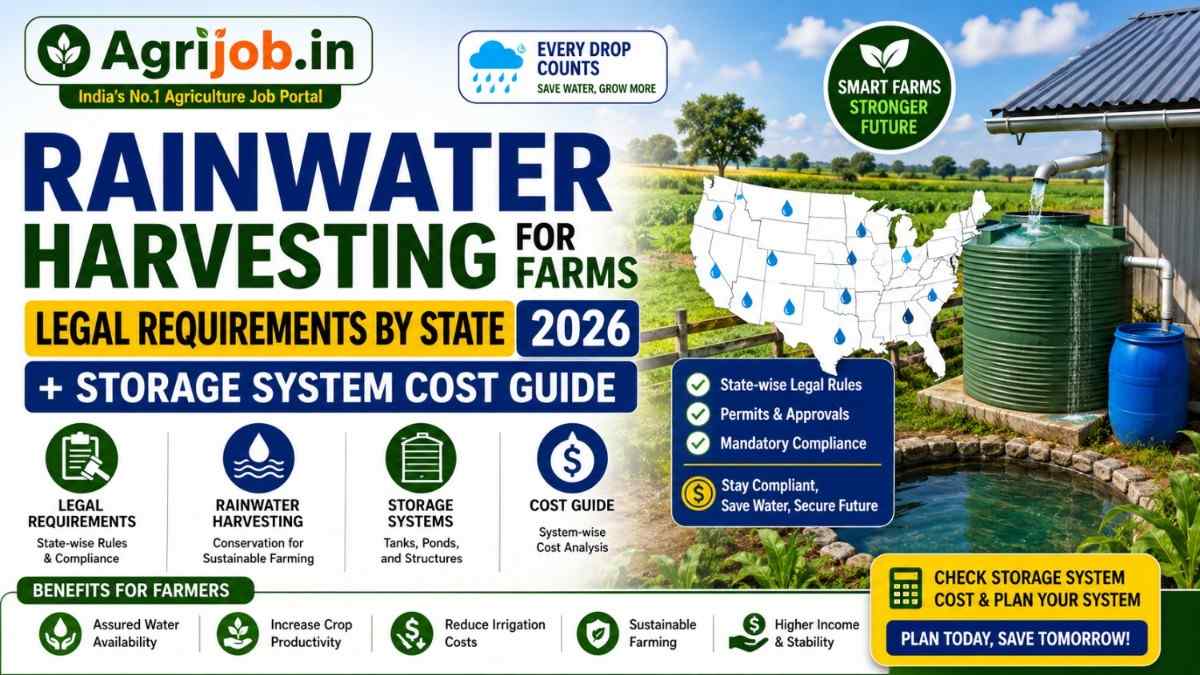
| Legal Status (All 50 States, 2026) | Legal in all 50 states — no complete bans anywhere |
| Most Restrictive State | Colorado — max 110 gallons residential; ag permits available |
| Most Permissive States | Texas, Florida, Ohio, Kentucky — no limits, no permits |
| States with Tax Incentives | TX, CA, VA, RI, AZ — tax exemptions or credits on equipment |
| Rain Barrel Cost Range | $70–$840 (55-gallon most common at ~$140) |
| Above-Ground Cistern (5,000 gal poly) | $2,000–$4,000 tank + $1,500–$3,000 installation |
| Underground Cistern (5,000 gal) | $6,500–$24,000 installed |
| Large Agricultural Tank (corrugated steel) | $19,000–$68,000 (20,000–100,000 gallons) |
| Cost Per Installed Gallon (2026) | $1.50–$7.00 depending on system type and material |
| Collection Formula | 1 inch rain × 1,000 sq ft roof = ~620 gallons |
| Annual Maintenance Cost | $100–$1,000 depending on system complexity |
| USDA EQIP Cost-Share (2026) | 50%–90% for qualifying farms and beginning farmers |
- Why Farm Rainwater Harvesting Makes Economic Sense in 2026
- Federal Law and the Three Levels of Regulation Explained
- State-by-State Legal Status: Rainwater Harvesting for Farms 2026
- How Much Rainwater Can Your Farm Buildings Collect?
- Storage System Cost Guide: Rain Barrels to Large Agricultural Cisterns
- Tank Material Comparison: Poly, Steel, Fiberglass, and Concrete
- Best Uses for Harvested Rainwater on Working Farms
- USDA EQIP and Federal Funding for Farm Rainwater Systems 2026
- ROI Analysis: When Does Farm Rainwater Harvesting Pay for Itself?
- Who Should Install a Farm Rainwater Harvesting System in 2026?
- Complete Rainwater Storage System Comparison Table 2026
- Key Rainwater Harvesting Terms Every Farmer Must Know
- Frequently Asked Questions
Why Farm Rainwater Harvesting Makes Economic Sense in 2026
Agriculture accounts for roughly 80% of consumptive water use in the western United States — and the cost of that water is rising on every front. Municipal water rates have climbed 15–20% in most US markets over the past three years. Groundwater pumping costs are increasing as aquifer levels decline and lift depths increase. Water allocation restrictions are tightening in drought-stressed basins across California, Arizona, Texas, and the Great Plains. Against this backdrop, rainwater harvesting represents the most straightforward water cost reduction available to farm operators in 2026: capturing free water that would otherwise become runoff, storing it on-site, and deploying it for irrigation, livestock watering, and farm operations when it is needed most.
The economics are compelling and accessible. A properly sized rainwater harvesting system can reduce a farm’s water costs by 40–50% by offsetting high-volume outdoor irrigation and livestock watering use. For commercial farms, the payback period is often just a few years. Having a backup water source during drought restrictions or municipal line breaks also provides operational resilience that is hard to put a price on. And critically — rainwater collection is legal in all 50 US states in 2026, though Colorado, Utah, and Nevada have specific limitations on storage amounts or require registration for larger systems. For virtually every farm operator in America, rainwater harvesting is a legal, practical, and financially attractive investment in water security.

Federal Law and the Three Levels of Regulation Explained
Before reviewing individual state rules, every farmer needs to understand the three-level regulatory framework that governs rainwater harvesting in 2026 — because the right to collect water on your farm is determined by a layered system, not a single authority.
- 🏛️ Federal level — No restrictions: The federal government imposes no restrictions on rainwater collection at the national level. No federal law prohibits, limits, or requires permits for rainwater harvesting on private property. This is a settled, consistent position across all administrations.
- 🗺️ State level — Primary regulatory authority: Individual states regulate water rights, storage volume limits, permitted uses of harvested rainwater, and any permit or registration requirements for larger systems. This is the most consequential level for farm operators — and the one that varies most dramatically across the country. State law sets the floor; local ordinances can add additional requirements on top of state law but cannot be more permissive than state restrictions.
- 🏘️ Local level — Building codes and permits: Cities and counties control building codes for tank installation, plumbing permits for indoor rainwater connections, overflow drainage requirements, and in some cases aesthetic restrictions on visible storage tanks. Even in fully permissive states, large cisterns typically require a local building permit and inspection. Homeowner Association (HOA) covenants may restrict visible storage — though Texas state law explicitly prohibits HOAs from banning rainwater harvesting systems.
The historical reason western states developed restrictions stems from prior appropriation water law. Under strict interpretation of prior appropriation, every drop of rain that falls on a watershed “belongs” to downstream rights holders — so intercepting it on your roof is technically diverting someone else’s legal water allocation. While modern studies show that individual farm rainwater collection has a negligible impact on the broader water cycle, these old laws were slow to change, which is why volume limits still exist in Colorado and a few other western states. Most states have significantly liberalised their rules in the past decade, and the trend continues toward greater permissiveness for agricultural operations specifically.
State-by-State Legal Status: Rainwater Harvesting for Farms 2026
Here is the complete 2026 legal landscape for agricultural rainwater harvesting across all key farming states — organised from most permissive to most restrictive. Always verify current law with your state’s department of water resources before installing any large-scale farm system, as regulations can change annually.
| State | Legal Status (2026) | Volume Limit | Permit Required? | Financial Incentives | Agricultural Notes |
|---|---|---|---|---|---|
| Texas | ✅ Fully legal + encouraged | None | No | Sales tax exemption on equipment | Most permissive state; HOA prohibition on bans; ag operations fully unrestricted |
| Florida | ✅ Legal, no restrictions | None | No | County rebates (Tampa Bay, others) | Highly encouraged; check local aesthetic ordinances for visible tanks |
| Ohio | ✅ Fully legal, unrestricted | None | No | None statewide | Riparian rights state — rain on your property is yours; OSU Extension supports farm systems |
| Kentucky | ✅ Legal, no restrictions | None | No | Lexington grants available | State actively promotes farm rainwater harvesting through On-Farm Water Management Programme |
| Tennessee | ✅ Legal, no restrictions | None | No | None statewide | SB 2417/HB 1850 supports harvesting as green infrastructure; non-potable use only without treatment |
| Virginia | ✅ Legal + encouraged | None | No | Tax deduction for equipment | Encouraged as stormwater management; tax deduction applicable to farm equipment purchases |
| Alabama | ✅ Legal + supported | None | Commercial: design may be required | Limited (mainly public bodies) | Agricultural systems: may require professional design for indoor non-potable; outdoor irrigation unrestricted |
| Louisiana | ✅ Legal + encouraged | None | No | None statewide | Covered cisterns required in New Orleans; agricultural outdoor use unrestricted |
| Maine | ✅ Legal, no restrictions | None | No | Portland stormwater fee offsets | No state regulations; some cities issue stormwater fees for improved systems |
| Maryland | ✅ Legal | None | No | Montgomery County rebates | Widely supported; farm systems encouraged as part of stormwater management |
| Delaware | ✅ Legal + incentivised | None | No | State incentive programmes | State actively sponsors incentive programmes for rainwater collection |
| California | ✅ Legal + encouraged | None (residential) | No (residential); large ag: check local | SB-558 property tax exemption for new systems | Rainwater Capture Act 2012 fully legalised for residential, commercial, and ag; check county requirements for large farm cisterns |
| Arizona | ✅ Legal under most circumstances | None | Large cisterns: check county | Tucson: commercial rainwater requirement + residential incentives | Tucson mandates commercial rainwater for landscape use since 2010; farm surface water collection generally allowed |
| Rhode Island | ✅ Legal + incentivised | None (residential) | No | Financial incentives available | Incentives specifically for residential and farm collection systems |
| Oregon | ✅ Legal (rooftop sources) | None (rooftop); other sources may need water right permit | Large cisterns: county permit | Local water district rebates | Rooftop collection fully unrestricted; capturing from streams or other sources requires water right permit; permit required for cisterns above 1,000 gallons in some counties |
| Kansas | ✅ Legal (domestic use) | None (domestic) | Yes — for non-domestic/ag use | None statewide | Kansas Water Appropriation Act protects domestic rainwater rights; ag use may require Department of Agriculture permit |
| Arkansas | ✅ Legal | None | Yes — indoor plumbing systems require licensed PE design | None statewide | Outdoor irrigation: no restrictions; indoor non-potable plumbing systems require professional engineer design under Arkansas Plumbing Code |
| Georgia | ⚠️ Regulated | None stated | Outdoor only; indoor requires compliance with state plumbing code | None statewide | Must be used for outdoor purposes only unless in full compliance with Environmental Protection Division requirements; Department of Natural Resources oversight |
| Illinois | ⚠️ Highly regulated | None stated | Yes — non-potable indoor use requires plumbing compliance | None statewide | SB0038: collected rainwater can only be used for non-potable purposes; rainwater harvesting systems must meet plumbing code; outdoor farm irrigation generally unrestricted |
| Nevada | ⚠️ Volume limits/registration | Registration required for larger systems | Yes — for larger systems | None statewide | Registration required for systems above certain volume thresholds; contact Nevada Division of Water Resources for current farm thresholds |
| Utah | ⚠️ Recently liberalised | Permit required for systems above 2,500 gallons | Yes — for systems above 2,500 gallons | None statewide | Significant reform since prior strict restrictions; residential up to 2,500 gallons now permitted; larger farm systems require water right permit |
| Colorado | ⚠️ Most restrictive state | 110 gallons (2 × 55-gal barrels) residential; ag permits available | Yes — agricultural permit through state water engineer | None statewide | Most restrictive residential rules; agricultural operations can apply for water right permits for larger collection; contact Colorado Division of Water Resources for current farm permit process |
Key takeaway for farm operators: The laws primarily affect large-scale commercial or agricultural installations — in practice, collecting a barrel of rainwater during an emergency is unlikely to attract enforcement attention even in states with restrictions. Restrictions almost never mean a complete ban. Agricultural operations in even the most regulated states — Colorado, Utah, Nevada — have pathways to legally collect and store rainwater through state water engineer permit processes specifically designed for farm water management. The important step is applying for the correct permit before installing a large system, not after.
How Much Rainwater Can Your Farm Buildings Collect in 2026?
Before choosing a storage system, every farm operator needs to calculate their potential annual rainwater yield from existing roof surfaces — the primary catchment source for most farm harvesting systems. The standard collection formula is straightforward and highly reliable:
The Collection Formula: 1 inch of rain on 1,000 square feet of roof area yields approximately 600–620 gallons of harvestable rainwater. Or expressed differently: Roof Area (sq ft) × Annual Rainfall (inches) × 0.623 = Annual Harvestable Volume (gallons).
| Farm Building | Roof Area | Annual Rainfall | Annual Harvestable Volume | Recommended Tank Size |
|---|---|---|---|---|
| Small equipment shed (20×30 ft) | 600 sq ft | 25 inches (Great Plains) | ~9,345 gallons/year | 2,500–5,000 gallon tank |
| Medium barn (30×50 ft) | 1,500 sq ft | 30 inches (Midwest) | ~28,035 gallons/year | 5,000–10,000 gallon tank |
| Large machine shed (60×100 ft) | 6,000 sq ft | 40 inches (Southeast) | ~149,520 gallons/year | 20,000–30,000 gallon system |
| Grain storage building (80×120 ft) | 9,600 sq ft | 20 inches (High Plains) | ~119,616 gallons/year | 20,000–40,000 gallon system |
| Large dairy or poultry barn (100×200 ft) | 20,000 sq ft | 35 inches (Southeast) | ~436,100 gallons/year | Pond or large cistern system |
Practical collection efficiency is 80–90% of theoretical yield due to first-flush diversion (the first 10–20 gallons per 1,000 sq ft of each rain event are diverted to prevent roof contamination from entering storage), evaporation, and distribution losses. Factor the 80–90% efficiency ratio into final sizing calculations. For farms with multiple buildings, combine roof areas to determine total catchment potential. A medium-sized farm with 3 buildings totalling 10,000 sq ft of roof in a 30-inch rainfall region can harvest approximately 150,000–170,000 gallons annually — equivalent to roughly 460–520 gallons per day, enough to supply livestock watering for 100–200 head of cattle or irrigate 1–2 acres of vegetable crops through dry seasons.
Storage System Cost Guide: Rain Barrels to Large Agricultural Cisterns 2026
Farm rainwater storage systems range from a $70 rain barrel at a single downspout to a $68,000 corrugated steel cistern serving an entire commercial operation. Here is the complete 2026 cost breakdown organised by system scale appropriate for farm applications:
Level 1 — Rain Barrels ($70–$840)
Rain barrels are the entry point — simple, legal everywhere, and useful for targeted farm applications like greenhouse watering, nursery stock, or small market gardens. The cost of rain barrels ranges from $70 to $840, ranging in size from 40 to 120 gallons. 55 gallons is the most common size at about $140. Local water district programmes in some areas provide free rain barrels to qualifying farm operators. Rain barrels require no permit, no professional installation, and no planning beyond placing them under a downspout. Ideal for farms wanting to start a harvesting programme at minimal cost before investing in larger infrastructure.
Level 2 — Above-Ground Polyethylene Cisterns ($1,500–$7,000 installed)
The workhorse of farm rainwater harvesting. Polyethylene tanks are the most common, costing $2,000–$4,000 for a 5,000-gallon storage tank. They are lightweight, corrosion-resistant, and suitable for above-ground cisterns. For farm applications, above-ground poly tanks from 1,000 to 10,000 gallons provide excellent livestock watering and supplemental irrigation capacity at manageable cost. Installation of a 5,000-gallon poly cistern with gutters, first-flush diverter, pump, and overflow connection typically runs $1,500–$3,000 in additional labour and materials — bringing total installed cost to $3,500–$7,000. No excavation required; site preparation involves levelling a gravel or concrete pad and running conveyance pipes from gutters to tank.
Level 3 — Above-Ground Steel Agricultural Tanks ($3,000–$25,000)
For medium to large farm operations needing 5,000–50,000 gallons of storage, above-ground galvanised steel or corrugated steel tanks are the standard agricultural solution. Galvanised steel rain tanks range in sizes from 90 gallons up to 3,750 gallons at $850–$11,600. Corrugated steel tanks are very high capacity options suitable for large-scale farm applications, ranging from 20,000 gallons up to 100,000 gallons, priced from $19,000 to $68,000. Steel tanks require on-site assembly, a vinyl bladder liner for water quality, and a level concrete or compacted gravel foundation. They are the most cost-effective option per gallon for large farm water storage above 10,000 gallons.
Level 4 — Underground Cisterns ($6,500–$24,000+)
Installing a residential underground cistern or rainwater collection system costs $6,500 to $24,000 for an underground tank depending on the size. Underground systems offer several farm advantages: they maintain water temperature (reducing algae growth and evaporation), preserve site aesthetics, free up surface area, and are inherently freeze-protected in cold climates. The higher cost reflects excavation ($440–$760 for average residential dig, more for large farm cisterns), specialised reinforced tank construction rated for soil pressure, and more complex pump and distribution infrastructure. For farms where aesthetics matter (agritourism, wedding venues) or where freeze protection is critical (northern US), underground cisterns justify their premium.
Level 5 — Farm Ponds and Earthen Storage ($3,000–$20,000+)
The most economical large-volume water storage solution for rural farms with suitable topography is an earthen farm pond — a USDA NRCS-assisted excavated depression lined or unlined that captures both rainwater runoff and roof drainage. Farm pond construction typically costs $3,000–$15,000 for a 1–2 acre-foot pond (325,000–650,000 gallons), representing the lowest cost per gallon of any storage option at $0.005–$0.05 per gallon. USDA NRCS EQIP funds farm pond construction as a conservation practice — covering up to 90% of cost for qualifying beginning farmers. Farm ponds serve multiple purposes: irrigation water storage, livestock watering, fire suppression, wildlife habitat, and in some cases aquaculture.
Tank Material Comparison: Which Is Best for Your Farm?
| Material | Price Range Per Tank | Capacity Range | Lifespan | Best Farm Application | Key Advantage |
|---|---|---|---|---|---|
| HDPE Polyethylene | $150–$5,700 | 100–10,000 gallons | 20–30 years | Livestock watering, greenhouse, small irrigation | Lowest cost; UV-resistant; non-corrosive; no liner needed |
| Galvanised Steel | $850–$11,600 | 90–3,750 gallons | 15–25 years | Medium farm storage; multiple units | Durable; common agricultural standard; rust-resistant coating |
| Corrugated Steel (ag scale) | $19,000–$68,000 | 20,000–100,000 gallons | 20–30 years | Large commercial farm storage, fire suppression | Highest volume available; on-site assembly; trusted agricultural standard |
| Fiberglass | $2,000–$5,000 (5,000 gal) | 500–50,000+ gallons | 30–50 years | Underground installation; water quality-sensitive uses | Longest lifespan; corrosion-proof; good for underground burial |
| Concrete (pre-cast) | $3,000–$15,000 | 500–50,000+ gallons | 50+ years | Permanent underground farm cistern | Maximum longevity; excellent temperature control; permanent infrastructure |
| Earthen pond (excavated) | $3,000–$20,000 | 100,000–1M+ gallons | Indefinite | Large-scale irrigation, livestock, fire suppression | Lowest cost per gallon; USDA EQIP eligible; multi-purpose farm asset |
Best Uses for Harvested Rainwater on Working Farms in 2026
The value of harvested rainwater on a working farm extends well beyond garden irrigation. Here are the highest-ROI agricultural applications ranked by water volume requirement and annual savings potential:
- 🐄 Livestock watering: The highest-volume, most consistent water demand on most livestock farms. A beef cattle herd of 100 head requires approximately 3,000–5,000 gallons per day in summer — a 50,000-gallon cistern fed by multiple barn rooftops can supply supplemental watering through drought periods, significantly reducing well pump runtime and groundwater extraction.
- 🌱 Crop irrigation (vegetables, orchards, market gardens): Rainwater is naturally soft — free of the chlorine and fluoride in municipal water and the dissolved minerals that accumulate in groundwater — making it the highest quality irrigation source for sensitive crops and nursery stock. A 10,000-gallon cistern can supply 1–2 acres of vegetable irrigation through a 4–6 week dry spell.
- 🔥 Fire suppression storage: Many rural areas lack municipal fire hydrant coverage. A 20,000–50,000 gallon rainwater storage pond or large cistern serves as dedicated fire suppression reserve — potentially qualifying for insurance premium reductions. Local fire districts in several states provide grant support for agricultural fire storage facilities.
- 🏗️ Equipment washing and yard cleaning: Tractor washing, equipment cleaning, and barn yard flushing consume significant water volumes annually. Using harvested rainwater for these uses — where water quality requirements are minimal — reduces farm water bills without any treatment investment.
- 🌿 Greenhouse and nursery operations: Because rainwater is “soft” (mineral-free), it prevents scale buildup in irrigation systems and is ideal for greenhouse crops, nursery stock, and hydroponics where hard water causes growth problems and system maintenance costs.
- ❄️ Frost protection: Overhead irrigation using stored rainwater for frost protection in orchards and vineyards is a well-established technique — a large cistern or pond provides the consistent high-volume water supply needed for overnight frost protection events.
- 🐟 Aquaculture and pond stocking: On farms with earthen ponds, rainwater harvesting naturally supports pond level maintenance during dry seasons, supporting fish production or recreational fishing operations.
USDA EQIP and Federal Funding for Farm Rainwater Systems 2026
The upfront cost of a farm rainwater harvesting system — particularly large cisterns or earthen ponds — can be substantially reduced through USDA NRCS programmes in 2026. Here is the complete funding landscape:
- 💰 USDA EQIP (Environmental Quality Incentives Programme): The USDA EQIP programme covers water storage and conservation infrastructure, covering up to 90% of project costs for beginning farmers and 50–75% for established operations. Eligible farm rainwater practices include on-farm ponds, cisterns, livestock watering facilities, and irrigation water storage. Applications are ranked competitively — contact your local USDA NRCS service centre at nrcs.usda.gov for application deadlines and ranking criteria in your state.
- 🌊 NRCS Conservation Practice Standard 378 (Pond): Covers earthen pond construction for water quality, livestock watering, and irrigation water supply. A 1-acre farm pond typically costs $3,000–$15,000 to construct — with 75–90% EQIP cost-share, farmer net outlay can be as low as $300–$3,750. Among the highest-ROI water investments available to rural farm operators.
- 🔧 NRCS Conservation Practice Standard 614 (Watering Facility): Covers livestock watering infrastructure including cisterns, tanks, and distribution systems fed by harvested rainwater. Particularly relevant for beef, dairy, and poultry operations seeking to reduce groundwater dependence for livestock water supply.
- 🏘️ USDA Rural Development Water and Waste Disposal Programme: Provides grants and low-interest loans for rural water storage and distribution infrastructure, including farm rainwater systems serving rural households and small agricultural operations. Contact USDA Rural Development for current programme terms.
- ⚡ Inflation Reduction Act (IRA) Conservation Funding: The IRA extended EQIP conservation programme funding through 2026 with increased annual allocations, providing more total funding available for water-efficiency and water-storage projects than in any prior year. Farmers in water-stressed basins and those converting from flood to drip/stored-water irrigation receive priority ranking.
- 🌱 State-level cost-share stacking: Several states — Kentucky, Kansas, Nebraska, Texas, California — have state-level agricultural water conservation programmes that stack with federal EQIP funding. Kentucky’s On-Farm Water Management Programme specifically supports farm rainwater harvesting infrastructure. Check your state agriculture department website for current availability.
ROI Analysis: When Does Farm Rainwater Harvesting Pay for Itself?
The ROI calculation for farm rainwater harvesting systems depends on your current water source, local water costs, system size, and how consistently you use harvested water. Here is a representative analysis for a medium-scale livestock farm:
| ROI Factor | Scenario A: Municipal Water | Scenario B: Well Water | Scenario C: Drought-Stressed Basin |
|---|---|---|---|
| Current water source | Municipal supply @ $5/1,000 gal | Groundwater well @ $0.50–$1.50/1,000 gal pump cost | Allocated surface water @ $3–$8/acre-inch |
| Annual farm water use | 500,000 gallons | 500,000 gallons | 10 acre-inches (325,000 gallons) |
| Current annual water cost | $2,500 | $250–$750 | $1,000–$2,600 |
| Rainwater replacing 40% | 200,000 gallons | 200,000 gallons | 4 acre-inches |
| Annual saving from rainwater | $1,000/year | $100–$300/year | $400–$1,040/year |
| System cost (10,000 gal cistern installed) | $6,000–$10,000 | $6,000–$10,000 | $6,000–$10,000 |
| After 65% EQIP cost-share | $2,100–$3,500 | $2,100–$3,500 | $2,100–$3,500 |
| Payback period (no subsidy) | 6–10 years | 20–100 years | 6–25 years |
| Payback period (with EQIP) | 2–3.5 years | 7–35 years | 2–9 years |
| Additional non-financial value | Drought resilience; stormwater fee reduction | Aquifer conservation; reduced pump wear | Water security during allocation cuts; drought buffer |
The ROI calculation makes clear that farms paying for municipal water see the fastest financial return — typically 2–4 years with EQIP cost-sharing. Well-water farms have lower direct water cost savings, but significant non-financial benefits in aquifer conservation and reduced pump maintenance. The most compelling overall case is for farms in drought-stressed basins facing allocation restrictions: here, the value of stored rainwater as a drought buffer during restricted periods often exceeds the pure water-cost calculation — providing operational continuity when purchased water simply is not available at any price.
Who Should Install a Farm Rainwater Harvesting System in 2026?
- 🐄 Livestock farms (cattle, sheep, poultry, swine): Highest priority. Consistent high-volume daily water demand for animal drinking makes on-farm storage the most operationally valuable rainwater investment. A 50,000-gallon cistern or farm pond combined with roof catchment from multiple barn buildings provides meaningful drought-season water security for herds of 100–500 head.
- 🌿 Market gardeners and small-scale vegetable farmers: Rainwater’s soft, chlorine-free quality is ideal for vegetable crops and nursery stock — improving plant health and reducing the scale buildup that clogs drip irrigation emitters from hard groundwater. A 2,500–5,000 gallon cistern can supply irrigation for 0.5–1 acre of market garden through a 3–4 week dry spell.
- 🍎 Orchard and vineyard operators: Frost protection irrigation, high-quality water for precise fertigation, and drought-season supply top up make rainwater storage particularly valuable for perennial crop operations where water quality directly affects premium product output.
- 🚜 Dryland farmers transitioning to supplemental irrigation: A large cistern or farm pond makes supplemental irrigation economically viable for operations that cannot justify a well but want water availability for critical growth stages or frost events.
- 🏕️ Agritourism and farm diversification operations: Farms hosting events, lodging, camping, or farm stores need reliable water supplies for sanitation, landscape maintenance, and emergency reserves. Harvested rainwater stored in an underground cistern provides resilient, independent water supply for these operations.
- 🌱 Beginning farmers seeking EQIP cost-share: Up to 90% cost-share for beginning farmers makes this the ideal time to build water storage infrastructure at minimal net cost. Apply immediately — EQIP applications for the current fiscal year may still be open in many states.
- ⚠️ Farms that should prioritise other investments first: Operations in fully water-secure locations with low-cost, reliable well water and no drought risk; farms without suitable roof catchment area; and farms in Colorado or Nevada with large-scale storage needs (who should engage the state water engineer for agricultural permit guidance before investing).
Complete Rainwater Storage System Comparison Table for Farms 2026
| System Type | Capacity | Cost (Installed, 2026) | Cost Per Gallon | Permit Required? | Best Farm Scale | EQIP Eligible? |
|---|---|---|---|---|---|---|
| Rain barrel (poly) | 40–120 gallons | $70–$840 | $1–$7/gal | No | Market garden, starter | No |
| Above-ground poly cistern | 500–10,000 gallons | $1,500–$7,000 | $1.50–$3/gal | Sometimes (larger sizes) | Small to mid farm | Yes |
| Galvanised steel tank | 500–3,750 gallons | $2,000–$12,000 | $2–$3.50/gal | Sometimes | Small to mid farm | Yes |
| Underground poly/fiberglass cistern | 1,000–10,000 gallons | $6,500–$24,000 | $2.50–$7/gal | Yes (most states) | All farm scales | Yes |
| Corrugated steel ag cistern | 20,000–100,000 gallons | $19,000–$68,000 | $0.50–$1.50/gal | Yes | Large commercial farm | Yes |
| Concrete underground cistern | 5,000–50,000 gallons | $15,000–$50,000+ | $1–$3/gal | Yes | Permanent farm infrastructure | Yes |
| Farm pond (earthen) | 100,000–1M+ gallons | $3,000–$20,000 | $0.005–$0.05/gal | Yes (NRCS design) | Large livestock/row-crop farm | Yes — high priority |
| Surface runoff system | Variable | $8,000–$30,000 | Variable | Yes | Large farm/commercial | Yes |
1. Confirm your state’s current rules — verify at your state’s water resources or natural resources department website, not from general internet summaries, as regulations change regularly.
2. Measure your farm’s roof catchment area — add up all barn, equipment shed, and storage building roof square footage to calculate total annual collection potential using the 620-gallon-per-1,000-sq-ft-per-inch formula.
3. Contact USDA NRCS before purchasing anything — EQIP cost-share requires pre-approval; the right call made before you order tanks can save thousands of dollars in eligible cost-share.
4. Start with an above-ground poly cistern if budget is limited — a 2,500–5,000 gallon polyethylene tank at $1,500–$4,000 installed delivers the best cost-to-value ratio for most beginning farm operators.
5. Install a first-flush diverter on every downspout — this $20–$60 component prevents the dirtiest roof runoff (bird droppings, debris, dust from the first few minutes of rainfall) from entering your storage tank, protecting water quality and reducing maintenance throughout the system life. Contact your local USDA NRCS service centre for current EQIP application status in your county.
Key Rainwater Harvesting Terms Every Farm Operator Must Know in 2026
- 💧 Catchment Area: The surface — typically a barn roof, equipment shed roof, or greenhouse — that intercepts rainfall and channels it into the collection system via gutters and downspouts. The size of the catchment area multiplied by local annual rainfall determines maximum harvestable volume. Larger catchment areas enable larger storage systems with faster fill times.
- 🔂 First-Flush Diverter: A device installed on downspouts that automatically diverts the first 10–20 gallons per 1,000 sq ft of roof area away from the storage tank at the start of each rainfall event. This initial runoff carries the highest concentration of bird droppings, dust, leaves, and chemical contaminants from the roof surface. Cost: $20–$60 per downspout — the highest-ROI single component in any farm harvesting system.
- 🏊 Cistern: Any storage tank with a capacity above 200 gallons used for rainwater storage. Cisterns can be above-ground (polyethylene, steel, fiberglass) or underground (concrete, fiberglass, polyethylene). Farm cisterns typically range from 1,000 to 100,000 gallons. Cost: $0.50–$7.00 per gallon installed depending on material, size, and placement.
- 💦 Wet System vs Dry System: Dry systems run conveyance pipes directly from gutters to the storage tank, emptying completely between rain events — simple and low-maintenance. Wet systems use underground pipes to connect multiple downspouts to one central tank, with water filling the underground pipes during rain events — higher collection efficiency but more complex and expensive to install.
- 📊 Collection Efficiency: The percentage of theoretical maximum rainfall volume actually captured and stored by a harvesting system. Practical collection efficiency is typically 80–90% due to first-flush diversion, evaporation, overflow, and system losses. Always apply the 80–90% factor when sizing storage for real-world planning.
- 🏛️ EQIP (Environmental Quality Incentives Programme): USDA NRCS cost-share programme covering up to 90% of farm rainwater storage construction costs for beginning farmers and 50–75% for established operations. Covers farm ponds, cisterns, livestock watering facilities, and irrigation water storage. Pre-approval required before any installation begins.
- 🌊 Prior Appropriation: The western US water law doctrine under which all water — including rainfall — may legally “belong” to downstream rights holders, forming the legal basis for volume restrictions on rainwater collection in Colorado, Utah, and Nevada. Understanding this doctrine explains why these states have different rules from eastern US states operating under riparian water law.
- ⚗️ Non-Potable Use: Uses of harvested rainwater that do not involve human drinking — including crop irrigation, livestock watering, equipment washing, toilet flushing, and fire suppression. Non-potable applications are the least regulated category of rainwater use and are the primary application for farm harvesting systems. Potable use (human drinking) requires treatment to state drinking water standards in all states.
- 🌿 Soft Water: Water with low dissolved mineral content — the natural characteristic of rainwater, which has not contacted soil or rock. Soft rainwater does not cause the scale buildup in drip irrigation emitters and greenhouse equipment that hard groundwater produces, making it particularly valuable for high-precision irrigation and nursery applications.
- 📈 Acre-Foot: A volume unit commonly used for large-scale agricultural water measurement equal to the volume of water needed to cover one acre of land to a depth of one foot — approximately 325,851 gallons. Farm pond storage and irrigation allocation are typically expressed in acre-feet. A 1-acre-foot farm pond stores approximately 325,000 gallons — roughly equivalent to a 30×50-foot (1,500 sq ft) barn roof in a 35-inch annual rainfall region.
The honest answer: Yes — for most farms, and emphatically yes with USDA EQIP cost-sharing.
Rainwater harvesting is legal in all 50 US states in 2026, with only three western states imposing modest volume limits on residential systems. Agricultural operations in virtually every state can legally collect and store large volumes of roof and surface rainwater for farm use. The economics are compelling for farms paying for municipal water (2–4 year payback with EQIP), valuable for aquifer-dependent farms facing rising pump costs and deepening water tables, and operationally critical for farms in drought-stressed basins where stored water represents the difference between a full season and forced fallowing.
Start with what you have: Measure your existing barn and shed roof area, calculate your annual collection potential, and contact USDA NRCS for EQIP cost-share before ordering anything. A 5,000-gallon above-ground poly cistern at $3,500–$5,000 installed — reduced to $350–$1,750 with EQIP beginning farmer coverage — is the right entry point for most farm operations, delivering meaningful livestock watering or irrigation supplementation through dry seasons while keeping capital risk minimal.
The bottom line: Every drop of rain that falls on your barn roof and runs off into a drainage ditch is wasted farm capital. Capturing it costs less than you think, saves more than you expect, and is legal everywhere in America.
Frequently Asked Questions
Is rainwater harvesting legal on farms in all 50 US states in 2026?
Rainwater collection is legal in all 50 US states in 2026, though Colorado, Utah, and Nevada have specific limitations on storage amounts or require registration for larger systems. While there are a handful of states that have strict regulations and require permits, most states are trending toward favouring and encouraging private rainwater catchment — some states even offer financial incentives and tax rebates. For agricultural operations specifically, most states provide more permissive treatment than for residential collection — and several, including Kentucky, Texas, Arizona, and Florida, actively promote farm rainwater harvesting through state agriculture department programmes. Colorado remains the most restrictive for residential systems at 110 gallons, but offers agricultural water right permits for larger farm collection systems through the state water engineer’s office.
How much does a farm rainwater harvesting storage system cost in 2026?
Farm rainwater harvesting systems range from $70 for a basic rain barrel to $68,000 for a large corrugated steel agricultural cistern. Installing a residential cistern or rainwater collection system costs $2,000 to $12,000 on average for an above-ground cistern, or $6,500 to $24,000 for an underground tank. Polyethylene tanks are the most common farm choice, costing $2,000–$4,000 for a 5,000-gallon storage tank. Corrugated steel cisterns range from 20,000 to 100,000 gallons at $19,000–$68,000. The practical per-gallon cost is $2–$6 per installed gallon for most farm cistern applications. Earthen farm ponds — the most economical large-volume option — cost $3,000–$20,000 for 100,000–650,000 gallon capacity. USDA EQIP can cover 50–90% of qualifying installation costs.
How much rainwater can I collect from my farm buildings?
1 inch of rain on 1,000 square feet of roof area yields approximately 600–620 gallons of harvestable rainwater. A 30×50-foot barn roof (1,500 sq ft) in a 30-inch annual rainfall region can yield approximately 27,900 gallons per year before the 80–90% practical collection efficiency adjustment — approximately 22,300–25,100 gallons actually captured. A larger 60×100-foot machine shed (6,000 sq ft) in the same location yields approximately 89,000–100,000 gallons annually. Multiple farm buildings can combine for very large collection volumes — a medium farm with 10,000 sq ft of combined roof area in a 30-inch rainfall region can harvest approximately 150,000–170,000 gallons per year, providing meaningful irrigation and livestock watering supplementation through dry seasons.
Do I need a permit to install a rainwater harvesting system on my farm?
Permit requirements vary by state and system size. Most states require no permit for small systems under 500–1,000 gallons. Larger cisterns typically trigger local building permits in most jurisdictions. Colorado requires a state water engineer permit for agricultural collection above the 110-gallon residential limit. In Arkansas, rainwater harvesting systems connected to indoor building plumbing must be designed by a licensed professional engineer. Some municipalities require permits for cisterns above certain capacities, and building codes may require specific materials or installation standards. Oregon requires standard rain barrel systems to be unrestricted but permits for large cisterns above 1,000 gallons in some counties. Always verify with your county building department and state water resources agency before installing any system above 1,000 gallons capacity.
What USDA programmes fund farm rainwater harvesting in 2026?
The USDA EQIP programme covers water storage and conservation infrastructure, covering up to 90% of project costs for beginning farmers. Eligible practices under EQIP include farm ponds, cisterns, livestock watering facilities, and irrigation water storage infrastructure. The Inflation Reduction Act extended EQIP conservation funding through 2026 with increased annual allocations. USDA NRCS Conservation Practice Standard 378 (Pond) and Standard 614 (Watering Facility) are the primary practice codes for farm rainwater storage. The USDA Rural Development Water and Waste Disposal Programme also provides grants and low-interest loans for rural water storage infrastructure. Apply through your local NRCS service centre at nrcs.usda.gov — pre-approval is required before installation begins.
What is the best rainwater storage tank material for a farm in 2026?
For most farm applications, polyethylene tanks are the most common and cost-effective choice, at $2,000–$4,000 for a 5,000-gallon storage tank — lightweight, corrosion-resistant, and suitable for above-ground cisterns. For large agricultural volumes above 10,000 gallons, corrugated galvanised steel tanks are the standard, ranging from 20,000 to 100,000 gallons at $19,000–$68,000. Fiberglass tanks at $2,000–$5,000 are lightweight, durable, and ideal for both above and below-ground installations. Concrete cisterns offer the longest lifespan (50+ years) for permanent underground farm storage but require professional installation and higher upfront cost. For livestock farms needing maximum volume at minimum cost per gallon, earthen farm ponds at $0.005–$0.05 per gallon capacity are the most economical solution and are specifically supported by USDA EQIP funding.
Which states offer financial incentives for farm rainwater harvesting in 2026?
Multiple states offer financial incentives for rainwater harvesting in 2026. Texas provides sales tax exemptions for rainwater harvesting equipment and is one of the most permissive states — actively encouraging residential and agricultural collection with no volume limits. California’s SB-558 provides a property tax exemption for new residential rainwater systems, with no state-level volume restrictions. Virginia offers a tax deduction for rainwater harvesting equipment. Rhode Island provides financial incentives for residential collection. Oregon local water districts offer rebates for system installation. Florida has county-level rebates available in Tampa Bay and several other counties. Arizona — particularly Tucson — has specific commercial rainwater requirements and residential incentive programmes. Delaware sponsors incentive programmes encouraging rainwater harvesting. Many municipalities nationwide offer rebates covering 50–100% of equipment cost.
What is the ROI payback period for a farm rainwater harvesting system?
For commercial farms, the payback period for a properly sized rainwater harvesting system is often just a few years through water bill reductions, stormwater fee savings, and improved operational reliability. Farms paying for municipal water at $3–$8 per 1,000 gallons typically see payback in 3–6 years without subsidy and 1–3 years with USDA EQIP cost-share covering 65–90% of installation cost. Well-water farms have lower direct water cost savings but benefit from reduced groundwater extraction and pump energy costs. The additional value of drought-season water security — maintaining livestock water supply or crop irrigation during drought restrictions when allocated or purchased water is unavailable — often exceeds the direct water cost savings in water-stressed western farming regions. Annual system maintenance costs of $100–$1,000 should be factored into the full ROI calculation.
Last Updated: July 2026. Rainwater harvesting laws and state-level incentive programmes change regularly. Always verify current rules with your state’s department of water resources, environmental quality, or natural resources before installing any large-scale farm system. Key resources: USDA NRCS (EQIP applications); National Conference of State Legislatures — Rainwater Harvesting State Laws; your state’s department of agriculture or water resources agency.