
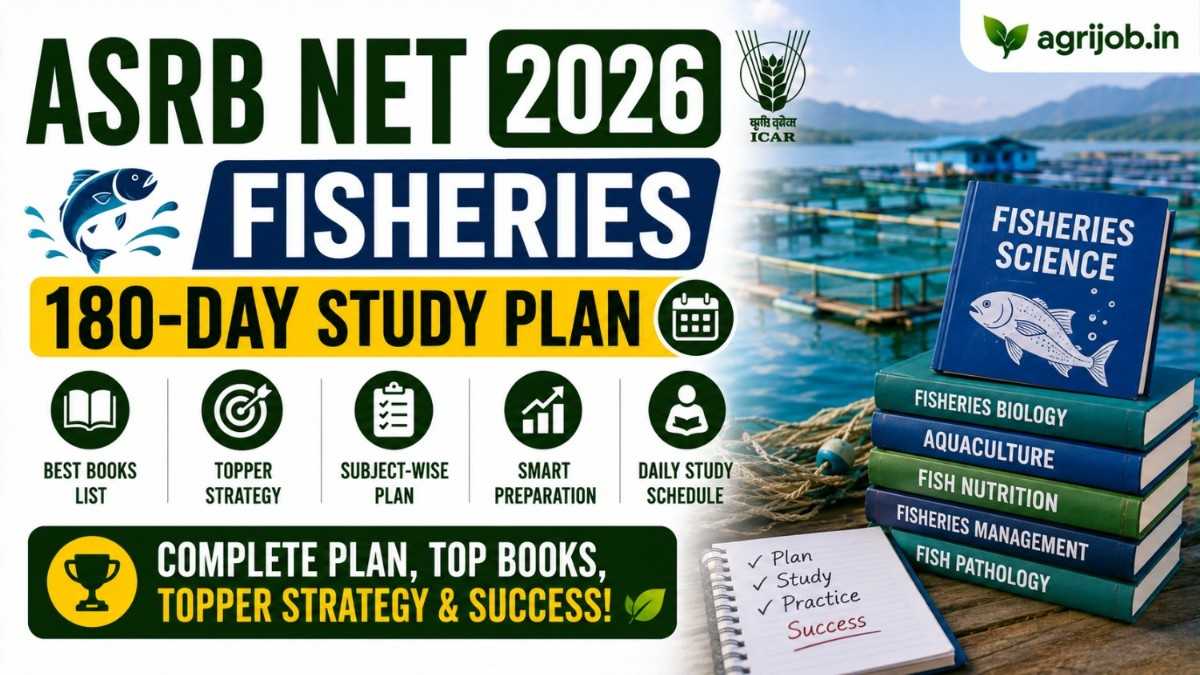
ASRB NET 2026 Fisheries Strategy – 180-Day Study Plan + Best Books
ASRB NET 2026 Fisheries India ke fisheries aur aquaculture graduates ke liye sabse prestigious competitive exam hai jo Rs.56,100/month basic pay aur ICAR Scientist ya State Agricultural University mein Lecturer position deta hai. Agricultural Scientists Recruitment Board (ASRB) har saal yeh exam conduct karta hai — 2025 cycle ke liye prelims September 2-4, 2025 aur mains March 1, 2026 hua, total 603 vacancies ke saath (ARS 458, SMS 47, STO 98). Is complete guide mein aap padhenge: ASRB NET 2026 Fisheries ka full exam pattern, 180-day subject-wise study plan, toppers ki proven strategy, subject-wise best books list, negative marking se bachne ke tips, aur FAQ — sab kuch ek jagah.

| Conducting Body | Agricultural Scientists Recruitment Board (ASRB) |
| Exam Name | National Eligibility Test (NET) + ARS + SMS (T-6) + STO (T-6) |
| Total Vacancies (2025 Cycle) | 603 (ARS: 458, SMS: 47, STO: 98) |
| Fisheries Discipline Code | Fisheries Science / Aquaculture (discipline no. 34) |
| Prelims Pattern | 150 MCQs, 150 marks, 2 hours, 1/3 negative marking |
| ARS Mains | 240 marks (descriptive), 3 hours + Viva-voce 60 marks |
| Eligibility | M.F.Sc. / M.Sc. Fisheries / Aquaculture, min. 21 years age |
| Basic Pay (Qualified) | Rs.56,100/month (Pay Level-10, 7th CPC) |
| Gross Salary (Approx.) | Rs.75,000 – Rs.1,00,000+/month with HRA + DA + TA |
| Official Website | asrb.org.in |
- ASRB NET 2026 Fisheries Exam Pattern – Prelims, Mains, Viva
- Salary aur Career Scope – NET, ARS, SMS, STO
- ASRB NET 2026 Fisheries Syllabus – Unit-wise Breakdown
- 180-Day Subject-wise Study Plan – Phase-by-Phase
- Topper Strategy – ASRB NET Fisheries Crack Karne ke 10 Secrets
- Best Books List – ASRB NET 2026 Fisheries Subject-wise
- Negative Marking Strategy – Attempt vs Skip Formula
- Who Should Apply for ASRB NET 2026 Fisheries?
- High-Value ASRB NET Fisheries Terms You Must Know
- FAQ – ASRB NET 2026 Fisheries Complete Guide
ASRB NET 2026 Fisheries Exam Pattern – Prelims, Mains, Viva
ASRB NET 2026 Fisheries teen stages mein conduct hota hai: Preliminary Examination, Mains Examination (sirf ARS ke liye), aur Viva-voce (sirf ARS ke liye). NET qualify karne wale candidates Lecturer/Assistant Professor position ke liye eligible ho jaate hain. ARS ke liye additionally Mains aur Interview qualify karna hota hai. Neeche complete exam pattern hai:
| Stage | Post | Questions / Marks | Duration | Type |
|---|---|---|---|---|
| Preliminary Exam | NET + ARS + SMS + STO | 150 MCQ / 150 Marks | 2 Hours | Online CBT – Objective |
| ARS Mains | ARS Only | 240 Marks | 3 Hours | Descriptive – Written |
| Viva-voce | ARS Only | 60 Marks | ~30-45 min | Interview Panel |
| SMS/STO Final | SMS (T-6) / STO (T-6) | Based on Prelims Score | – | Merit + Prelims score |
Critical Rule – Negative Marking: ASRB NET 2026 Fisheries prelims mein har galat answer par 1/3 mark kata jaata hai. Fraction marks round off nahi hote. Isliye blind guessing exam score ko seriously damage karta hai — attempt strategy sabse important skill hai is exam mein.

Salary aur Career Scope – ASRB NET 2026 Fisheries
ASRB NET 2026 Fisheries qualify karna ek life-changing opportunity hai. Jo candidates NET qualify karte hain unhe State Agricultural Universities, Fisheries Colleges, aur Central Fisheries Institutes mein Lecturer/Assistant Professor banne ka eligibility certificate milta hai. ARS qualify karna ICAR institutes mein Scientist-B position deta hai — India ke sabse prestigious agri-research careers mein se ek.
| Post | Basic Pay (Pay Level-10) | Approx. Gross Salary | Posting |
|---|---|---|---|
| Lecturer / Asst. Professor (NET) | Rs.56,100/month | Rs.75,000–Rs.90,000/month | State Agricultural Universities / Fisheries Colleges |
| Scientist-B (ARS) | Rs.56,100/month | Rs.80,000–Rs.1,00,000/month | ICAR Institutes (CIFA, CMFRI, CIFRI, CIFE, NBFGR) |
| SMS T-6 (Subject Matter Specialist) | Rs.56,100/month | Rs.75,000–Rs.95,000/month | KVKs (Krishi Vigyan Kendras) across India |
| STO T-6 (Senior Technical Officer) | Rs.56,100/month | Rs.75,000–Rs.90,000/month | ICAR Institutes / Research Farms |
Key ICAR Institutes for Fisheries: Central Institute of Freshwater Aquaculture (CIFA, Bhubaneswar), Central Marine Fisheries Research Institute (CMFRI, Kochi), Central Inland Fisheries Research Institute (CIFRI, Barrackpore), Central Institute of Fisheries Education (CIFE, Mumbai), aur National Bureau of Fish Genetic Resources (NBFGR, Lucknow) — yeh sab ARS qualified fisheries scientists ko absorb karte hain.
ASRB NET 2026 Fisheries Syllabus – Unit-wise Complete Breakdown
ASRB NET 2026 Fisheries syllabus Master’s degree level ka hai aur tamam major topics cover karta hai. Official syllabus asrb.org.in par available hai. Neeche unit-wise breakdown hai with estimated weightage:
| Unit | Major Topics | Estimated Weightage |
|---|---|---|
| Unit 1 – Fish Biology & Taxonomy | Morphology, anatomy, taxonomy (Pisces), physiology of fishes, reproductive biology, growth, fish genetics and cytogenetics, fish ecology | 15–18% |
| Unit 2 – Aquatic Ecology & Environment | Aquatic ecosystems (freshwater, brackish, marine), water quality parameters, limnology, estuarine ecology, aquatic pollution and management, climate change impacts | 10–13% |
| Unit 3 – Aquaculture Systems | Freshwater fish culture (carp, catfish, tilapia, murrel, trout), shrimp farming (Penaeus monodon, L. vannamei), cage culture, RAS, biofloc, aquaponics, mariculture, composite fish culture | 20–25% |
| Unit 4 – Fish Nutrition & Feed Technology | Nutritional requirements of fish and shrimp, feed formulation, feed ingredients, feeding strategies, feed management, pellet technology, live food culture (Artemia, Moina) | 10–12% |
| Unit 5 – Fish Health Management | Fish diseases (bacterial, viral, fungal, parasitic), diagnosis, treatment, prophylaxis, use of probiotics and prebiotics, biosecurity, disease outbreak management, vaccines | 10–12% |
| Unit 6 – Fisheries Resource Management | Capture fisheries, stock assessment, MSY, MEY, fishing gears and methods, fisheries regulations, marine protected areas, EEZ, inland fisheries management | 10–13% |
| Unit 7 – Fish Processing & Technology | Post-harvest technology, preservation methods (chilling, freezing, drying, canning), value-added products, HACCP, food safety standards, export quality, fish by-products | 8–10% |
| Unit 8 – Fisheries Economics & Extension | Fisheries economics, cooperatives, marketing, export-import data, fisheries policies, National Fisheries Policy 2020, PM Matsya Sampada Yojana, fisheries extension methods | 8–10% |
180-Day Subject-wise Study Plan – ASRB NET 2026 Fisheries
ASRB NET 2026 Fisheries ke liye 180-day plan 4 phases mein divided hai. Har phase mein specific units, daily study hours, weekly targets, aur review checkpoints hain. Yeh plan un candidates ke liye bana hai jo fresh start kar rahe hain — already strong candidates Phase 1 compress karke aage badh sakte hain.
Phase 1 – Foundation Building (Days 1–45): Fish Biology, Taxonomy, Aquatic Ecology
- 📅 Days 1–15 (Fish Biology & Taxonomy): Jhingran V.G. ki “Fish and Fisheries of India” se start karein. Morphology, anatomy, taxonomy (Order Perciformes, Cypriniformes, Siluriformes), reproductive biology, growth patterns, aur osmoregulation cover karein. Daily 4-5 hours study + 50 MCQ practice. Key target: tamam economically important fish species aur unka taxonomy yaad karna.
- 🌊 Days 16–30 (Aquatic Ecology): Limnology, estuarine ecology, freshwater aur marine ecosystems, primary productivity, food chain/web, DO/BOD/COD/pH/temperature importance. Boyd C.E. ki “Water Quality in Warmwater Fish Ponds” must-read hai. Weekly mock test: 50 MCQs in 40 minutes.
- 🌿 Days 31–45 (Fish Physiology & Genetics): Osmoregulation, respiration, excretion, reproductive physiology, fish genetics (chromosomes, polyploidy, hybridization), sex determination, selective breeding basics. ICAR textbooks aur PG lecture notes use karein. Phase 1 end par: full unit revision + 150 MCQ mock test (simulate real exam pressure).
Phase 2 – Core Aquaculture Mastery (Days 46–90): Aquaculture + Nutrition + Water Quality
- 🐟 Days 46–65 (Aquaculture Systems): Pillay T.V.R. ki “Aquaculture: Principles and Practices” is phase ka Bible hai. Composite fish culture, shrimp farming (extensive/semi-intensive/intensive/biofloc/RAS), cage culture, freshwater prawn culture, ornamental fish culture, mariculture. Stocking density, FCR, survival rate, aur production data numerical yaad karein — exam mein directly MCQ aate hain.
- 🍽️ Days 66–80 (Fish Nutrition & Feed Technology): Protein requirements (species-wise), amino acid profiles, lipid nutrition, vitamins aur minerals, feed formulation, pellet types, FCR optimization, live food culture (Artemia, Chlorella, Daphnia, rotifers). De Silva & Anderson ki “Fish Nutrition in Aquaculture” reference material hai.
- 💧 Days 81–90 (Water Quality Management): DO, temperature, pH, ammonia, nitrite, nitrate, alkalinity, hardness — acceptable ranges species-wise yaad karein. Pond management, water exchange, aeration systems, biofiltration, probiotics ka role in water quality. Weekly mock: 75 MCQs from Units 1–4.
Phase 3 – Advanced Topics (Days 91–135): Fisheries Management, Fish Health, Technology
- 🏥 Days 91–110 (Fish Health Management): Major bacterial diseases (Aeromonas, Pseudomonas, Vibrio, Edwardsiella), viral diseases (KHV, WSSV, IHHNV, MBV for shrimp), fungal (Saprolegnia), parasitic (Argulus, Ichthyophthirius, Trichodina), diagnosis methods, treatment protocols, biosecurity SOP. Plumb J.A. ki “Health Maintenance and Principal Microbial Diseases of Cultured Fishes” key reference hai.
- 🎣 Days 111–125 (Fisheries Resource Management): MSY (Maximum Sustainable Yield), MEY, OAY, Schaefer model, surplus production models, VPA, fishing gear types (trawls, gill nets, purse seines, hooks and lines), EEZ (200 nautical miles), fishery regulations, Marine Stewardship Council (MSC), CCRF (Code of Conduct for Responsible Fisheries – FAO 1995).
- 🏭 Days 126–135 (Fish Processing Technology): Chilling methods, IQF freezing, glazing, drying (sun/mechanical), smoking, canning, surimi, fish meal, fish oil, HACCP implementation, FSSAI standards for seafood, EU/USA export quality requirements. Phase 3 end par: 150 MCQ full mock test from Units 1–6.
Phase 4 – Economics, Policy, Revision & Mock Tests (Days 136–180)
- 📊 Days 136–150 (Fisheries Economics & Policy): India fisheries export data (Rs.60,000+ crore FY 2023-24), top export destinations, PM Matsya Sampada Yojana (Rs.20,050 crore outlay), National Fisheries Policy 2020, Blue Economy, fisheries cooperatives, marketing chains, fishermen welfare schemes. Current affairs pe focus karein — policy-based MCQs har exam mein aate hain.
- 🔄 Days 151–165 (Rapid Revision – All Units): Unit-wise 1-page summary sheets (flash cards) banayein. PYQs (previous year questions) solve karein — last 5 years ke ASRB NET aur ICAR ARS fisheries papers must solve karein. Weak topics identify karein aur targeted re-reading karein.
- 🎯 Days 166–180 (Full Mock Test Mode): Har 2 din mein ek full 150 MCQ mock test (2 hours timer ke saath). Real exam conditions simulate karein — phone band, proper sitting, OMR-style answer sheet. Score track karein: target 100+ accurate answers out of 150. Last 3 days: sirf revision, no new topics.
| Phase | Days | Topics | Daily Hours | Weekly Mock |
|---|---|---|---|---|
| Phase 1 – Foundation | 1–45 | Fish Biology, Taxonomy, Ecology | 5–6 hrs | 50 MCQs |
| Phase 2 – Aquaculture Core | 46–90 | Aquaculture Systems, Nutrition, Water Quality | 6–7 hrs | 75 MCQs |
| Phase 3 – Advanced | 91–135 | Fish Health, Fisheries Mgmt., Technology | 6–7 hrs | 100 MCQs |
| Phase 4 – Revision + Mocks | 136–180 | Economics, Policy, Full Revision, Mock Tests | 7–8 hrs | 150 MCQs (full test) |
Topper Strategy – ASRB NET 2026 Fisheries Crack Karne ke 10 Secrets
Jo candidates ASRB NET 2026 Fisheries mein consistently high scores lete hain unki strategy mein kuch common patterns hain. Yeh 10 secrets toppers ki preparation se directly nikali gayi insights hain:
- 🎯 Official Syllabus hi Bible hai: asrb.org.in se official fisheries syllabus PDF download karein aur usse laminate karke study table par chipka lein. Har topic jo cover ho jaaye use tick karein. Jo syllabus mein nahi hai uspe time waste mat karein — chahe kitna bhi interesting lage.
- 📖 PYQs se Start Karein, Books se Nahi: Toppers pehle 5 years ke previous year questions solve karte hain — isse pata chalta hai ki kaunse topics se repeatedly questions aate hain. ASRB NET fisheries mein Aquaculture Systems aur Fish Biology se consistently 40-50% questions aate hain.
- ⏱️ Speed + Accuracy ka Dual Training: Speed aur accuracy ek saath develop karein. Pehle 90 days accuracy par focus, last 90 days speed par. Timer ke saath practice karna shuru karein — 2 hours mein 150 questions matlab 48 seconds per question.
- 🧠 Numerical Data Cards: Production figures (India fisheries production ~14 million MT), species-wise stocking densities, FCR values, DO ranges, temperature optima — yeh sab flash cards mein likhein aur har roz 10 minute review karein. In numbers se directly MCQs aate hain.
- 🌐 FAO Publications Free mein Padhen: FAO Fisheries Technical Papers, State of World Fisheries and Aquaculture (SOFIA) report, aur FAO Code of Conduct for Responsible Fisheries (CCRF 1995) — yeh sab fao.org par free available hain aur exam mein directly reference hote hain.
- 📝 Self-Made Notes Banana Mandatory: Jo padhein use apne words mein likhen. Yeh retention 40-60% badhata hai. Unit-wise 2-page notes banayein — revision mein sirf yeh notes use honi chahiye, original books dobara nahi khulni chahiye revision phase mein.
- 👥 Study Group ya Telegram Channel Join Karein: ASRB NET fisheries aspirants ke Telegram groups par join karein — daily MCQs, doubt clearing, aur peer pressure se consistency maintain hoti hai. Dusron ko explain karna apni understanding bahut strong karta hai.
- 🏥 Fish Diseases ke Scientific Names Rote Karein: Fish pathology mein causative agent ke scientific names (Aeromonas hydrophila, White Spot Syndrome Virus – WSSV, Viral Nervous Necrosis – VNN) direct MCQs mein aate hain. Flashcard method use karein — 30 major diseases in 30 days.
- 📅 Weekly Test Analysis Mandatory: Har mock test ke baad galat questions analyze karein — sirf score mat dekhein. Galti ka pattern samjhein: kya conceptual confusion hai, calculation error hai, ya time pressure hai? Har type ki galti ka alag solution hai.
- 😴 Last 15 Days Mein Naye Topics Band: Jo candidates exam se 15 din pehle naya topic shuru karte hain unka confidence aur score dono girte hain. Last 15 days: sirf revision, mock tests, aur adequate sleep (7-8 hours) — yeh formula consistently toppers follow karte hain.
Previous NET fisheries qualifiers ka common feedback: “Aquaculture Systems unit sabse high-yield unit hai — sirf isi unit se consistent practice karo toh 25-30 marks pakke hain.” Shrimp farming systems (extensive/semi-intensive/intensive/biofloc/RAS), stocking densities, production figures, aur FCR values — yeh sab number-by-number yaad karein. Second highest: Fish Biology — taxonomy charts, anatomical diagrams banayein. Ek topper ka shortcut: “Mai ICAR CIFA aur CMFRI ke Annual Reports regularly padhta tha — current research ke questions directly wahan se aate the.” ICAR institute annual reports free download available hain institute websites se.
Best Books List – ASRB NET 2026 Fisheries Subject-wise
ASRB NET 2026 Fisheries ke liye sahi books choose karna preparation ka sabse critical decision hai. Neeche subject-wise curated books list hai jo toppers aur faculty members recommend karte hain:
| Subject / Unit | Book Title | Author | Use For |
|---|---|---|---|
| Fish Biology & Taxonomy | Fish and Fisheries of India | V.G. Jhingran | Must-read: taxonomy, biology of Indian fish species — standard reference |
| Fish Biology & Taxonomy | Ichthyology | Lagler, Bardach & Miller | Anatomy, morphology, physiology — international standard reference |
| Aquaculture Systems | Aquaculture: Principles and Practices (2nd Ed.) | T.V.R. Pillay & M.N. Kutty | Comprehensive aquaculture textbook — most exam questions from here |
| Aquaculture Systems | Principles of Aquaculture | R.R. Stickney | Species-specific culture practices, system designs |
| Water Quality | Water Quality in Warmwater Fish Ponds | C.E. Boyd | Gold standard for water quality parameters — MCQs directly from here |
| Fish Nutrition | Fish Nutrition in Aquaculture | S.S. De Silva & T.A. Anderson | Nutritional requirements, feed formulation, FCR |
| Fish Nutrition | Nutrient Requirements of Fish and Shrimp | NRC (National Research Council) | Official nutrient requirement data — authoritative reference |
| Fish Health / Diseases | Health Maintenance & Principal Microbial Diseases of Cultured Fishes | J.A. Plumb & L.A. Hanson | Bacterial, viral, fungal, parasitic diseases — diagnosis and treatment |
| Fish Health / Diseases | Aquatic Animal Health (OIE Manual) | OIE (World Organisation for Animal Health) | International disease standards, notifiable diseases |
| Fisheries Resource Management | Principles of Marine Fisheries Biology | C.J. Sindermann | Stock assessment, population dynamics, marine fisheries management |
| Fisheries Resource Management | Introduction to Fisheries Science | Mohan Joseph M. (ICAR) | Indian context fisheries management — ICAR approved textbook |
| Fish Processing | Fish Processing Technology | G.M. Hall (Ed.) | Post-harvest technology, value addition, HACCP — comprehensive |
| Fisheries Economics | Fisheries Economics and Management | Hannesson (various editions) | Economic principles of fisheries — standard reference |
| Mariculture / Marine | Marine Fisheries Biology | P.V. Dehadrai & others (ICAR) | Marine species biology, coastal aquaculture |
| General Reference + MCQ | Objective Fisheries Science (MCQ Book) | Various authors (ICAR/Publication Division) | Practice MCQs aligned with syllabus — last 60 days use |
| Current Affairs + Policy | SOFIA Report (FAO – annual) | FAO Fisheries Department | Free online — global fisheries data, India data, policy updates |
Negative Marking Strategy – Attempt vs Skip Formula
ASRB NET 2026 Fisheries mein 1/3 negative marking hai jo exam ka sabse dangerous trap hai. Yahan ek proven mathematical formula hai jo toppers use karte hain:
- ✅ Green Zone (Attempt karein): Agar aapko 80%+ confidence hai ki answer correct hai — attempt zaroor karein. Yahan skip karna marks waste karna hai.
- 🟡 Yellow Zone (Elimination use karein): Agar 2 options eliminate ho sakti hain toh remaining 2 mein se guess karna mathematically profitable hai: expected score = 0.5 × 1 – 0.5 × (1/3) = +0.33 marks. Attempt karein.
- 🔴 Red Zone (Skip karein): Agar sirf 1 option eliminate ho sakti hai (3 options remaining), expected score = 0.33 × 1 – 0.67 × (1/3) = +0.11 marks — marginal positive. Conservative candidates skip kar sakte hain.
- ⚫ Black Zone (Kabhi attempt mat karein): Agar koi bhi option eliminate nahi ho sakta, random guess expected score = 0.25 × 1 – 0.75 × (1/3) = 0.00 marks — neutral. But risk hai, isliye skip karein.
Target Attempt Strategy: 180 days ke baad ek well-prepared ASRB NET 2026 Fisheries candidate ko 110-130 questions confidently attempt karne chahiye. 100 correct answers = 100 – 0 = 100 marks (cut-off se well above typically). Random 150 attempts mein 37-38 correct expected hain which results in 37 – (112 × 0.33) = ~0 marks. Strategy hi score determine karta hai.
Who Should Apply for ASRB NET 2026 Fisheries?
- 🎓 M.F.Sc. / M.Sc. Fisheries Graduates: Jo State Agricultural Universities (Kerala Agricultural University, Assam Agricultural University, OUAT, Dr. BSKKV) ya central universities se fisheries mein PG complete kar chuke hain aur academic/research career banana chahte hain.
- 🔬 ICAR JRF/SRF Holders: Jo already ICAR fellowship hold kar rahe hain aur Ph.D. ke saath parallel ASRB NET bhi crack karna chahte hain — double qualification strategy career mein exponential growth deti hai.
- 🏛️ Aspiring ICAR Scientists: Jo CIFA, CMFRI, CIFRI, CIFE, NBFGR jaise ICAR institutes mein Scientist-B position chahte hain — ARS qualify karna mandatory hai.
- 📚 Teaching Aspirants: Jo Fisheries Colleges ya State Agricultural Universities mein Lecturer/Assistant Professor banana chahte hain — NET clearance mandatory eligibility certificate hai.
- 👩🔬 Women Fisheries Graduates: ICAR aur agricultural universities mein women scientists aur faculty ke liye special recruitment drives aur relaxations hote hain — ASRB NET qualified women candidates ke liye opportunities bahut zyada hain.
- 🌊 Aquaculture Entrepreneurs Turning Researcher: Jo already industry mein hain (shrimp farming, cage culture, ornamental fish) aur academic backing ke saath credibility aur career pivot chahte hain.
- 🏞️ North-East Region Candidates: ICAR NEH Region (Barapani, Shillong) mein fisheries positions ke liye North-East candidates ko special preference milti hai — strongly encouraged to appear.
- 🧬 M.Sc. Marine Biology / Aquatic Biology Candidates: M.Sc. Fisheries Science / Marine Biology / Aquatic Biology mein specialization (Mariculture, Aquatic Environmental Management, Aquatic Ecology, Inland Aquaculture) vale candidates ARS Aquaculture discipline ke liye eligible hain.
High-Value ASRB NET 2026 Fisheries Terms You Must Know
- 🔑 MSY (Maximum Sustainable Yield): Fisheries management ka core concept — wo maximum harvest jo ek fish stock long-term mein sustainably provide kar sakta hai. Schaefer surplus production model se calculate hota hai. Exam mein frequently asked.
- 🔑 FCR (Feed Conversion Ratio): Feed diya / weight gain — numerically lower FCR better performance indicate karta hai. Different species ke FCR values (shrimp: 1.5-2.0; tilapia: 1.5-1.8; carp: 2.0-3.0) yaad rakhein.
- 🔑 WSSV (White Spot Syndrome Virus): Shrimp farming ka most devastating viral disease — causative agent: Whispovirus, hosts: Penaeus spp., economic losses billions of dollars globally annually. No cure — only prevention.
- 🔑 RAS (Recirculating Aquaculture System): Closed-loop fish production system with biofilters, mechanical filtration, UV treatment — 95%+ water recycled. High capital cost but highest production density — future of sustainable aquaculture.
- 🔑 CCRF (Code of Conduct for Responsible Fisheries): FAO 1995 document — voluntary international guidelines for sustainable fishing, aquaculture, post-harvest practices, aur fisheries research. Frequently asked in policy MCQs.
- 🔑 PM Matsya Sampada Yojana (PMMSY): India ke largest fisheries scheme — Rs.20,050 crore outlay, 2020-2025, aim: 22 million MT fish production, Rs.1 lakh crore fisheries exports. Exam mein scheme data directly aata hai.
- 🔑 Biofloc Technology: Microbial biomass (bacteria + microalgae + protozoa) production in culture water — improves water quality, provides supplemental protein to fish/shrimp, reduces feed cost. Trending topic in aquaculture exams.
- 🔑 EEZ (Exclusive Economic Zone): 200 nautical miles se exclusive fishing rights India ke coast se — India ka EEZ 2.02 million sq. km. Marine fisheries management aur illegal fishing control ke liye critical.
- 🔑 HACCP (Hazard Analysis and Critical Control Points): Fish processing aur seafood export ke liye mandatory food safety system — EU aur USA seafood exports ke liye HACCP-certified plants required hain. Processing technology questions mein core topic.
- 🔑 Artemia nauplii: Shrimp aur marine fish larvae ke liye universally used live feed — first feeding stage most critical. Artemia salina cysts se hatching, enrichment protocols (HUFA enrichment) — nutrition unit mein important.
FAQ – ASRB NET 2026 Fisheries Complete Guide
ASRB NET 2026 Fisheries exam pattern kya hai?
ASRB NET 2026 Fisheries exam ek online objective-type test hai jisme 150 MCQ questions hote hain, har question 1 mark ka hai, total 150 marks, aur duration 2 hours hai. Har galat answer par 1/3 negative marking hoti hai — fraction marks round off nahi hote. Syllabus completely Fisheries discipline-specific hai aur Master’s degree level topics cover karta hai — Fish Biology, Aquaculture, Fisheries Resource Management, Fish Nutrition, Fish Pathology, Fisheries Economics, aur Fishery Technology ke major units hain.
ASRB NET 2026 Fisheries ke liye eligibility kya hai?
ASRB NET 2026 Fisheries ke liye candidate ko Fisheries Science / Aquaculture / Marine Biology / Fish Biology mein Master’s degree (M.F.Sc. ya M.Sc.) recognised university se honi chahiye. Age minimum 21 years as of January 1, 2026 honi chahiye. OBC/SC/ST/PwBD candidates ke liye age relaxation government norms ke anusaar milti hai. ARS ke liye additionally NET qualify karne ke baad descriptive mains (240 marks) aur viva-voce (60 marks) dena hota hai.
ASRB NET 2026 Fisheries qualify karne par salary kitni milti hai?
ASRB NET 2026 Fisheries qualify karne par selected candidates ko 7th CPC Pay Matrix Level-10 par Rs.56,100 basic pay milti hai. Gross salary (HRA + TA + DA) Rs.75,000 se Rs.1,00,000+ per month hoti hai depending on posting location. ARS qualify karke ICAR Scientist-B banne par Rs.56,100 basic pay se career shuru hota hai jisme seniority ke saath Rs.1,77,500 tak growth possible hai. Government job ke additional benefits mein medical, pension, housing facility, aur research exposure bhi include hain.
ASRB NET 2026 Fisheries ke liye 180 days mein kaunse topics cover karne chahiye?
ASRB NET 2026 Fisheries ke liye 180-day plan mein: Phase 1 (Days 1-45) mein Fish Biology, Taxonomy, aur Aquatic Ecology; Phase 2 (Days 46-90) mein Aquaculture Systems, Fish Nutrition, aur Water Quality Management; Phase 3 (Days 91-135) mein Fisheries Resource Management, Fish Pathology, aur Fish Processing Technology; Phase 4 (Days 136-180) mein Fisheries Economics, National Fisheries Policies, aur Full Revision + Mock Tests cover karne chahiye. Har phase mein weekly mock tests mandatory hain aur PYQs parallel mein solve karte rehna chahiye.
ASRB NET 2026 Fisheries ke liye sabse best books kaunsi hain?
ASRB NET 2026 Fisheries ke liye must-read books: Jhingran V.G. – Fish and Fisheries of India (fish biology + taxonomy), Pillay T.V.R. – Aquaculture: Principles and Practices (aquaculture systems — most questions yahan se), Boyd C.E. – Water Quality in Warmwater Fish Ponds (water quality parameters), Stickney R.R. – Principles of Aquaculture, Plumb J.A. – Health Maintenance and Principal Microbial Diseases of Cultured Fishes (fish diseases), aur FAO SOFIA Report (free online — policy data). ICAR approved textbooks jo university libraries mein milte hain unhe bhi zaroor use karein.
ASRB NET 2026 total vacancies aur fisheries mein kitni seats hain?
ASRB NET 2025 cycle ke liye revised total vacancies 603 thi — ARS 458, SMS (T-6) 47, aur STO (T-6) 98. ASRB NET 2026 ka notification jald hi asrb.org.in par aayega. Fisheries/Aquaculture discipline mein ARS ke liye har saal 2-10 vacancies aati hain depending on ICAR institute requirements, aur NET qualify karne par state agricultural universities ke tamam fisheries colleges mein Lecturer positions ke liye eligible ho jaate hain jisme seats unlimited category hain.
ASRB NET 2026 Fisheries mein negative marking se kaise bachein?
ASRB NET 2026 Fisheries mein 1/3 negative marking hai — isliye attempt strategy critical hai. Rule yeh hai: sirf un questions ko attempt karein jisme 70%+ confidence ho. Green Zone: 80%+ confidence — hamesha attempt; Yellow Zone: 2 options eliminate kar sako — attempt karo (expected positive score); Red Zone: 0 options eliminate — skip karo. Target 110-130 questions attempt with 85%+ accuracy. Mock tests mein accuracy track karein aur blind guessing se always bachein.
ASRB NET 2026 Fisheries aur ICAR JRF mein kya fark hai?
ASRB NET 2026 Fisheries aur ICAR JRF dono ICAR system ke under exams hain lekin purpose alag hai. ICAR JRF (Junior Research Fellowship) Ph.D. admission aur Rs.31,000-Rs.35,000/month fellowship ke liye hai — freshers ke liye. ASRB NET Fisheries Lecturer/Assistant Professor eligibility (Rs.56,100+ salary) aur ARS Scientist position ke liye hai — PG degree mandatory hai. ASRB ARS additionally descriptive mains (240 marks) + viva (60 marks) hai. JRF aur NET dono clear karna ideal career combination hai — JRF se Ph.D. karo, NET se teaching eligibility lo.
Official Resources aur Useful Links:
- 🔗 ASRB Official Website – asrb.org.in (Notification, Syllabus, Admit Card, Results)
- 🔗 ICAR Official Website – icar.org.in (Institute-wise vacancy, Research programs)
- 🔗 FAO Fisheries Division – fao.org (SOFIA Report, CCRF, Fisheries Technical Papers – Free)
- 🔗 Department of Fisheries India – dof.gov.in (PM Matsya Sampada Yojana, National Fisheries Policy 2020)
Yeh guide regularly reviewed aur updated ki jaati hai. ASRB NET 2026 Fisheries notification, exam date, aur latest updates ke liye is page ko bookmark karein.
Last Updated: June 2026