

PM Kusum Component B Subsidy 2026
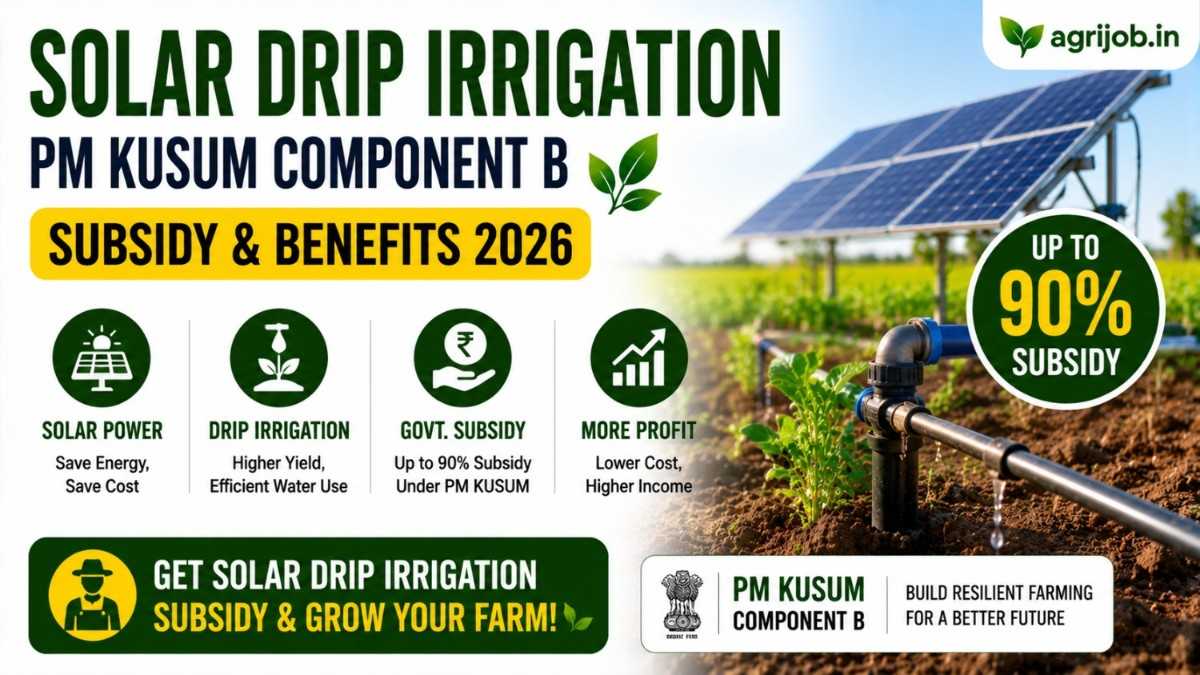
Solar-powered drip irrigation through PM Kusum Component B lets Indian farmers replace diesel pumps with subsidised solar systems while qualifying for selection priority if they pair the pump with a water-saving drip setup. This guide walks through exactly how the online application process works on the national and state portals, lists the major state-wise application links you’ll actually need, explains how the approved vendor (empanelment) system functions, and breaks down the real subsidy math so you know what you’ll pay before you start. We’ll cover eligibility, the document checklist, the step-by-step apply process, vendor selection, common rejection reasons, and a full FAQ section so nothing catches you off guard mid-application.
- What Is PM Kusum Component B?
- Key Facts at a Glance
- Subsidy & Money Breakdown
- Eligibility & Required Documents
- How to Apply Online: Step-by-Step Process
- State-Wise Portal List
- Approved Vendors & Empanelment Explained
- Component B Solar Pump vs Drip-Only Subsidy
- High-Value Terms You Must Know
- Common Mistakes That Delay Approval
- Who Should Apply?
- Frequently Asked Questions
What Is PM Kusum Component B?
PM Kusum Component B funds the installation of standalone, off-grid solar agriculture pumps up to 7.5 HP for farmers in areas without reliable grid electricity. Unlike Component A, which sets up large grid-connected solar power plants on barren land, or Component C, which solarises existing electric pumps, Component B specifically targets farmers replacing diesel pumps with a fully self-contained solar pumping system. The scheme’s design deliberately connects to irrigation efficiency: priority in beneficiary selection goes to farmers using or adopting micro irrigation such as drip or sprinkler systems, since pairing solar power with drip irrigation maximizes both energy savings and water conservation on the same farm.
For our broader walkthrough of all three PM-KUSUM components, pump cost tables, and ROI analysis, see our complete Solar Farming India 2026 guide. This article goes deeper specifically into Component B’s application mechanics, the state portal directory, and how the approved vendor system actually works in practice.

Key Facts at a Glance
- Component: PM Kusum Component B (standalone off-grid solar pumps)
- Pump Capacity Range: Up to 7.5 HP
- Central CFA: 30% of benchmark/tender cost, whichever is lower
- State Subsidy: Minimum 30% (some states add more)
- Farmer Share: Typically 30-40%, partly bank-financeable
- Drip Irrigation Link: Priority selection for micro-irrigation adopters
- Installation Mode: Mandatory through MNRE/state-empanelled vendors only
- Application Mode: Online via pmkusum.mnre.gov.in or state nodal agency portal
- Typical Installation Timeline: 60-90 days after approval and payment
Subsidy & Money Breakdown
The official subsidy formula under Component B is straightforward on paper but worth understanding precisely, since marketing claims of a flat “60% subsidy” can be misleading depending on which state you’re in. The Ministry of New and Renewable Energy provides Central Financial Assistance (CFA) of 30% of the benchmark cost or the tender cost, whichever is lower. The state government is required to contribute at least 30% on top of that. The farmer covers whatever remains, which works out to roughly 30-40% of the total system cost in most states, though this can fall further in states offering enhanced top-ups for SC/ST farmers or women-led groups.
| Pump Capacity | Approx. Cost Before Subsidy (Rs.) | Central CFA (30%) | State Subsidy (Min. 30%) | Approx. Farmer Share (Rs.) |
|---|---|---|---|---|
| 3 HP | 1,80,000-2,00,000 | ~54,000-60,000 | ~54,000-60,000 | 55,000-70,000 |
| 5 HP | 3,00,000-3,50,000 | ~90,000-1,05,000 | ~90,000-1,05,000 | 90,000-1,05,000 |
| 7.5 HP | 3,50,000-4,50,000 | ~1,05,000-1,35,000 | ~1,05,000-1,35,000 | 1,05,000-1,35,000 |
Bank financing is available for a meaningful portion of the farmer’s remaining share, so most applicants don’t need to pay the full balance upfront in cash. Several states fix exact farmer-share amounts for specific pump types rather than leaving it as a percentage; for instance, some North Eastern state agencies have set the farmer contribution for a 2 HP DC submersible pump at a flat figure under Rs.25,000. Always check your specific state nodal agency’s benchmark cost circular rather than relying on a generic percentage, since the benchmark cost itself varies by state tender outcomes.
Eligibility & Required Documents
Eligibility for Component B centers on land access and the absence of reliable grid power for irrigation, rather than farm size alone, though small and marginal farmers and existing micro-irrigation users get priority when demand exceeds the sanctioned quota in a district.
- 🌾 Individual farmers, groups of farmers, or Water User Associations with contiguous cultivable agricultural land and an existing working borewell for irrigation
- 📍 Land located in an off-grid area where standard grid electricity supply is not available for the pump
- 💧 Priority given to farmers already using, or willing to adopt, micro irrigation systems such as drip or sprinkler
- 🚫 Not previously covered under a similar solar pump scheme on the same land within the scheme’s lookback period (typically the past several years)
- 👥 Group applications require a signed agreement among members for equitable water distribution and subsidy sharing, filed in the name of a designated group leader
| Document | Required For |
|---|---|
| Aadhaar Card | Identity verification, mandatory |
| Land Records / Patwari Certificate | Proving cultivable land ownership or lease |
| Passport-size photograph | Application form |
| Bank passbook copy | DBT subsidy and payment processing |
| No-grid-connection certificate or self-declaration | Confirming off-grid eligibility |
| Caste certificate (SC/ST, where applicable) | Enhanced state subsidy slab |
| Group agreement (if applicable) | Joint or WUA applications |
How to Apply Online: Step-by-Step Process
- Visit the official portal: Go to pmkusum.mnre.gov.in (national portal) or your state nodal agency’s dedicated PM Kusum page, since most states process Component B applications through their own DISCOM or renewable energy agency system rather than the central portal directly.
- Complete farmer registration: Register with your name, mobile number, and Aadhaar number; you’ll receive an OTP for verification.
- Fill in land and pump details: Enter land records (Khasra/Khatauni number), existing borewell details, and your preferred pump capacity (typically a choice between 3 HP, 5 HP, and 7.5 HP).
- Declare micro-irrigation status: Indicate whether you currently use, or intend to install, drip or sprinkler irrigation, since this affects priority ranking in the selection queue.
- Upload documents: Submit scanned Aadhaar, land records, bank passbook, photograph, and caste certificate if applicable, usually as PDF or JPG files under a set size limit.
- Submit and receive registration ID: Note your unique application ID to track status going forward.
- Wait for document verification: The State Implementing Agency reviews documents and site suitability; this stage typically takes a few weeks depending on district-level processing load.
- Receive approval and select a vendor: Once approved, choose an installation company from the official empanelled vendor list for your state; some vendors also assist with the paperwork itself.
- Deposit your farmer share: Pay your contribution to the designated agency or vendor account as instructed, only after receiving official approval.
- Installation and final inspection: The empanelled vendor installs the solar pump system, typically within 60-90 days of payment, followed by a final inspection and handover.
State-Wise Portal List
Most states route Component B applications through their own renewable energy development agency rather than a single central form, and the exact portal name varies considerably from state to state. The table below lists the implementing agency and likely starting point for several major states; always confirm the live URL on your state agriculture or energy department’s official site before entering any documents, since portal addresses occasionally change between budget cycles.
| State | Implementing Agency | Typical Portal |
|---|---|---|
| Uttar Pradesh | UPNEDA | upnedakusumc2.in (and UPNEDA main site) |
| Maharashtra | MEDA / MahaUrja | kusum.mahaurja.com |
| Karnataka | KREDL | kredl.karnataka.gov.in |
| Telangana | TGREDCO | tgredco.telangana.gov.in |
| Jharkhand | JREDA | jreda.jharkhand.gov.in |
| Assam | AEDA | pmkusum.assam.gov.in |
| Rajasthan | RRECL | energy.rajasthan.gov.in |
| Haryana | HAREDA | hareda.gov.in |
| Gujarat | GEDA | geda.gujarat.gov.in |
| Bihar | BREDA | breda.bih.nic.in |
| Madhya Pradesh | MPUVNL | mpurja.mp.gov.in |
| Punjab | PEDA | peda.gov.in |
If your state isn’t listed above, search “[your state name] renewable energy development agency PM Kusum” or check the national portal’s state directory link, which forwards applicants to the correct nodal agency. District agriculture offices and Common Service Centres (CSCs) can also assist with registration where internet access or document scanning is a barrier.
Approved Vendors & Empanelment Explained
Every solar pump installed under Component B must go through an officially empanelled vendor, meaning a company that has cleared MNRE’s or the state implementing agency’s tender and technical qualification process. This isn’t a minor formality: subsidy disbursement is routed directly to the vendor’s account via Direct Benefit Transfer once installation is verified, and warranty support is only guaranteed when the system is installed by a listed vendor. Working with an unlisted installer, even one offering a slightly lower upfront quote, risks both the subsidy itself and any recourse if the pump fails.
- 📜 Indigenous manufacturing requirement: Solar panels must use indigenously manufactured cells and modules, and the motor-pump-set, controller, and balance of system must also be domestically manufactured, with vendors required to declare any imported components.
- 🔧 Technical standards: Vendors must meet specifications for the Universal Solar Pump Controller (USPC) and pass testing procedures for the solar water pumping system as defined by MNRE.
- 📋 State-specific empanelment: Beyond the national centralized tender list, most states run their own additional empanelment round, so the approved list for Uttar Pradesh may differ from the list for Karnataka.
- 💰 Subsidy routing: Central and state subsidy amounts are paid directly to the empanelled vendor on the farmer’s behalf, not to the farmer’s own account, which is why vendor selection happens after approval rather than before.
- 🔍 How to verify: Check your state nodal agency’s official “approved vendor list” or “rate card” page, typically published as a downloadable PDF or searchable table on the same portal used for applications.
Component B Solar Pump vs Drip-Only Subsidy
A common point of confusion is whether PM Kusum Component B itself pays for the drip irrigation pipes and emitters, or only the solar pump. It primarily funds the pump and solar power generation system; drip and sprinkler hardware is typically subsidised separately under the Per Drop More Crop component of the Pradhan Mantri Krishi Sinchayee Yojana (PMKSY), administered through state horticulture or agriculture departments. The two schemes are designed to complement each other rather than overlap, and a farmer pursuing both can often apply for each in parallel, though the application processes and implementing agencies are separate.
| Factor | PM Kusum Component B | Per Drop More Crop (PMKSY) |
|---|---|---|
| What it funds | Solar pump + power generation system | Drip/sprinkler pipes, emitters, filters |
| Subsidy range | ~60% combined (central + state) | 45-55% (higher for small/marginal farmers) |
| Implementing agency | State renewable energy agency | State horticulture/agriculture department |
| Drip system required? | No, but gives selection priority | Yes, it’s the subject of the subsidy |
| Can apply for both? | Yes, in parallel | Yes, in parallel |
| Best for | Replacing diesel/no-grid irrigation | Reducing water use on existing pump |
High-Value Terms You Must Know
- Benchmark cost: The MNRE-defined reference price for a given pump capacity, used to calculate the central subsidy amount; the actual subsidy uses whichever is lower between this figure and the tender cost.
- Central Financial Assistance (CFA): The 30% (or higher in special cases) contribution from the national government toward the pump system cost.
- State Implementing Agency (SIA): The state-level body, often a renewable energy development agency, responsible for processing applications and approving installations.
- Direct Benefit Transfer (DBT): The mechanism by which subsidy funds move directly to the vendor’s bank account rather than passing through the farmer or any intermediary.
- Universal Solar Pump Controller (USPC): A standardised controller component that all empanelled vendor systems must meet specifications for, ensuring compatibility and quality across brands.
- Micro irrigation: Drip and sprinkler systems that deliver water directly to the root zone or in fine sprays, contrasted with flood or furrow irrigation, and a priority factor in Component B selection.
- Per Drop More Crop: The PMKSY sub-scheme specifically subsidising drip and sprinkler irrigation hardware, separate from but complementary to PM Kusum.
- Empanelment: The formal approval status a vendor holds after clearing MNRE’s or a state’s tender and technical qualification process, required before that vendor can install subsidy-linked systems.
Common Mistakes That Delay Approval
Most Component B application delays trace back to a handful of recurring issues rather than genuine ineligibility. Blurry or mismatched land documents are one of the most frequent rejection reasons, since the name on the land record must align with the applicant’s Aadhaar details. Selecting a pump capacity larger than what the land and water table can realistically support also triggers additional technical review. Applying during peak demand windows right when a state reopens its quota can mean missing out entirely, since district-level allocations have filled within days in some past cycles.
- ⚠️ Submitting blurry scans or land documents where the applicant’s name doesn’t exactly match Aadhaar records
- ⚠️ Paying an agent or vendor before receiving official approval from the State Implementing Agency
- ⚠️ Choosing a pump capacity mismatched to actual water table and land size, triggering technical rejection
- ⚠️ Missing the application window when district quotas open, since allocation often runs first-come, first-served
- ⚠️ Assuming Component B covers drip irrigation hardware, then being surprised by a separate Per Drop More Crop application requirement
- ⚠️ Not verifying vendor empanelment status before agreeing to installation terms
Who Should Apply for Component B?
- 🌾 Farmers currently running diesel pumps in areas without grid electricity access
- 💧 Existing drip or sprinkler irrigation users looking to pair their system with solar power for priority approval
- 👥 Water User Associations managing shared irrigation infrastructure for multiple farmers
- 👩🌾 Women-led Self-Help Groups eligible for enhanced state-level subsidy slabs in several states
- 🏔️ Farmers in remote or tribal areas where grid extension is unlikely in the near term
- 🌱 Horticulture and vegetable growers needing frequent, reliable daytime irrigation for water-sensitive crops
- 📈 SC/ST category farmers qualifying for the highest state-level top-up subsidy slabs
- 🏘️ Small and marginal landholders given explicit priority when district quotas are oversubscribed
For related reading on protected cultivation subsidy schemes that pair well with reliable solar-powered irrigation, see our guide on agriculture business ideas for small landholders.
For official, current guidance, always refer directly to the National Portal for PM-KUSUM under the Ministry of New and Renewable Energy, and to the MNRE scheme page for the latest guidelines, empanelled vendor lists, and benchmark cost circulars. For drip and sprinkler-specific subsidy details, check your State Horticulture Mission’s Per Drop More Crop page.
This guide is regularly reviewed and updated for accuracy as subsidy percentages, state portals, and vendor lists change. Bookmark this page for the latest figures on PM Kusum Component B and solar-powered drip irrigation in India.
Frequently Asked Questions
What is PM Kusum Component B and how does it relate to drip irrigation?
PM Kusum Component B funds standalone off-grid solar agriculture pumps up to 7.5 HP, and farmers using or willing to install micro irrigation systems like drip or sprinkler are given priority in beneficiary selection, since the scheme aims to combine solar power with water-saving irrigation.
How much subsidy is available under PM Kusum Component B in 2026?
Central financial assistance covers 30 percent of the benchmark or tender cost, whichever is lower, the state government adds a minimum of 30 percent, and the farmer pays the remaining balance, which is typically 30 to 40 percent and can be partly financed through a bank loan.
How do I apply online for PM Kusum Component B?
Farmers apply through the national portal at pmkusum.mnre.gov.in or their respective state nodal agency portal, completing Aadhaar verification, land document upload, pump capacity selection, and payment of the farmer share before an empanelled vendor is assigned for installation.
Which state portals handle PM Kusum Component B applications?
Major state portals include UPNEDA for Uttar Pradesh, KREDL for Karnataka, MahaUrja for Maharashtra, TGREDCO for Telangana, JREDA for Jharkhand, and AEDA for Assam, with most other states routing applications through their respective renewable energy development agency websites.
What is an empanelled vendor under PM Kusum and why does it matter?
An empanelled vendor is a solar pump installation company officially approved by MNRE or the state implementing agency through a tender process, and farmers must select installation only through this approved list since subsidy disbursement and warranty support are tied to empanelled vendor status.
Can I get extra subsidy if I combine solar pump with drip irrigation?
Drip irrigation itself is typically subsidised separately under the Per Drop More Crop component of PMKSY, and while PM Kusum Component B does not add a direct cash bonus for drip adoption, it gives selection priority to farmers using micro irrigation, improving approval chances.
How long does PM Kusum Component B installation take after approval?
After document verification and approval, farmers typically deposit their share within a set window, and the empanelled vendor completes installation within 60 to 90 days, after which final inspection and subsidy disbursement to the vendor account follows.
Is PM Kusum Component B available for group or community applications?
Yes, groups of farmers and Water User Associations can apply jointly for Component B, provided they execute a formal agreement for equitable water distribution and subsidy sharing, with the application typically filed in the name of the group’s designated leader.
What documents are required for PM Kusum Component B application?
Required documents generally include Aadhaar card, land ownership or Patwari certificate, passport-size photograph, bank passbook for DBT transfer, caste certificate for enhanced subsidy slabs where applicable, and proof of no existing grid power connection for the agricultural pump.
Last Updated: June 2026