
MS Agriculture in USA 2026 – Cost, Top Universities & Visa
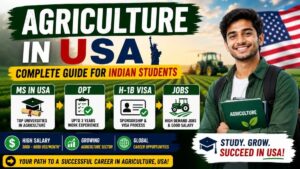
Pursuing an MS Agriculture in USA 2026 is one of the highest-impact decisions an Indian agriculture graduate can make — offering world-class research facilities, globally recognised degrees, and career salaries of $50,000–$90,000 per year (Rs.42–75 lakh annually). The USA is home to over 33 SEVP-approved universities offering specialised Masters programmes in Agriculture, Agribusiness, Plant Sciences, Agricultural Economics, Food Science, and Soil Science. With more than 3.6 lakh Indian students currently enrolled in US universities — the highest number on record — and the 2026 intake more competitive than ever, Indian agri-students must plan at least 12–18 months in advance. This complete 2026 guide covers everything: top universities and their fees, total cost breakdown, available scholarships including Fulbright-Nehru, GRE and IELTS requirements, F-1 visa process, and career prospects after graduation.

| Degree | Master of Science (MS) in Agriculture & Allied Fields |
| Duration | 1.5 to 2 Years (3–4 Semesters) |
| Annual Tuition Cost | $20,000 – $50,000 (Rs.17 lakh – Rs.42 lakh) |
| Total Cost (2 Years) | $60,000 – $1,40,000 (Rs.50 lakh – Rs.1.17 crore) |
| GRE Requirement | 300–320 (310+ recommended for top universities) |
| IELTS / TOEFL | IELTS 6.5–7.0 / TOEFL iBT 80–100 |
| Visa Type | F-1 Student Visa |
| Visa Fee | $185 MRV Fee + $350 SEVIS Fee (approx. Rs.45,000 total) |
| Top Scholarship | Fulbright-Nehru Master’s Fellowship (Fully Funded) |
| Post-Study Work | 12 months OPT + 24 months STEM OPT extension (eligible programmes) |
| Average US Salary After MS | $50,000 – $90,000/year (Rs.42 – 75 lakh/year) |
- Why Study MS Agriculture in USA in 2026?
- Top 8 Universities for MS Agriculture in USA 2026
- Total Cost of MS Agriculture in USA – Fees & Living
- Eligibility & Admission Requirements 2026
- Scholarships for MS Agriculture in USA – Indian Students
- How to Apply for MS Agriculture in USA – Step by Step
- F-1 Student Visa Guide for Indian Students 2026
- Who Should Apply for MS Agriculture in USA?
- MS Agriculture USA vs MS Agriculture India – Comparison
- High-Value Agriculture Career Terms You Must Know
- Frequently Asked Questions (FAQ)
Why Study MS Agriculture in USA in 2026?
The USA remains the world’s top destination for postgraduate agriculture education in 2026, attracting students from over 190 countries. For Indian agriculture graduates specifically, an MS Agriculture in USA offers a combination that no other country currently matches — cutting-edge research infrastructure, direct access to USDA-funded projects, globally transferable credentials, and strong industry placement in agri-tech, food science, agribusiness consulting, and international development organisations.
- 🔬 World-Class Research Infrastructure: US agricultural universities are home to the world’s most advanced plant genomics, precision farming, soil science, and food technology laboratories — directly linked to USDA, NASA, NSF, and private agri-tech funding ecosystems.
- 💰 Graduate Assistantships & Funding: Unlike most countries, US universities routinely offer Teaching Assistantships (TA) and Research Assistantships (RA) that cover full tuition plus a monthly stipend of $1,200–$2,500 — effectively making the degree cost-neutral for selected candidates.
- 🌍 Global Career Value: An MS Agriculture from a top US university commands Rs.8–20 lakh per annum starting salary in India and $50,000–$90,000 in the USA — significantly higher than domestic postgraduate outcomes.
- 📋 OPT & STEM Extension: Post-graduation, F-1 students qualify for 12 months of Optional Practical Training (OPT) in the USA. Agriculture and related STEM-classified programmes may qualify for an additional 24-month OPT extension — giving Indian students up to 3 years of US work experience before returning or transitioning to H-1B status.
- 🤝 India-USA Agricultural Collaboration: With India and the USA expanding bilateral cooperation in climate-resilient agriculture, precision farming, and food security under multiple MOUs, US-educated Indian agriculture professionals are in high demand at ICAR, NABARD, international NGOs, and agri-tech multinationals.
Top 8 Universities for MS Agriculture in USA 2026
The following universities are the most sought-after by Indian students for MS Agriculture in USA 2026, based on global rankings, research output, assistantship availability, and alumni placement records:

| # | University | State | Annual Tuition (Approx.) | Key Specialisations |
|---|---|---|---|---|
| 1 | Cornell University | New York | $32,000 – $45,000 | Plant Sciences, Agricultural Economics, Food Science |
| 2 | UC Davis | California | $29,000 – $44,000 | Agronomy, Animal Science, Agricultural Sustainability |
| 3 | Purdue University | Indiana | $22,000 – $35,000 | Agribusiness, Crop Science, Agricultural Engineering |
| 4 | Texas A&M University | Texas | $20,000 – $32,000 | Soil Science, Agricultural Economics, Horticulture |
| 5 | University of Illinois Urbana-Champaign | Illinois | $25,000 – $38,000 | Crop Sciences, Food & Nutritional Sciences |
| 6 | Michigan State University | Michigan | $21,000 – $34,000 | Plant Pathology, Agricultural Technology, Animal Science |
| 7 | Iowa State University | Iowa | $20,000 – $30,000 | Agronomy, Agricultural & Biosystems Engineering |
| 8 | University of Florida | Florida | $21,000 – $33,000 | Horticultural Sciences, Food Science, Agricultural Education |
Pro tip for Indian students: Texas A&M University and Iowa State University offer the most competitive tuition-to-research-quality ratio, with strong graduate assistantship programmes that can reduce out-of-pocket costs by 60–80%. Both universities have active Indian student associations and dedicated agricultural research units with long-standing USDA partnerships.
Total Cost of MS Agriculture in USA 2026 – Complete Breakdown
Understanding the complete cost of MS Agriculture in USA 2026 is critical for financial planning. Costs vary significantly between states and institutions, but here is a comprehensive annual and total 2-year breakdown for Indian students:
| Cost Component | Low Estimate / Year | High Estimate / Year | 2-Year Total (Mid) |
|---|---|---|---|
| Tuition Fees | $20,000 (Rs.17 lakh) | $50,000 (Rs.42 lakh) | Rs.59 lakh |
| Living Expenses | $10,000 (Rs.8.4 lakh) | $20,000 (Rs.16.8 lakh) | Rs.21 lakh |
| Health Insurance | $1,500 (Rs.1.3 lakh) | $3,000 (Rs.2.5 lakh) | Rs.3.8 lakh |
| Books & Materials | $1,000 (Rs.0.8 lakh) | $2,000 (Rs.1.7 lakh) | Rs.2.1 lakh |
| Visa & SEVIS Fees | $535 (Rs.45,000) | $535 (Rs.45,000) | Rs.45,000 (one-time) |
| Travel (India–USA) | Rs.60,000 | Rs.1,20,000 | Rs.90,000 (one-time) |
| Total (2 Years) | ~Rs.52 lakh | ~Rs.1.2 crore | ~Rs.86 lakh (mid) |
Important note for Indian students: The average total cost per year, including tuition and living, has been estimated at approximately USD 29,993 (around Rs.25 lakh) by education consultants tracking the 2026 intake. Graduate assistantships — available at most of the top-8 universities listed above — can reduce the net cost to near zero by covering tuition and providing a monthly stipend of $1,200–$2,500. Applying for assistantships simultaneously with your admission application is strongly recommended.
MS Agriculture in USA 2026 – Eligibility & Admission Requirements
Academic Eligibility
- 🎓 Bachelor’s Degree: A 4-year B.Sc. Agriculture, B.Sc. Agribusiness, B.Sc. Agricultural Engineering, B.Sc. Horticulture, or equivalent degree from a UGC-recognised university is required. Most universities require a minimum GPA of 3.0/4.0 or equivalent (approximately 60–65% aggregate in Indian grading).
- 📊 GRE Score: A combined GRE score of 300–320 (Verbal + Quantitative) is expected by most top universities. While some programmes are GRE-optional post-2022, a competitive score of 310+ strengthens both admission and assistantship prospects significantly.
- 🗣️ English Proficiency — IELTS / TOEFL: IELTS minimum 6.5–7.0 overall (no band below 6.0) or TOEFL iBT minimum 80–100. Top research universities typically expect TOEFL 100+ or IELTS 7.0+. Students from English-medium universities may be eligible for waivers at select institutions.
- 📝 Statement of Purpose (SOP): A well-written 500–1,000 word SOP outlining your research interests, academic background, and career goals is mandatory. The SOP is particularly critical for research-focused MS programmes and for competitive assistantship selection.
- 📩 Letters of Recommendation (LOR): 2–3 academic or professional letters of recommendation from professors, research supervisors, or senior professionals in agriculture. LORs from internationally recognised academics significantly strengthen your profile.
- 📄 Resume / CV: A detailed CV listing academic achievements, research projects, internships, publications, and extracurricular activities. NABARD internships, ICAR project experience, or agri-startup involvement are viewed very positively.
Eligibility at a Glance
| Requirement | Minimum | Competitive / Recommended |
|---|---|---|
| Undergraduate Degree | B.Sc. Agriculture or equivalent | 60%+ aggregate / CGPA 7.0+ |
| GRE Score | 300 (some programmes waive) | 310–320 for Tier-1 universities |
| TOEFL iBT | 80 | 100+ for top universities |
| IELTS | 6.5 | 7.0–7.5 for top universities |
| SOPs | 1 (500–1000 words) | Tailored per university, research-specific |
| Application Fee | $50–$100 per university | Apply to 6–8 universities; waiver available |
Scholarships for MS Agriculture in USA – Indian Students 2026
Several fully funded and partial scholarships are available specifically for Indian students pursuing MS Agriculture in USA 2026. Here are the most important ones to target:
- 🏆 Fulbright-Nehru Master’s Fellowship: The most prestigious fully funded scholarship for Indian students going to the USA, administered by the United States-India Educational Foundation (USIEF). Covers tuition, living allowance, airfare, and health insurance. Requires a bachelor’s degree with minimum 55% marks, 3+ years of professional experience, and demonstrated leadership. Application typically opens in July–August each year for the following academic cycle.
- 🎓 ICAR Overseas Scholarship: The Indian Council of Agricultural Research offers overseas scholarships for ICAR scientists and eligible agriculture graduates for MS/PhD studies at accredited US universities in priority agricultural disciplines. Covers tuition and maintenance allowance.
- 💼 Graduate Teaching & Research Assistantships (TA/RA): The single most impactful funding source for Indian students — offered directly by university departments. TA/RA positions at universities like Purdue, Texas A&M, Iowa State, and Michigan State cover full tuition waiver plus a monthly stipend of $1,200–$2,500. Apply directly to faculty research groups along with your university application.
- 🌟 Inlaks Shivdasani Scholarship: Open to Indian nationals for MS/PhD studies at US, European, and UK institutions. Covers tuition + living expenses + travel allowance + health allowance. Highly competitive; applications typically open in January–February each year.
- 🏦 MPOWER Udaan India Scholarship: A scholarship-plus-education-loan programme for Indian students pursuing STEM master’s degrees (including agriculture) in the USA. Provides partial scholarship alongside affordable student loan options designed for international students without a US co-signer.
- 🌾 University-Specific Agriculture Fellowships: Cornell’s College of Agriculture and Life Sciences, UC Davis’s College of Agricultural and Environmental Sciences, and Purdue’s College of Agriculture all offer departmental fellowships and diversity grants ranging from $5,000 to $25,000 per year for international graduate students. These are available to shortlisted applicants and must be requested at the time of application.
How to Apply for MS Agriculture in USA 2026 – Step by Step
The application process for MS Agriculture in USA 2026 requires careful planning across 8–10 months. Here is the complete step-by-step process:
- Research & Shortlist Universities (12–15 months before intake): Identify 6–8 SEVP-approved US universities offering MS Agriculture programmes aligned with your research interest and budget. Check each university’s departmental faculty list and identify professors whose research overlaps with your interests — this is critical for TA/RA applications.
- Prepare for GRE and IELTS/TOEFL (10–12 months before): Register for the GRE General Test (target 310+) and IELTS or TOEFL (target IELTS 7.0 / TOEFL 100+). Plan for 2–3 months of dedicated preparation. Score reports must be sent directly to universities by the testing agencies and take 15–20 days to arrive.
- Contact Faculty for Research Assistantships (9–10 months before): Email 3–5 shortlisted faculty members at each target university with a concise, personalised email describing your research background and asking about RA openings. A confirmed faculty mentor dramatically increases your admission and funding chances.
- Prepare SOP, CV, and LORs (8–9 months before): Draft a tailored Statement of Purpose for each university, update your CV, and request Letters of Recommendation from at least 3 referees. Give referees a minimum of 6–8 weeks lead time.
- Submit Online Applications (6–8 months before intake): Most US universities accept applications through their own portals or via the Common Application. Fall 2027 intake deadlines typically fall between December 2026 and February 2027. Pay application fees of $50–$100 per university, or request waivers where available.
- Receive Admission Offer and I-20 (4–5 months before): Upon acceptance, pay the tuition deposit to secure your seat. Your university will issue Form I-20 — your Certificate of Eligibility, which is mandatory for the F-1 visa process. Review all SEVIS details on your I-20 carefully before proceeding.
- Apply for F-1 Student Visa (3–4 months before): After receiving your I-20, pay the SEVIS I-901 fee ($350), complete Form DS-160 online, pay the MRV visa fee ($185), and schedule your visa interview at the nearest US Embassy or Consulate in India.
- Arrange Housing, Insurance, and Travel (1–2 months before): Book on-campus or off-campus housing (apply early as university housing fills quickly), purchase international health insurance if not covered by university plan, and book flights. You can enter the USA no earlier than 30 days before your programme start date on an F-1 visa.
The biggest mistake Indian agriculture students make is applying only to university admissions portals without separately emailing faculty for Research Assistantships. In the US system, a RA offer from a faculty supervisor often unlocks a full tuition waiver plus monthly stipend — making the degree essentially free. Identify 3–5 professors at each university whose published research aligns with your B.Sc. dissertation, internships, or NABARD/ICAR project experience. Write a crisp 250-word email explaining your research background and asking about RA openings in their lab. Even 1 positive response can change the financial calculus of your entire US education plan. Start this process 10–12 months before your target intake.
F-1 Student Visa Guide for MS Agriculture in USA 2026
The F-1 Student Visa is the mandatory visa for all Indian students pursuing full-time academic programmes including MS Agriculture in USA 2026. Here is the complete process for Indian applicants in the 2026 cycle:
F-1 Visa Key Costs
| Fee Component | Amount (USD) | Approx. INR | When Paid |
|---|---|---|---|
| MRV Visa Application Fee | $185 | ~Rs.15,500 | Before scheduling interview |
| SEVIS I-901 Fee (F-1) | $350 | ~Rs.29,000 | After receiving I-20 |
| Total Visa Fees | $535 | ~Rs.44,500 |
F-1 Visa Step-by-Step Process for Indian Students
- Receive Form I-20: After accepting your admission offer and paying the deposit, your university issues Form I-20. This document contains your SEVIS ID and programme details — it is the foundation of your entire visa application.
- Pay SEVIS I-901 Fee ($350): Visit www.fmjfee.com to pay the SEVIS fee online. Save the payment receipt — you must carry it to the visa interview.
- Complete Form DS-160 Online: Fill the online non-immigrant visa application at the US Department of State portal. Every detail must match your supporting documents exactly — inconsistencies are the most common cause of visa rejection under Section 214(b).
- Pay MRV Fee ($185) and Schedule Interview: Pay the visa application fee and schedule your appointment at the US Embassy or Consulate in India. Locations available: New Delhi, Mumbai, Chennai, Hyderabad, and Kolkata. Apply up to 120 days before your programme start date; note you cannot enter the USA more than 30 days before it begins.
- Attend Biometric (VAC) Appointment: Visit the Visa Application Centre for fingerprints and a digital photograph before your consular interview.
- Attend Visa Interview: Carry your valid passport, Form I-20, DS-160 confirmation page, SEVIS fee receipt, MRV fee receipt, visa appointment letter, academic mark sheets, GRE/IELTS/TOEFL scores, and proof of financial support (bank statements from last 3–6 months, education loan sanction letter, or sponsor’s income documents). The interview officer primarily assesses your academic intent, financial capacity, and ties to India (your intention to return). Confidence, clarity, and honesty matter more than memorised answers.
In 2026, US consulates are placing enhanced scrutiny on financial documentation for Indian students, including income tax returns of sponsors, multi-year bank histories, and fixed deposit records. Students with ICAR-funded programmes, confirmed university assistantships, or Fulbright-Nehru fellowships face significantly smoother visa processes as their funding is verifiable and government-backed.
Who Should Apply for MS Agriculture in USA 2026?
The following 8 candidate profiles are the best-suited to pursue MS Agriculture in USA 2026 and will derive maximum career and financial value from this investment:
- 🌾 B.Sc. Agriculture Graduates from SAUs: Students from State Agricultural Universities (SAUs) like BHU, PAU, IARI, ANGRAU, and TNAU with strong academic records (65%+) and a clear research interest are ideal candidates for RA-funded US programmes.
- 🔬 Research-Oriented Students: Those with published papers, poster presentations, national seminar participations, or ICAR/NABARD project experience are highly competitive at Tier-1 US agriculture departments where research quality determines assistantship allocation.
- 💼 Agribusiness & Agri-Tech Aspirants: Students targeting careers in agri-tech startups (US or India), food processing multinationals, agricultural consulting, or commodity trading will benefit enormously from a US MS focused on Agricultural Economics, Agribusiness, or Food Science.
- 🏛️ ICAR / NABARD Service Aspirants: A US agriculture MS significantly strengthens interview performance for NABARD Grade A Officer, ICAR Scientist Group A, and state PSC Agriculture Officer positions — all of which weigh international research exposure.
- 👩🔬 Women in Agriculture: Female B.Sc. Agriculture graduates are strongly encouraged to apply — the Fulbright-Nehru fellowship, ICAR scholarship, and most US university assistantship programmes actively promote gender diversity in agricultural research.
- 🌍 International Development Career Aspirants: Students targeting careers at FAO, World Bank, CGIAR, IFPRI, or other international development organisations will find a US MS Agriculture credential — particularly from Cornell, UC Davis, or Purdue — is a near-mandatory qualification for entry-level researcher and analyst roles.
- 📊 Agricultural Economics & Policy Students: Those interested in the intersection of agriculture, policy, and finance — whether for NABARD, RBI, Ministry of Agriculture, or international NGOs — will find the US MS curriculum in Agricultural Economics uniquely comprehensive and globally respected.
- 🤖 Agri-Tech & Precision Farming Innovators: Students interested in drone-based crop monitoring, AI in agriculture, IoT sensors for farm management, and precision irrigation should strongly target US universities for MS programmes as the USA leads globally in agri-technology R&D funding and industry placement.
MS Agriculture USA vs MS Agriculture India – Key Differences
| Parameter | MS Agriculture in USA 2026 | MS Agriculture in India (SAU/IARI) |
|---|---|---|
| Annual Cost | Rs.17 lakh–Rs.42 lakh (tuition only) | Rs.20,000–Rs.1.5 lakh (govt. university) |
| Funding Available | TA/RA can cover 100% tuition + stipend | ICAR-JRF Rs.31,000/month for eligible students |
| Research Infrastructure | World-class; USDA/NSF-funded labs | Good; improving rapidly, ICAR-funded |
| Degree Duration | 1.5–2 years | 2 years |
| Global Credential Value | Internationally recognised; FAO/World Bank preferred | Strong in India; limited global recognition |
| Starting Salary (India) | Rs.8–20 lakh/year (private/MNC) | Rs.4–10 lakh/year (govt/private) |
| Post-Study Work | 12–36 months OPT in USA | Direct entry into Indian job market |
| Best For | Research careers, global MNCs, international organisations | Govt. jobs, ICAR, NABARD, state agriculture services |
If your target career is within India’s government agricultural services — ICAR Scientist, NABARD Grade A, State AO, or KVK Programme Coordinator — a domestic MS from IARI, BHU, or PAU combined with ICAR-JRF funding is the smarter and more cost-efficient path. However, if your ambition points toward agri-tech startups, food processing multinationals, FAO, World Bank, international development organisations, or a global research career, then the investment in MS Agriculture in USA 2026 — especially with TA/RA funding or the Fulbright-Nehru fellowship — delivers exponential career and financial returns that the domestic route simply cannot match. The key is securing assistantship or scholarship funding to manage the cost differential.
High-Value Agriculture Career Terms You Must Know in 2026
These are the high-search-volume career keywords that agriculture students considering MS Agriculture in USA must understand deeply to navigate academics, research, and career opportunities:
- 📌 Optional Practical Training (OPT): A post-graduation work authorisation available to F-1 students in the USA for 12 months. STEM-classified agriculture programmes (Agri-Economics, Food Science, Agricultural Engineering) qualify for an additional 24-month OPT extension — giving 3 total years of US work experience. Salary during OPT: $45,000–$80,000/year for agriculture roles.
- 📌 Curricular Practical Training (CPT): Work authorisation during your MS programme that allows US-based internships with agri-companies, USDA offices, or NGOs while enrolled. CPT must be integral to your programme curriculum and approved by your designated school official.
- 📌 Research Assistantship (RA): A funded position under a university professor’s research grant — covers full tuition + monthly stipend of $1,200–$2,500. The most impactful funding source for MS Agriculture students and effectively eliminates tuition debt.
- 📌 Teaching Assistantship (TA): A funded position supporting undergraduate course instruction — covers full or partial tuition + monthly stipend. Available to strong academic performers, particularly those with good English communication skills.
- 📌 Fulbright-Nehru Master’s Fellowship: The most prestigious bilateral scholarship between India and the USA, administered by USIEF. Covers all costs including tuition, living allowance, airfare, and health insurance. Approximately 85 fellowships are awarded annually across all disciplines — competition is high but the return is transformative.
- 📌 USDA National Institute of Food and Agriculture (NIFA): The primary US federal funding agency for agricultural research — US MS Agriculture students routinely work on NIFA-funded projects, gain publications, and build networks that directly translate into US and global research careers. Website: nifa.usda.gov.
- 📌 CGIAR (Consultative Group on International Agricultural Research): The world’s largest global agricultural research partnership — an MS Agriculture from a top US university is the standard entry credential for CGIAR researchers, with salaries of $40,000–$80,000/year across its 15 international research centres.
- 📌 Precision Agriculture: A STEM-classified sub-field within MS Agriculture programmes in the USA covering AI, IoT, drones, and satellite data for farm management — one of the fastest-growing agri-tech sectors globally with strong US industry placement prospects post-OPT.
- 📌 SEVIS (Student and Exchange Visitor Information System): The US government’s mandatory tracking system for all F-1 students. Your university must keep your SEVIS record active throughout your stay in the USA — travel, employment, or programme changes must all be cleared with your Designated School Official (DSO).
- 📌 H-1B Visa Pathway: After completing OPT/STEM OPT, Indian agriculture MS graduates working in the USA may apply for H-1B work visas sponsored by employers in agri-tech, food science, or research sectors — the long-term pathway to permanent US residency for high-performing agricultural professionals.
Frequently Asked Questions – MS Agriculture in USA 2026
What is the cost of MS Agriculture in USA in 2026?
The total cost of MS Agriculture in USA 2026 ranges from $20,000 to $50,000 per year in tuition fees alone — approximately Rs.17 lakh to Rs.42 lakh per year. Including living expenses of $10,000–$20,000 annually, the total yearly cost is approximately $30,000–$70,000 (Rs.25 lakh–Rs.58 lakh). Graduate Research Assistantships (RA) and Teaching Assistantships (TA) at most top universities cover 100% tuition plus a monthly stipend, effectively reducing out-of-pocket costs to near zero for selected candidates.
Which are the top universities for MS Agriculture in USA 2026?
The top universities for MS Agriculture in USA 2026 include Cornell University, University of California Davis, Purdue University, Texas A&M University, University of Illinois Urbana-Champaign, Michigan State University, Iowa State University, and University of Florida. Among these, Texas A&M and Iowa State offer the best cost-to-research-quality ratio and are among the most accessible for Indian students with assistantship applications.
What GRE score is required for MS Agriculture in USA?
Most top universities require a combined GRE score of 300–320 (Verbal + Quantitative) for MS Agriculture in USA 2026 admission. A competitive score of 310+ is recommended for Tier-1 institutions like Cornell, UC Davis, and Purdue, and for assistantship eligibility. While some programmes have made GRE optional after 2022, submitting a strong score above 310 remains a significant differentiator in competitive application cycles for Indian students.
What scholarships are available for MS Agriculture USA for Indian students?
The top scholarships available for Indian students pursuing MS Agriculture in USA 2026 include the Fulbright-Nehru Master’s Fellowship (fully funded, administered by USIEF), ICAR Overseas Scholarship, university graduate Teaching and Research Assistantships (TA/RA worth $15,000–$30,000/year per award), and the Inlaks Shivdasani Scholarship. Research Assistantships, applied for directly with faculty supervisors, are the most accessible and impactful funding route for most Indian applicants.
What IELTS or TOEFL score is needed for MS Agriculture in USA?
For MS Agriculture in USA 2026, most universities require a minimum IELTS score of 6.5–7.0 or a TOEFL iBT score of 80–100. Top research universities like Cornell and UC Davis typically require TOEFL 100+ or IELTS 7.0+. While some institutions offer waivers for students from English-medium universities, a strong English test score remains one of the most effective ways to strengthen a competitive application and improve assistantship prospects.
How do I get an F-1 student visa for MS Agriculture in USA 2026?
To obtain an F-1 student visa for MS Agriculture in USA 2026, secure admission and Form I-20 from a SEVP-approved US university, pay the SEVIS I-901 fee ($350), complete Form DS-160, pay the $185 MRV visa fee, and schedule your interview at the US Embassy or Consulate in India. Carry your passport, I-20, DS-160 confirmation, SEVIS receipt, financial proof (6 months bank statements or education loan sanction letter), and academic documents. The visa officer assesses academic intent, financial capability, and ties to India.
What is the duration of MS Agriculture in USA?
The standard duration of MS Agriculture in USA is 1.5 to 2 years (3–4 semesters). Thesis-based MS programmes typically take 2 years, while non-thesis or course-only programmes can be completed in 1.5 years. Post-graduation, students on F-1 visas qualify for 12 months of Optional Practical Training (OPT) in the USA, with STEM-classified agriculture programmes eligible for an additional 24-month STEM OPT extension — totalling up to 36 months of post-study US work authorisation.
What is the salary after MS Agriculture in USA for Indian students?
Graduates with an MS Agriculture from a top US university can expect entry-level salaries of $50,000–$90,000/year (Rs.42 lakh–Rs.75 lakh annually) in the USA in roles such as Agricultural Research Scientist, Agribusiness Analyst, Food Safety Manager, or USDA Programme Coordinator. Indian students who return to India after their US degree and OPT experience command Rs.8–20 lakh per annum at agri-tech companies, NABARD, ICAR, food processing MNCs, and international development organisations — 2–3x the salary of domestic MS Agriculture graduates from the same cohort year.
🔗 Fulbright-Nehru Fellowship (USIEF): www.usief.org.in
🔗 USDA National Institute of Food and Agriculture: www.nifa.usda.gov
🔗 SEVIS Fee Payment: www.fmjfee.com
🔗 US DS-160 Visa Application: ceac.state.gov
🔗 ICAR Overseas Scholarship: www.icar.org.in
⚠️ Disclaimer: Agrijob.in is an independent agricultural careers and information portal. We are not affiliated with any US university, the US Department of State, or the Government of India. All fee figures, scholarship values, and visa costs are based on publicly available sources as of June 2026 and are subject to change. Candidates must verify all details from official university and embassy websites before applying. Exchange rates are approximate and subject to fluctuation.
🗓️ Last Updated: June 2026 | This guide is regularly reviewed and updated for accuracy. Bookmark this page for the latest 2026–27 intake information on MS Agriculture in USA.