
Agriculture Gold Loan vs Crop Loan 2026 – Best Complete Guide for Indian Farmers
Agriculture Gold Loan vs Crop Loan 2026 is the most important financial decision millions of Indian farmers face every sowing season. With the Union Budget 2025–26 raising the Kisan Credit Card (KCC) loan limit to ₹5 lakh and the Reserve Bank of India (RBI) overhauling gold loan rules effective April 2026, the landscape has changed dramatically. Whether you are a small and marginal farmer in Bihar, a tenant farmer in Andhra Pradesh, or an NRI agriculture graduate returning to India, this complete guide will help you choose the right loan in 2026. Read on for full details and apply via agrijob.in.

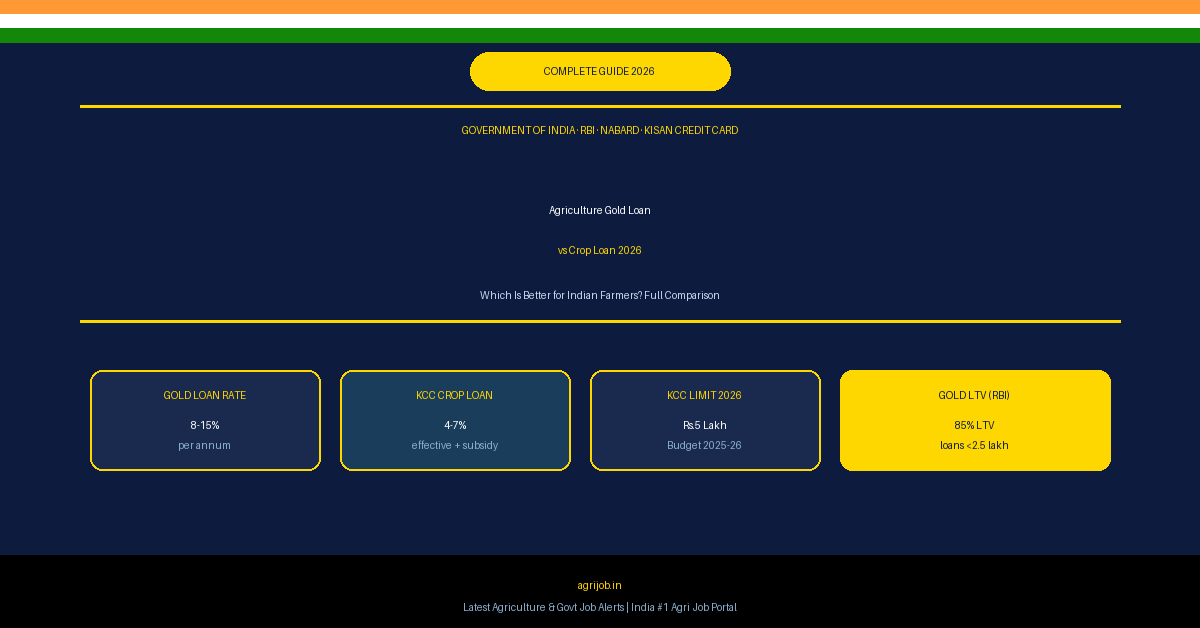
Table of Contents
Table of Contents
Agriculture Gold Loan vs Crop Loan 2026 – Quick Overview
Before diving deep, here is a side-by-side snapshot of the two most popular farm credit products in India for 2026.
| Feature | Agriculture Gold Loan | Crop Loan / KCC |
|---|---|---|
| Offered By | Banks, NBFCs (Muthoot, Manappuram, SBI, PNB, BOI etc.) | Public & Private Banks, RRBs, Cooperative Banks |
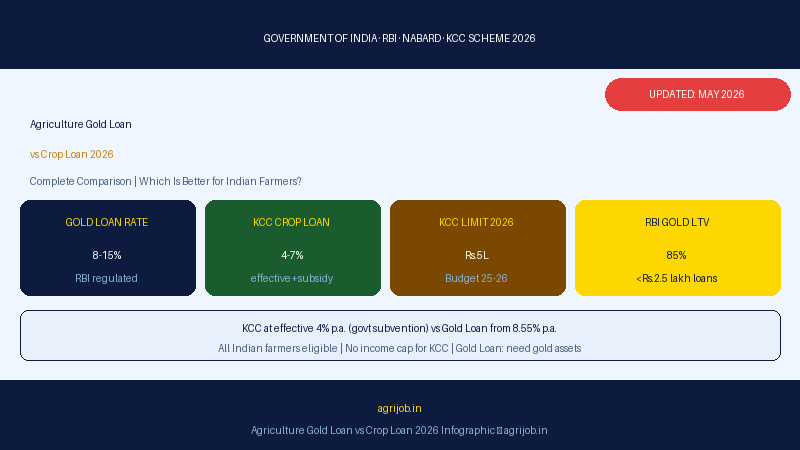
| Interest Rate | 8.55% – 15% p.a. | 7% p.a. (effective 4% with timely repayment) |
| Government Subsidy | 1–2% rebate for agri use (priority sector) | 3% interest subvention (MISS Scheme) |
| Loan Limit | Up to ₹1.5 crore (based on gold value) | Up to ₹5 lakh (KCC, Budget 2025–26) |
| Collateral | Gold jewellery (18–22 carat) | Land records / crop details (no collateral up to ₹1.6L) |
| LTV Ratio (RBI 2026) | 85% (≤₹2.5L) | 80% (₹2.5–5L) | 75% (>₹5L) | No LTV — credit limit based on scale of finance |
| Processing Time | Same day to 2 hours | 3–7 working days |
| Repayment | Bullet / Monthly / Seasonal (max 12 months for bullet) | Revolving credit — repay & re-draw as per crop cycle |
| Insurance Cover | Gold insured by lender (RBI mandate 2025) | PMFBY crop insurance included |
| Documentation | Aadhaar, PAN, proof of agri activity, gold | Aadhaar, land records, PAN, passport photo |
| Eligible Borrowers | Any farmer with gold assets | All farmers incl. tenant farmers & share-croppers |
| Official Source | RBI.org.in | NABARD.org |
What Is an Agriculture Gold Loan? (2026 RBI Rules)
An Agriculture Gold Loan is a secured loan where a farmer pledges gold jewellery (18–22 carat) as collateral to get instant funds from a bank or NBFC. Because agriculture falls under the RBI’s Priority Sector Lending guidelines, farmers who declare the loan purpose as agricultural get a rebate of 1–2% on interest rates.

In June 2025, the RBI released its landmark Lending Against Gold and Silver Collateral Directions, 2025, which became fully effective on 1 April 2026. These rules introduced a tiered Loan-to-Value (LTV) system — replacing the old flat 75% cap — and added strong protections for small-ticket borrowers, especially farmers.
Here are the new RBI gold loan rules every farmer must know in 2026:
- LTV 85% for loans up to ₹2.5 lakh — farmers can now borrow more against the same gold.
- LTV 80% for loans between ₹2.5 lakh and ₹5 lakh.
- LTV 75% for loans above ₹5 lakh.
- No mandatory credit appraisal for loans below ₹2.5 lakh — instant disbursement without income proof.
- Bullet repayment must be settled within 12 months.
- Gold return within 7 days of repayment, failing which the lender pays a penalty.
- Maximum pledging: 1 kg gold per borrower (new cap for large borrowers).
- All gold insured by lender — your jewellery is protected against theft or damage.
- Lender must communicate in the borrower’s local language.
Agriculture Gold Loan Interest Rates – Bank-Wise Table 2026
Interest rates on Agriculture Gold Loans vary by bank, loan amount, and gold purity. Here is a comparative table of major lenders as of May 2026:
| Bank / NBFC | Interest Rate (p.a.) | Max Loan Amount | Special Agri Scheme |
|---|---|---|---|
| State Bank of India (SBI) | 8.75% onwards | ₹50 lakh | SBI Multi-Purpose Gold Loan |
| Bank of India (BOI) | 8.36% – 9.05% | ₹50 lakh | Agri Gold Loan at ~9.00% |
| Punjab National Bank (PNB) | 8.35% onwards | ₹50 lakh | PNB Swarnim (Agri only) |
| Central Bank of India | 7.00% – 9.15% | ₹50 lakh | 7% under interest subvention |
| Poonawalla Fincorp | 11% onwards | ₹50 lakh | General gold loan |
| Muthoot Finance / Manappuram | 12% – 24% | ₹1.5 crore | No specific agri scheme |
| Market Starting Rate | 8.55% p.a. | ₹1.5 crore | Priority sector rate from 8% |
Note: Farmers who declare agri purpose can get a 1–2% rebate, bringing gold loan rates as low as 8% p.a. from regulated banks.
What Is a Crop Loan / Kisan Credit Card (KCC)? 2026 Update
The Kisan Credit Card (KCC) — India’s government-backed crop loan scheme — was launched in 1998 by the Government of India in cooperation with RBI and NABARD. It works like a revolving credit facility: farmers draw funds for seeds, fertilisers, irrigation, or labour — and repay after harvest — then draw again for the next season, all within the same credit limit.
The biggest 2026 update: Union Budget 2025–26 raised the KCC loan limit under the Modified Interest Subvention Scheme (MISS) from ₹3 lakh to ₹5 lakh. This directly benefits 7.75 crore KCC holders across India, including dairy farmers, animal husbandry practitioners, and fishery workers — all eligible under the expanded scheme.
The KCC scheme is available through Public Sector Banks, Private Banks, Regional Rural Banks (RRBs), Small Finance Banks, Cooperative Banks, and PACS (Primary Agricultural Credit Societies).
Crop Loan Interest Rate 2026 – KCC Under MISS Scheme
The interest rate structure for the KCC / Crop Loan under the Modified Interest Subvention Scheme (MISS) is one of the most farmer-friendly in the world. Here is how it works:
| Loan Amount | Base Rate | Govt Subvention | Timely Repayment Bonus | Effective Rate |
|---|---|---|---|---|
| Up to ₹5 lakh (MISS 2026) | Market rate | 1.5% to banks | 3% extra rebate | 4% p.a. |
| Up to ₹3 lakh (old limit) | 7% p.a. | 1.5% to banks | 3% rebate on time | 4% p.a. |
| Above ₹5 lakh | Bank’s own rate | No subvention | No extra rebate | 9–12% p.a. |
Example: Farmer Ramesh in Muzaffarpur, Bihar takes a KCC loan of ₹1 lakh at 7% for one year. He repays on time. The government gives his bank a 1.5% subvention, and Ramesh gets a 3% rebate — his effective interest rate drops to just 4% p.a., saving him ₹3,000 in interest compared to the base rate.
Agriculture Gold Loan vs Crop Loan 2026 – Eligibility Criteria
Understanding who qualifies is essential before applying for either loan. Here is a complete eligibility breakdown:
Eligibility for Agriculture Gold Loan
- Any Indian citizen aged 18 years or above
- Must possess eligible gold jewellery (18–22 carat; 22 carat gold preferred)
- Proof of agricultural activity required for agri-purpose concession rates
- No minimum landholding required
- No income proof needed for loans below ₹2.5 lakh (RBI 2026 rule)
- NRIs with gold assets in India may also apply through authorised family members
Eligibility for Crop Loan / KCC
- Individual farmers — owner cultivators, tenant farmers, oral lessees, share-croppers
- Self-Help Groups (SHGs) and Joint Liability Groups (JLGs) of farmers
- Farmers engaged in allied activities: dairy, poultry, fishery, animal husbandry
- No minimum or maximum land size restriction
- PM Kisan Samman Nidhi beneficiaries get priority
- Tenant farmers with self-declaration of cultivation — no land ownership proof required
How to Apply for KCC Crop Loan Online / Offline 2026
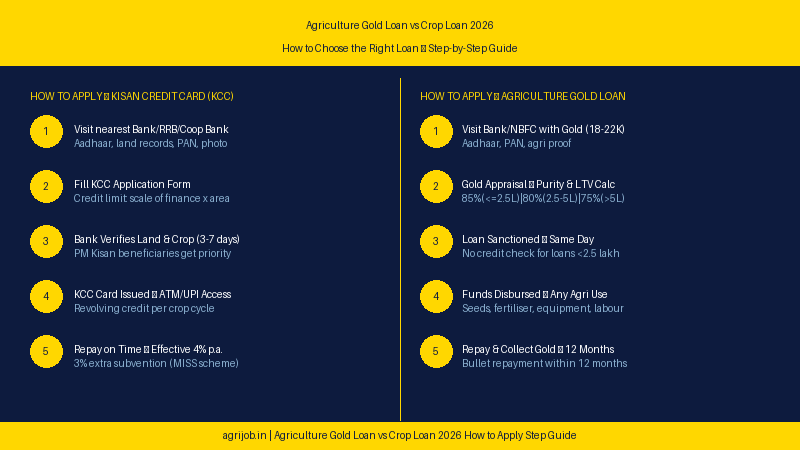
- Visit your nearest Bank branch, RRB, or Cooperative Bank. PM Kisan beneficiaries can also apply via the Kisan Rin Portal (KRP) launched in September 2023.
- Collect the KCC application form. Fill in personal details, land holding, crop pattern, and estimated scale of finance for the year.
- Submit documents: Aadhaar card, PAN card, land ownership records (or self-declaration for tenants), passport-size photos, and bank account details.
- Bank appraisal: The bank calculates your credit limit based on the scale of finance for your specific crop, area under cultivation, and post-harvest expenses. Processing takes 3–7 working days.
- KCC issuance: Once approved, the KCC (a Rupay debit card) is issued. You can withdraw from ATMs, use PoS machines, or transfer funds via UPI directly from your KCC account.
- Repay after harvest and the credit limit resets for the next crop season. Repay within the due date to earn the 3% prompt repayment incentive (effective rate: 4%).
How to Apply for Agriculture Gold Loan 2026 – Step-by-Step
- Choose your lender: Public sector banks (SBI, PNB, BOI) offer the lowest agri gold loan rates. NBFCs (Muthoot, Manappuram) offer faster processing but higher rates.
- Carry your gold jewellery (18–22 carat) along with Aadhaar, PAN, and proof of agriculture activity (land records, Kisan credit card, or PM Kisan registration).
- Gold appraisal: The lender’s certified appraiser weighs and tests purity of your gold. The loan amount is calculated as LTV% × Current Gold Market Value.
- Loan sanction: For loans below ₹2.5 lakh — sanctioned the same day, no credit check. For larger amounts — bank verifies your repayment capacity (income, existing loans).
- Funds disbursed directly to your bank account or as cash for amounts within permissible limits. Use for seeds, fertilisers, labour, irrigation, equipment, or post-harvest storage.
- Repayment: Choose bullet repayment (within 12 months), monthly interest payments, or crop-season-aligned instalments. Pay on time and get the agriculture interest rebate.
Which Loan Is Better? Agriculture Gold Loan vs Crop Loan 2026 — Verdict
There is no single “better” option — the right loan depends entirely on your situation. Here is a quick decision guide:
| Your Situation | Best Option |
|---|---|
| Need funds urgently (today) for sowing season | ✅ Agriculture Gold Loan |
| Want the lowest possible interest rate (4%) | ✅ Crop Loan / KCC |
| Don’t own land (tenant farmer) | ✅ Crop Loan / KCC (no land needed) |
| Loan amount needed > ₹5 lakh | ✅ Agriculture Gold Loan (up to ₹1.5 crore) |
| Want revolving credit across multiple seasons | ✅ Crop Loan / KCC |
| Have gold assets but irregular income | ✅ Agriculture Gold Loan (<₹2.5L: no income proof) |
| Want crop insurance bundled with loan | ✅ Crop Loan / KCC (PMFBY included) |
| NRI or overseas Indian investor in agri land | ✅ Consult NABARD / authorised dealer bank |
Bottom line: The Kisan Credit Card (KCC) crop loan at 4% effective interest is almost always the first choice for active farmers with land records. The Agriculture Gold Loan is the best emergency backup — instant, no land required, no credit checks up to ₹2.5 lakh, and now more accessible than ever under the RBI’s 2026 rules.
Is Agriculture Gold Loan or Crop Loan a Good Option for NRIs and International Agriculture Graduates?
For NRIs returning to India to pursue farming or agri-business, both loan products are available, but with important nuances. This section addresses the Agriculture Gold Loan vs Crop Loan 2026 in India for NRIs and provides an India vs USA comparison for agricultural credit.
In the USA, a farm operating loan from the USDA Farm Service Agency (FSA) carries an interest rate of approximately 7.5–8.5% p.a. (2025–26). By contrast, India’s KCC crop loan offers a subsidised effective rate of just 4% p.a. — making India’s government crop loan one of the most affordable farm credit products globally.
NRIs who own agricultural land in India are eligible for KCC loans through designated banks. However, they must have an Indian resident co-applicant or ensure the loan is availed through a resident power-of-attorney holder. The gold loan route is even simpler for NRIs — if gold jewellery is held in India by family members, they can pledge it on behalf of the NRI investor.
For international agriculture students from India studying in the USA, UK, Australia, or Canada, the agriculture gold loan vs crop loan comparison is relevant when they return home. The KCC provides a revolving credit line ideal for establishing a new farm enterprise, while the gold loan offers bridge financing without the paperwork that a new-to-farming graduate may struggle to provide (land records, crop history). Eligible NRIs living abroad can explore both options via NABARD’s NRI-specific schemes and PM Kisan portal.
Key Government Schemes Supporting Farm Loans 2026
- Modified Interest Subvention Scheme (MISS) 2025–26: Cabinet approved continuation providing 7% rate (effective 4%) on KCC loans up to ₹5 lakh. Benefits 7.75 crore farmers.
- PM Kisan Samman Nidhi: ₹6,000/year income support + priority KCC issuance for registered beneficiaries.
- PMFBY (Pradhan Mantri Fasal Bima Yojana): Crop insurance bundled with KCC at subsidised premium.
- Kisan Rin Portal (KRP): Launched September 2023, enabling digital KCC applications and tracking across all participating banks.
- RBI Gold Lending Directions 2025 (effective April 2026): Standardised gold loan framework protecting small farmer borrowers — tiered LTV, 12-month bullet cap, local language communication.
- NABARD Refinance: NABARD provides refinance support to RRBs and cooperative banks offering KCC to small and marginal farmers at concessional rates.
Important Links – Agriculture Gold Loan vs Crop Loan 2026
| Resource | Link |
|---|---|
| Apply for KCC Online (PM Kisan Portal) | pmkisan.gov.in |
| Kisan Rin Portal (KRP) – Digital KCC Apply | kisanrincredit.gov.in |
| RBI Gold Loan Directions 2025 (Official) | Reserve Bank of India – RBI.org.in |
| NABARD – Kisan Credit Card Guidelines | NABARD.org |
| PIB – Budget 2025-26 KCC Enhancement | PIB.gov.in |
| More Agriculture Finance Articles | Agriculture Jobs & Finance – agrijob.in |
| Latest Govt Jobs for Agriculture Graduates | Govt Jobs 2026 – agrijob.in |
| Join Telegram for Instant Job Alerts | agrijob.in Telegram Channel |
Frequently Asked Questions about Agriculture Gold Loan vs Crop Loan 2026
Q1. What is Agriculture Gold Loan vs Crop Loan 2026?
Agriculture Gold Loan vs Crop Loan 2026 refers to the comparison of two major farm credit products available to Indian farmers this year. The Agriculture Gold Loan is a secured loan against gold jewellery (starting at 8.55% p.a.), while the Crop Loan (KCC) is a government-backed revolving credit scheme offering rates as low as 4% p.a. with timely repayment. Both are regulated by RBI and classified under Priority Sector Lending.
Q2. What is the interest rate on Agriculture Gold Loan in 2026?
Agriculture Gold Loan interest rates start from 8.55% p.a. from banks and go up to 15–24% from NBFCs. Farmers who declare agricultural purpose can get a 1–2% rebate under RBI’s Priority Sector Lending norms, bringing the rate as low as 8% from public sector banks. Rates vary by lender, gold purity, and loan amount.
Q3. What is the KCC crop loan interest rate in 2026?
Under the Modified Interest Subvention Scheme (MISS), the KCC crop loan base rate is 7% p.a. on loans up to ₹5 lakh (enhanced from ₹3 lakh in Budget 2025–26). Farmers who repay on time receive an additional 3% prompt repayment incentive, bringing the effective interest rate to just 4% p.a. — one of the lowest agricultural loan rates in the world.
Q4. What is the new RBI gold loan LTV rule in 2026?
As per the RBI’s Lending Against Gold and Silver Collateral Directions, 2025, effective 1 April 2026, the tiered LTV rules are: 85% for loans up to ₹2.5 lakh, 80% for loans between ₹2.5 lakh and ₹5 lakh, and 75% for loans above ₹5 lakh. This is an improvement for small-ticket rural borrowers, who can now access more funds against the same gold.
Q5. Can tenant farmers without land apply for crop loan?
Yes. Tenant farmers, oral lessees, and share-croppers without land ownership can apply for KCC through a self-declaration of cultivation. Joint Liability Groups (JLGs) of landless farmers are also eligible. PM Kisan beneficiaries get priority processing. This makes KCC the most inclusive farm credit product in India.
Q6. Can NRIs or Indian students abroad apply for Agriculture Gold Loan vs Crop Loan 2026?
NRIs who own agricultural land in India can apply for KCC through a resident power-of-attorney holder or co-applicant. For the Agriculture Gold Loan, if the gold is held in India, a resident family member can pledge it. Indian agriculture graduates returning from USA, UK, or Australia are fully eligible for both schemes as resident Indian farmers. NABARD also has special refinance schemes for NRI-promoted agri enterprises.
Final Thoughts on Agriculture Gold Loan vs Crop Loan 2026
Agriculture Gold Loan vs Crop Loan 2026 is a critical choice that can save — or cost — Indian farmers thousands of rupees every season. If you are an active farmer with land records, the Kisan Credit Card (KCC) at an effective 4% p.a. under the MISS scheme is the most affordable option available anywhere in the world. If you need emergency funds today, without paperwork, and you have gold at home, the Agriculture Gold Loan is your fastest option — especially with the new RBI 2026 rules giving 85% LTV on small-ticket loans below ₹2.5 lakh. Take advantage of the government’s enhanced KCC limit of ₹5 lakh and apply before the next crop season. Visit agrijob.in for more agriculture finance guides and government job updates.
Disclaimer: This Agricultural jobs related information is only for the purpose of providing information to you and for Agricultural career advancement of Agricultural, Horticulture, Agronomy, Soil Science, Plant Breeding, Agriculture Marketing, Forestry, Poultry, Fisheries, Agri Business Management Graduates. We are not representing this employer or any Employment Agency nor we guarantee any employment. We do not ask candidates for any fees, Personal Information like (Bank OTP, Credit-Debit Card No, Aadhar Card OTP etc.) Please be Aware And never Share Such Information to any one or In the Name of agrijob.in. Please verify the correctness of the Agri jobs details yourself. We do not offer any guarantee on correctness of any details mentioned here. If a candidate pays any amount to anyone claiming to represent any company then it would be the responsibility of that candidate and he cannot hold us or the concerned employer responsible for such fraudulent activities.Aadhaar Card Complete Guide 2026 – What It Is, How to Apply, Download, Update & All Services