

Drone rice paddy management in Japan 2026 has reached a decisive crossroads: the multi-rotor agility of the DJI Agras T50 now competes directly against the Yamaha RMAX, a single-rotor veteran with over 35 years of continuous rice-field deployment. Japan treats approximately 40% of its entire rice crop using unmanned aerial sprayers, making this comparison critically important for every cooperative, agri-contractor, and farm owner operating in Japan today. This guide is for Japanese rice farmers, precision-agriculture consultants, cooperative managers, and agtech investors aged 25–60 who need a data-backed answer to one question: which drone delivers the best return on investment in 2026? We cover specifications, coverage rates, operating costs, regulatory compliance, spray performance, terrain suitability, and the verdict — all in one place.

For most Japanese rice paddy operations in 2026, the DJI Agras T50 delivers superior coverage at 21 ha/hour with a 40-litre tank and phased-array radar precision, while the Yamaha RMAX remains the premium choice for operators prioritizing 35+ years of regulatory validation, cooperative trust, and single-rotor downwash penetration in dense-canopy rice fields. Your plot size, budget, and cooperative’s existing certification decide the winner.
- Japan Rice Crop Drone Coverage: ~40% of national rice paddies sprayed by UAV (JAAA, 2024)
- DJI Agras T50 Tank Capacity: 40 litres liquid / 50 kg granule spreader
- DJI Agras T50 Coverage Rate: Up to 21 ha/hour at 7 m/s (standard paddy application)
- Yamaha RMAX Annual Coverage: 2.4 million acres of Japanese farmland per year (across 2,600+ helicopters)
- Yamaha RMAX Practical Payload: 16 kg / approx. 15-litre effective spray per sortie
- DJI Agras T50 Starting Price: Approx. $19,000–$29,000 USD (drone + basic kit)
- Yamaha RMAX Approx. Price: $32,000–$50,000+ USD depending on configuration
- Japan Drone Law: Minimum 2 licensed operators required for field spraying (MLIT/MAFF)
- Labour Reduction: Pesticide-spraying drones cut paddy working time by 61% (Japan MAFF Smart Agriculture data)
- Japan Ag Drone Market Size (2025): USD 169.4 million, projected to reach USD 659.3 million by 2030
- What Is Drone Rice Paddy Management in Japan?
- Who Should Read This Comparison Guide?
- Coverage Rates and Operating Costs in 2026
- Full Specifications: DJI Agras T50 vs Yamaha RMAX
- How Drone Paddy Spraying Works: Step-by-Step Process
- DJI Agras T50 vs Yamaha RMAX – Head-to-Head Table
- Pros and Cons of Each Platform
- Japan Drone Spraying Regulations and Certification 2026
- Important Terms in Agricultural Drone Spraying
- Important Links and Official Resources
- Conclusion
- Key Takeaways
- Frequently Asked Questions
What Is Drone Rice Paddy Management in Japan?
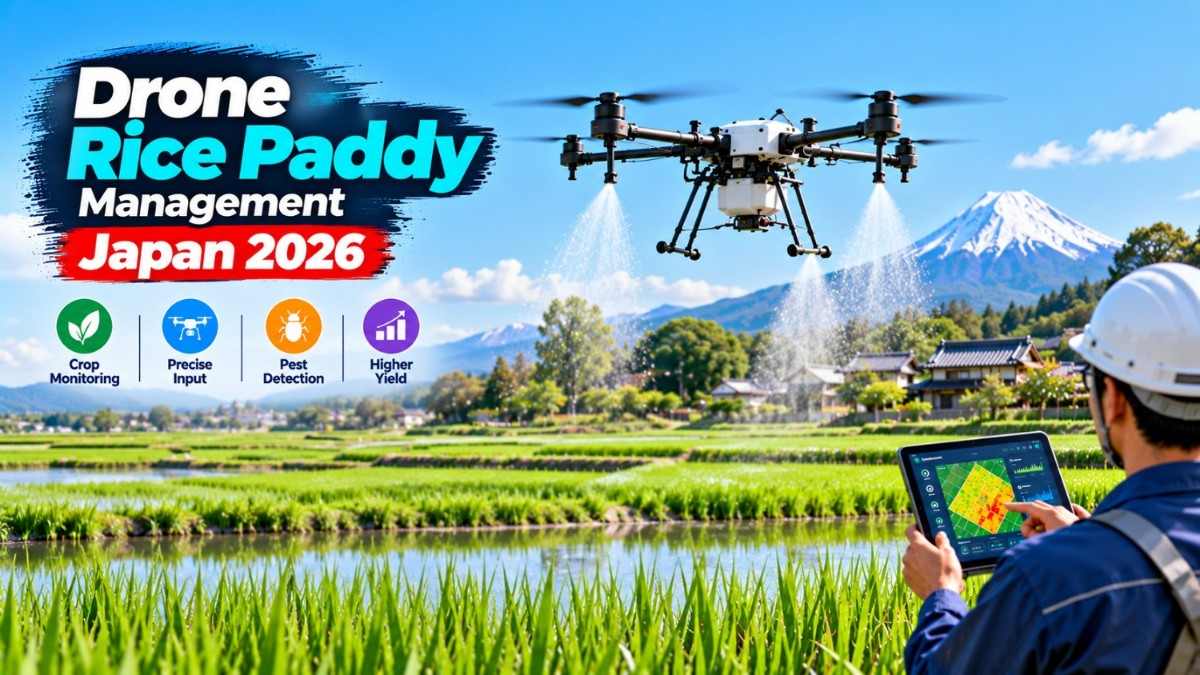
Drone rice paddy management is the use of unmanned aerial vehicles (UAVs) to spray pesticides, fungicides, herbicides, and granular fertilizers over flooded rice paddy fields, replacing manual backpack sprayers and manned aircraft. Japan pioneered this technology in 1987 when Yamaha Motor developed the R-50, the world’s first industrial unmanned agricultural helicopter. By 2026, the practice has expanded to cover approximately 40% of Japan’s rice crop, with over 2,600 Yamaha helicopter UAVs and a rapidly growing fleet of DJI multi-rotor drones operating across Hokkaido, Niigata, Akita, and other major rice-producing prefectures.
The core advantage of UAV spraying over tractor boom sprayers is access: Japan’s paddy fields average just 0.3–1.5 ha per plot, separated by irrigation levees that no ground vehicle can cross efficiently. Drone sprayers can treat irregular, waterlogged, and levee-bounded plots in continuous flight paths, reducing total labour hours by an average of 61% per hectare according to Japan’s Ministry of Agriculture, Forestry and Fisheries (MAFF) smart agriculture programme data. The downwash from rotor systems also pushes spray droplets deeper into the crop canopy than boom sprayers at ground level, improving pesticide efficacy and reducing chemical runoff into irrigation water.

Two dominant platforms define this market: the DJI Agras T50, a Chinese-manufactured hexacopter bringing advanced phased-array radar, RTK precision, and 21 ha/hour throughput; and the Yamaha RMAX, a Japanese-made single-rotor gas-powered unmanned helicopter with decades of MAFF and Japan Agricultural Aviation Association (JAAA) regulatory approval. Their philosophies differ fundamentally, and choosing between them has real consequences for farm profitability, cooperative compliance, and crop protection outcomes.
Who Should Read This Drone Rice Paddy Comparison Guide?
- 🌾 Rice farm owners (1–30 ha) evaluating whether to purchase a drone or hire a spraying service cooperative
- 🚁 Agricultural cooperatives (JA members) managing fleet procurement decisions across multiple member farms
- 📊 Agri-contractors and custom spray operators calculating ROI per hectare across multi-farm service territories
- 🎓 Agricultural university researchers and extension officers advising on precision farming technology adoption
- 💼 Agtech investors and distributors assessing Japan market positioning for DJI vs Yamaha platforms
- 🧪 Pesticide company representatives needing to understand drone-registered formulation requirements for Japan’s JAAA registry
- 🏛️ Local government officers overseeing subsidised smart agriculture deployment under Japan’s Act on Promotion of Smart Agricultural Technology (2024)
- 👨🌾 Young farmers aged 20–40 seeking to modernise operations amid Japan’s aging agricultural workforce crisis
Coverage Rates and Operating Costs in 2026
The most commercially critical difference between these two platforms is their hourly throughput and cost per hectare. At standard rice paddy application rates in Japan (15–30 litres per hectare), the DJI Agras T50’s 40-litre tank and 16 L/min dual-pump flow rate enables continuous treatment across multiple plots with shorter refill intervals than the RMAX’s gas-powered sortie cycle. Here is a direct cost and coverage breakdown for a typical Japanese 10-ha paddy block:
| Metric | DJI Agras T50 | Yamaha RMAX |
|---|---|---|
| Tank / Payload Capacity | 40 L liquid / 50 kg granule | ~15 L effective liquid |
| Coverage Rate (paddy standard) | Up to 21 ha/hour | Approx. 4–6 ha/hour |
| Spray Swath Width | 9 m at 3 m height | ~7–9 m depending on speed |
| Flight Time (loaded) | ~12–15 min per battery | ~30–45 min (gas engine) |
| Refill / Recharge Downtime | 9-min fast charge per battery | Fuel refill ~5 min, tank refill ~3 min |
| Drone Unit Price (approx.) | $19,000–$29,000 USD | $32,000–$50,000+ USD |
| Annual Maintenance Cost | Low (electric, fewer moving parts) | High (engine, gearbox, rotor blade intervals) |
| Estimated Cost per Hectare (service) | ~¥3,000–¥4,500/ha | ~¥5,000–¥7,000/ha |
| Operator Licence Required | Yes – MLIT category + JAAA certification | Yes – JAAA Level 2 + YACS training |
Japan’s agricultural drone market is projected to grow from USD 169.4 million in 2025 to USD 659.3 million by 2030, a compound annual growth rate of 31.2%, driven primarily by demand for labour-saving solutions as Japan’s farming workforce ages. Operators who invest in the correct platform now will capture the majority of this expanding custom-spray service revenue.
Full Specifications: DJI Agras T50 vs Yamaha RMAX
Understanding the complete technical profile of both platforms is essential before making a procurement decision. The DJI Agras T50 is a hexacopter (6-rotor coaxial design delivering 12 effective rotors) launched in 2024, optimised for maximum spray volume per hour. The Yamaha RMAX is a single-main-rotor gas-powered unmanned helicopter in production since 1997, designed specifically for Japan’s cooperative spraying model and regulatory framework.
| Specification | DJI Agras T50 | Yamaha RMAX |
|---|---|---|
| Rotor Configuration | Coaxial hexacopter (12 rotors) | Single main rotor + tail rotor |
| Power Source | Electric battery (fast-charge) | Gas engine (246 cc, 2-stroke liquid-cooled) |
| Max Takeoff Weight | 99.8 kg (fully loaded) | ~94 kg (fully loaded) |
| Spray Tank Capacity | 40 L liquid | ~15–16 L practical payload |
| Granule Hopper | 50 kg spreader included | Optional granule unit |
| Max Flow Rate | 16 L/min (2 nozzles) / 24 L/min (4 nozzles) | ~2–4 L/min (centrifugal nozzle) |
| Spray Swath | 9 m (at 3 m AGL) | 7–9 m (speed-dependent) |
| Obstacle Sensing | Active Phased-Array Radar + Binocular Vision | YACS II (GPS stability); no forward object radar |
| RTK Precision | Dual RTK modules, <10 cm row error | High-performance GPS (no RTK standard) |
| IP Rating | IP67 | Chemical drip-proof construction |
| Wind Resistance | Level 7 (15 m/s) | Operational up to ~10 m/s recommended |
| Max Operating Speed | 10 m/s (spray) / 15 m/s (transit) | Max 50 km/h; spray warning alert above 20 km/h |
| Droplet Size Range | 50–500 μm (adjustable atomiser) | Centrifugal nozzle (fixed range) |
| Canopy Penetration | Strong multi-rotor downwash | Exceptional single-rotor deep downwash |
| Control System | DJI Agriculture App + RC Plus controller | Yamaha Attitude Control System II (YACS II) |
| Autonomous Mapping | Yes – DJI Terra + field boundary import | Limited – GPS-guided grid only |
How Drone Paddy Spraying Works: Step-by-Step Process
- Obtain pilot certification: Register with the Japan Agricultural Aviation Association (JAAA) and complete the required training and MLIT drone operator category exam. Japanese law mandates at least 2 licensed operators present during any paddy field spraying operation.
- Confirm pesticide registration: Check the JAAA pesticide registry — only MAFF-approved drone-compliant agrochemicals may be used. As of 2022, most mainstream paddy agrochemicals in Japan are UAV-compliant, but always verify the specific formulation, especially herbicides (registered for rice fields only in granule or film-oil forms).
- Map the field boundaries: For DJI Agras T50 users, import field boundaries via DJI Terra or use the RC Plus controller to manually map plot edges. Yamaha RMAX operators set GPS waypoints manually using the YACS II controller and conduct a pre-flight perimeter survey.
- Calibrate spray rate and nozzle settings: Set application volume (typically 15–30 L/ha for rice paddy), select nozzle configuration (2 or 4 nozzles for T50; centrifugal nozzle setting for RMAX), and confirm droplet size range matches crop growth stage and target pest.
- Pre-flight inspection and weather check: Verify wind speed below operational limits (15 m/s for T50; 10 m/s recommended for RMAX), check for overhead power lines and irrigation infrastructure within the flight zone, and inspect battery charge (T50) or engine oil and fuel levels (RMAX).
- Execute autonomous spray mission: Launch the drone on the planned grid pattern. The T50 uses Active Phased-Array Radar to automatically avoid obstacles and maintain precise altitude over paddy surfaces. RMAX operators must monitor flight manually, adjusting for terrain variations.
- Refill and continue: Refill the spray tank (and swap battery for the T50) between sorties. With a 40-litre tank at 15 L/ha, the T50 covers approximately 2.6 ha per sortie before requiring a refill. Three operators sharing two T50 batteries can maintain near-continuous spraying.
- Post-application record keeping: Log spray date, weather conditions, pesticide batch number, coverage area, and operator ID. These records are required for JAAA compliance audits and may be needed by crop insurance providers.
The peak spraying window for Japanese rice is compressed into roughly 6–8 weeks between late June and mid-August (heading and flowering stages). With a T50 covering 21 ha/hour, a single unit can service approximately 150–200 ha per day under ideal conditions. Size your fleet — or your service contracts — to handle your full cooperative’s acreage within this peak window, accounting for weather cancellations (typically 30–40% of operating days during Japan’s rainy season).
DJI Agras T50 vs Yamaha RMAX — Head-to-Head Performance Comparison
This comparison covers every dimension relevant to rice paddy management in Japan’s 2026 regulatory, agronomic, and economic environment.
| Category | DJI Agras T50 | Yamaha RMAX | Winner |
|---|---|---|---|
| Coverage Rate (ha/hr) | Up to 21 ha/hr | 4–6 ha/hr | ✅ DJI Agras T50 |
| Tank Capacity | 40 L liquid + 50 kg granule | ~15 L liquid | ✅ DJI Agras T50 |
| Canopy Penetration | Strong multi-rotor downwash | Superior single-rotor downwash depth | ✅ Yamaha RMAX |
| Obstacle Sensing | Phased-Array Radar + Binocular Vision | GPS only — no forward radar | ✅ DJI Agras T50 |
| Precision / RTK | Dual RTK — <10 cm row accuracy | GPS-guided, no RTK standard | ✅ DJI Agras T50 |
| Flight Endurance | 12–15 min/battery (electric) | 30–45 min (gas engine) | ✅ Yamaha RMAX |
| Maintenance Complexity | Low (electric; fewer parts) | High (engine, gearbox overhauls) | ✅ DJI Agras T50 |
| Unit Price | $19,000–$29,000 USD | $32,000–$50,000+ USD | ✅ DJI Agras T50 |
| Regulatory History in Japan | Growing JAAA/MLIT approval base | 35+ years, dominant JAAA certification history | ✅ Yamaha RMAX |
| Cooperative / JA Acceptance | Increasing but newer entrant | Deeply embedded in JA cooperative networks | ✅ Yamaha RMAX |
| Autonomous Mission Planning | Full — DJI Terra + variable-rate maps | GPS grid only | ✅ DJI Agras T50 |
| Cost per Hectare (service rate) | ~¥3,000–¥4,500/ha | ~¥5,000–¥7,000/ha | ✅ DJI Agras T50 |
| Parts Availability in Japan | Growing DJI Agriculture network | Yamaha national dealer network; RMAX parts scarcity increasing | ✅ DJI Agras T50 |
| Chemical Drift Control | Adjustable droplet 50–500 μm | Fixed centrifugal range | ✅ DJI Agras T50 |
For new fleet buyers and custom-spray contractors in 2026, the DJI Agras T50 wins on 10 of 14 comparison dimensions. Its lower entry cost, vastly superior coverage rate, advanced obstacle sensing, and RTK precision make it the more commercially viable choice for Japan’s expanding drone-spray market. However, existing Yamaha cooperative operators should not abandon RMAX fleets without a transition plan — the RMAX’s 35-year JAAA regulatory validation and cooperative network trust represent real institutional value that takes years to replicate.
Pros and Cons of DJI Agras T50 and Yamaha RMAX for Japanese Rice Paddies
DJI Agras T50 — Advantages
- ✅ 3.5× higher coverage rate than RMAX — 21 ha/hr vs 4–6 ha/hr
- ✅ Lower total cost of ownership — electric drivetrain requires no engine overhauls or gasoline logistics
- ✅ Active Phased-Array Radar with automatic obstacle avoidance prevents collisions with irrigation pylons and power lines common in Japan’s paddy landscape
- ✅ Dual RTK precision eliminates spray overlaps and missed strips, reducing chemical waste by up to 45% vs broadcast methods
- ✅ Variable-rate spreading mode allows granular fertilizer application in a single platform pass — RMAX requires a separate setup
- ✅ Faster certification pathway for new operators entering Japan’s growing drone-spray service market
DJI Agras T50 — Disadvantages
- ❌ Short per-battery flight time (12–15 min) requires multi-battery logistics in the field and disciplined team management
- ❌ Shorter operational history in Japan compared to 35+ years of RMAX data — some cooperative procurement committees remain cautious
- ❌ Chinese-origin hardware may face import restrictions in some government-subsidised programme tenders (a growing regulatory consideration in Japan’s 2026 policy environment)
Yamaha RMAX — Advantages
- ✅ 35+ years of JAAA regulatory validation — the most trusted platform in Japan’s cooperative spraying network
- ✅ Superior single-rotor downwash penetration — one large rotor disc creates deeper canopy airflow than multiple small rotors, particularly beneficial in tall, dense rice cultivars at heading stage
- ✅ Longer continuous flight time (30–45 min on fuel) reduces the logistical complexity of battery swapping in remote paddy locations
- ✅ Fully Japanese-designed and serviced — aligns with cooperative procurement preferences and Japan’s domestic industrial technology positioning
Yamaha RMAX — Disadvantages
- ❌ 2.6× higher unit cost compared to DJI Agras T50 for equivalent spraying capacity
- ❌ Complex gas engine maintenance — 246 cc 2-stroke engine requires regular overhauls, oil changes, and specialist Yamaha technician servicing
- ❌ No obstacle-sensing radar — operators must manually manage flight paths around rice paddy infrastructure
- ❌ Parts scarcity increasing — third-party analysis confirms RMAX spare parts availability is declining as Yamaha shifts development focus to newer YMR-series electric platforms
Japan Drone Spraying Regulations and Certification 2026
Aerial application of agricultural chemicals in Japan is governed by a dual-regulatory framework managed by the Ministry of Agriculture, Forestry and Fisheries (MAFF) and the Ministry of Land, Infrastructure, Transport and Tourism (MLIT). The Japan Agricultural Aviation Association (JAAA) administers the specific certification programmes for both pilot training and pesticide approval under this framework.
Key compliance requirements for 2026 paddy operations include: a minimum of two licensed operators present at all times during spraying; use of only JAAA-registered pesticide formulations (Japan maintains 382+ registered drone-compliant formulations); and adherence to spray altitude and speed limits (the RMAX has an on-board warning if speed exceeds 20 km/h during application). In February 2019, MAFF simplified the efficacy and residue test requirements for new drone-compatible agrochemicals, significantly expanding the available product range.
Japan’s Act on the Promotion of Smart Agricultural Technology, enacted in October 2024, further institutionalized drone use in rice cultivation. Under this act, prefectural and national government subsidies now support cooperative drone fleet purchases, with data showing average labour hour reductions of 9% overall and 61% specifically for pesticide spraying operations in paddy rice cultivation. Both DJI Agras T50 and Yamaha RMAX platforms are eligible for cooperative subsidy programmes provided they meet JAAA certification standards.
Important Terms in Agricultural Drone Spraying for Japan Rice Paddies
Understanding these high-value industry terms will improve your platform decision-making and compliance with Japanese regulations.
- JAAA (Japan Agricultural Aviation Association): The primary regulatory and certification body for aerial pesticide application in Japan. All drone operators must register with JAAA; all pesticide formulations must hold JAAA-approved drone application status before commercial use.
- UAV-Compliant Agrochemical: A pesticide formulation registered by MAFF for aerial application via unmanned vehicles. Japan maintains 382+ such registrations as of 2022, covering fungicides, insecticides, herbicides (rice only), and plant growth regulators.
- RTK (Real-Time Kinematic) GPS: A satellite positioning technique that achieves centimetre-level precision (<10 cm) by using a ground-based reference station. The DJI Agras T50’s dual RTK system enables millimetre-accurate spray line alignment, critical for avoiding re-spray overlaps on narrow paddy strips.
- YACS II (Yamaha Attitude Control System II): Yamaha’s proprietary flight stabilisation system on the RMAX, providing automatic speed deceleration, altitude hold, and GPS-guided navigation. It lacks the obstacle-sensing radar of newer multi-rotor platforms.
- Active Phased-Array Radar: DJI’s forward-and-backward facing radar system on the Agras T50 that maps terrain topography in real time, enabling autonomous terrain-following in rice paddies with varying elevation across adjacent plots.
- Droplet Size (μm): The diameter of spray droplets produced by a nozzle, measured in micrometres. Fine droplets (50–150 μm) penetrate canopies better but increase drift risk. Coarse droplets (300–500 μm) reduce drift. The T50’s adjustable atomiser allows operators to optimise droplet size for specific pesticide types and weather conditions — a capability the RMAX’s fixed centrifugal nozzle cannot match.
- Variable-Rate Application (VRA): The ability to vary spray rates across a field in real time, guided by pre-loaded prescription maps derived from NDVI satellite imagery or drone scouting. The T50 supports VRA when paired with DJI’s Mavic 3M Multispectral scouting drone; RMAX does not natively support VRA.
- Smart Agriculture Act (2024): Japan’s Act on the Promotion of Smart Agricultural Technology (enacted October 2024) provides the legislative and funding framework for drone fleet subsidy programmes across agricultural cooperatives, underpinning the expected market growth from USD 169.4M (2025) to USD 659.3M (2030).
- Downwash Penetration: The downward airflow generated by rotor systems that physically pushes spray droplets through the crop canopy. Single-rotor systems like the RMAX generate a concentrated, powerful downwash column. Multi-rotor systems like the T50 generate a broader but distributed downwash — generally sufficient for rice paddies but less effective in very tall or extremely dense canopy conditions.
- JA (Japan Agricultural Cooperative): The national agricultural cooperative network that manages communal equipment procurement, pesticide purchasing, and spraying service coordination for the majority of Japan’s 1.2 million rice farming households.
Important Links and Official Resources
| Resource | Link |
|---|---|
| Japan Ministry of Agriculture, Forestry and Fisheries (MAFF) | www.maff.go.jp |
| Japan Agricultural Aviation Association (JAAA) | www.jaaa.ne.jp |
| DJI Agriculture Official (Agras T50) | agriculture.dji.com |
| Yamaha Motor Industrial Unmanned Helicopters | global.yamaha-motor.com/business/uav/ |
| MAFF Smart Agriculture Programme (Japan) | www.maff.go.jp/j/kanbo/smart/ |
| World Economic Forum – Japan Smart Agriculture 2026 | weforum.org – Japan Agriculture Tech |
| Agrijob.in – Precision Agriculture & Agtech Careers Guide | www.agrijob.in |
Conclusion: Which Drone Wins for Rice Paddy Management in Japan 2026?
Drone rice paddy management in Japan is no longer an emerging technology — it is the operational backbone of a rice industry facing acute labour shortages, climate volatility, and rising food security pressure. Both the DJI Agras T50 and the Yamaha RMAX are proven tools, but they serve fundamentally different operator profiles in 2026. The T50 wins decisively on throughput, precision, cost efficiency, and autonomous capability. The RMAX retains its edge in cooperative trust, regulatory history, and deep canopy penetration for specific crop conditions.
For new operators, custom-spray contractors, and cooperatives building fresh fleets, the DJI Agras T50 is the commercially superior choice in 2026, delivering up to 21 ha/hour at a unit cost roughly 40% lower than the RMAX. For established Yamaha cooperative networks with trained YACS II operators and existing JAAA certification pipelines, transitioning to the T50 requires a multi-season plan — not an immediate switch. Bookmark this page and check back as MAFF subsidy eligibility and JAAA certification rules are updated through the year.
- Japan uses drones to spray approximately 40% of its national rice crop, making it the world’s most mature agricultural UAV market by adoption depth.
- The DJI Agras T50 covers up to 21 ha/hour — roughly 3.5× the Yamaha RMAX’s 4–6 ha/hour — at a unit price 40% lower.
- The Yamaha RMAX holds 35+ years of JAAA and MAFF regulatory validation, making it the default cooperative choice where institutional trust outweighs raw throughput.
- Japan’s Smart Agriculture Act (2024) subsidises drone fleet procurement for cooperatives — both platforms are eligible, but operators must hold JAAA certification and use MAFF-registered agrochemicals.
- Pesticide-spraying drones reduce paddy rice labour hours by 61% according to Japan MAFF data, with the country’s drone agri-market set to grow from USD 169.4M (2025) to USD 659.3M by 2030.
- New operators and contractors entering Japan’s drone spray market in 2026 should evaluate the DJI Agras T50 as their primary platform, with RMAX retained only where cooperative contracts specifically require it.
Frequently Asked Questions About Drone Rice Paddy Management Japan 2026
What percentage of Japan’s rice crop is sprayed by drone in 2026?
Approximately 40% of Japan’s entire rice crop is treated by unmanned aerial sprayers as of 2024–2026 data from the Japan Agricultural Aviation Association (JAAA). This includes both traditional single-rotor platforms like the Yamaha RMAX and newer multi-rotor systems such as the DJI Agras T50. Japan has the longest continuous agricultural UAV operation history in the world, having adopted the technology commercially in 1997.
How many hectares per hour can the DJI Agras T50 spray in a rice paddy?
The DJI Agras T50 can spray up to 21 hectares per hour at a standard rice paddy application rate of 15 L/ha and an operating speed of 7 m/s. Real-world throughput in Japan’s fragmented paddy landscape — accounting for levee turns, battery swaps, and tank refills — typically ranges from 12–16 ha per effective spray hour, still 2–3× higher than the Yamaha RMAX under equivalent field conditions.
Is the Yamaha RMAX still being produced in 2026?
The Yamaha RMAX remains operational across Japan’s cooperative spraying network in 2026, with over 2,600 units historically deployed. However, multiple industry analyses note that RMAX spare parts availability is declining as Yamaha Motor redirects development investment toward its newer electric YMR-series platforms. New RMAX purchases are increasingly difficult to justify commercially when the DJI Agras T50 delivers 3.5× the coverage at lower capital cost. Existing RMAX operators should plan for fleet transition within the next 3–5 years.
Do I need a special licence to spray rice paddies with a drone in Japan?
Yes. Agricultural drone spraying in Japan requires two certifications: an MLIT drone operator category certificate under Japan’s revised Civil Aeronautics Law, and a JAAA (Japan Agricultural Aviation Association) pesticide application qualification. Japanese law mandates a minimum of two licensed operators present at all times during any paddy field spraying operation. Training is available through JAAA-certified institutions across all major rice-producing prefectures.
How much does drone paddy spraying cost per hectare in Japan?
Custom drone spraying service rates in Japan typically range from ¥3,000–¥4,500 per hectare for DJI Agras T50-based services and ¥5,000–¥7,000 per hectare for Yamaha RMAX cooperative services, reflecting the higher operational cost of the gas-powered single-rotor platform. Cooperative members often receive subsidised rates through JA (Japan Agricultural Cooperative) programmes, particularly under smart agriculture subsidy schemes active under Japan’s 2024 Smart Agricultural Technology Act.
Which agricultural drone has better canopy penetration for rice — DJI or Yamaha?
The Yamaha RMAX produces superior single-rotor downwash penetration compared to the DJI Agras T50’s multi-rotor downwash for dense-canopy conditions. The RMAX’s single large main rotor disc generates a concentrated, high-velocity vertical airflow column that pushes spray droplets deeper into tall, mature rice stands. However, for the majority of Japan’s rice paddy applications — standard cultivars at tillering through early heading stages — the T50’s distributed multi-rotor downwash delivers equivalent or sufficient canopy penetration with significantly better coverage efficiency.
Are Chinese-made agricultural drones like DJI Agras eligible for Japanese government subsidies?
As of 2026, DJI Agras platforms are generally eligible for Japan’s cooperative drone fleet subsidies under the Smart Agriculture Technology Act (2024) provided they meet JAAA certification requirements and use MAFF-registered agrochemicals. However, procurement rules for specific government tender programmes are evolving, and some national security-sensitive public procurement guidelines may apply restrictions to Chinese-origin hardware. Operators applying for subsidised equipment should verify eligibility directly with their prefectural MAFF extension office before purchase.
What is Japan’s agricultural drone market size in 2026?
Japan’s agricultural drone market was valued at approximately USD 169.4 million in 2025 and is projected to reach USD 659.3 million by 2030, representing a compound annual growth rate (CAGR) of 31.2% (MarketsandMarkets). This exceptional growth is driven by acute labour shortages from Japan’s ageing farming workforce, government smart agriculture subsidies, and the proven 61% labour hour reduction that drone spraying delivers in paddy rice operations compared to manual methods.
How does the DJI Agras T50’s RTK system help in Japan’s small paddy plots?
Japan’s average paddy plot is just 0.3–1.5 ha, often with irregular boundaries and narrow alleyways between plots. The T50’s dual RTK modules deliver less than 10 cm flight path accuracy, enabling the drone to fly precise parallel spray lines right up to levee edges without overlapping adjacent plots or missing strips. This precision reduces chemical waste, prevents pesticide drift into irrigation channels, and allows closer-to-boundary flight paths that maximise coverage of each plot without requiring manual boundary corrections during the mission.
What pesticides are registered for drone application in Japanese rice fields?
Japan maintains over 382 pesticide formulations registered for agricultural drone application under MAFF’s UAV-compliant agrochemical registry, managed by the Japan Agricultural Aviation Association (JAAA). For rice paddies, registered categories include fungicides, insecticide mixtures, and plant growth regulators. Herbicides are specifically registered only for rice fields, in granule or film-oil formulations. Since MAFF simplified efficacy and residue testing requirements in February 2019, the majority of mainstream paddy agrochemicals have achieved UAV-compliant registration. Always verify the specific product batch and application method against the current JAAA registry before use.
Last Updated: October 2026 — This guide is reviewed and updated regularly for accuracy. Bookmark this page for the latest information on drone rice paddy management, Japanese agricultural drone regulations, and DJI Agras vs Yamaha RMAX performance data.
Disclaimer: This article is for informational purposes only. Regulatory requirements, pesticide registration lists, subsidy eligibility, and equipment pricing are subject to change. Always verify current requirements with MAFF, JAAA, and your prefectural agricultural extension office before making procurement decisions or conducting aerial application operations. The author and Agrijob.in accept no liability for decisions made solely on the basis of this guide.