

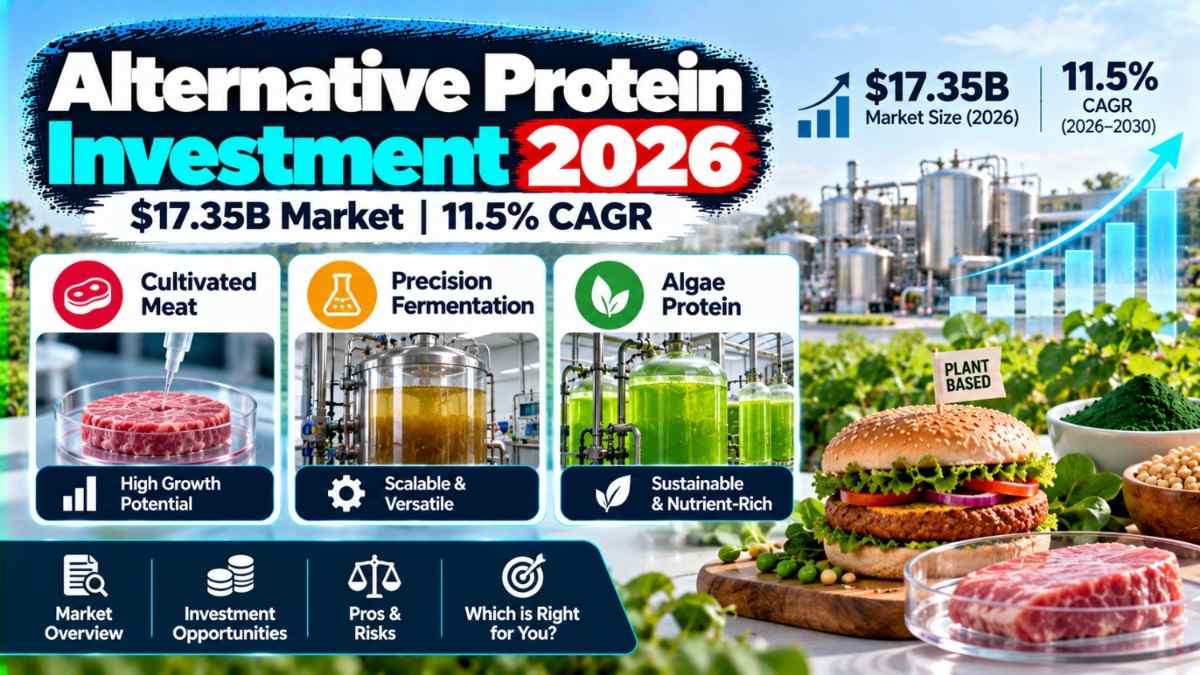
Alternative protein investment 2026 is no longer a speculative bet — it is a $17.35 billion global market expanding at an 11.5% CAGR toward $46.21 billion by 2035. This guide is for investors, food-tech analysts, and entrepreneurs aged 25–55 who want to deploy capital in cultivated meat, precision fermentation, or algae-based proteins before the next funding cycle peaks. You will find current market data, head-to-head comparisons, eligibility criteria for investment entry, step-by-step allocation strategies, and a full FAQ covering every key question in the sector.

The global alternative protein market is valued at $17.35 billion in 2026 and is forecast to reach $46.21 billion by 2035. Precision fermentation leads 2026 fundraising at $132 million in Q2 alone, cultivated meat raised $74 million in all of 2025 (down 48%), and algae protein is a steady $1.1 billion sub-segment growing at 6.6% CAGR — making fermentation the strongest risk-adjusted investment category this year.
- Global Market Size (2026): USD 17.35 Billion
- Forecast Market Size (2035): USD 46.21 Billion
- CAGR (2026–2035): 11.5%
- Total VC Investment (2025): $881 million (down from $1.1B in 2024)
- Precision Fermentation Market (2025): $6.14 Billion
- Precision Fermentation CAGR (2026–2034): 44.05%
- Cultivated Meat Market (2026 Est.): USD 433.96 Million
- Cultivated Meat 2025 VC Funding: $74 Million (48% drop YoY)
- Algae Protein Market (2026 Est.): USD 1.1 Billion
- Fermentation Q2 2026 Fundraising Lead: $132 Million
- Cumulative Government Investment (since 2021): $2.5 Billion
- Annual Benchmark Needed (GFI): $10.1 Billion/year
- What Is Alternative Protein Investment?
- Who Should Invest in Alternative Proteins?
- Market Size and Expected Returns 2026
- Eligibility and Investment Entry Requirements
- How to Invest in Alternative Proteins – Step-by-Step
- Cultivated Meat vs Precision Fermentation vs Algae: Full Comparison
- Pros and Cons of Alternative Protein Investment
- Important Terms and Concepts
- Important Dates and Milestones 2026
- Important Links
- Conclusion
- Key Takeaways
- Frequently Asked Questions
What Is Alternative Protein Investment?
Alternative protein investment is the allocation of capital into companies and technologies that produce proteins from non-conventional sources — including cell-cultivated animal tissue, microbial fermentation, and photosynthetic algae — as replacements for conventionally farmed meat and dairy. The sector spans early-stage biotech ventures, public food-tech equities, agri-sovereign funds, and infrastructure plays in bioreactor manufacturing.
The three dominant investment sub-categories in 2026 are cultivated meat (animal cells grown in bioreactors), precision fermentation (microorganisms engineered to produce specific proteins like casein or whey), and algae-based proteins (spirulina and chlorella cultivated in photobioreactors or open ponds). Each has a distinct risk profile, regulatory timeline, and commercial maturity curve that directly determines return potential.

According to the Good Food Institute’s 2026 State of the Industry series, privately held fermentation companies have raised a cumulative $4.8 billion since 2013, while plant-based companies have raised $8.4 billion since 2006. Cultivated meat, the youngest category, still commands significant scientific interest but faces the steepest path to price parity with conventional meat.
Who Should Invest in Alternative Proteins in 2026?
- 🏦 Venture capital fund managers seeking deep-tech food exposure with 7–12 year exit horizons in precision fermentation infrastructure
- 📈 Family office investors allocating 3–8% of alternative assets to food-tech as an ESG-aligned, impact-positive category
- 🌱 Angel investors with biotechnology or food manufacturing backgrounds who can evaluate bioreactor scaling claims and cost-per-kg projections
- 🏛️ Sovereign and development bank allocators following China’s CNY 4 billion ($555 million) biomanufacturing infrastructure commitment model
- 🍃 Retail and ETF investors seeking exposure to public-market food-tech indices that include fermentation and algae ingredient companies
- 🔬 Corporate strategists at food and agri conglomerates evaluating M&A or minority stakes in precision fermentation startups supplying dairy analogue ingredients
- 🌾 Agricultural entrepreneurs in India and Asia-Pacific looking to partner with algae cultivation ventures supplying spirulina and chlorella to nutraceutical exporters
- 📚 Research-linked technology transfer investors monetising university IP in synthetic biology and bioprocessing through seed-stage food-tech spinoffs
Alternative Protein Market Size and Expected Returns 2026
The global alternative protein market is valued at USD 17.35 billion in 2026 and is forecast to reach USD 46.21 billion by 2035, representing an absolute dollar opportunity of $28.86 billion over the next decade. Investment returns, however, vary sharply by sub-category, stage, and geography.
| Sub-Category | 2026 Market Size | 2035 Forecast | CAGR | 2025 VC Raised | Risk Level |
|---|---|---|---|---|---|
| Precision Fermentation | $8.84 Billion | $166.5 Billion | 44.05% | $357 Million | Medium |
| Cultivated Meat | $433.96 Million | $6.17 Billion (2034) | ~38% (est.) | $74 Million | Very High |
| Algae Protein | $1.1 Billion | $1.75 Billion (2031) | 6.6–7.12% | N/A (private) | Low–Medium |
| Plant-Based (for context) | ~$7 Billion | ~$15 Billion | ~7–8% | $450 Million | Low–Medium |
| Total Sector | $17.35 Billion | $46.21 Billion | 11.5% | $881 Million | Mixed |
The investment recalibration of 2025–2026 is significant: total alternative protein VC fell from $1.1 billion in 2024 to $881 million in 2025. However, the pullback was selective — plant-based funding rose 39%, while cultivated protein fell 48% and fermentation dropped 43%. Q2 2026 data shows fermentation rebounding strongly, leading all categories at $132 million raised.
Eligibility and Investment Entry Requirements
Entry requirements differ significantly across investment vehicles and investor categories. Below are the standard eligibility parameters for the most common routes:
- Accredited Investor Status (US/EU): Minimum net worth of $1 million (excluding primary residence) or annual income exceeding $200,000 for individual VC deal access
- QIB Threshold (India): Institutional investors with assets under management exceeding Rs. 100 crore for SEBI-regulated food-tech fund participation
- Public ETF Access: No minimum — retail investors can access exposure via food-tech and sustainable agriculture ETFs listed on NYSE, BSE, or NSE with as little as Rs. 500 via SIP
- Minimum VC Fund Commitment: Typically $250,000–$500,000 for Series A–B rounds in precision fermentation; $50,000–$100,000 for angel syndicates
- Corporate Strategic Entry: M&A or minority stake routes available to food companies with annual revenue above $50 million
- Grant and Government Schemes: ICAR, DBT Biotech Industrial Research Assistance Council (BIRAC), and NABARD Green Finance windows offer non-dilutive capital for Indian algae protein ventures
| Investor Type | Entry Route | Minimum Capital | Best Sub-Category |
|---|---|---|---|
| Retail / Individual | ETF, Mutual Fund | Rs. 500 / $10 | Plant-based, Algae |
| HNI / Angel | Angel Syndicate, Seed Round | $25,000–$100,000 | Fermentation |
| Accredited / VC | Series A–C Rounds | $250,000+ | Fermentation, Cultivated |
| Institutional | Fund-of-Funds, Direct | $1 Million+ | All Three |
| Corporate Strategic | M&A, JV, Minority Stake | $5 Million+ | Fermentation, Algae |
How to Invest in Alternative Proteins in 2026 – Step-by-Step
- Define your sub-category allocation: Decide what proportion of your alternative protein allocation goes to cultivated meat (highest risk/reward), precision fermentation (best risk-adjusted growth), and algae (defensive, steady returns). A balanced starter allocation is 20% cultivated / 60% fermentation / 20% algae.
- Choose your investment vehicle: Retail investors should start with food-tech ETFs (e.g., HFND, YUMY) or sustainable agriculture funds. Accredited investors should target fermentation-focused VC funds such as Lever VC, Blue Horizon, or Big Idea Ventures.
- Conduct regulatory due diligence: Verify the target company’s regulatory clearance status. As of 2026, only 7 companies globally have received cultivated meat approval. Fermentation-derived ingredients operate under existing GRAS (Generally Recognised as Safe) frameworks in the US and Novel Food regulations in the EU.
- Analyse the cost-per-kg roadmap: For cultivated meat, the commercial viability target is a production cost of $2.92 per pound. For precision fermentation proteins, cost parity with whey is the benchmark. Request the company’s techno-economic analysis (TEA) before committing capital.
- Assess bioreactor scale and IP moat: Ask for the company’s current bioreactor capacity (litres), scale-up timeline to 10,000L+, and number of granted patents. Bioreactor scaling is the single largest commercial hurdle for both cultivated meat and fermentation companies.
- Evaluate the founding team’s bioprocessing credentials: Look for co-founders with PhDs in synthetic biology, chemical engineering, or food science, plus at least one operator with experience scaling a manufacturing facility from pilot to commercial production.
- Structure your exit timeline: Set realistic horizons — 5–7 years for fermentation plays with clear ingredient-supply revenue, 8–12 years for cultivated meat ventures, and 3–5 years for algae ingredient suppliers already generating B2B revenue.
Fermentation companies with signed B2B supply contracts (not just LOIs) to established dairy, cosmetics, or pet food brands represent the lowest-risk near-term position in the alternative protein sector. Look for companies like Verley ($30M raised Q1 2026) and Standing Ovation ($28.5M Q1 2026) that are delivering commercial volumes of precision-fermented whey and casein — these have predictable revenue before consumer brand-level marketing is needed.
Cultivated Meat vs Precision Fermentation vs Algae: Full Comparison 2026
| Comparison Factor | Cultivated Meat | Precision Fermentation | Algae Protein |
|---|---|---|---|
| 2026 Market Size | $433.96 Million | $8.84 Billion | $1.1 Billion |
| Projected CAGR | ~38% (est.) | 44.05% (2026–2034) | 6.6–7.12% |
| Regulatory Status | Approved in US, Singapore, Israel only; 7 states banned in US | Operating under GRAS / Novel Food; EU labeling ban on “meat” terms | FDA GRAS (Spirulina/Chlorella); widely approved globally |
| Investment Risk | Very High | Medium | Low–Medium |
| Capital Required to Scale | $100M+ per facility | $20M–$80M Series B–C | $5M–$30M |
| 2025 VC Raised | $74 Million (–48% YoY) | $357 Million (–43% YoY) | Private; growing steadily |
| Key Companies | Upside Foods, Mosa Meat, Good Meat, SuperMeat | The EVERY Company, Standing Ovation, Verley, Vivici | Cyanotech, Corbion, Sun Chlorella |
| Revenue Model | B2C restaurant + retail (early stage) | B2B ingredient supply to food/dairy/cosmetics brands | B2B nutraceutical + food ingredient supply |
| Time to Price Parity | 8–15 years | 3–7 years | Already competitive in supplements |
| Best For Investor Type | High-risk VC only | Growth-stage VC + Strategic | HNI, Family Office, Retail ETF |
Precision Fermentation is the strongest risk-adjusted investment in 2026. With a projected CAGR of 44.05% to 2034, a market already at $8.84 billion, and commercially operating companies supplying dairy alternatives to established food brands, fermentation offers the clearest path from investment to exit. Algae protein is the ideal defensive allocation for conservative investors seeking steady 6–7% annual market growth with no regulatory uncertainty. Cultivated meat remains a high-conviction long-horizon bet for risk-tolerant VCs — but 2026 is not the year to make large new commitments given state-level bans and funding compression.
Pros and Cons of Alternative Protein Investment
Advantages of Investing in Alternative Proteins
- ✅ Massive addressable market: The global protein market exceeds $500 billion — even a 5% alternative protein penetration represents $25 billion in revenue opportunity
- ✅ ESG and impact alignment: Alternative proteins use 72–99% less water and 47–99% less land than conventional meat, making them compelling for ESG-mandated institutional allocators
- ✅ Government tailwinds: Cumulative public investment has reached $2.5 billion globally since 2021; China’s $555 million 2026 biomanufacturing commitment signals sovereign-level confidence
- ✅ Proven ingredient demand: Precision fermentation dairy proteins already command premium pricing from cosmetics, infant formula, and sports nutrition brands — revenue visibility before consumer adoption
- ✅ Diversification value: Alternative protein returns have low correlation with traditional food commodity cycles, offering genuine portfolio diversification
Disadvantages and Risks
- ❌ Regulatory fragmentation: Seven US states have enacted cultivated meat bans as of 2025; the EU banned use of “meat” and 31 related terms for alternative products in March 2026
- ❌ Scale-up cost barriers: Bioreactor manufacturing for cultivated meat requires $100M+ per commercial-scale facility — capital intensity rivals pharmaceutical manufacturing
- ❌ Consumer adoption lag: Despite growing awareness, mainstream price parity for cultivated meat is 8–15 years away; consumer willingness to pay a premium is narrowing
- ❌ Compressed VC funding: Total alternative protein investment fell to $881 million in 2025 from $1.1 billion in 2024 — liquidity conditions for early-stage companies are tightening
Important Terms and Concepts in Alternative Protein Investment
Understanding these 10 high-value terms is essential for evaluating investment opportunities and engaging with founders:
- Precision Fermentation: A bioprocess where microorganisms (yeast, bacteria, fungi) are programmed via synthetic biology to produce specific functional proteins — such as whey, casein, or ovalbumin — identical to animal-derived equivalents. Market value $6.14 billion in 2025, growing at 44% CAGR.
- Cultivated Meat: Animal muscle and fat tissue grown from stem cells in bioreactors without slaughter. Also called cell-cultivated meat, lab-grown meat, or cultured protein. Only commercially available in the US (Upside Foods, Good Meat), Singapore, and Israel as of 2026.
- Bioreactor Capacity (Litres): The total volume of cell culture media a facility can hold simultaneously. Commercial-scale cultivated meat requires bioreactors of 10,000–200,000 litres — currently limited to pharmaceutical and select food-tech facilities.
- GRAS (Generally Recognised as Safe): The FDA designation that allows a food ingredient to be marketed without a specific pre-market approval. Spirulina, chlorella, and many fermentation-derived proteins hold GRAS status — the key regulatory fast lane for algae and fermentation companies.
- Techno-Economic Analysis (TEA): A financial and engineering model that calculates the cost per kilogram of producing an alternative protein at various scales. The TEA is the single most important document in alternative protein due diligence — request it before any investment.
- Mycoprotein: Protein derived from fungal biomass fermentation (e.g., Quorn’s use of Fusarium venenatum). A commercialised precision fermentation output with $600M+ in annual global sales. Relevant benchmark for fermentation startups on cost and scale.
- Scaffold / Serum-Free Media: For cultivated meat, the growth scaffold (the 3D structure cells attach to) and the replacement for foetal bovine serum in cell culture media are the two costliest components. Companies solving serum-free, food-grade media have a significant competitive moat.
- Good Food Institute (GFI): The leading global non-profit think tank tracking alternative protein investment, science, and policy. GFI’s annual State of the Industry reports are the sector’s most cited data source. Their 2026 report covers plant-based, fermentation, and cultivated meat comprehensively.
- Novel Food Regulation (EU): The European regulatory framework (EU 2015/2283) requiring pre-market safety approval for foods not widely consumed in the EU before May 1997 — applicable to most cultivated meat and some fermentation-derived products in European markets.
- Phycocyanin: A high-value blue pigment and antioxidant protein extracted from spirulina algae, priced at $500–$2,000 per kilogram for food-grade applications. Phycocyanin extraction is the primary revenue driver that makes algae protein cultivation economically viable at small scale.
Important Dates and Regulatory Milestones 2026
| Date / Period | Event / Milestone |
|---|---|
| December 2025 | South Korea enacted the Food Tech Industry Promotion Act — legal framework for fermentation-enabled foods |
| Q1 2026 | Standing Ovation raises $28.5M; Verley raises $30M — largest fermentation funding rounds of the cycle |
| March 2026 | EU policymakers agree to ban “meat” and 31 related terms for alternative products — labeling impact on EU market |
| Q2 2026 | Fermentation companies lead all alternative protein fundraising at $132M — investor confidence signal |
| Q2 2026 | StrainX Bioworks raises $13M Series A (Asia-Pacific); Planetary raises $20M (Europe) |
| 2026 (ongoing) | 7 US states maintain cultivated meat bans; Indiana and Texas enacted two-year sales moratoriums |
| 2026 (ongoing) | China’s SDIC commits CNY 4 billion (~$555M) to biomanufacturing infrastructure with alternative proteins as priority |
| 2026–2027 (expected) | China projected to surpass US as largest government funder of cultivated meat R&D |
| 2026–2034 | Precision fermentation proteins market growth window — CAGR 44.05% to $166.5 billion |
| 2035 (target) | Global alternative protein market forecast: $46.21 Billion |
Important Links
| Resource | Link |
|---|---|
| GFI 2026 State of the Industry Reports (Free Download) | gfi.org/state-of-alternative-proteins |
| GFI 2026 State of Global Policy Report (PDF) | GFI Policy Report PDF |
| FAO Protein Diversification Research Hub | fao.org |
| ICAR – Indian Biotechnology and Food Science Research | icar.org.in |
| NABARD Green Finance / Agri Food Innovation Window | nabard.org |
| SEBI – Investment Regulations for Indian Investors | sebi.gov.in |
Conclusion: Where Should You Invest in Alternative Proteins in 2026?
The alternative protein investment landscape in 2026 is defined by two concurrent forces: regulatory turbulence compressing near-term cultivated meat returns, and precision fermentation proving its commercial viability at scale with $132 million raised in Q2 2026 alone. For most investors, precision fermentation offers the strongest risk-adjusted entry point this year — combining a 44% projected CAGR, commercially operating ingredient companies, and established B2B revenue streams. Algae protein is the defensive allocation for those who want steady exposure with minimal regulatory risk, while cultivated meat remains a high-conviction long-duration play for institutional-grade risk tolerance.
Before committing capital to any alternative protein venture in 2026, request the company’s techno-economic analysis, verify regulatory clearance status, and confirm existing B2B supply contracts. Bookmark this page — we update it every time the Good Food Institute, FDA, or USDA releases material data on the sector.
- The global alternative protein market is valued at $17.35 billion in 2026, growing to $46.21 billion by 2035 at an 11.5% CAGR
- Precision fermentation leads 2026 fundraising at $132 million in Q2 alone and holds a 44.05% projected CAGR to 2034
- Cultivated meat VC funding fell 48% in 2025 to $74 million; 7 US states now have active sales bans in place
- Algae protein (spirulina, chlorella) is a $1.1 billion market with steady 6–7% growth and minimal regulatory friction
- Cumulative global government investment reached $2.5 billion since 2021, but GFI estimates $10.1 billion per year is needed to fully develop the sector
- Best 2026 entry: 60% precision fermentation / 20% algae / 20% cultivated meat for a balanced alternative protein portfolio — seek fermentation companies with confirmed B2B supply contracts
Frequently Asked Questions About Alternative Protein Investment 2026
What is the total size of the alternative protein market in 2026?
The global alternative protein market is estimated at USD 17.35 billion in 2026, according to Next Move Strategy Consulting. The market is forecast to reach USD 46.21 billion by 2035, growing at an 11.5% CAGR. This includes plant-based foods, precision fermentation-derived proteins, cultivated meat, and algae-based ingredients.
Which alternative protein category raised the most VC funding in 2026?
In Q2 2026, precision fermentation companies led all alternative protein categories with $132 million raised, followed by plant-based at $41 million and cultivated meat at $25 million. This represents a significant rebound for fermentation after a 43% drop in 2025 full-year funding to $357 million. Key Q1 2026 rounds included Verley ($30M) and Standing Ovation ($28.5M) for precision-fermented dairy proteins.
Is cultivated meat a good investment in 2026?
Cultivated meat is a high-risk, long-horizon investment in 2026. VC funding fell 48% in 2025 to $74 million, 7 US states have enacted sales bans, and commercial production cost must reach $2.92 per pound to compete with conventional meat. Only 7 companies globally have received regulatory clearance to sell cultivated products. For risk-tolerant institutional VCs with 10+ year horizons, the sector offers potentially transformative returns; for most other investor types, precision fermentation offers better risk-adjusted opportunity in 2026.
What is precision fermentation and why is it a strong investment?
Precision fermentation is a process where microorganisms are genetically programmed to produce specific animal proteins — such as whey, casein, egg white proteins, or collagen — without raising animals. The market was valued at $6.14 billion in 2025 and is projected to grow at a 44.05% CAGR to $166.5 billion by 2034. It is a strong investment because companies are already generating B2B ingredient revenue from dairy, cosmetics, and pet food brands operating within existing GRAS and Novel Food regulatory frameworks — eliminating the pre-commercial revenue desert that cultivated meat faces.
How can retail investors in India access alternative protein investments?
Indian retail investors can access alternative protein exposure through internationally diversified food-tech ETFs available via SEBI-regulated global investing platforms (such as those offering US-listed ETFs under the RBI’s Liberalised Remittance Scheme up to $250,000 per year). Indian entrepreneurs interested in algae protein can explore NABARD’s Green Finance windows and BIRAC (Biotechnology Industry Research Assistance Council) grants for domestic spirulina and chlorella cultivation ventures, which qualify as agri-biotech enterprises.
What is the investment opportunity in algae protein?
The global algae protein market is estimated at $1.1 billion in 2026, growing at a 6.6% CAGR. Spirulina and chlorella dominate with FDA GRAS status and established global supply chains. The high-value opportunity within algae is phycocyanin extraction — a blue pigment protein priced at $500–$2,000 per kilogram for food-grade applications — which makes algae cultivation economically viable even at small scale. Algae protein is the most accessible and least regulatory-risky sub-category for early-stage and mid-market investors.
What role is China playing in alternative protein investment in 2026?
China is making the single largest sovereign investment in alternative proteins in 2026. The state-owned State Development and Investment Corporation committed CNY 4 billion ($555 million) to advance biomanufacturing infrastructure, with “new proteins” a stated strategic priority. The Good Food Institute’s 2026 State of Global Policy report notes that China is projected to surpass the US as the largest government funder of cultivated meat R&D in 2026–2027, partly because US federal investment in cultivated meat declined in 2025.
How does the EU’s 2026 labeling ban affect alternative protein investment?
In March 2026, EU policymakers agreed to ban the use of the word “meat” and 31 related terms (burger, sausage, steak, etc.) for fermentation-enabled, plant-based, and cultivated products — despite survey data showing European consumers support these terms for plant-based products. This creates a near-term marketing and consumer education burden for EU-market companies, likely increasing consumer acquisition costs and slowing retail adoption. Investors evaluating EU-focused fermentation or cultivated meat companies should model a 12–18 month consumer re-education period and budget accordingly.
What does the Good Food Institute recommend as the annual investment needed in alternative proteins?
GFI’s Global Innovation Needs Assessment identifies $10.1 billion per year as the benchmark required to fully develop a mature alternative protein sector. Current cumulative global government investment has reached just $2.5 billion since 2021 — representing less than 10% of the annual benchmark. This structural underfunding represents both a risk (insufficient infrastructure) and an opportunity (massive capital gap that well-positioned private investors can help fill at favourable entry valuations).
What are the biggest risks of investing in alternative protein companies in 2026?
The four biggest risks are: (1) Regulatory fragmentation — state-level bans in the US and EU labeling restrictions create market access uncertainty; (2) Scaling cost barriers — bioreactor manufacturing for cultivated meat requires $100M+ per facility, threatening cash runway for undercapitalised ventures; (3) Consumer adoption lag — mainstream price parity for cultivated meat is 8–15 years away, extending return timelines significantly; and (4) Funding compression — total sector VC fell 20% from 2024 to 2025, tightening liquidity for early-stage companies and increasing the risk of bridge round failures.
Last Updated: October 2026 | This guide is reviewed and updated regularly as GFI, FDA, USDA, and market data is released. Bookmark this page for the latest alternative protein investment data.
⚠️ Disclaimer: This article is for informational and educational purposes only. Agrijob.in is not a registered investment advisor. All investment decisions carry risk. Consult a SEBI-registered advisor (India) or SEC-registered financial professional (US) before committing capital to any alternative protein venture or fund. All market data cited is sourced from Good Food Institute, Next Move Strategy Consulting, Fortune Business Insights, and other publicly available third-party research reports.