
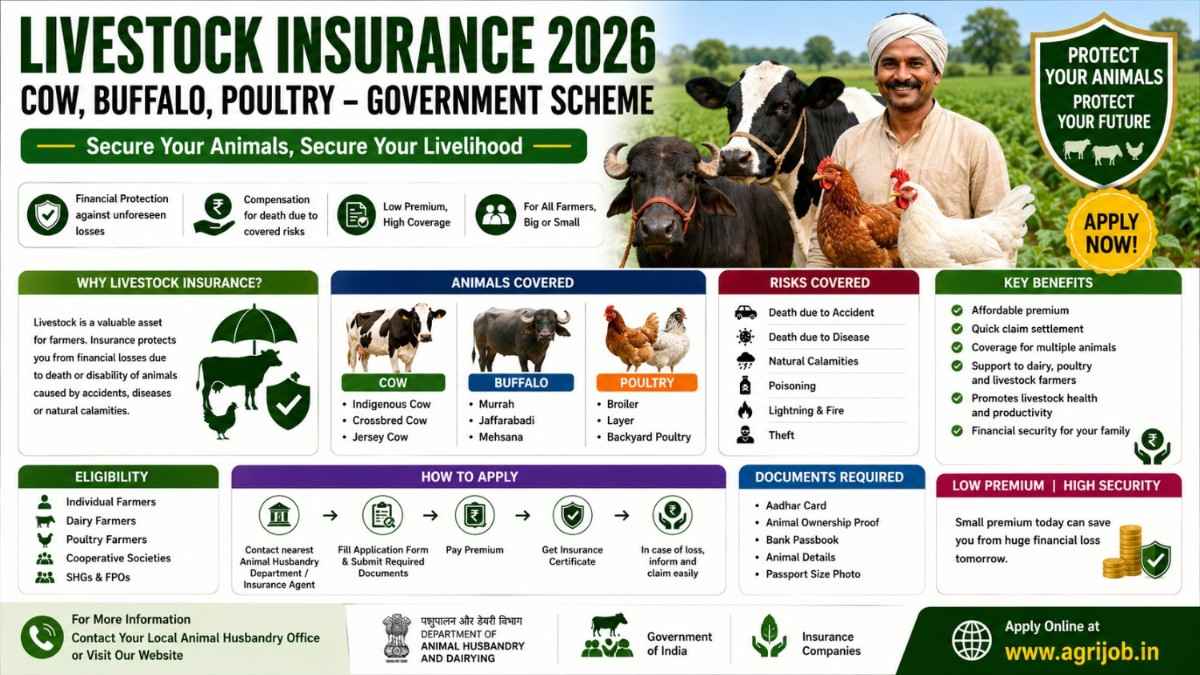
Livestock insurance 2026 is the most important financial safety net every Indian farmer with cattle, buffalo, or poultry must know about. If you own animals worth lakhs of rupees and one dies due to disease or accident, you could lose everything overnight — unless you have government livestock insurance coverage. Under the Rashtriya Pashudhan Bima Yojana and state-level Pashudhan Bima schemes, the government subsidises 50–70% of your premium, meaning you can insure a cow or buffalo worth ₹50,000 for as little as Rs.600–Rs.900 per year. This complete 2026 guide covers everything: what livestock insurance is, who is eligible, premium rates, compensation amounts, how to apply, and how to file a claim.

What Is Livestock Insurance 2026? (Definition & Scheme Overview)
Livestock insurance 2026 refers to a government-backed financial protection scheme for farmers and animal owners across India. When an insured animal — cow, buffalo, sheep, goat, pig, or poultry — dies due to accident, disease, or natural calamity, the government compensates the farmer with the full insured market value. This prevents complete financial ruin that typically follows animal death for small and marginal farmers.
The flagship central scheme is the Rashtriya Pashudhan Bima Yojana (RPBY), operated by the Department of Animal Husbandry and Dairying (DAHD), Govt. of India. Several states including Bihar, Uttar Pradesh, Rajasthan, and Maharashtra also run their own Pashudhan Bima Yojana with additional state-level subsidies. India has over 53 crore livestock animals, yet less than 4% are currently insured — making livestock insurance 2026 a critical priority for rural income protection.

- 🐄 Animals covered: Crossbred and high-yielding cows, buffaloes, sheep, goats, pigs, and poultry birds (layers and broilers).
- 💰 Premium subsidy: 50% for general farmers; 70% for SC/ST and BPL cardholders — paid directly by the Govt. of India.
- 🏛️ Implementing agencies: State Animal Husbandry Departments + empanelled insurers (New India Assurance, Oriental Insurance, Bajaj Allianz).
- 📅 Policy duration: 1-year and 3-year options available under the 2026 scheme.
- 🎯 Target: 50 lakh animals to be insured under RPBY in the 2025-26 financial year per DAHD targets.
| Scheme Name | Rashtriya Pashudhan Bima Yojana (RPBY) 2026 |
| Implementing Ministry | Ministry of Fisheries, Animal Husbandry & Dairying, Govt. of India |
| Animals Covered | Cow, Buffalo, Sheep, Goat, Pig, Poultry |
| Max Cover Per Animal | Up to ₹1,00,000 (market value basis) |
| Annual Premium (General) | 3% of sum insured (50% subsidised by govt) |
| Premium for SC/ST/BPL | 1.5% (70% govt subsidy — maximum benefit) |
| Application Mode | Online (state portal) + Offline (nearest vet centre) |
| Claim Settlement | Within 15–30 days of death report via DBT |
Premium & Compensation Table – Livestock Insurance 2026
The livestock insurance 2026 scheme structures premiums based on animal type and farmer category. The table below shows exactly what you pay and what protection you receive:
| Animal Type | Max Insured Value | Full Premium (3%/yr) | General Farmer Pays (50% subsidy) | SC/ST/BPL Pays (70% subsidy) |
|---|---|---|---|---|
| 🐄 Crossbred Cow | ₹50,000 | ₹1,500 | ₹750/year | ₹450/year |
| 🐃 HF/Jersey Cow | ₹80,000 | ₹2,400 | ₹1,200/year | ₹720/year |
| 🐃 Murrah Buffalo | ₹1,00,000 | ₹3,000 | ₹1,500/year | ₹900/year |
| 🐑 Sheep / Goat | ₹5,000 | ₹150 | ₹75/year | ₹45/year |
| 🐓 Poultry (per bird) | ₹200 | ₹8–10 | ₹4–5/year | ₹2–3/year |
| 🐷 Pig | ₹10,000 | ₹300 | ₹150/year | ₹90/year |
Annual income protection value: A Murrah buffalo producing 8 litres/day earns ₹8,000–₹12,000/month for the farmer — that’s ₹96,000–₹1,44,000/year. Insuring it for just Rs.900/year (SC/ST rate) protects a ₹1,00,000 asset and an entire year’s income. That is the true value of livestock insurance 2026 for rural households.
Livestock Insurance 2026 Eligibility – Who Can Apply?
Livestock insurance 2026 is open to all animal owners in India who meet these conditions:
- 🧑🌾 Farmer category: Any individual farmer, SHG member, dairy cooperative member, or livestock owner with a valid Aadhaar card.
- 🐄 Animal age (cattle & buffalo): 2 years to 10 years. Animals outside this range are generally not insurable.
- 🏥 Animal health: Must be healthy and certified by a government veterinarian at the time of ear-tagging.
- 🏷️ Ear tagging: Each animal must receive a permanent ear tag with a unique ID (linked to NADRS — National Animal Disease Reporting System) before the policy is issued.
- 🏘️ Geographic eligibility: All 36 states/UTs participate. Priority given to high-livestock-density districts.
- 📋 Maximum per household: 5 large animals (cattle/buffalo) and 50 small animals (sheep/goat) per beneficiary per year.
| Farmer Category | Govt. Premium Subsidy | Farmer Pays | Max Animals/Year |
|---|---|---|---|
| General (UR) | 50% | 50% of premium | 5 large / 50 small |
| OBC | 50% | 50% of premium | 5 large / 50 small |
| SC / ST | 70% | 30% of premium | 5 large / 50 small |
| BPL Cardholder | 70% | 30% of premium | 5 large / 50 small |
| Women SHG Members | 50–70% | 30–50% of premium | 5 large / 50 small |
| EWS | 50% | 50% of premium | 5 large / 50 small |
How to Apply for Livestock Insurance 2026 – Step-by-Step Process
Applying for livestock insurance 2026 can be done online via your state animal husbandry portal or offline at your nearest Government Veterinary Centre. Follow these 7 steps:
- Contact your nearest Veterinary Officer or Block Animal Development Officer (BADO). They will inspect and certify your animal as healthy and eligible for livestock insurance 2026.
- Get the animal ear-tagged. The vet attaches a permanent plastic ear tag with a unique ID number. This tag is mandatory for all future insurance and claim purposes.
- Get the animal photographed. Photographs (front, side, back) with the visible ear tag are taken and submitted with the application to prevent fraud.
- Fill the livestock insurance 2026 application form. Include your Aadhaar number, bank account details, animal species/breed/age/estimated value, and category proof (SC/ST certificate if applicable).
- Submit your documents. Required: Aadhaar card, bank passbook copy, recent passport-size photo, animal health certificate from govt vet, and caste/income certificate for subsidy eligibility.
- Pay your share of the premium. Your portion (30–50% depending on category) can be paid via cash, NEFT, or UPI at the vet centre or online through the state portal.
- Receive your policy document. The insurance company issues a policy certificate with the animal’s ear tag number, insured value, policy period, and claim contact number. Store this safely.
Bihar farmers can apply via dahbihar.gov.in — Department of Animal Husbandry Bihar. Pan-India scheme information is available at the DAHD official livestock insurance portal.
Livestock insurance 2026 has a 15-day waiting period after policy issuance — your animal must survive 15 days post-tagging before a death claim is valid. Apply well before monsoon (Foot and Mouth Disease season) or autumn (Lumpy Skin Disease season). Never wait until after your area reports an active outbreak — insurers may pause new enrolments during disease alerts.
How to Claim Livestock Insurance Compensation – 7-Step Guide
When an insured animal dies, act immediately. Here is how to file a livestock insurance 2026 claim and receive full DBT compensation within 15–30 days:
- Notify the insurer within 24 hours of death. Call the toll-free number on your policy document and inform your local Veterinary Officer. Late notification (beyond 48 hours) can invalidate the claim.
- Do not dispose of the animal body. Keep the carcass intact until the vet inspector arrives. Removing the ear tag or disposing the body before inspection is grounds for claim rejection.
- Arrange a post-mortem (PM) report. The government veterinarian conducts a PM and issues a cause-of-death certificate — the single most important document for your livestock insurance 2026 claim.
- Submit the claim form with all documents. Required: original policy certificate, ear tag recovered from body, PM report, death certificate, Aadhaar copy, and bank account proof.
- Insurance surveyor visits within 72 hours. A licensed surveyor verifies the PM report, confirms the animal’s identity via ear tag and photographs, and assesses the claim.
- Claim assessed and approved. For claims under Rs.50,000, direct settlement is processed quickly. Larger claims may require additional verification from the district animal husbandry officer.
- Compensation credited via DBT. The full insured amount is transferred via Direct Benefit Transfer directly to your Aadhaar-linked bank account within 15–30 days of claim approval.
Who Should Apply for Livestock Insurance Scheme 2026?
Livestock insurance 2026 is especially critical for these groups — if you fall into any category below, apply without delay:
- 🐄 Dairy farmers with 1–5 cows or buffaloes who depend on milk sales as their primary income. A single animal death can wipe out ₹50,000–₹1,00,000 in assets overnight.
- 👩 Women SHG members in states like Bihar, UP, and MP who received cattle under DAY-NRLM (Deendayal Antyodaya Yojana) or MGNREGA livestock support programmes.
- 🏘️ SC/ST farmers who benefit from the maximum 70% premium subsidy — paying as little as Rs.450/year for ₹50,000 animal cover.
- 🐓 Poultry farmers running commercial layer or broiler units with 500–5,000 birds, where a single disease outbreak can cause lakhs in losses within days.
- 🐑 Sheep and goat rearers in tribal and hilly areas where veterinary access is limited and animal diseases spread rapidly through flocks.
- 🏦 Farmers with KCC (Kisan Credit Card) loans against livestock — banks increasingly require livestock insurance as a mandatory collateral protection condition.
- 🌾 BPL cardholders who received animals under PM Matsya Sampada Yojana or Rashtriya Gokul Mission — livestock insurance protects their government-granted asset from day one.
- 📍 Farmers in flood-prone and disaster-prone districts (Bihar, Assam, Odisha, Rajasthan) where animal mortality rates are significantly above the national average.
Livestock Insurance vs Crop Insurance – Key Differences 2026
Many farmers confuse livestock insurance 2026 with crop insurance under PMFBY. These are completely separate schemes. Here is a clear comparison:
| Parameter | Livestock Insurance 2026 (RPBY) | Crop Insurance (PMFBY) |
|---|---|---|
| What It Covers | Cattle, buffalo, sheep, goat, poultry | Kharif, Rabi, and horticulture crops |
| Implementing Dept | Animal Husbandry Dept, DAHD | Agriculture Dept, PMFBY portal |
| Claim Trigger | Death of individual insured animal | Crop yield loss due to weather/pest |
| Compensation Type | Full insured value (per animal) | Area-yield shortfall (area basis) |
| Premium Subsidy | 50–70% govt subsidy | 85–95% govt subsidy |
| Enrolment Mode | Vet centre / state AH portal | Bank, CSC, or PMFBY app |
| Claim Settlement | 15–30 days (individual basis) | 45–60 days (area aggregate basis) |
| Best For | Dairy farmers, poultry farmers | Crop-growing farmers |
High-Value Animal Husbandry & Insurance Terms You Must Know
Understanding these key terms helps you navigate livestock insurance 2026 and related government schemes with confidence:
- 🐄 Rashtriya Pashudhan Bima Yojana (RPBY) — The central government livestock insurance scheme providing ₹20,000–₹1,00,000 cover per animal with up to 70% premium subsidy. The main scheme for cattle insurance in India 2026.
- 🐃 Cattle Insurance Scheme India — Broad term covering all government and private insurance products for cows and buffaloes. Compensation based on current market value, implemented via State Animal Husbandry Departments.
- 🐓 Poultry Insurance India — Covers commercial poultry farms of 50+ birds. Premium is ₹4–10 per bird per year. Claims triggered by disease mortality, fire, or flood. Annual turnover of India’s poultry sector: ₹1.6 lakh crore.
- 🌾 Pradhan Mantri Fasal Bima Yojana (PMFBY) — India’s flagship crop insurance scheme. NOT for livestock. Separate from livestock insurance 2026. Read our PMFBY 2026 complete guide for crop coverage details.
- 💉 Rashtriya Gokul Mission — Govt. scheme for breed improvement of indigenous cattle. Provides ₹10,000–₹40,000 per Gokul Gram award. Animals registered here can be easily enrolled in livestock insurance 2026.
- 🏦 Kisan Credit Card (KCC) for Animal Husbandry — Provides working capital of ₹1.60 lakh (collateral-free) to dairy, poultry, and fishery farmers. Banks now make livestock insurance mandatory for KCC disbursement.
- 🧬 National Animal Disease Reporting System (NADRS) — Govt. of India’s digital platform to monitor animal disease outbreaks. Ear-tagged insured animals registered here allow faster claim settlement.
- 📊 Animal Husbandry Infrastructure Development Fund (AHIDF) — ₹15,000 crore fund for dairy processing, animal feed plants, and meat processing. Farmers investing via AHIDF loans must insure their livestock assets.
- 🐟 PM Matsya Sampada Yojana — ₹20,050 crore fisheries scheme. Covers insurance for fish farmers and aquaculture units. A sister scheme to livestock insurance 2026 for the fisheries sector.
- 🩺 Lumpy Skin Disease (LSD) Livestock Insurance Claim 2026 — High-search keyword following 2022–23 LSD outbreaks that killed over 1.5 lakh cattle across India. Animals dying of LSD are fully covered under livestock insurance 2026.
Frequently Asked Questions – Livestock Insurance 2026
What is livestock insurance 2026 under the government scheme?
Livestock insurance 2026 is a central and state government-backed scheme providing financial compensation when insured cattle, buffalo, sheep, goat, or poultry die due to disease, accident, or natural calamity. Under the Rashtriya Pashudhan Bima Yojana, the premium is subsidised up to 70% and cover reaches Rs.1,00,000 per animal.
How much insurance cover can I get for my cow or buffalo?
Under livestock insurance 2026, cover is based on the current market value assessed at tagging. A crossbred cow is insured for ₹30,000–₹80,000. A Murrah buffalo gets up to ₹1,00,000 cover. The higher the breed quality and milking output, the higher the insured value assigned by the government veterinarian.
Who is eligible to apply for livestock insurance in India 2026?
Any farmer or livestock owner with a valid Aadhaar card is eligible for livestock insurance 2026. SC/ST farmers, BPL cardholders, small and marginal farmers, and women SHG members get priority and maximum subsidy of 70%. The animal must be healthy, aged 2–10 years, and certified by a government vet.
What is the premium for livestock insurance 2026?
The annual livestock insurance premium is 3–4.5% of the sum insured. SC/ST and BPL farmers pay just Rs.450/year to insure a ₹50,000 animal (70% subsidy). General farmers pay Rs.750/year for the same cover (50% subsidy). The government pays the remaining premium share directly to the insurance company.
Can I insure poultry birds under a government livestock insurance scheme?
Yes. Livestock insurance 2026 covers layer and broiler chickens, ducks, and turkeys on a flock basis (minimum 50 birds). Coverage is ₹50–₹200 per bird. Annual premiums are 4–5% per bird. Total flock losses from bird flu, Newcastle Disease, or fire are fully compensated under the scheme.
How do I claim livestock insurance compensation after my animal dies?
To claim livestock insurance 2026 compensation, notify the insurance company within 24 hours of death. A government veterinarian must issue a post-mortem and cause-of-death certificate. Submit the claim form with ear tag, PM report, death certificate, and bank details. Compensation is credited via DBT to your Aadhaar-linked account within 15–30 days.
Which government departments implement livestock insurance in India?
Livestock insurance 2026 is implemented by the Department of Animal Husbandry and Dairying (DAHD) under India’s Ministry of Fisheries, Animal Husbandry and Dairying. State Animal Husbandry Departments coordinate at district level, with empanelled insurers including New India Assurance, Oriental Insurance, and Bajaj Allianz.
What is the difference between Pashudhan Bima Yojana and PMFBY?
PMFBY (Pradhan Mantri Fasal Bima Yojana) covers only crops — not animals. Livestock insurance 2026 falls under the Rashtriya Pashudhan Bima Yojana (RPBY) or state Pashudhan Bima schemes. Both are government-subsidised but cover entirely different assets. Farmers should take both schemes simultaneously for complete agricultural income protection. More on PMFBY at the official PMFBY government portal.
This livestock insurance 2026 guide is regularly reviewed and updated for accuracy. Bookmark this page for the latest scheme notifications and premium updates. Also read our guide on all Government Schemes for farmers on AgriJob.in.
Last Updated: May 2026