
The UP Divyangjan Post-Matric Scholarship 2026 provides up to Rs.50,000 per year in fee reimbursement and maintenance allowances to Uttar Pradesh students with a minimum 40% benchmark disability, studying from Class 11 to PhD level. Applications are open at scholarship.up.gov.in — the last date for fresh Dashmottar (UG/PG/Diploma) applications is October 31, 2026.
UP Divyangjan Post-Matric Scholarship 2026 is a state-funded scholarship scheme managed by the Divyangjan Kalyan Vibhag (PWD Department), Government of Uttar Pradesh, to provide financial assistance to students with disabilities pursuing higher education — from Class 11 right up to PhD level. This guide is for UP-domicile students with 40% or more disability, their parents, and teachers who want a clear, verified breakdown of the scholarship amount, eligibility, UDID requirements, and step-by-step application process for 2026-27.

This article covers everything: what the scholarship covers, who qualifies, exact ₹ amounts by category, how the UP portal differs from NSP, required documents, the full online application process, and the key dates you must not miss this session.
- Scheme Name: UP Divyangjan Post-Matric Scholarship (Dashmottar) 2026-27
- Nodal Department: Divyangjan Kalyan Vibhag, Uttar Pradesh Government
- Official Portal: scholarship.up.gov.in
- Academic Level: Class 11, Class 12, UG, PG, Diploma, ITI, PhD
- Maximum Annual Benefit: Up to Rs.50,000 per year (fee reimbursement + maintenance)
- Disability Requirement: Minimum 40% benchmark disability (UDID card mandatory)
- Income Limit: Family income up to Rs.2.50 Lakh per year from all sources
- Post-Matric (Class 11-12) Last Date: September 21, 2026
- Dashmottar (UG/PG/PhD) Last Date: October 31, 2026
- Payment Mode: DBT directly to Aadhaar-linked bank account
- Application Fee: Nil — completely free
- Female Reservation: 50% of scholarship slots reserved for female applicants
📋 Table of Contents
- What is UP Divyangjan Post-Matric Scholarship 2026?
- Who Should Apply for This Scholarship?
- Scholarship Amount and Financial Benefits
- Eligibility Criteria — Full Details
- Required Documents — Complete Checklist
- How to Apply Online at scholarship.up.gov.in
- UP Scholarship Portal vs NSP — Key Differences
- Advantages and Disadvantages of the Scheme
- Important Terms Related to Divyangjan Scholarship
- Important Dates and Timeline 2026-27
- Important Links
- Conclusion
- Key Takeaways
- Frequently Asked Questions
What is UP Divyangjan Post-Matric Scholarship 2026?
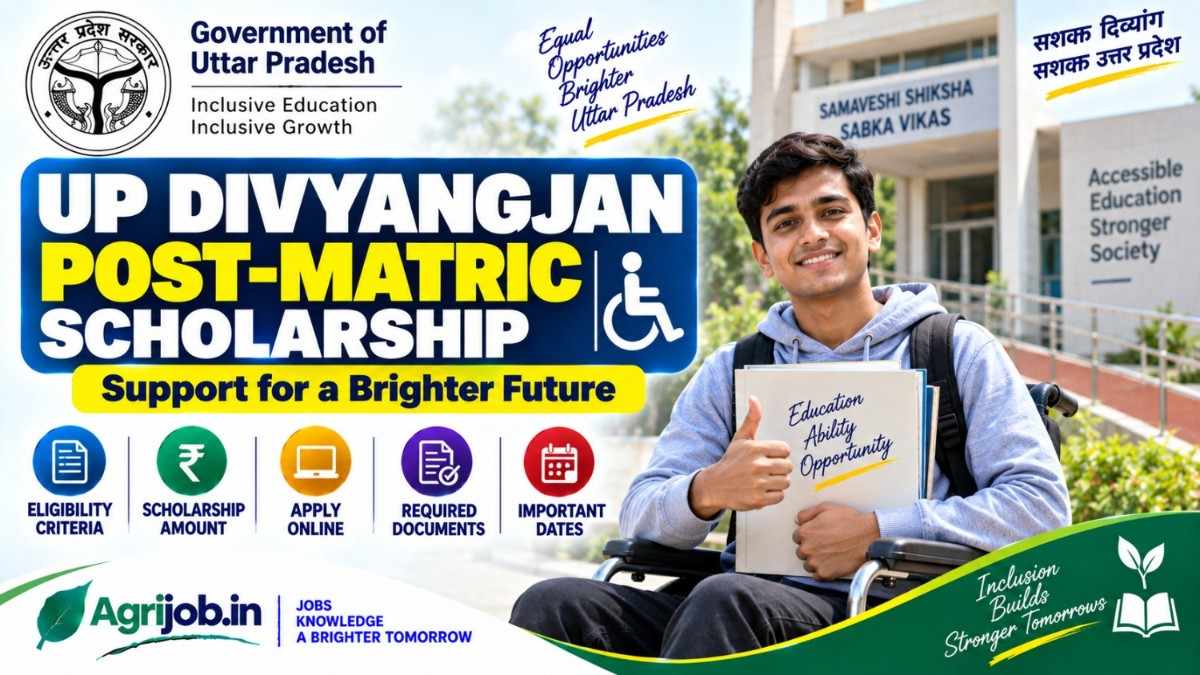
The UP Divyangjan Post-Matric Scholarship 2026 is a state-funded educational support scheme run by the Divyangjan Kalyan Vibhag (Department for Persons with Disabilities) under the Government of Uttar Pradesh. It provides direct financial assistance — covering tuition fee reimbursement and monthly maintenance allowances — to students with benchmark disabilities pursuing post-matriculation education in Class 11, Class 12, undergraduate, postgraduate, diploma, and doctoral (PhD) programmes at recognised institutions in Uttar Pradesh.

Uttar Pradesh runs its scholarship system through the official state portal scholarship.up.gov.in, which is separate from the central National Scholarship Portal (NSP). The state scheme is funded entirely by the UP Budget and managed by five nodal departments — the Divyangjan Kalyan Vibhag being the nodal authority for students with disabilities. Approximately 2.5 crore UP students benefit from state scholarship schemes annually, making it the largest state-level scholarship programme in India.
The central government also runs a parallel Post-Matric Scholarship for Students with Disabilities via NSP (scholarships.gov.in) under the DEPwD. Both schemes can complement each other, but a student cannot hold two central or state scholarships simultaneously. This guide focuses on the UP state scheme at scholarship.up.gov.in.
Who Should Apply for This Scholarship?
This scholarship is designed for a specific set of students. Check whether your profile fits before applying.
- 🎓 Class 11 or Class 12 students with a recognised disability who are domiciled in Uttar Pradesh and studying at a government or government-aided school or college
- 🏫 Undergraduate students (BA, BSc, BCom, BCA, BBA, B.Tech, MBBS, B.Ed, BTC, LLB) with at least 40% benchmark disability enrolled in UP-recognised institutions
- 📚 Postgraduate students (MA, MSc, MCom, M.Tech, MBA, LLM) with disability who need fee reimbursement and monthly maintenance support
- 🔬 PhD and MPhil research scholars with benchmark disability pursuing doctoral programmes at UP universities
- 🛠️ Diploma, ITI, and Polytechnic students with 40% or higher disability enrolled in state-recognised technical institutions
- 👩🎓 Girl students with disabilities — 50% of scholarship slots are exclusively reserved for female divyangjan applicants, making this a priority group
- 💰 Students from low-income families where the total annual family income from all sources does not exceed Rs.2.50 Lakh per year
- 🆔 Students holding a valid UDID card (Unique Disability ID) or a disability certificate issued by a competent government medical authority confirming 40% or more disability
Scholarship Amount and Financial Benefits
The UP Divyangjan Post-Matric Scholarship provides financial support in three components: tuition fee reimbursement, maintenance allowance, and a disability-specific allowance. Together, these can add up to Rs.50,000 or more per academic year depending on the course and institution.
| Benefit Component | Amount / Rate | Frequency |
|---|---|---|
| Tuition Fee Reimbursement | Up to Rs.1,40,000 per year (actual fee, as approved by State Fee Fixation Committee) | Annual |
| Maintenance Allowance — Hostellers | Rs.1,200 per month (Rs.14,400 per year) | Monthly via DBT |
| Maintenance Allowance — Day Scholars | Rs.650 per month (Rs.7,800 per year) | Monthly via DBT |
| Disability Allowance (Visual/Intellectual) | Rs.4,000 per year | Annual |
| Disability Allowance (Other Types) | Rs.2,000 per year | Annual |
| Book Allowance | Rs.1,500 per year | Annual |
| Reader Allowance (Blind Students) | Rs.175 per month (Rs.2,100 per year) | Monthly |
| Study Tour Charges (Group 1) | Up to Rs.1,600 per year | Annual |
| Additional Academic Allowance | 10% extra on base academic allowance for Divyangjan students | Annual |
Total benefit in an academic year: A hosteller divyangjan student pursuing a professional course (B.Tech/MBBS) at a private college with actual fees of Rs.30,000/year would receive Rs.30,000 fee reimbursement + Rs.14,400 maintenance + Rs.4,000 disability allowance + Rs.1,500 books = approximately Rs.50,000 per year, all credited directly to their Aadhaar-linked bank account through DBT.
Private college students should note that fee reimbursement is limited to the standard fee structure approved by the UP State Level Fee Fixation Committee — not the actual fee charged. If your private college charges more than the committee-approved rate, only the approved portion is reimbursed. Always verify your institution’s approved fee before estimating your benefit.
Eligibility Criteria — Full Details
Every condition below must be fulfilled to qualify for the UP Divyangjan Post-Matric Scholarship 2026. Not meeting even one condition will result in rejection during district-level verification.
- Domicile: Must be a permanent resident of Uttar Pradesh with a valid UP domicile certificate. Students studying outside UP can apply under the Post-Matric (Other State) category at the same portal.
- Disability: Must hold a valid UDID card or government-issued Disability Certificate confirming a minimum of 40% benchmark disability, certified by a competent medical authority (District Medical Officer / Civil Surgeon of a government hospital).
- Academic Level: Must be enrolled in a recognised post-matric course — Class 11, Class 12, BA/BSc/BCom, B.Tech, MBBS, B.Ed, Diploma, ITI, Polytechnic, MA/MSc/MCom, M.Tech, MBA, LLB, LLM, MPhil, or PhD — at a government or UP-recognised private institution.
- Income Limit: Total annual family income from all sources must not exceed Rs.2.50 Lakh per annum. Income certificate from a Revenue Officer (Tehsildar) is mandatory. Form 16 is not acceptable as an income proof.
- Family Cap: Maximum two children with disabilities from the same family can receive this scholarship simultaneously. If the second child is a twin, both qualify.
- No Double Scholarship: A student already receiving any other central or state government scholarship or stipend is not eligible. If two scholarships are awarded, the student must choose the more beneficial one.
- Attendance: Minimum 75% attendance in the current academic year at the institution is required. Institutions verify attendance before forwarding applications.
- Aadhaar: Aadhaar card linked to the student’s bank account via NPCI seeding is mandatory for DBT credit. Applications without NPCI Aadhaar seeding lead to payment failure.
Category-Wise Application Fee Table
| Category of Disability | Minimum Disability % | Application Fee |
|---|---|---|
| Visual Impairment (Blind/Low Vision) | 40% or above | Nil |
| Hearing Impairment (Deaf/Hard of Hearing) | 40% or above | Nil |
| Locomotor Disability | 40% or above | Nil |
| Intellectual Disability | 40% or above | Nil |
| Multiple Disabilities | 40% or above (combined) | Nil |
| Speech & Language Disability | 40% or above | Nil |
Required Documents — Complete Checklist
Arrange all documents before starting the online application. Incomplete document uploads are the most common reason for application rejection at the institute verification stage.
- UDID Card or Disability Certificate — Issued by the competent authority designated by the District Medical Officer/Civil Surgeon of a government hospital. Must show 40% or higher disability. UDID card (Unique Disability ID) is the preferred document.
- Aadhaar Card — Aadhaar number must be NPCI-seeded to the applicant’s bank account. DigiLocker-linked Aadhaar is accepted on the portal since 2026.
- Parental/Guardian Income Certificate — Issued by a Revenue Authority or Tehsildar. Must be current for the 2026-27 academic year. Form 16 is explicitly not accepted.
- Caste / Category Certificate — If applying under SC/ST category in addition to Divyangjan quota (for additional reservation benefits under multiple schemes).
- UP Domicile Certificate — Permanent residency proof for Uttar Pradesh.
- Previous Year Mark Sheet — Scanned copy of the qualifying examination marksheet (Class 10 for Class 11 applicants; last year’s marksheet for renewal applicants).
- Admission / Tuition Fee Receipt — Current academic year fee receipt from the institution (non-refundable fees only).
- Bank Passbook / Cancelled Cheque — Student’s own bank account linked with Aadhaar. Joint accounts or parental accounts are not accepted.
- Passport-Size Photograph — Recent, clear photograph in JPEG format (size under 100 KB for portal upload).
- Enrollment / Bonafide Certificate — Issued by the current institution confirming admission for 2026-27.
How to Apply Online at scholarship.up.gov.in
The UP Divyangjan Post-Matric Scholarship is applied for through the official UP Scholarship portal. The process has two mandatory stages: One Time Registration (OTR) and then filling the fresh/renewal application form. Follow each step carefully.
- Visit the Official Portal: Go to scholarship.up.gov.in. Do not use any other website — fake portals are common for UP scholarship searches.
- Complete One-Time Registration (OTR): Click on “Student” → “Registration” → Select category “Divyangjan” (for PWD students). Fill in your name, Aadhaar number, date of birth, mobile number, and email. Complete Aadhaar-based e-KYC verification. An OTR number is generated — save it carefully. Only one OTR can be created per student.
- Log In as Fresh Applicant: Return to the portal. Click “Student” → “Fresh Login”. Select “Divyangjan Post-Matric” scheme. Enter your OTR number and date of birth to log in.
- Fill the Application Form: Enter personal details, family income, Aadhaar number, bank account details (IFSC, account number), current institution details, and course enrolled in. Double-check all entries — corrections are allowed only in the official correction window.
- Upload Required Documents: Upload scanned copies of all documents listed in the checklist above. Ensure UDID/disability certificate, income certificate, Aadhaar, and fee receipt are all uploaded. Files must be in JPG/PDF format within the size limit.
- Submit the Application: Click “Submit” after reviewing all entries. Download the filled application PDF. Print two copies — one is submitted to your institution for physical verification.
- Submit Hard Copy to Institution: Submit the printed application with original documents to your college/school within the deadline specified by the portal. The institution then verifies and forwards your application to the District Welfare Officer (DWO).
- Track Application Status: After submission, check status at scholarship.up.gov.in → “Status” → “Application Status”. Track stages: Institute Verification → DWO Verification → Sanction → PFMS Payment.
UP Scholarship Portal vs NSP — Key Differences
Many students confuse the two systems. The UP state portal and the central NSP are entirely different. Applying on the wrong portal means your application will not be processed under the correct scheme.
| Feature | UP Scholarship Portal (scholarship.up.gov.in) | NSP — National Scholarship Portal (scholarships.gov.in) |
|---|---|---|
| Run By | Government of Uttar Pradesh (State) | Ministry of Social Justice / DEPwD (Central Govt) |
| Funded By | UP State Budget | Central Government of India |
| Eligible Students | UP domicile students only | All Indian students (national) |
| Divyangjan Nodal Dept | Divyangjan Kalyan Vibhag, UP | DEPwD, Ministry of Social Justice |
| Max Annual Benefit | Up to Rs.50,000 (state scheme) | Up to Rs.1,40,000 tuition + Rs.1,200/month maintenance |
| Income Limit | Rs.2.50 Lakh per year | Rs.2.50 Lakh per year |
| Reservation for Girls | 30–50% (varies by sub-scheme) | 50% for female applicants |
| Can Both Be Taken? | No — a student must choose one. Double-claiming triggers recovery. | |
| Best For | UP students in state institutions | Students in high-fee professional/central institutions |
For UP-domicile disabled students studying in state institutions, the UP Scholarship Portal (scholarship.up.gov.in) is the primary route. Students in central universities, IITs, IIMs, NLUs, or premier private institutions with fees exceeding Rs.1 lakh should evaluate the NSP central scheme for higher fee reimbursement coverage. In all cases — apply to only one scheme and choose the one that maximises your actual benefit.
Advantages and Disadvantages of the UP Divyangjan Scholarship
Advantages
- ✅ No application fee — completely free for all divyangjan students regardless of category
- ✅ Covers full academic range — Class 11 to PhD, including technical, professional, and research degrees
- ✅ Direct bank transfer — scholarship amount credited directly to student’s account via DBT through PFMS, eliminating middlemen
- ✅ 50% reservation for girls — female students with disabilities get priority access, improving gender inclusion
- ✅ Multiple allowances — maintenance, disability, book, and reader allowances are combined, giving comprehensive support beyond just fee reimbursement
- ✅ Renewable annually — scholarship continues every year as long as student meets attendance (75%) and progression criteria
- ✅ Distance education eligible — students in recognized correspondence or online courses can also apply for book allowance and maintenance support
Disadvantages
- ❌ UDID mandatory — students without a UDID card or valid disability certificate face rejection; UDID issuance takes 30–60 days, causing delays for new applicants
- ❌ Strict income cap — Rs.2.50 Lakh income limit excludes many middle-income families with disabled children who still face genuine financial hardship
- ❌ Private college cap — fee reimbursement for private institutions is capped at the state Fee Fixation Committee rate, which is often lower than the actual fee charged
- ❌ Only one scholarship allowed — students must forgo other merit-based scholarships if they accept this scheme, which can be a difficult trade-off for meritorious students
- ❌ Bank NPCI seeding required — payment failures occur frequently when Aadhaar is not NPCI-seeded to the bank account, causing months-long delays in disbursement
Important Terms Related to Divyangjan Scholarship
Understanding these key terms will help you navigate the UP Divyangjan scholarship system accurately and avoid common errors during application.
- Benchmark Disability: A disability of 40% or more as defined under the Rights of Persons with Disabilities (RPWD) Act, 2016. This is the minimum threshold for all Divyangjan scholarship schemes in India.
- UDID Card (Unique Disability ID): A biometric-enabled national identity card for persons with disabilities, issued by the Ministry of Social Justice through the Swavalamban portal (swavlambancard.gov.in). It is mandatory for all central and most state disability schemes in 2026.
- OTR (One Time Registration): A one-time digital registration at scholarship.up.gov.in that generates a unique student ID used for all UP scholarship applications. Only one OTR per student is permitted. An active mobile number and Aadhaar-based e-KYC are required.
- DBT (Direct Benefit Transfer): The payment mechanism through which scholarship funds are transferred directly to the student’s Aadhaar-linked bank account without intermediaries, using the PFMS (Public Financial Management System).
- NPCI Seeding: Linking your Aadhaar number to your bank account via the National Payments Corporation of India (NPCI). Without NPCI seeding, DBT payments fail and are returned to the government, causing months of delay.
- Dashmottar Scholarship: The UP government’s term for Post-Matric scholarships for courses above Class 12 — including UG, PG, diploma, professional courses, and PhD programmes. These have a separate application window (September 15–October 31, 2026).
- Divyangjan Kalyan Vibhag: The Department for Persons with Disabilities under the Government of Uttar Pradesh, which is the nodal department for administering all state-level disability-related welfare schemes and scholarships.
- DigiLocker Integration: From 2026, UP Scholarship portal is integrated with DigiLocker, allowing students to fetch verified marksheets, caste certificates, and income certificates directly from issuing authorities without manual scanning.
- State Fee Fixation Committee: A UP government body that approves the maximum fee that can be charged by private colleges. Fee reimbursement under this scholarship is limited to the committee-approved rate for the specific course and institution.
- Institute Verification: The first stage of application verification where the student’s college or school confirms the student’s enrollment, attendance, fees paid, and document authenticity before forwarding to the District Welfare Officer.
Important Dates and Timeline 2026-27
| Event | Date / Deadline |
|---|---|
| Fresh Applications Open (Class 9–12 including Post-Matric Inter) | August 11, 2026 |
| Last Date — Fresh Applications (Class 11–12 / Post-Matric Inter) | September 21, 2026 |
| Renewal Applications Deadline (Class 9–12) | August 25, 2026 |
| Dashmottar Applications Open (UG / PG / PhD / Diploma) | September 15, 2026 |
| Last Date — Fresh Dashmottar Applications (UG/PG/PhD) | October 31, 2026 |
| Renewal Deadline — Dashmottar Students | October 15, 2026 |
| Hard Copy Submission / Institute Primary Verification | October 25, 2026 |
| District Welfare Officer (DWO) Verification | November 2026 |
| Scholarship Disbursement (1st Instalment) — Expected | January–March 2027 |
| NSP Central Disability Scholarship — Online Applications | June 1, 2026 – October 31, 2026 |
Important Links
| Link Name | URL |
|---|---|
| Apply Online — UP Scholarship Portal (scholarship.up.gov.in) | scholarship.up.gov.in |
| Central NSP — Post-Matric Disability Scholarship (DEPwD) | scholarships.gov.in |
| UDID Card Application — Swavalamban Portal | swavlambancard.gov.in |
| DEPwD — Ministry of Social Justice (Official) | depwd.gov.in |
| PFMS Payment Status Check | pfms.nic.in |
| India.gov.in — Government Scholarships | india.gov.in |
| Post-Matric Scholarship SC Students Guide — Agrijob.in | Read Full Guide on Agrijob.in |
Conclusion — Final Thoughts on UP Divyangjan Post-Matric Scholarship 2026
The UP Divyangjan Post-Matric Scholarship 2026 is one of the most comprehensive financial support systems available to disabled students in India’s largest state. With up to Rs.50,000 per year covering tuition fees, maintenance, disability allowance, and book support — and 50% reservation for girl students — this scheme removes a significant financial barrier for divyangjan students from Class 11 all the way to PhD. The scholarship is available free of charge and is paid directly to your bank account via DBT.
The most critical step before applying is ensuring your UDID card is ready and your bank account is NPCI-seeded with Aadhaar — both are prerequisites that take time to complete. Start the process now if either is pending. Fresh Dashmottar applications close October 31, 2026 — do not wait for the last week when portal traffic peaks.
Bookmark this page — we update it each time the official UP Scholarship portal releases new dates or guidelines. Read our related guide on Post-Matric Scholarship for SC Students to understand the parallel scheme available to SC-category divyangjan students.
- UP Divyangjan Post-Matric Scholarship 2026 provides up to Rs.50,000/year in combined financial benefits — tuition, maintenance, disability, and book allowances
- Minimum 40% benchmark disability and a valid UDID card are mandatory; obtain your UDID at swavlambancard.gov.in before applying
- Family income must be below Rs.2.50 Lakh per year from all sources; Tehsildar-issued income certificate (not Form 16) is required
- 50% of scholarship slots are reserved for girl students with disabilities — female applicants have higher selection probability
- Fresh Dashmottar applications (UG/PG/PhD) close on October 31, 2026 at scholarship.up.gov.in — apply early to avoid last-minute server overload
- Ensure your bank account is NPCI-Aadhaar seeded before submitting — unlinked accounts cause payment failure and months of delay
Frequently Asked Questions About UP Divyangjan Post-Matric Scholarship 2026
What is the UP Divyangjan Post-Matric Scholarship 2026?
The UP Divyangjan Post-Matric Scholarship 2026 is a state-funded financial assistance scheme managed by the Divyangjan Kalyan Vibhag, Government of Uttar Pradesh. It provides tuition fee reimbursement, maintenance allowance, and disability allowance to students with 40% or more benchmark disability studying from Class 11 to PhD at recognised UP institutions. Applications are submitted at scholarship.up.gov.in.
How much money do disabled students get under this scholarship?
The scholarship provides multiple components: tuition fee reimbursement up to Rs.1,40,000 per year, maintenance allowance of Rs.1,200/month for hostellers (Rs.14,400/year) or Rs.650/month for day scholars (Rs.7,800/year), disability allowance of Rs.2,000–Rs.4,000 per year, and book allowance of Rs.1,500 per year. Combined benefits can reach Rs.50,000 or more annually depending on the course, institution, and residential status.
What is the last date to apply for UP Divyangjan Post-Matric Scholarship 2026?
For Class 11–12 (Post-Matric Intermediate) students, the last date for fresh applications is September 21, 2026. For Dashmottar students (UG, PG, Diploma, PhD — all courses above Class 12), the fresh application deadline is October 31, 2026. Renewal applications for Class 9–12 close on August 25, 2026, and for Dashmottar students on October 15, 2026.
Is UDID card mandatory for UP Divyangjan Scholarship 2026?
Yes, a valid UDID card (Unique Disability ID) or a disability certificate issued by a competent medical authority designated by the District Medical Officer is mandatory. The UDID card is the preferred document in 2026. If you do not have one, apply at swavlambancard.gov.in immediately — the process takes 30–60 days and should be completed before the scholarship application window opens.
What is the income limit for UP Divyangjan Scholarship 2026?
The total annual family income from all sources must not exceed Rs.2.50 Lakh per year. An income certificate issued by a Revenue Authority or Tehsildar is mandatory. Income from all earning members of the family — parents, guardians, or spouse — is counted together. Form 16 is explicitly not accepted as an income proof document for this scholarship.
Can a student get both UP state scholarship and the NSP central disability scholarship?
No. A student cannot receive two government scholarships or stipends simultaneously. The UP state scholarship (at scholarship.up.gov.in) and the central NSP Post-Matric Scholarship for Disabled Students (at scholarships.gov.in) are separate schemes but a student must choose only one. If both are awarded, the student must surrender one and repay any amount already received from the second.
What types of courses are covered under UP Divyangjan Post-Matric Scholarship?
The scholarship covers all recognised post-matric courses at UP institutions: Class 11 and 12, BA/BSc/BCom, B.Tech, B.Ed, BTC, MBBS, Diploma, ITI, Polytechnic, MA/MSc/MCom, M.Tech, MBA, LLB, LLM, MPhil, and PhD. Students in distance education or correspondence courses are also eligible, though academic allowances for correspondence students are calculated differently.
How is the UP Divyangjan Scholarship money paid to students?
The scholarship amount is transferred directly to the student’s bank account via DBT (Direct Benefit Transfer) through the PFMS (Public Financial Management System). The bank account must be in the student’s own name and must be linked (NPCI-seeded) with the student’s Aadhaar number. Tuition fee reimbursement is credited to the institution’s account; maintenance and other allowances are paid directly to the student. Check payment status at pfms.nic.in.
What happens if a student fails in a year? Is the scholarship renewed?
If a student fails in the first attempt in a class, the scholarship can still be renewed for one more year to allow the student to clear the exam. For a second consecutive failure in the same class, the scholarship is typically suspended until the student is promoted to the next year. The student must maintain a minimum 75% attendance in the current year, verified by the institution, for renewal eligibility.
Can UP students studying outside Uttar Pradesh apply for this scholarship?
Yes. UP-domicile students studying at institutions outside Uttar Pradesh can apply under the designated “Post-Matric (Other State)” category on the same portal — scholarship.up.gov.in. The institution outside UP must be recognised by a UGC, AICTE, or relevant statutory body, and must be registered on the UP Scholarship portal for verification purposes.
Disclaimer: This article is for informational purposes only. Scholarship details, dates, and amounts are sourced from official UP government data and verified third-party portals as of September 2026. Always verify the latest details at the official scholarship.up.gov.in portal before applying. Agrijob.in is not responsible for any discrepancies arising from changes made by the Uttar Pradesh government after publication.
Author: NITISH SINGH | Agrijob.in