
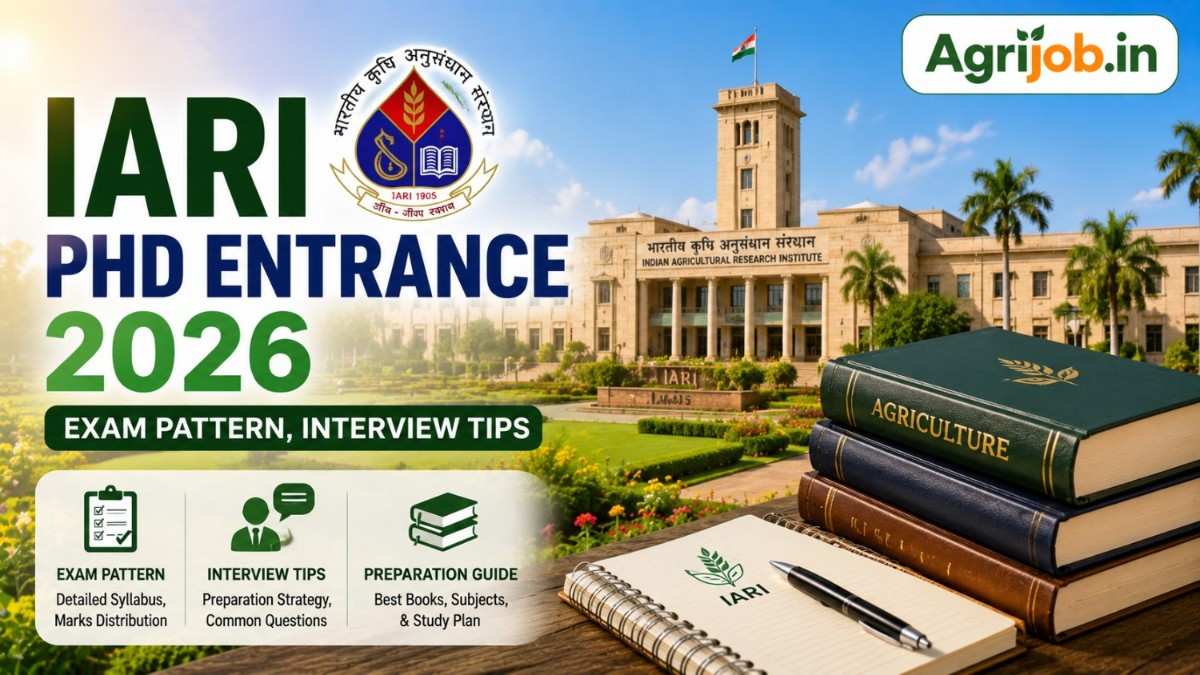
IARI PhD Entrance 2026: Exam Pattern, Interview Tips
IARI PhD entrance 2026 is the gateway for Master’s degree holders who want to pursue doctoral research at the Indian Agricultural Research Institute, New Delhi — India’s top-ranked agricultural research university. This guide is for MSc Agriculture graduates and allied-science postgraduates preparing for the written exam, academic evaluation, and interview that together decide final admission. Whether you are starting your preparation from scratch or polishing your strategy in the final weeks, this guide covers everything: exam pattern, syllabus, eligibility, stipend and scholarship structure, the step-by-step application process, and topper-tested interview insights drawn from candidates who have actually cleared the IARI PhD entrance in recent years.

- Conducting Body: IARI / NTA (Education Division, ICAR)
- Exam Weightage: Written exam 80% + Academic score 10% + Interview 10%
- Total Disciplines: Approx. 26 PhD disciplines
- Eligibility: Master’s degree, minimum 60% marks (55% for SC/ST/PwBD)
- Exam Mode: Computer-Based Test (CBT), objective MCQs
- Exam Parts: Part I – General Agriculture; Part II/III – Subject Paper
- Application Fee: Approx. Rs.500–Rs.1,000 (category-wise concession)
- Application Mode: Online via iari.res.in / NTA ICAR portal
- Who Should Apply for IARI PhD Entrance 2026?
- IARI PhD Entrance 2026 Exam Pattern & Syllabus
- Eligibility, Age Limit & Application Fee
- Stipend, Fellowship & Money Matters
- Step-by-Step Application Process
- Selection Process: From Application to Admission
- Written Exam Preparation Strategy
- Interview Preparation — Successful Candidates’ Insights
- IARI PhD Entrance vs ICAR AIEEA PG: Key Differences
- Important Terms Every IARI PhD Aspirant Must Know
- Common Myths & Mistakes to Avoid
- Frequently Asked Questions
Who Should Apply for IARI PhD Entrance 2026?
The IARI PhD entrance 2026 is designed for serious research aspirants, not casual applicants. Before you invest months of preparation, check whether your profile fits these candidate categories.
- 🎓 MSc Agriculture graduates who scored above 60% and want to specialise further through doctoral research.
- 🔬 Working JRF/SRF fellows at ICAR institutes who wish to convert their research experience into a formal PhD.
- 🌱 Allied-science postgraduates (botany, zoology, biotechnology, chemistry, environmental science) eligible for specific disciplines.
- 👩🔬 Women candidates seeking a research career in a government-funded, merit-based system with reserved seats.
- 🧑🌾 SC/ST/OBC/EWS/PwBD candidates who qualify for fee concessions and age relaxation as per category norms.
- 🏫 Aspiring agricultural university faculty who need a PhD from a NAAC-accredited institute to qualify for teaching positions.
- 📊 Candidates targeting RBI Grade B / NABARD Grade A research roles where a PhD adds significant weight to technical recruitment.
- 🔁 Repeat aspirants who missed selection earlier and are reattempting with a stronger subject-paper strategy.
IARI PhD Entrance 2026 Exam Pattern & Syllabus
Admission to IARI’s PhD programmes across its 26 disciplines is decided through a structured written test. The pattern consists of one paper with Part I covering General Agriculture and Part II covering the subject-specific paper. Part I typically carries 30 MCQs with four choices each, while Part II contains around 120 MCQs and CMQs plus 5 written questions for several disciplines. In recent admission cycles, ICAR PhD-level intake has been increasingly conducted through the AICE-JRF/SRF examination administered by the National Testing Agency in Computer-Based Test mode with objective multiple-choice questions. Always cross-check the current year’s exact pattern in the official Information Bulletin, since weightage and question count can shift slightly year to year.

| Exam Component | Coverage | Approx. Questions | Weightage in Final Merit |
|---|---|---|---|
| Part I – General Agriculture | Crop science, soil, climate, agri-extension, current affairs in agriculture | ~30 MCQs | Part of 80% written weightage |
| Part II/III – Subject Paper | Postgraduate-level depth in chosen discipline | ~120 MCQs/CMQs + written questions | Part of 80% written weightage |
| Academic Record | Marks from Class 10 onward, including MSc | — | 10% |
| Personal Interview | MSc thesis defence, subject depth, research aptitude | — | 10% |
Because the written exam alone determines 80% of your final score, candidates preparing for IARI PhD entrance 2026 should treat Part II subject-paper mastery as the single highest-leverage activity in their study plan — far more decisive than last-minute interview polishing.
General Agriculture (Part I) — Core Topics
- 🌾 Principles of crop production, cropping systems, and farming systems
- 🌍 Soil science fundamentals: classification, fertility, nutrient management
- 💧 Irrigation, water management, and dryland agriculture
- 🐛 Plant protection: major pests, diseases, and integrated management
- 📈 Agricultural economics, marketing, and government schemes
- 🧬 Genetics, plant breeding, and biotechnology basics
- 📰 Current developments in Indian agriculture and ICAR initiatives
Eligibility, Age Limit & Application Fee
Eligibility for IARI PhD admission 2026 is determined primarily by your postgraduate academic record. A Master’s degree with a minimum of 60% marks in B.Sc. Agriculture (for related M.Sc. streams) is the typical baseline used across IARI’s postgraduate and doctoral programmes. Category-wise relaxation generally brings this down for SC/ST/PwBD candidates.
| Category | Minimum Marks Required | Age Relaxation | Application Fee (Approx.) |
|---|---|---|---|
| General/OBC/EWS | 60% in relevant Master’s degree | Nil | Rs.1,000 |
| SC/ST/PwBD | 55% in relevant Master’s degree | 5 years | Rs.500 |
| Foreign Nationals (sponsored) | As per ICAR/FAO norms | As applicable | Separate slab notified |
There is no rigid upper age limit for IARI PhD admission in most disciplines, but candidates should always verify the current year’s Information Bulletin, since age norms occasionally apply to sponsored or in-service categories. Academic score for the final merit list is calculated from the percentage of marks obtained in examinations from matric (Class X standard) onward, not just the qualifying Master’s degree.
Stipend, Fellowship & Money Matters
Most PhD scholars admitted through the IARI/ICAR system receive a Junior Research Fellowship (JRF) or Senior Research Fellowship (SRF) stipend funded by ICAR, in addition to subsidised hostel and mess facilities. PhD-level graduates from IARI typically see strong placement outcomes, with the average post-PhD package in the agro-research and private agribusiness sector ranging between roughly Rs.6–10 lakhs per annum.
| Component | Approximate Value | Notes |
|---|---|---|
| JRF/SRF Stipend | As per current ICAR fellowship norms | Revised periodically by ICAR |
| Hostel & Mess | Highly subsidised | Among India’s most affordable PG/PhD campuses |
| Annual Tuition (PhD) | Rs.10,000–Rs.15,000 range (discipline-dependent) | Varies by year and division |
| Post-PhD Average Package | Rs.6–10 lakhs/annum | Research institutes, agribusiness, academia |
Step-by-Step Application Process
Applying for IARI PhD entrance 2026 follows a structured online process. Missing any single step can delay or disqualify your application, so follow this sequence carefully.
- Visit the official IARI admission portal at iari.res.in or the NTA ICAR examination portal and download the current Information Bulletin.
- Register using a valid email ID and active mobile number to generate your login credentials.
- Fill in personal details, academic history from Class 10 onward, and select your preferred PhD discipline.
- Upload scanned copies of mark sheets, category certificate (if applicable), photograph, and signature as per specified format.
- Pay the application fee online through net banking, UPI, or debit/credit card.
- Review the complete form carefully — discipline choice generally cannot be changed after submission.
- Submit the form and download/print the confirmation page for your records.
- Download the admit card once released and verify exam centre, date, and reporting time.
Keep scanned copies of all certificates (Class 10, Class 12, BSc, MSc mark sheets, category certificate) ready in the exact file size and format specified in the bulletin before you start the form — last-minute formatting errors are the most common reason applications get stuck.
Selection Process: From Application to Admission
The selection journey for IARI PhD admission 2026 moves through clearly defined stages, each filtering the candidate pool further before final seat allotment.
- Online Application & Fee Payment — Candidates register and submit documents within the notified window.
- Admit Card Release — Roll number, exam centre, and reporting instructions are issued.
- Written Entrance Examination — Computer-based or OMR-based test covering Part I and Part II/III papers (80% weightage).
- Provisional Answer Key & Objections — Candidates can raise objections within the specified window before final key release.
- Result & Shortlisting — Merit-based shortlist released, typically 2–3 times the available seats per discipline.
- Document Verification — Shortlisted candidates verify original certificates at the designated centre or online.
- Personal Interview — Discipline-wise panel evaluates research aptitude, subject depth, and MSc thesis understanding (10% weightage).
- Final Merit List & Counselling — Combined score (80%+10%+10%) determines discipline-wise final ranking and seat allotment.
Written Exam Preparation Strategy
Since the written paper alone decides 80% of your final score, your preparation timeline should weight subject-paper depth heavily over general reading. Here is a practical month-wise approach used by many successful candidates.
- 📚 Months 1–2: Rebuild MSc-level subject fundamentals from standard textbooks and your own thesis literature review.
- 📝 Months 2–3: Solve previous years’ IARI and ICAR AIEEA PG/PhD question papers discipline-wise to map recurring topics.
- 🗞️ Throughout: Maintain a running note of current agricultural schemes, ICAR announcements, and policy updates for the General Agriculture section.
- ⏱️ Final month: Take timed mock tests under exam conditions to build speed and negative-marking discipline.
- 👥 Final 2 weeks: Group revision with peers from the same discipline to clarify doubts and cross-check tricky MCQs.
Interview Preparation — Successful Candidates’ Insights
While the IARI PhD interview carries only 10% weightage, it remains the stage where many otherwise strong candidates lose composure. Insights gathered from candidates who have successfully cleared the IARI PhD entrance interview round point to a consistent pattern of preparation rather than last-minute cramming.
1. Know Your MSc Thesis Cold
The single most repeated question across IARI interview panels is a deep dive into the candidate’s MSc thesis — objectives, methodology, statistical analysis used, and key findings. Successful candidates recommend re-reading your own thesis end-to-end at least a week before the interview and being ready to defend every result, not just summarise it.
2. Prepare a Tight Two-Minute Introduction
Panels typically open with “tell us about yourself.” A focused two-minute answer covering academic background, MSc research focus, and why you want to pursue this specific PhD discipline at IARI creates a strong first impression and naturally steers the conversation toward your strengths.
3. Read Recent Work From the Division You’re Applying To
Candidates who skim 2–3 recent papers or ongoing projects from the IARI division relevant to their discipline are consistently able to answer “why this institute” convincingly, and can connect their proposed PhD problem to active research themes — a detail panels notice immediately.
4. Be Honest About Gaps
When a question falls outside your knowledge, successful candidates say clearly that they are not certain rather than guessing incorrectly or bluffing. Panels generally respond better to an honest “I don’t know, but here is how I would approach finding out” than to a fabricated answer.
5. Practice Out Loud, Not Just in Your Head
Mock interviews with a senior, an MSc guide, or even a peer group help convert silent preparation into fluent spoken answers. Candidates who rehearsed their thesis explanation out loud at least three to four times reported far less hesitation under the actual panel.
6. Carry Your Research Story, Not Just Your Marksheet
Interviewers are assessing research aptitude as much as subject knowledge. Framing your MSc experience as a coherent story — what problem you tackled, what challenge you faced, how you adapted your methodology — consistently lands better than reciting a list of techniques used.
Prepare two or three thoughtful questions to ask the panel at the end — about ongoing projects in the division, expected publication targets, or supervisor allocation. It signals genuine research interest rather than just admission-seeking.
IARI PhD Entrance vs ICAR AIEEA PG: Key Differences
Many aspirants confuse the IARI PhD entrance pathway with the ICAR AIEEA PG exam meant for Master’s admission. Understanding the difference early prevents wasted preparation effort on the wrong exam.
| Parameter | IARI PhD Entrance | ICAR AIEEA PG |
|---|---|---|
| Purpose | Doctoral (PhD) admission | Master’s (M.Sc./M.Tech) admission |
| Eligibility | Relevant Master’s degree, 60% marks | Relevant Bachelor’s degree, 60% marks |
| Exam Depth | Postgraduate subject depth | Undergraduate-level concepts |
| Interview Stage | Yes, 10% weightage | Generally not required |
| Competition Level | Very high (limited seats/discipline) | High but broader seat pool |
| Outcome | JRF/SRF fellowship + PhD degree | PG scholarship + Master’s degree |
| Best For | MSc graduates seeking research careers | BSc graduates seeking specialisation |
Important Terms Every IARI PhD Aspirant Must Know
Understanding these recurring terms will help you read official notifications, compare options, and communicate confidently during your interview.
- JRF (Junior Research Fellowship): Monthly stipend awarded to PhD scholars during the initial research years, funded through ICAR.
- SRF (Senior Research Fellowship): Enhanced stipend awarded after a scholar clears specific academic milestones in the PhD programme.
- AICE-JRF/SRF: The All India Competitive Examination through which NTA conducts PhD-level entrance for ICAR Deemed Universities including IARI.
- Information Bulletin: The official annual document detailing eligibility, fee, syllabus, exam pattern, and important dates for IARI admissions.
- Academic Council: The IARI body responsible for finalising seat numbers, eligibility norms, and discipline-wise admission policy each year.
- Introductory Agriculture (36 Credits): A bridge course mandatory for non-agriculture postgraduates admitted to IARI’s PhD programmes.
- Merit List: The final ranked list combining written exam, academic score, and interview marks, published discipline-wise.
- NAAC Accreditation: The quality certification held by IARI as a Deemed University, relevant for future academic and research job eligibility.
- Discipline-wise Seats: PhD seat allocation that varies every year across the institute’s 26 disciplines based on faculty and infrastructure capacity.
- Category-wise Relaxation: Marks and fee concessions applicable to SC/ST/OBC/EWS/PwBD candidates as per government reservation norms.
Common Myths & Mistakes to Avoid
Several misconceptions about the IARI PhD entrance 2026 process cause avoidable preparation mistakes. Clearing these up early can save months of misdirected effort.
- ❌ Myth: “The interview decides admission.” Reality: The written exam carries 80% weightage — interview performance cannot offset a weak written score.
- ❌ Myth: “Only IARI’s own exam matters.” Reality: Most PhD intake now flows through the NTA-conducted AICE-JRF/SRF exam, so always confirm the current year’s conducting body.
- ❌ Myth: “Any agent or coaching centre can guarantee a seat.” Reality: Admission is purely merit-based through a transparent government process; be wary of anyone promising guaranteed selection for payment — this is a red flag for fraud, not a genuine preparation service.
- ❌ Myth: “Non-agriculture graduates cannot apply.” Reality: Allied-science postgraduates are eligible for several disciplines, subject to completing the Introductory Agriculture bridge course.
- ❌ Myth: “Academic score from MSc alone matters.” Reality: Academic score is computed from marks obtained from matric (Class X) onward, not just the qualifying degree.
For authoritative, up-to-date information, always cross-verify details with official sources such as the IARI official website, the ICAR official portal, and the NTA ICAR examination portal before finalising your preparation plan or submitting any application.
This guide is regularly reviewed and updated for accuracy. Bookmark this page for the latest IARI PhD entrance 2026 notifications and interview preparation insights.
Frequently Asked Questions
What is the weightage of written exam and interview in IARI PhD entrance 2026?
The final merit is calculated as written entrance examination 80% weightage, academic record from Class 10 onward 10% weightage, and personal interview 10% weightage. This makes the written exam by far the most decisive stage of IARI PhD entrance 2026.
What is the exam pattern for IARI PhD entrance exam 2026?
The paper has Part I (General Agriculture, around 30 MCQs) and Part II/III (Subject-specific paper with around 120 MCQs/CMQs plus written questions in some disciplines). Confirm the exact current pattern in the official Information Bulletin each year.
How many disciplines are available for IARI PhD admission 2026?
IARI New Delhi offers PhD admission across roughly 26 disciplines covering agronomy, genetics and plant breeding, soil science, plant pathology, entomology, agricultural economics, agricultural engineering, biotechnology, and allied fields.
What is the eligibility for IARI PhD admission 2026?
Candidates need a Master’s degree in a relevant discipline with minimum 60% marks (55% for SC/ST/PwBD) from a recognised university. Non-agriculture postgraduates must clear a 36-credit Introductory Agriculture course in the first year.
How should I prepare for the IARI PhD interview round?
Revisit your MSc thesis in depth, prepare a two-minute self-introduction connecting your past research to your proposed PhD problem, read recent papers from your target division, and practice your answers out loud with mock interviews before the actual panel.
What is the application fee for IARI PhD entrance 2026?
Application fees generally fall between Rs.500 and Rs.1,000 for General/OBC/EWS candidates, with concessional fees for SC/ST/PwBD applicants. Exact fee slabs are notified each year in the official Information Bulletin.
Is the IARI PhD entrance exam tougher than ICAR AIEEA PG?
Yes, it is generally considered more competitive because it tests postgraduate-level subject depth and the candidate pool consists mostly of MSc degree holders competing for very limited discipline-wise seats.
Can a candidate from a non-agriculture background apply for IARI PhD?
Yes, candidates with a relevant Master’s degree in allied sciences such as botany, zoology, biotechnology, or chemistry can apply for specific disciplines, provided they meet subject-matter eligibility and complete the Introductory Agriculture bridge course if required.
Last Updated: June 2026