
Blue Revolution Scheme India 2026 — also called the Neel Kranti Mission — is the Government of India’s most ambitious plan to transform every segment of the fisheries sector, from pond fish farming and prawn culture to ornamental fish, seaweed, and pearl cultivation. Backed by a total investment of Rs.20,050 crore under its successor scheme PMMSY, it offers subsidies of 40%–60% to fishers, farmers, SHGs, and entrepreneurs across all 36 states and UTs. This guide covers every type of farming supported — fish, prawn, shrimp, pearl, seaweed, and more — along with eligibility rules, subsidy amounts, how to apply, and the key differences between the original Blue Revolution and the current PMMSY framework.

The Blue Revolution Scheme (Neel Kranti Mission) is a Government of India Centrally Sponsored Scheme launched in 2015-16 with Rs.3,000 crore outlay, later evolved into PMMSY (2020) with Rs.20,050 crore to bring sustainable growth across all fisheries sectors. General category farmers get 40% subsidy; SC/ST and women farmers get 60% subsidy on eligible aquaculture and infrastructure units.
- Scheme Name: Blue Revolution / Neel Kranti Mission → evolved to PMMSY
- Original Launch: December 2015 (Blue Revolution CSS); September 10, 2020 (PMMSY)
- Ministry: Ministry of Fisheries, Animal Husbandry & Dairying
- Total Investment (PMMSY): Rs.20,050 crore (2020–2025, extended to 2026)
- Budget 2026-27 Allocation: Rs.2,500 crore
- Subsidy — General Category: 40% of unit cost
- Subsidy — SC/ST/Women: 60% of unit cost
- Fish Production Target: 220 lakh metric tonnes (22 million MT)
- Employment Target: 55 lakh new jobs in fisheries sector
- Official Portal: pmmsy.dof.gov.in / dof.gov.in
- Approved Projects (as of Sep 2026): Rs.21,394 crore
- What Is the Blue Revolution Scheme India 2026?
- Who Should Apply for Blue Revolution / PMMSY Benefits?
- All Types of Farming Covered Under Blue Revolution
- Subsidy Amounts and Income Potential by Farming Type
- Eligibility Criteria and Requirements
- How to Apply for Blue Revolution / PMMSY in 2026 — Step by Step
- Blue Revolution Scheme vs PMMSY 2026 — Key Differences
- Advantages and Disadvantages of the Blue Revolution Scheme
- Important Terms Related to Blue Revolution and Fisheries
- Important Dates and Timeline
- Important Links
- Conclusion
- Key Takeaways
- Frequently Asked Questions About Blue Revolution Scheme India 2026
What Is the Blue Revolution Scheme India 2026?
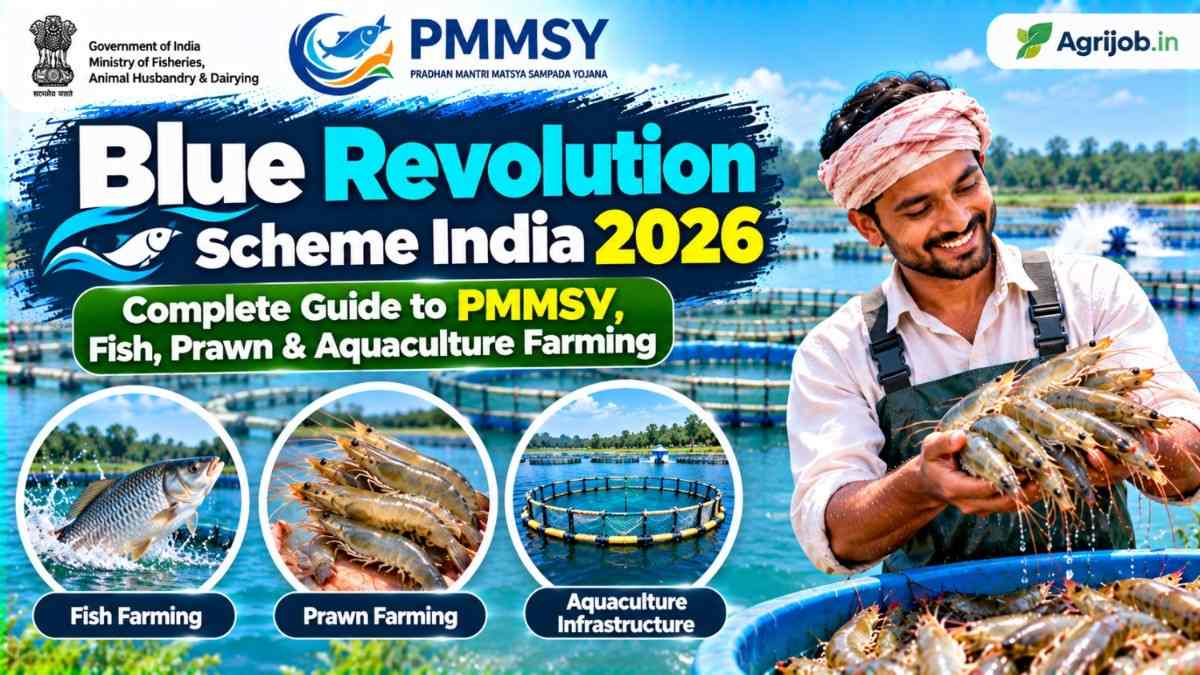
The Blue Revolution Scheme, officially called the Centrally Sponsored Scheme on Blue Revolution: Integrated Development and Management of Fisheries, is the Government of India’s umbrella programme to achieve economic, nutritional, and employment goals through the fisheries and aquaculture sector. It was launched in December 2015 under the Ministry of Agriculture with an outlay of Rs.3,000 crore for five years (2015–16 to 2019–20).
The scheme merged all existing fisheries development programmes under a single umbrella to eliminate overlaps and direct funding more efficiently. In September 2020, the Government elevated this vision into the Pradhan Mantri Matsya Sampada Yojana (PMMSY), the largest-ever investment in Indian fisheries at Rs.20,050 crore. PMMSY has been extended beyond 2025, with Rs.2,500 crore allocated in Union Budget 2026–27. As of September 2026, approved projects under PMMSY have crossed Rs.21,394 crore.

The core vision is to achieve ecologically healthy, economically viable, and socially inclusive development across India’s entire fisheries value chain — from seed production and farming to cold storage, processing, and export.
Who Should Apply for Blue Revolution / PMMSY Benefits?
The Blue Revolution and PMMSY benefits are open to a wide range of individuals and organisations engaged in any part of the fisheries and aquaculture sector:
- 🐟 Traditional fishermen and fishing communities — seeking insurance, boat upgrades, and income support
- 🌊 Fish farmers — wanting to set up or expand ponds, cages, or biofloc units
- 🦐 Prawn and shrimp farmers — in coastal Andhra Pradesh, Kerala, Odisha, Gujarat, and saline land areas
- 🐚 Pearl and ornamental fish cultivators — looking for hatchery and infrastructure support
- 🌿 Seaweed and bivalve farmers — in Tamil Nadu, Kerala, and Lakshadweep coastal areas
- 👩 Women, SC/ST beneficiaries — eligible for 60% subsidy instead of standard 40%
- 🏢 SHGs, cooperatives, and Fish Farmers Producer Organisations (FFPOs) — for collective aquaculture enterprises
- 🚐 Fish vendors and fish market entrepreneurs — for refrigerated vehicles, kiosks, and market units
All Types of Farming Covered Under Blue Revolution — Detailed Breakdown
One of the most important features of the Blue Revolution Scheme and PMMSY is their comprehensive coverage of every type of aquaculture and fisheries activity. Unlike earlier targeted schemes, the Blue Revolution takes an integrated approach. Here are all the major farming types supported:
1. Inland Fish Farming (Freshwater Aquaculture)
This is the largest sub-sector, contributing over 75% of India’s total fish production. Inland fish farming includes pond culture, tank culture, reservoir stocking, and cage culture in rivers and reservoirs. Common species supported include Rohu, Catla, Mrigal (Indian Major Carps), Pangasius, and Tilapia. Support is provided for pond construction, renovation, fingerling supply, feed, and training. The scheme targets raising aquaculture productivity from the current 3 tonnes/hectare to 5 tonnes/hectare.
2. Marine Fisheries and Deep-Sea Fishing
Marine fisheries cover fishing in the sea, estuaries, and coastal waters. The Blue Revolution supports construction and modernisation of fishing harbours and fish landing centres, GPS-equipped fishing boats, safety equipment, and mechanised vessel upgrades. Key beneficiary states include Gujarat, Maharashtra, Kerala, Tamil Nadu, Andhra Pradesh, Odisha, West Bengal, and Goa. India is the third-largest fish-producing nation globally, and marine catch forms a significant share of total output.
3. Prawn and Shrimp Farming (Brackishwater Aquaculture)
Shrimp and prawn farming represent the highest-value aquaculture activity in India. The primary commercial species is Litopenaeus Vannamei (Whiteleg Shrimp), which dominates Indian shrimp exports. States like Andhra Pradesh have recorded net returns of over Rs.1.5 lakh per acre per cycle from shrimp farming. The Blue Revolution and PMMSY provide financial assistance for:
- Setting up poly-lined shrimp ponds and hatcheries
- Saline land reclamation for aquaculture use
- Supply of quality post-larvae (PLs) at subsidised rates
- Biofloc-based zero-water-exchange shrimp systems
- Disease diagnostic and water quality testing laboratories
4. Ornamental Fish Farming
Ornamental fisheries — producing decorative fish for aquariums — is a fast-growing niche under the Blue Revolution. The scheme includes dedicated SOPs for Production and Processing Clusters for Ornamental Fisheries, announced at the 4th Anniversary of PMMSY. Farmers can access support for hatcheries, breeding units, tanks, aeration systems, and packaging for live fish transport. This segment generates significant income for women’s self-help groups in Kerala, West Bengal, and Maharashtra.
5. Pearl Cultivation
Pearl cultivation using freshwater mussels (Lamellidens marginalis) is supported under Blue Revolution and PMMSY’s Fisheries Cluster Development Programme. The government has announced dedicated SOPs for Pearl Cultivation Clusters. Farmers in Odisha, Rajasthan, and Chhattisgarh have benefited from pearl culture training, nucleus material, and marketing support. A single pearl farmer with a 0.4-hectare pond can earn Rs.60,000 to Rs.1,50,000 per cycle depending on quality.
6. Seaweed Cultivation
Seaweed farming is a priority activity under PMMSY’s coastal livelihood programme. India has a coastline exceeding 8,000 km with immense seaweed potential, particularly in Tamil Nadu, Gujarat, and Lakshadweep. The government has designated a Centre of Excellence for Seaweed Farming and released SOPs under Fisheries Cluster Development. Seaweed is used in food, pharmaceuticals, cosmetics, and biofuel industries. Support includes raft procurement (over 10,510 rafts supported under Blue Revolution), training, and market linkage.
7. Cage Culture in Reservoirs and Open Waters
Cage culture involves rearing fish in net cages placed in reservoirs, lakes, or rivers. The Blue Revolution sanctioned 770 sea cages for fish culture and supports large-scale cage culture in major reservoirs. Net income from one cage unit can reach Rs.1.8 lakh per cage per annum (as per NFDB data). This technology is popular in Andhra Pradesh, Himachal Pradesh, and Jammu & Kashmir.
8. Integrated Fish Farming (Rice-Fish, Poultry-Fish, Livestock-Fish Systems)
The Blue Revolution specifically encourages integrated farming models that combine aquaculture with crop cultivation or livestock rearing. Examples include rice-fish farming, duck-fish systems, and poultry-fish integration. These systems maximise resource use: fish waste fertilises crops, and crop residue feeds fish. The scheme also covers 800 hectares for saline area aquaculture through integrated fish farming in multiple states. This model is ideal for small and marginal farmers seeking diversified income.
9. Bivalve Culture (Mussels, Oysters, Clams)
Bivalve farming — growing mussels, oysters, and clams — is a coastal livelihood activity supported under PMMSY. Kerala (particularly Ashtamudi and Vembanad lakes) is the leading bivalve producing state. The scheme provides support for rope culture systems, raft procurement, and training. Bivalves require no feed input, making them one of the most cost-efficient and environmentally sustainable aquaculture options.
10. Biofloc Fish Farming Technology
Biofloc technology (BFT) enables intensive fish and shrimp farming in small areas with minimal water use. Under PMMSY, fisheries training centres provide Biofloc Technology training at subsidised rates, and beneficiaries can avail up to 60% subsidy on biofloc unit construction (for women/SC/ST). This technology is particularly suitable for landless fishermen or those with limited water access.
Subsidy Amounts and Income Potential by Farming Type
One of the biggest draws of Blue Revolution and PMMSY is the direct financial subsidy that reduces the capital cost of starting or scaling a fisheries enterprise. Here is a comprehensive breakdown:
| Farming Type / Activity | Subsidy — General | Subsidy — SC/ST/Women | Estimated Net Income |
|---|---|---|---|
| Freshwater Fish Pond (per hectare) | 40% | 60% | Rs.50,000–Rs.1,00,000/yr |
| Shrimp / Prawn Farming (per acre) | 40% | 60% | Rs.1,00,000–Rs.2,00,000/cycle |
| Cage Culture Unit | 40% | 60% | Rs.1.8 lakh/cage/yr (NFDB) |
| Pearl Cultivation Unit | 40% | 60% | Rs.60,000–Rs.1,50,000/cycle |
| Ornamental Fish Unit | 40% | 60% | Rs.30,000–Rs.80,000/yr |
| Seaweed Raft Unit | 40% | 60% | Rs.20,000–Rs.50,000/yr |
| Biofloc Unit | 40% | 60% | Rs.40,000–Rs.1,20,000/yr |
| Fish Hatchery / Seed Farm | 40% | 60% | Rs.2–5 lakh/yr (scale-dependent) |
| Refrigerated Transport Vehicle | 40% | 60% | Business income varies |
| Fish Feed Mill/Plant | 40% | 60% | Commercial enterprise income |
Funding Pattern: Centre shares 60% of cost with general states (40% state share); 90:10 for North-East and Himalayan states; 100% Central assistance for Union Territories. Union Budget 2026–27 has allocated Rs.2,500 crore for continuing PMMSY activities.
SC/ST and women farmers should always apply under their category to avail the higher 60% subsidy. Applications submitted under the general category cannot be reclassified after submission. Keep all caste certificates and Aadhaar documents ready before visiting the District Fisheries Office or logging in to the NFDP portal.
Eligibility Criteria and Requirements
Eligibility under Blue Revolution and PMMSY is broad and inclusive. Here are the key criteria:
- Who qualifies: Fishers, fish farmers, fish workers, fish vendors, SHGs, cooperatives, FFPOs, entrepreneurs, SC/ST persons, women, and differently-abled individuals
- Age: 18 years and above (no upper age limit specified for most activities)
- Land/Water Access: Applicant must have ownership or lease rights over the pond, cage site, or coastal area to be developed
- Bank Account: Linked Aadhaar-enabled bank account mandatory for Direct Benefit Transfer (DBT)
- KCC (Kisan Credit Card): KCC facility extended to fishers and fish farmers from 2018–19 — can be used for working capital under PMMSY activities
- Insurance: Fishermen can avail group insurance of Rs.5 lakh cover; over 31.89 lakh farmers in 22 states have been insured under PMMSY
Documents Required:
- Aadhaar Card / valid identity proof
- Land ownership/lease documents or water body rights certificate
- Caste certificate (for SC/ST category claims)
- Bank passbook (Aadhaar-linked)
- Passport-size photographs
- Detailed project report (DPR) for larger infrastructure projects
| Category | Subsidy % | Beneficiary Contribution |
|---|---|---|
| General (non-SC/ST, non-women) | 40% | 60% of unit cost |
| SC/ST applicants | 60% | 40% of unit cost |
| Women applicants | 60% | 40% of unit cost |
| Differently-abled persons | 60% | 40% of unit cost |
How to Apply for Blue Revolution / PMMSY in 2026 — Step by Step
- Visit the Official NFDP Portal: Go to the National Fisheries Development Programme portal at pmmsy.dof.gov.in or the NFDP portal to create a beneficiary account using Aadhaar and mobile number.
- Select Your Activity: Choose the specific farming activity you want to apply for (pond culture, cage culture, shrimp farming, ornamental fish, pearl, seaweed, hatchery, feed mill, cold chain, or infrastructure).
- Check State Guidelines: PMMSY is a Centrally Sponsored Scheme — each state implements it with minor variations. Visit your State Fisheries Department website for state-specific guidelines and available funding under the current financial year.
- Submit Application with Documents: Upload all required documents — Aadhaar, land/lease papers, bank account details, caste certificate (if applicable), and project plan or DPR (for larger units).
- Verification and Field Inspection: District Fisheries Officer (DFO) conducts a field inspection to verify the proposed site and project feasibility before approval.
- Approval and Release of Subsidy: After approval, subsidy is released directly to the bank account via DBT in instalments linked to project milestones (first installment on start, subsequent on completion stages).
- Avail Kisan Credit Card (KCC): After project sanction, apply for the KCC at any nationalised bank to meet working capital needs for feed, fingerlings, and operational expenses.
Blue Revolution Scheme vs PMMSY 2026 — Key Differences
Many applicants confuse the original Blue Revolution Scheme with PMMSY. While PMMSY is the successor and successor framework, they are distinct phases. Here is a clear comparison:
| Parameter | Blue Revolution Scheme (CSS) | PMMSY 2026 |
|---|---|---|
| Launch Year | 2015–16 | September 2020 |
| Total Outlay | Rs.3,000 crore | Rs.20,050 crore |
| Scheme Duration | 2015–16 to 2019–20 | 2020–21 to 2025–26 (extended) |
| Budget 2026–27 | Concluded | Rs.2,500 crore allocated |
| Ministry | Agriculture (DAHD&F) | Fisheries, AH & Dairying (DoF) |
| Scope | Fisheries infrastructure + production | Full value chain — production to export |
| Pearl/Seaweed/Ornamental | Basic support only | Dedicated Cluster Development SOPs |
| Insurance Coverage | Limited | Rs.5 lakh group cover; 31.89 lakh insured |
| Digital Integration | Manual state portals | NFDP portal; DBT directly to bank |
| Employment Target | Not explicitly stated | 55 lakh new jobs in 5 years |
For any applicant in 2026, PMMSY is the active and relevant scheme to apply under. The original Blue Revolution CSS concluded in 2019–20. PMMSY carries forward all Blue Revolution components with significantly larger funding, better digital infrastructure, higher targets, and enhanced insurance and credit support. Apply through the NFDP portal under PMMSY, not the older Blue Revolution CSS interface.
Advantages and Disadvantages of the Blue Revolution Scheme
Advantages (Pros):
- ✅ Universal coverage — supports all 36 states and UTs, inland and marine both
- ✅ Generous subsidy — 40% to 60% of unit cost significantly reduces entry barriers
- ✅ Diverse farming types — covers fish, prawn, pearl, seaweed, ornamental, and cage culture
- ✅ Insurance protection — Rs.5 lakh group cover for fishermen communities
- ✅ Credit linkage — Kisan Credit Card extended to fishers and fish farmers for working capital
Disadvantages (Cons):
- ❌ Benefits tend to favour medium and large landholders who can invest in pond construction upfront
- ❌ State-level delays — subsidy release timelines vary significantly by state bureaucracy
- ❌ Limited awareness in inland rural areas far from coastal districts
Important Terms Related to Blue Revolution and Fisheries
- PMMSY (Pradhan Mantri Matsya Sampada Yojana): India’s flagship Rs.20,050 crore fisheries scheme launched September 2020, the successor to the original Blue Revolution CSS.
- Neel Kranti Mission: The Hindi name for the Blue Revolution — meaning “Blue Revolution Mission” — reflecting the government’s ambition for a transformational leap in fisheries.
- NFDB (National Fisheries Development Board): The autonomous body under MoFAHD that implements and monitors fisheries schemes including PMMSY funding disbursement.
- FFPO (Fish Farmers Producer Organisation): A collective body of fish farmers analogous to FPOs in agriculture; eligible for larger infrastructure grants under PMMSY.
- Biofloc Technology: A zero-water-exchange fish/shrimp farming method using microbe-enriched water; widely promoted under PMMSY for landless farmers.
- FIDF (Fisheries and Aquaculture Infrastructure Development Fund): A Rs.7,522 crore fund offering 3% interest subvention on long-term fisheries loans with up to 12-year repayment (2-year moratorium).
- KCC (Kisan Credit Card) for Fisheries: Working capital credit facility extended to fishers and fish farmers since 2018–19; used to fund feed, fingerlings, and operational expenses.
- PM-MKSSY (PM-Matsya Kisan Samridhi Sah-Yojana): A sub-scheme under PMMSY approved in February 2024, running FY 2023-24 to FY 2026-27, with Rs.6,000 crore for formalisation and market linkage of micro and small fisheries enterprises.
- Sagar Mitra: A volunteer community mobiliser under PMMSY who links fishermen with government scheme benefits, digital services, and market information.
- Aquapark: Announced in Interim Budget 2024–25; five integrated aquaculture parks with cold chain and processing units to reduce post-harvest losses and increase farmer income.
Important Dates and Timeline
| Date / Period | Event / Milestone |
|---|---|
| December 2015 | Blue Revolution CSS launched (Rs.3,000 crore, 5 years) |
| 2018–19 | KCC extended to fishers and fish farmers; FIDF launched |
| 2019–20 | Separate Ministry of Fisheries, AH & Dairying created |
| September 10, 2020 | PMMSY launched (Rs.20,050 crore) — Blue Revolution 2.0 |
| February 2024 | PM-MKSSY sub-scheme approved (Rs.6,000 crore, FY 2023–2027) |
| Interim Budget 2024–25 | 5 Aquaparks announced; Rs.2,352 crore for Blue Revolution 2.0 |
| August 11, 2026 | PMMSY approved project total reaches Rs.21,394 crore |
| September 10, 2026 | PMMSY completes 6 years; Union Budget 2026–27 allocates Rs.2,500 crore |
| FY 2026–27 | PM-MKSSY active; applications open on NFDP portal |
Important Links
| Resource | Link |
|---|---|
| PMMSY Official Portal | pmmsy.dof.gov.in |
| Department of Fisheries (GoI) | dof.gov.in |
| National Fisheries Development Board | nfdb.gov.in |
| PIB: 6 Years of PMMSY (Sep 2026) | PIB Official Report |
| india.gov.in Fisheries Portal | india.gov.in/fisheries |
| Agrijob.in — More Agriculture Scheme Guides | agrijob.in |
Conclusion — Blue Revolution Scheme India 2026
The Blue Revolution Scheme India 2026, now implemented through PMMSY with a record Rs.20,050 crore investment, offers one of the most accessible and comprehensive subsidy programmes for anyone involved in fisheries and aquaculture — from traditional fishermen and pond farmers to prawn cultivators, pearl farmers, and seaweed growers. With 40%–60% subsidies, insurance cover, Kisan Credit Card access, and dedicated cluster development programmes for niche sectors like ornamental fish and seaweed, the scheme removes the capital barrier that kept millions of rural households from entering commercial aquaculture. If you are eligible, apply through the NFDP portal at pmmsy.dof.gov.in and bookmark this page — we update it every time official scheme guidelines change.
- Blue Revolution Scheme evolved into PMMSY in 2020 with Rs.20,050 crore — India’s largest fisheries investment ever.
- General category farmers get 40% subsidy; SC/ST and women farmers get 60% subsidy on all eligible activities.
- 10 major farming types are covered: freshwater fish, marine, prawn/shrimp, ornamental, pearl, seaweed, cage culture, biofloc, bivalve, and integrated farming.
- Over 31.89 lakh fishermen in 22 states have received insurance coverage of Rs.5 lakh under PMMSY.
- Rs.2,500 crore allocated in Union Budget 2026–27; apply now at pmmsy.dof.gov.in via the NFDP portal.
Frequently Asked Questions About Blue Revolution Scheme India 2026
What is the Blue Revolution Scheme in India?
The Blue Revolution Scheme, also known as the Neel Kranti Mission, is a Government of India Centrally Sponsored Scheme launched in December 2015 to bring about integrated, sustainable development of the fisheries sector. It merged all earlier fisheries schemes under one umbrella and later evolved into the Pradhan Mantri Matsya Sampada Yojana (PMMSY) in September 2020 with Rs.20,050 crore investment.
What is the difference between Blue Revolution and PMMSY?
The Blue Revolution CSS was the first phase (2015–16 to 2019–20) with Rs.3,000 crore. PMMSY is the expanded second phase launched in 2020 with Rs.20,050 crore, covering a much wider scope including insurance, digital integration, ornamental fish clusters, seaweed, and pearl cultivation SOPs. In 2026, PMMSY is the active operative scheme.
How much subsidy do fish farmers get under Blue Revolution / PMMSY?
General category fish farmers and aquaculture entrepreneurs receive a subsidy of 40% of the eligible unit cost. SC/ST applicants and women receive 60% subsidy. The remaining amount (60% or 40% respectively) must be contributed by the beneficiary, either from own funds or through a bank loan linked to the project.
Is prawn and shrimp farming covered under the Blue Revolution Scheme?
Yes. Prawn and shrimp farming — particularly Whiteleg Shrimp (L. Vannamei) culture in coastal brackishwater areas — is one of the priority activities under the Blue Revolution and PMMSY. Financial assistance is provided for poly-lined pond construction, hatchery support, post-larvae supply, biofloc shrimp systems, and disease diagnostic labs.
Can I apply for pearl cultivation support under PMMSY?
Yes. Pearl cultivation using freshwater mussels is supported under PMMSY’s Fisheries Cluster Development Programme. The government has released dedicated SOPs for Pearl Cultivation Clusters. Eligible farmers can apply for subsidy on nucleus material, pond infrastructure, and training through the NFDP portal.
What is the total investment under PMMSY as of 2026?
As of September 10, 2026 (PMMSY’s 6th anniversary), the Department of Fisheries has approved projects worth Rs.21,394 crore under PMMSY — exceeding the original Rs.20,050 crore outlay. The Union Budget 2026–27 has additionally allocated Rs.2,500 crore to continue scheme activities.
Who is eligible to apply under the Blue Revolution / PMMSY?
Eligible beneficiaries include fishers, fish farmers, fish workers, fish vendors, SHGs, cooperatives, Fish Farmers Producer Organisations (FFPOs), entrepreneurs, SC/ST individuals, women, and differently-abled persons engaged in any fisheries or aquaculture activity. Both individual and group applications are accepted.
How to apply for Blue Revolution / PMMSY scheme online?
Applications are made through the National Fisheries Development Programme (NFDP) portal at pmmsy.dof.gov.in. Register with your Aadhaar and mobile number, select the relevant activity, upload required documents (Aadhaar, land papers, bank account, caste certificate), and submit. The District Fisheries Officer then verifies and inspects before approving the application.
Does the Blue Revolution Scheme cover ornamental fish farming?
Yes. Ornamental fisheries is a dedicated component under PMMSY. Dedicated SOPs for Ornamental Fish Production and Processing Clusters have been released. Women’s SHGs and entrepreneurs can access subsidised hatchery units, aeration equipment, breeding tanks, and marketing support for decorative fish production.
What is the income potential from fish farming under PMMSY?
Income varies significantly by activity. Freshwater pond farming can generate Rs.50,000–Rs.1,00,000 per hectare per year. Shrimp farming in Andhra Pradesh yields Rs.1,00,000–Rs.2,00,000 per acre per cycle. Cage culture can earn Rs.1.8 lakh per cage per annum (NFDB data). PMMSY targets raising aquaculture productivity from 3 tonnes/hectare to 5 tonnes/hectare, which will proportionally raise farmer incomes.
Last Updated: October 2026 | Source: Department of Fisheries, Government of India (dof.gov.in); PIB Press Release, September 2026; NFDB; pmmsy.dof.gov.in | This guide is reviewed and updated regularly for accuracy. Bookmark this page for the latest information.
Disclaimer: This article is for informational purposes only. Subsidy figures, eligibility criteria, and deadlines are as per official guidelines current at the time of publication. Readers should verify the latest notification on pmmsy.dof.gov.in or with their District Fisheries Officer before applying. Agrijob.in is not a government portal and does not process applications.