
JNVST 2027 Class 6 Syllabus – Apply Now, 31 July
JNVST 2027 Class 6 Selection Test Syllabus has been officially released by the Navodaya Vidyalaya Samiti (NVS) under the Ministry of Education, Government of India, through its Final Prospectus 2027. The Jawahar Navodaya Vidyalaya Selection Test (JNVST 2027) is a competitive entrance exam for admission to Class VI (Class 6) in Jawahar Navodaya Vidyalayas across India. The test consists of 80 questions for 100 marks across 3 sections — Mental Ability Test & EVS, Arithmetic, and Language — and is conducted in over 29 languages across all states and UTs. The last date to submit the online application is 31 July 2026. This is the most updated 2026 notification — read the complete syllabus, exam pattern, eligibility, and step-by-step application guide at agrijob.in. This is a top govt job notification for parents seeking the best sarkari naukri-equivalent free education for their children.

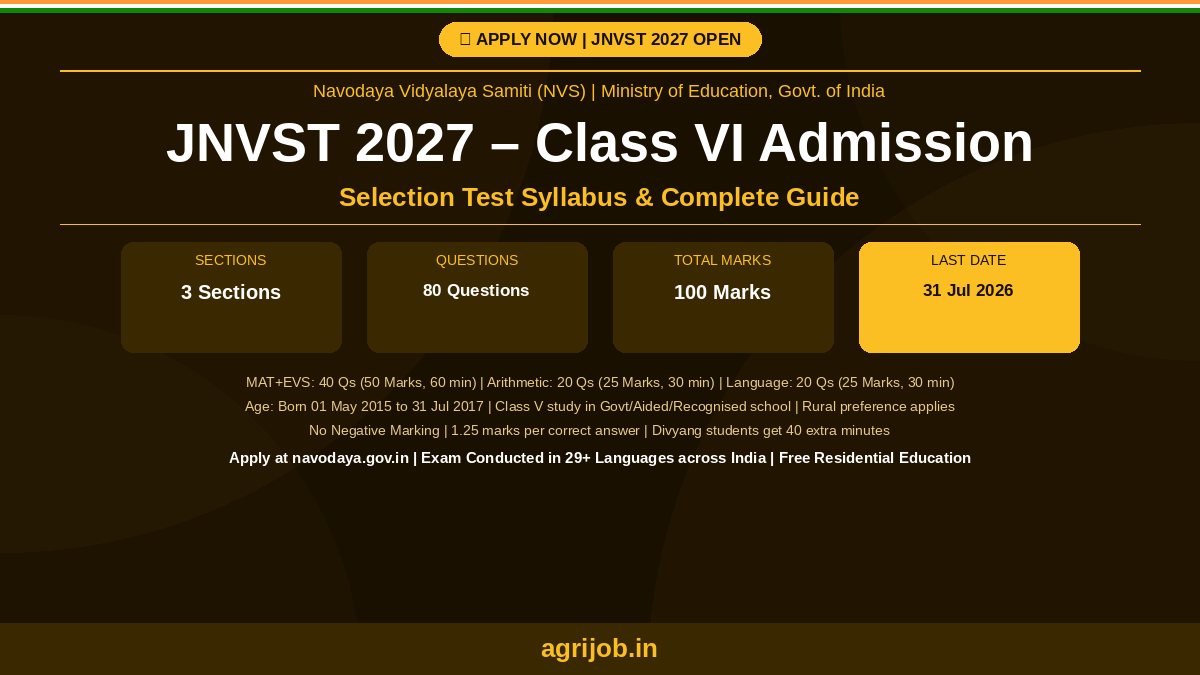
Table of Contents
JNVST 2027 Class 6 Selection Test Syllabus – Quick Overview
| Detail | Information |
|---|---|
| Conducting Body | Navodaya Vidyalaya Samiti (NVS), Ministry of Education, Govt. of India |
| Exam Name | Jawahar Navodaya Vidyalaya Selection Test (JNVST 2027) |
| Admission For | Class VI (Class 6) in Jawahar Navodaya Vidyalayas |
| Prospectus Year | Final Prospectus 2027 |
| Total Questions | 80 Questions |
| Total Marks | 100 Marks |
| Exam Duration | 2 Hours (11:30 AM – 1:30 PM) |
| Number of Sections | 3 Sections |
| Age Eligibility | Born between 01 May 2015 and 31 July 2017 |
| Class V Study | Must be studying in Class V in Govt/Govt-Aided/Recognised/NIOS school |
| Exam Languages | 29+ languages (State/UT wise) |
| Negative Marking | No Negative Marking |
| Marks per Correct Answer | 1.25 marks |
| Divyang Candidates | Extra 40 minutes allowed |
| Application Fee | NIL (Free) |
| Last Date to Apply | 31 July 2026 |
| Official Website | navodaya.gov.in |
Who Should Apply for JNVST 2027 Class 6 Admission?
The JNVST 2027 Class 6 Selection Test is open to candidates meeting specific eligibility criteria. This is one of India’s most sought-after free residential school admissions — here is who qualifies:
- Age Requirement: Candidates must be born between 01 May 2015 and 31 July 2017 (both dates inclusive). No relaxation is available for age limit
- Class V Study: The candidate must be studying in Class V during the academic year 2026–27 in a Government, Government-Aided, Recognised Private school, or NIOS (National Institute of Open Schooling)
- Class III, IV, V Schooling: The candidate must have studied Class III, IV, and V from recognised institutions — a certificate from the Headmaster confirming rural/urban school location for these years is required at document verification
- District Residence: Only bonafide residents of the district where the JNV is located are eligible. The candidate must be studying in Class V in a school within that district
- Rural/Urban Location: Location of Class V school (Rural or Urban) must be correctly declared; 75% seats are reserved for rural area candidates in each district
- Category Candidates: SC, ST, OBC (as per central list), and Divyang (differently-abled) candidates are eligible for seats reserved under their respective categories as per Government norms
- One Attempt Only: A candidate can appear for JNVST only once — no second attempt is permitted under any circumstances
Application Fee for JNVST 2027
| Category | Application Fee |
|---|---|
| General / OBC / EWS | NIL — Completely Free |
| SC / ST | NIL — Completely Free |
| Divyang (PH) | NIL — Completely Free |
| All Categories | No Fee Whatsoever |
There is absolutely no application fee for JNVST 2027 Class 6 admission. The entire application process is free and done online at navodaya.gov.in. Jawahar Navodaya Vidyalayas also provide completely free residential education — including boarding, lodging, meals, uniforms, textbooks, and stationery — to selected students. This makes NVS one of India’s best free quality education institutions and a top govt education initiative.

JNVST 2027 Class 6 Exam Pattern
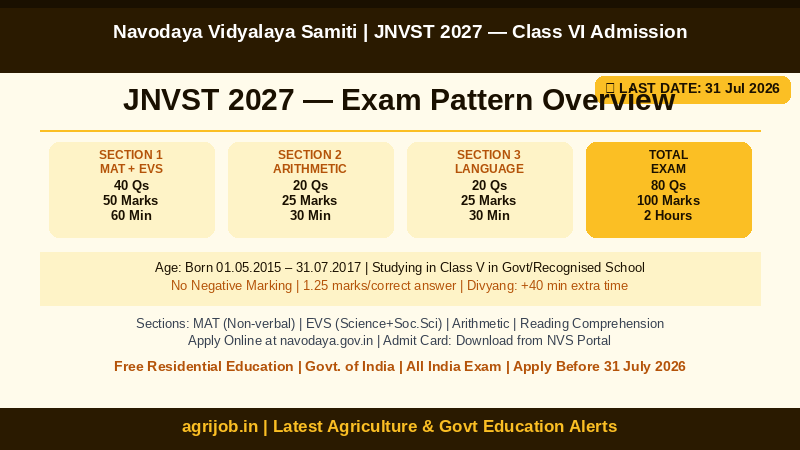
The JNVST 2027 Class 6 Selection Test follows a fixed exam pattern. Understanding this pattern is the first step in your preparation strategy. Here is the complete updated exam pattern for 2027:
| Section | Subject | No. of Questions | Marks | Duration |
|---|---|---|---|---|
| Section 1 | Mental Ability Test (MAT) + Environmental Studies (EVS) | 20 + 20 = 40 | 25 + 25 = 50 | 60 Minutes |
| Section 2 | Arithmetic Test | 20 | 25 | 30 Minutes |
| Section 3 | Language Test (Reading Comprehension) | 20 | 25 | 30 Minutes |
| TOTAL | 80 | 100 | 2 Hours |
- Exam Time: 11:30 AM to 1:30 PM (candidates must be seated by 11:00 AM sharp)
- Answer Type: Objective type (MCQ) — 4 options per question, 1 correct answer
- Marks per Correct Answer: 1.25 marks
- Negative Marking: NIL — no marks deducted for wrong answers
- Answer Sheet: OMR (Optical Mark Recognition) sheet — use only Blue/Black Ball Point Pen
- Pencil: Strictly NOT allowed on OMR sheet
- Divyang Students: Additional 40 minutes (total 2 hours 40 minutes)
- Minimum Qualifying Marks: 14 marks in Section 1 (MAT+EVS), 7 marks in Section 2 (Arithmetic), 7 marks in Section 3 (Language) — all three must be cleared
JNVST 2027 Class 6 Syllabus — Section 1: Mental Ability Test (MAT) + EVS
Section 1 of the JNVST 2027 Class 6 Selection Test Syllabus is the most important section, carrying 50 marks out of 100. It is divided into two parts — Mental Ability Test (MAT) with 20 questions and Environmental Studies (EVS) with 20 questions.
Part A: Mental Ability Test (MAT) — 20 Questions, 25 Marks
The MAT is a non-verbal test — all questions are based on figures and diagrams only. No reading is required. The purpose is to assess the general mental ability and intelligence of the candidate. The MAT is divided into 5 parts with 4 questions each:
- Part I — Pattern Completion (Questions 1–4): A problem figure has a missing part. Candidates must identify which answer figure (A, B, C, or D) correctly completes the pattern without changing direction. Includes alphabetical and number patterns
- Part II — Figure Series Completion (Questions 5–8): Three problem figures are given in a series with the fourth figure left blank. Candidates find the correct figure from 4 options that logically continues the series
- Part III — Geometrical Figure Completion (Questions 9–12): One part of a geometrical figure (triangle, square, circle) is shown as the question figure. Candidates must identify the answer figure that completes the geometrical shape
- Part IV — Mirror and Water Imaging (Questions 12–16): A problem figure is shown with a mirror held at line XY. Candidates select the answer figure that is the exact mirror image of the problem figure
- Part V — Embedded Figure (Questions 17–20): A simple figure is hidden inside a complex figure. Candidates identify which of the 4 answer figures contains the problem figure hidden or embedded within it
Part B: Environmental Studies (EVS) — 20 Questions, 25 Marks
The EVS section (Questions 21–40) takes an interdisciplinary approach, integrating Science, Social Science, and Environmental Education. It includes 15 MCQs and one passage followed by 5 questions. The complete EVS syllabus topics are:
- The Natural World: Transportation, Rivers, Mountains, Plants and animals on land and in water, Natural disasters, Types of houses and shelters, Water cycle (evaporation, condensation, precipitation, infiltration)
- The Human Body: Food and nutrients, Hygiene and cleanliness, Super senses of animals (e.g. dogs’ sense of smell), Basic knowledge of internal body systems — digestive system, circulatory system, respiratory system
- Science in Daily Life: Food preservation methods (pickling, drying, boiling), Water and air pollution, Conservation of water and soil, Environmental protection
- Social Surroundings: Superlatives of India (tallest, longest, highest), States and their capitals, National symbols of India, Different landscapes, Festivals of India (Holi, Diwali, Pongal, Eid), Seasons, Forests, Crops and agriculture, Clothes and fibres
- Reading Comprehension Passage (5 questions): One passage followed by 5 questions testing comprehension of environmental content — candidates must read carefully and answer accurately
JNVST 2027 Class 6 Syllabus — Section 2: Arithmetic Test
Section 2 of the JNVST 2027 Class 6 Selection Test Syllabus covers Arithmetic, with 20 questions for 25 marks in 30 minutes. The emphasis is on understanding and application of concepts, not just rote calculations. The complete arithmetic syllabus (12 topics) is:
- Topic 1 — Number System: Number and numeric system including ascending order, descending order, nearest number, number names, place value — up to 10, 100, 1000
- Topic 2 — Four Fundamental Operations: Addition, subtraction, multiplication, and division of whole numbers and their properties
- Topic 3 — Factors and Multiples: Factors, multiples, LCM, HCF and their properties; prime factorization (e.g. prime factorization of 1000 = 2×2×2×5×5×5)
- Topic 4 — Fractions: Fractions and fundamental operations — addition and subtraction of like fractions, multiplication of fractions. (Note: Unlike fraction division and unlike fraction division are NOT included)
- Topic 5 — Measurement: Measurement of length, mass, capacity, time, money and unit conversion (e.g. km to m, kg to g, litre to ml, hours to minutes, rupees to paise)
- Topic 6 — Simplification: Simplification of numerical expressions using BODMAS/BIDMAS rules
- Topic 7 — Perimeter and Area: Perimeter of polygon; area of square, rectangle, and triangle (triangle calculated as part of rectangle — no complex formulas)
- Topic 8 — Angles and Directions: Types of angles (acute, obtuse, right, straight, reflex); simple applications including directions (N, S, E, W, NE, NW, SE, SW) and basic mapping
- Topic 9 — Data Analysis: Reading and interpreting data using bar diagrams, tables, and pictographs — questions based on basic data handling and averages
Key Preparation Tip: JNVST Arithmetic questions test understanding, not just calculation speed. Focus on why a formula works rather than just memorising it. For example: average of first four odd numbers (1, 3, 5, 7) = (1+3+5+7)/4 = 4. Practice concept-based questions from Class V NCERT Mathematics.
JNVST 2027 Class 6 Syllabus — Section 3: Language Test
Section 3 of the JNVST 2027 Class 6 Selection Test Syllabus is the Language Test — 20 questions for 25 marks in 30 minutes. This section tests reading comprehension of candidates. The test consists of four passages, each followed by 5 questions. There are no grammar or vocabulary theory questions directly — all answers come from reading and understanding the passages.
- Format: 4 passages × 5 questions each = 20 questions total
- Question Types from Each Passage:
- Direct comprehension questions (what, who, when, where)
- Vocabulary questions — antonyms (opposite) of words used in passage (e.g. opposite of “preservation” = “destruction”)
- Synonym identification — which word is NOT a synonym of the given word (e.g. “wise” — sensible, intelligent, judicious, but NOT humorous)
- Inference questions — what can be concluded from the passage
- Cause and effect questions — what happens if a condition changes
- Passage Topics: Passages may cover forests, wildlife, nature, social stories, history, geography, science topics — all appropriate for Class V level reading
- Language Medium: This test is conducted in the language opted by the candidate in the application form — available in 29+ regional languages. Once selected, the language CANNOT be changed
Key Preparation Tip: Practice reading short passages in your chosen language and answering comprehension questions. Focus on finding synonyms, antonyms, and drawing logical conclusions from text. Read regularly in your opted language to build fluency and speed for the Language Test section of JNVST 2027.
JNVST 2027 — Languages Available for Examination
The JNVST 2027 Class 6 Selection Test is conducted in multiple regional languages, state-wise. Candidates select their preferred language during online application and this cannot be changed later — choose carefully. Here are the available languages state/UT wise:
| State / UT | Available Languages |
|---|---|
| Andhra Pradesh | Hindi, English, Telugu, Marathi, Urdu, Oriya, Kannada |
| Bihar | English, Hindi, Urdu |
| Gujarat | English, Hindi, Gujarati, Marathi |
| Karnataka | Hindi, English, Kannada, Telugu, Marathi, Urdu, Malayalam, Tamil |
| Kerala | Hindi, English, Malayalam, Tamil, Kannada |
| Madhya Pradesh | English, Hindi, Urdu, Marathi, Gujarati |
| Maharashtra | English, Hindi, Kannada, Marathi, Urdu, Telugu, Gujarati, Bengali |
| Rajasthan | English, Hindi |
| Telangana | Hindi, English, Telugu, Kannada, Marathi, Urdu |
| Uttar Pradesh | English, Hindi, Urdu |
| West Bengal | English, Hindi, Bengali, Nepali, Urdu |
| Assam | English, Hindi, Assamese, Bodo, Garo, Bengali, Manipuri |
| All Other States/UTs | English, Hindi + State regional language (as applicable) |
Tie-Breaker Rules for JNVST 2027
If two or more candidates secure the same total marks in the JNVST 2027 Class 6 Selection Test, the following priority order is used to break the tie:
- Candidate scoring higher marks in Mental Ability & EVS Test (Section 1) gets preference
- If Section 1 marks are equal, the candidate scoring higher in Arithmetic Test (Section 2) gets preference
- An ST candidate is given preference over an SC candidate
- An SC candidate is given preference over a General or OBC candidate
- An OBC candidate is given preference over a General (unreserved) candidate
- A girl candidate is given preference over a boy candidate
- A younger candidate (by age) is preferred over an older candidate — considering better IQ level at younger age
Selection Process for JNVST 2027 Class 6 Admission
The complete selection process for JNVST 2027 Class 6 Selection Test is as follows — updated process for 2027:
- Online Application: Submit the application at navodaya.gov.in before 31 July 2026 with all required details, certificates, and photographs
- Admit Card Download: Download admit card from navodaya.gov.in or the online application portal — no physical admit card will be sent. Production of Aadhaar card or Govt-approved residence certificate is mandatory at the exam centre
- Written Examination (JNVST 2027): Candidates appear at the allotted examination centre (no change of centre permitted) on the exam date — 11:30 AM to 1:30 PM
- OMR Sheet Evaluation: Answers on OMR sheets are evaluated by machine — no manual checking. Ensure correct darkening with Blue/Black Ball Point Pen only
- Merit List Preparation: Merit list prepared based on total marks (with tie-breaker rules as above), applying category-wise reservations (SC/ST/OBC/Divyang/Rural)
- Provisional Selection: Provisionally selected candidates are notified and called for document verification at the respective JNV
- Document Verification: All original documents verified at the JNV — TC from parent school, age proof, category certificates, rural/urban school certificate, residence proof
- Final Admission Confirmation: Admission confirmed after successful document verification — selected students join the JNV for Class VI
How to Apply Online for JNVST 2027 Class 6 Admission
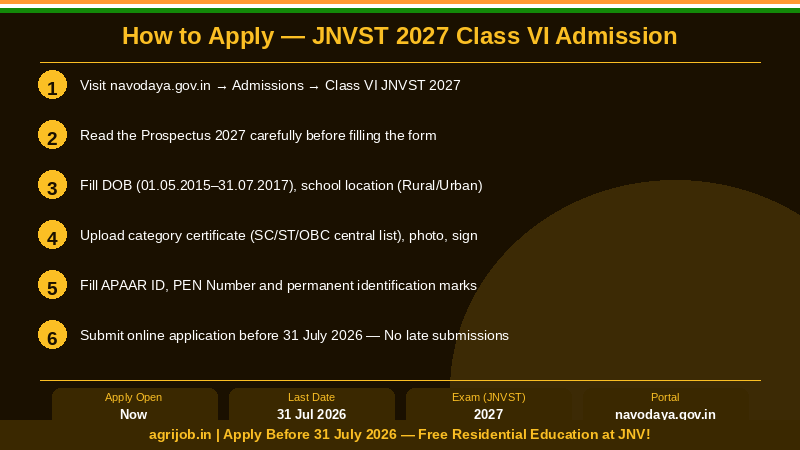
Follow this step-by-step guide to successfully submit the online application for JNVST 2027 Class 6 Selection Test before the last date, 31 July 2026. Apply Before 31 July 2026 — New Vacancy of free quality education closing soon!
- Visit the official NVS website: navodaya.gov.in and navigate to Admissions → Class VI JNVST 2027
- Read the Final Prospectus 2027 completely before starting the application — all eligibility conditions are detailed there
- Check Annexure-II if your district has two JNVs to determine which JNV you should apply to
- Confirm the candidate’s Date of Birth falls between 01 May 2015 and 31 July 2017 — birth certificate and school records must match
- Confirm the candidate is studying in Class V in a recognised school in the relevant district for JNVST 2027
- Select the language / medium of examination carefully — this CANNOT be changed after submission
- Fill all personal details: Name, Date of Birth (in figures AND words), Father’s/Mother’s name, permanent identification marks, APAAR ID, PEN Number
- Correctly fill the school location — Rural or Urban — as per the actual location of the Class V school
- Upload the following documents in JPG format:
- Candidate’s recent passport-size photograph
- Signature of candidate
- Signature of parent/guardian
- Category certificate (SC/ST/OBC Central List) — OBC must have CENTRAL OBC certificate
- Aadhaar card or Govt-approved residence certificate of parent
- Review all filled details for accuracy — submit the online application before 31 July 2026
- Save a printout or PDF of the submitted application form for future reference
Find more government education and sarkari naukri notifications at agrijob.in Agriculture Jobs and Latest Govt Jobs 2026.
Documents Required for JNVST 2027
The following documents are required at the time of online application and subsequently at document verification for provisionally selected candidates in JNVST 2027 Class 6 Selection Test:
- Birth Certificate (as per school records — Date of Birth must match)
- Certificate of studying in Class V in a recognised institution (Govt./Govt-Aided/Recognised/NIOS)
- Certificate from Headmaster/Head Teacher confirming Class III, IV, and V study details including the Rural/Urban nature of the school location
- Undertaking for Migration (as per format in Prospectus)
- Disability Certificate if applicable — copy of UDID (Unique Disability ID)
- SC/ST Category Certificate — issued by competent authority
- OBC Category Certificate — as per CENTRAL OBC list, issued by competent Govt. authority (format attached in Prospectus)
- Aadhaar Card of the candidate OR Govt. approved residence certificate of parent (for appearing at exam centre)
- TC (Transfer Certificate) from parent school — to be submitted at document verification after provisional selection
- EWS Certificate (if applicable) — issued on or after applicable date per Govt. norms
- APAAR ID and PEN Number (not mandatory but recommended for synchronisation with academic records)
Important Dates for JNVST 2027
| Event | Date |
|---|---|
| Prospectus 2027 Released | 2026 |
| Online Application Opens | Active Now |
| Last Date to Submit Online Application | 31 July 2026 |
| Admit Card Download | From navodaya.gov.in (before exam) |
| JNVST 2027 Exam Date | To be notified by NVS (typically April 2027) |
| Result Declaration | After exam evaluation |
| Document Verification | After result, at respective JNV |
| Admission to Class VI | Academic year 2027–28 |
Important Links for JNVST 2027 Class 6 Admission
| Link | URL |
|---|---|
| Apply Online — JNVST 2027 | navodaya.gov.in — Official Portal |
| Official NVS Website | navodaya.gov.in |
| Ministry of Education (Authority Link) | education.gov.in — Ministry of Education, Govt. of India |
| India Government Portal | india.gov.in |
| NVS Admission Helpline Email | As mentioned on navodaya.gov.in |
| More Agriculture & Education Jobs | Latest Agriculture Jobs on agrijob.in |
| Latest Govt Jobs 2026 | Govt Jobs 2026 on agrijob.in |
| Join Telegram for Alerts | Join @agrijob_in on Telegram |
Frequently Asked Questions about JNVST 2027 Class 6 Selection Test Syllabus
What is JNVST 2027 Class 6 Selection Test Syllabus?
JNVST 2027 Class 6 Selection Test Syllabus is the official curriculum and exam pattern for the Jawahar Navodaya Vidyalaya Selection Test (JNVST) 2027 released by Navodaya Vidyalaya Samiti (NVS) for admission to Class VI. The test has 80 questions for 100 marks across 3 sections — Section 1: MAT+EVS (40 Qs, 50 Marks, 60 min), Section 2: Arithmetic (20 Qs, 25 Marks, 30 min), and Section 3: Language (20 Qs, 25 Marks, 30 min). The last date to apply is 31 July 2026 at navodaya.gov.in.
What is the age limit for JNVST 2027 Class 6 admission?
Candidates appearing for JNVST 2027 Class 6 Selection Test must be born between 01 May 2015 and 31 July 2017 (both dates inclusive). No age relaxation is available for any category. The Date of Birth must match the school records and birth certificate — any discrepancy will lead to cancellation of candidature.
What is the exam pattern of JNVST 2027 Class 6?
The JNVST 2027 Class 6 exam consists of 80 objective-type questions for 100 marks in 2 hours (11:30 AM – 1:30 PM). Section 1 (MAT+EVS): 40 questions, 50 marks, 60 minutes. Section 2 (Arithmetic): 20 questions, 25 marks, 30 minutes. Section 3 (Language): 20 questions, 25 marks, 30 minutes. Each correct answer gives 1.25 marks. No negative marking. Divyang students get an extra 40 minutes.
What is the last date to apply for JNVST 2027 Class 6 Selection Test?
The last date to submit the online application for JNVST 2027 Class 6 Selection Test is 31 July 2026. No applications will be accepted after this date. Candidates must apply at navodaya.gov.in. Apply Before 31 July 2026 — do not delay!
Is there negative marking in JNVST 2027?
No, there is no negative marking in JNVST 2027 Class 6 Selection Test. Each correct answer gives 1.25 marks and wrong answers do not lead to any deduction. However, candidates must score minimum qualifying marks in each section: 14 marks in Section 1 (MAT+EVS), 7 marks in Section 2 (Arithmetic), and 7 marks in Section 3 (Language).
What is the syllabus for Section 1 MAT in JNVST 2027 Class 6?
The MAT (Mental Ability Test) in JNVST 2027 Class 6 Section 1 is a non-verbal test with 20 questions across 5 parts: Part I — Pattern Completion (Q1–4), Part II — Figure Series Completion (Q5–8), Part III — Geometrical Figure Completion (Q9–12), Part IV — Mirror and Water Imaging (Q12–16), Part V — Embedded Figure (Q17–20). All questions are based on figures and diagrams — no reading or text is involved in MAT.
What are the topics in JNVST 2027 Arithmetic Section?
The JNVST 2027 Arithmetic Section (Section 2) covers 9 main topics: Number System, Four Fundamental Operations, Factors and Multiples (including prime factorization), Fractions (like fractions only — unlike division not included), Measurement and Unit Conversion, Simplification of Numerical Expressions (BODMAS), Perimeter and Area (square, rectangle, triangle), Types of Angles and Directions, and Data Analysis (bar graphs, tables, pictographs).
Disclaimer: This Agricultural jobs related information is only for the purpose of providing information to you and for Agricultural career advancement of Agricultural, Horticulture, Agronomy, Soil Science, Plant Breeding, Agriculture Marketing, Forestry, Poultry, Fisheries, Agri Business Management Graduates. We are not representing this employer or any Employment Agency nor we guarantee any employment. We do not ask candidates for any fees, Personal Information like (Bank OTP, Credit-Debit Card No, Aadhar Card OTP etc.) Please be Aware And never Share Such Information to any one or In the Name of agrijob.in. Please verify the correctness of the Agri jobs details yourself. We do not offer any guarantee on correctness of any details mentioned here. If a candidate pays any amount to anyone claiming to represent any company then it would be the responsibility of that candidate and he cannot hold us or the concerned employer responsible for such fraudulent activities.