
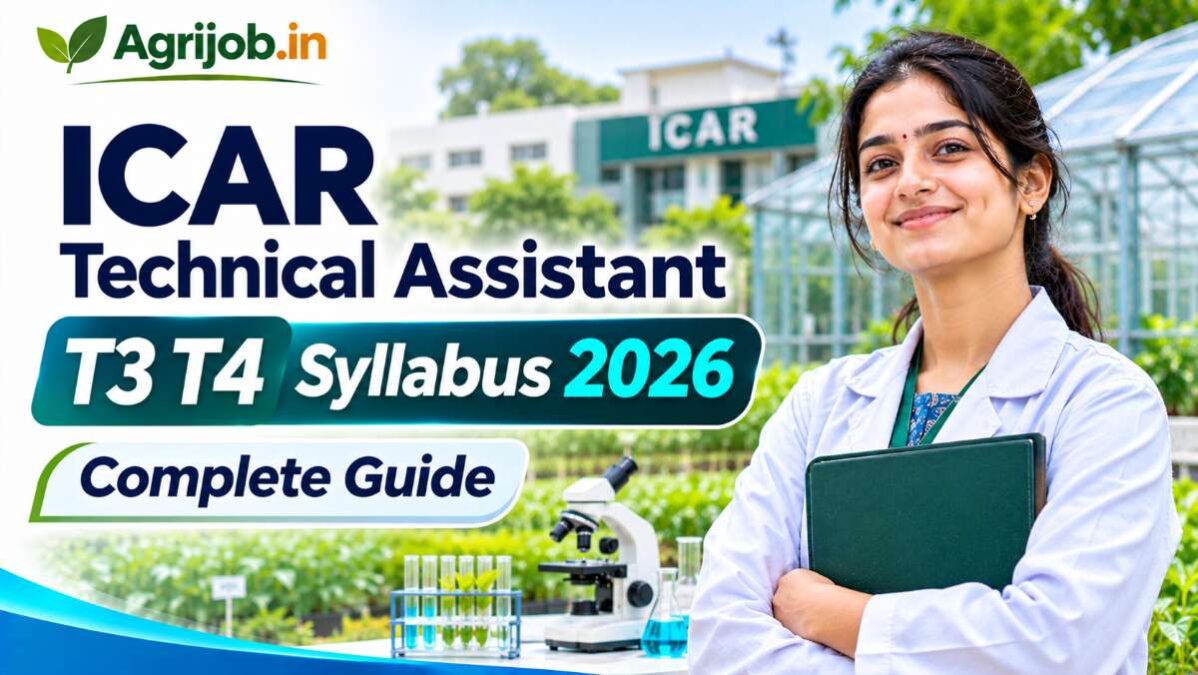
ICAR Technical Assistant syllabus 2026 is now officially out, and every science graduate eyeing a central government job in agricultural research must study this document carefully. The Indian Council of Agricultural Research (ICAR) notified the complete scheme and syllabus on 28 September 2026 through an Office Memorandum issued by Deputy Secretary (TS) Gajanand Yadav. This guide is for BSc/BTech graduates in agriculture, animal science, fisheries, engineering, library science, and IT who want to crack the ASRB centralized exam and secure a Pay Level-5 government post. It covers the full exam pattern, all 10 functional group syllabi for Paper-II, eligibility basics, salary details, and step-by-step preparation advice — everything in one place.
What Is the ICAR Technical Assistant (T-3) and Senior Technical Assistant (T-4) Exam 2026?
The ICAR Technical Assistant (T-3) and Senior Technical Assistant (T-4) exam is a centralized national-level recruitment examination conducted by the Agricultural Scientists Recruitment Board (ASRB) on behalf of ICAR. It fills vacancies in the ICAR Technical Service Cadre across India. T-3 posts are at ICAR Institutes and national research centres, while T-4 posts are at Krishi Vigyan Kendras (KVKs). Both posts fall under Direct Recruitment and no interview is held — selection is purely merit-based on Mains performance.
The official scheme was notified with immediate effect through Office Memorandum F.No.TS-19(6)/2024-EStt.IV dated 28 September 2026. Candidates may apply for either one or both posts based on their eligibility.
ICAR Technical Assistant 2026 – Salary and Pay Structure
The ICAR Technical Assistant (T-3) post is placed at Pay Level-5 of the 7th Central Pay Commission Pay Matrix, with a starting basic pay of Rs.29,200 per month. Senior Technical Assistant (T-4) is placed at Pay Level-6 (starting basic Rs.35,400 per month). Both posts carry annual increments of 3% of basic pay and offer promotional pathways to T-5 and T-6 levels.
| Post | Pay Level (7th CPC) | Starting Basic Pay | Grade Pay (pre-7th CPC ref.) |
|---|---|---|---|
| Technical Assistant (T-3) — ICAR Institutes | Level-5 | Rs.29,200/month | Rs.2,800 |
| Senior Technical Assistant (T-4) — KVKs | Level-6 | Rs.35,400/month | Rs.4,200 |
Note: Pay Level and starting basic pay are as per the 7th CPC Pay Matrix applicable to Central Government employees. The official recruitment notification will confirm any additional allowances specific to the post.
Eligibility Criteria for ICAR T-3 and T-4 Exam 2026
Eligibility varies by functional group. The general requirement for most functional groups is a Bachelor’s degree in the relevant subject from a recognized university. The official notification issued by ICAR/ASRB will specify the exact qualifications, age limits, and relaxations for each group. Minimum qualifying marks in the Preliminary Examination are set by ASRB as follows:
| Category | Minimum Qualifying Marks (Paper-I) |
|---|---|
| UR (Unreserved) | 40% |
| OBC / EWS / SC | 30% |
| ST | 25% |
A candidate may apply for only one Functional Group/Sub-Group irrespective of eligibility for more than one group. Functional group-wise vacancies will be listed in the ASRB notification. Check the official portal for complete eligibility details before applying.
ICAR Technical Assistant Exam Pattern 2026 – Paper-I and Paper-II
The exam follows a two-stage pattern. Paper-I is a qualifying Preliminary Examination; shortlisting for Mains is done by ASRB from Paper-I scores. Final selection is entirely based on Paper-II (Mains) performance. No interview is conducted for either post.
Paper-I – Preliminary Examination (Qualifying)
| Section | Subject | Questions | Marks | Duration |
|---|---|---|---|---|
| 1 | General Knowledge | 25 | 25 | 1 Hour |
| 2 | General English | 25 | 25 | |
| 3 | Quantitative Aptitude | 25 | 25 | |
| 4 | General Agriculture | 25 | 25 | |
| Total | 100 | 100 | ||
- Objective type, MCQ format; bilingual (English & Hindi) except General English
- Negative marking: 0.25% (1/4 mark) per wrong answer
Paper-II – Mains Examination (Merit-Based)
| Particulars | Details |
|---|---|
| Mode | Objective Type, MCQ (English & Hindi) |
| Total Questions | 100 |
| Total Marks | 300 (each question carries 3 marks) |
| Duration | 2 Hours |
| Negative Marking | 1 mark (0.33%) per wrong answer |
| Scope | Domain/subject-specific — based on Functional Group chosen |
| Interview | No interview |
ICAR Technical Assistant Syllabus 2026 – Paper-I Topics
The ICAR Technical Assistant syllabus 2026 for Paper-I covers four subjects at graduate level. All sections except General English are bilingual.
1. General Knowledge
General awareness of environment, current events, everyday observations, History, Culture, Geography, Economic Science, general Policy, and Scientific Research — with special focus on India and neighbouring countries.
2. General English
Basic comprehension, writing ability, grammar, and correct usage of English.
3. Quantitative Aptitude
Numbers, decimals, fractions, Percentage, Ratio & Proportion, Square Roots, Averages, Interest, Profit & Loss, Discount, Mixture & Alligation, Time & Distance, Time & Work, Algebra, Geometry (triangles, circles, polygons), Mensuration (prism, cone, cylinder, sphere), Trigonometry, Histograms, Bar diagrams, Pie Charts.
4. General Agriculture
Agro-ecosystems, Dryland Farming, Agroforestry, Soil Fertility, Integrated Farming Systems, Climate Change and Indian agriculture; Cereal Crops, Pulses, Oilseeds, Horticultural Crops; Plant Breeding, Tissue Culture; Animal Breeding, Animal Health, Livestock, Poultry, Fisheries; Farm Machinery, Post-Harvest Technology, ICT in Agriculture; Role of ICAR, NAARM, KVKs; Agricultural legislation (Seed Act 1966, PPV&FR Act 2001, Biodiversity Act 2002, Insecticide Act 1968, PQ Order 2003); International organizations — CIMMYT, IRRI, ICRISAT, IIAT, CIAT, IWMI, ICARDA; New Education Policy 2020.
ICAR Technical Assistant Syllabus 2026 – Paper-II (10 Functional Groups)
Paper-II syllabus is functional group-specific. ICAR has defined 10 functional groups for the Mains Examination. A candidate must choose only one group, irrespective of eligibility for multiple groups.
| S.No. | Functional Group / Sub-Group |
|---|---|
| 1 | Field/Farm Technician & Laboratory Technician (Agriculture) |
| 2 | Field/Farm Technician & Laboratory Technician (Animal Science) |
| 3 | Field/Farm Technician & Laboratory Technician (Fisheries Science) |
| 4 | Field/Farm Technician & Laboratory Technician (Home Science/Community Science) |
| 5 | Workshop Staff (Civil Engineering) |
| 6 | Workshop Staff (Agricultural Engineering) |
| 7 | Workshop Staff (Electrical Engineering) |
| 8 | Workshop Staff (Electronics & Instrumentation Engineering) |
| 9 | Library Information Science / Documentation Staff |
| 10 | Information Technology |
Group A – Agriculture (Field/Farm & Lab Technician)
Ecology & environment; Cropping patterns & farming systems; Agroforestry; Weed management; Soil science & fertility; Water-use efficiency & irrigation; Farm management & economics; Agricultural extension & KVKs; Agricultural Engineering basics; Cell biology & genetics; Plant Breeding (classical and molecular — CRISPR-Cas9, genomic selection, speed breeding, tissue culture, bioinformatics); Seed production & certification; Plant Physiology; Enzymes, photosynthesis, growth substances; Horticulture (fruits, vegetables, spices, floriculture, medicinal plants); Pest and disease management (IPM, biological control, pesticides); Food science & technology; Food security & nutrition; Biotechnology (cell biology, molecular biology, genetic engineering); Food Microbiology & Food Chemistry.
Group B – Animal Science (Field/Farm & Lab Technician)
Animal Nutrition (energy, protein, minerals, vitamins, feed additives, ruminant/poultry/swine nutrition); Animal Physiology (blood, circulation, respiration, excretion, endocrinology, reproduction, environmental physiology); Animal Reproduction (semen quality, AI, oestrus detection); Livestock Production & Management (dairy farming, meat/egg/wool production); Genetics & Animal Breeding (population genetics, selection methods, Hardy-Weinberg, genomics); Extension; Anatomy, Pharmacology & Hygiene (histology, embryology, bovine & fowl anatomy, veterinary hygiene); Animal Diseases (infectious, production, deficiency diseases, immunization, anaesthesia); Veterinary Public Health (zoonoses, epidemiology, jurisprudence); Milk & Milk Products Technology; Meat Hygiene & Technology.
Group C – Fisheries Science (Field/Farm & Lab Technician)
Aquaculture (freshwater, brackishwater, mariculture, cage/recirculatory/aquaponics systems); Fish Breeding & Seed Production; Ornamental Fish Farming & Aquarium Management; Fish Genetics & Biotechnology; Fish Nutrition & Feed Technology; Fish Diseases Management (microbiology, immunology, GAP, HACCP, biosecurity); Inland Fisheries; Marine Fisheries; Aquatic Ecology (plankton, benthos, nutrient cycles, food chains); Soil & Water Chemistry; Taxonomy of Finfishes & Shellfishes; Fishery Biology; Fishing Crafts & Gears; Fish Processing, Products & Byproducts; Fisheries Economics, Extension, Policy & Trade.
Group D – Home Science / Community Science
Basic agriculture & plant science; Human Nutrition (food groups, food processing, meal planning, diet therapy, community nutrition); Child/Human Development (prenatal to adolescence, family welfare programmes); Management (work simplification, housing, home furnishing, family finance); Clothing construction & textiles (sewing, fabric classification, traditional textiles, embroideries); Home Science Education, communication & extension methods, rural development, women empowerment.
Group E – Workshop Staff (Civil Engineering)
Engineering Mathematics; Building Materials (stone, cement, concrete mix design); Solid Mechanics; Structural Analysis (trusses, beams, vibrations); Design of Steel Structures; Design of Concrete & Masonry Structures; Construction Practice, Planning & Management; Fluid Mechanics, Hydraulic Machines & Hydro Power; Hydrology & Water Resources Engineering; Environmental Engineering (water supply, waste water, solid waste, air/noise pollution); Geo-technical & Foundation Engineering; Surveying & Geology; Transportation Engineering (highways, tunnelling, railways, harbours, airports); Emerging Technologies (BIM, GIS, Drones, Smart Sensors, IoT, 3D Printing, AR/VR); Sustainability & Green Infrastructure (GRIHA, LEED, rainwater harvesting, green buildings); Agricultural Structures specific to ICAR & KVK systems (farm ponds, polyhouses, godowns, cattle sheds).
Group F – Workshop Staff (Agricultural Engineering)
Statistics & mathematics; Electric motors & instruments; Thermodynamics & fluid mechanics; Soil mechanics; Farm machinery & mechanization; Renewable energy (solar, wind, biogas, biofuels); Post-harvest processing, drying, milling, storage & food processing plants; Surveying, hydrology, irrigation, water harvesting, soil erosion control.
Group G – Workshop Staff (Electrical Engineering)
Engineering Mathematics; Electrical Materials; Electric Circuits & Fields; Electrical & Electronic Measurements; Computer Fundamentals; Basic Electronics Engineering; Analog & Digital Electronics; Systems & Signal Processing; Control Systems; Electrical Machines (transformers, DC machines, induction motors, synchronous machines); Power Systems; Power Electronics & Drives; Instrumentation & Automation in Agriculture (sensors, DAQ, PLCs, SCADA, automation in irrigation/fertigation).
Group H – Workshop Staff (Electronics & Instrumentation Engineering)
Engineering Mathematics; Electrical Engineering & Network Theorems; Electronics (semiconductors, amplifiers, oscillators); Digital Electronics; Process Instrumentation; Control Engineering (PID controllers, control valves); Linear IC Applications; Microcontrollers & PLCs (8051, SCADA, DCS, CNC); Electronic Measuring Instruments; Analytical & Bio-Medical Instrumentation; Internet of Things (IoT) in Instrumentation; AI & Machine Learning in Instrumentation; Cyber-Physical Systems & Industry 4.0.
Group I – Library Information Science / Documentation Staff
Library & Society (Five Laws of Library Science, library types, professional ethics, library legislation); Knowledge Organization (classification schemes — DDC, UDC, Colon; cataloguing codes — AACR-II; MARC, metadata standards — Dublin Core); Library & Information Management (acquisition, technical processing, TQM); Reference & Information Services (CAS, SDI, online resources, open access repositories); Information Technology in Libraries (hardware, software, networking, data mining, big data); Library Automation (KOHA, RFID, digital libraries, NDLI, KrishiKosh, cloud computing); Library Networks (INFLIBNET, DELNET, NICNET, INIS, AGRIS, PM-ONOS); Research Methodology (bibliometrics, scientometrics, webometrics).
Group J – Information Technology
Operating System Concepts (process management, memory management, file systems, distributed OS); Computer Networking (topologies, ISO-OSI & TCP/IP, cryptography, firewalls); DBMS (relational databases, SQL, normalization, concurrency control); Software Engineering (SDLC models, project management, PERT, CPM, CASE tools); Data Structures & Programming Languages (C++, Java, Python — OOP, sorting, searching); Website Development (HTML5, CSS3, JavaScript, CMS, PHP, JSP, .NET); Mobile Application Development (Android, iOS, React Native, Flutter); Linux/Windows Server Administration; Database Administration (Oracle, MySQL, PostgreSQL, NoSQL); AI Technologies (ML algorithms, neural networks, deep learning — CNN/RNN/LSTM, TensorFlow, PyTorch, Keras, generative AI, LLMs).
How to Prepare for ICAR Technical Assistant Exam 2026 – Step-by-Step
- Download the official syllabus PDF from icar.org.in (F.No.TS-19(6)/2024-EStt.IV dated 28 September 2026) and read every page carefully for your chosen functional group.
- Identify your functional group based on your graduation subject and check whether vacancies are announced for it. You can apply for only one group.
- Start with Paper-I preparation — General Agriculture and Quantitative Aptitude are the highest-scoring sections for most candidates. Allocate 2–3 hours daily.
- Build a subject-specific study plan for Paper-II using the topic-wise syllabus from Annexure-II of the official OM. Cover each major topic systematically.
- Practise negative marking discipline — Paper-II carries 1 mark deduction per wrong answer. Attempt questions only when you are confident. 70–75 accurate answers can outperform 100 random attempts.
- Use standard textbooks relevant to your functional group, ICAR institute publications, and previous ASRB question papers.
- Bookmark agrijob.in for exam date announcements, admit card alerts, and result updates.
Important Dates – ICAR T-3 T-4 Centralized Exam 2026
The syllabus has been officially notified on 28 September 2026. Exam dates, application window, and vacancy details will be announced by ASRB separately via the official notification. The table below reflects the current status as known from the official OM.
| Event | Status / Date |
|---|---|
| Scheme & Syllabus Released | 28 September 2026 |
| Office Memorandum No. | F.No.TS-19(6)/2024-EStt.IV |
| Official Notification by ASRB | As per official notification (check asrb.org.in) |
| Application Start Date | As per official notification |
| Last Date to Apply | As per official notification |
| Admit Card Release | As per official notification |
| Preliminary Exam (Paper-I) Date | As per official notification |
| Mains Exam (Paper-II) Date | As per official notification |
| Result Declaration | As per official notification |
Important Links – ICAR Technical Assistant T3 T4 Syllabus 2026
Frequently Asked Questions About ICAR Technical Assistant Syllabus 2026
What is the ICAR Technical Assistant (T-3) exam pattern 2026, and how many stages does the selection process involve for ASRB centralized recruitment?
What is the salary of ICAR Technical Assistant T-3 in 2026, and what pay level does the post carry under the 7th Pay Commission pay matrix?
How many functional groups are there in the ICAR T-3 T-4 Mains Exam 2026, and can a candidate apply for more than one group in ASRB centralized exam?
What is the negative marking rule for ICAR Technical Assistant 2026 Prelims and Mains, and how should candidates plan their attempt strategy accordingly?
When was the official ICAR Technical Assistant T-3 T-4 syllabus 2026 released, and where can candidates download the complete official PDF for free?
Last Updated: November 2026. This page is reviewed and updated when official data changes. Bookmark agrijob.in for the latest ICAR recruitment updates.
Disclaimer: This post is for informational purposes only and is based on the official Office Memorandum F.No.TS-19(6)/2024-EStt.IV dated 28 September 2026. Always verify data on the official portal (icar.org.in and asrb.org.in) before taking action. Exam dates, application links, and vacancy counts will be released separately by ASRB.
