
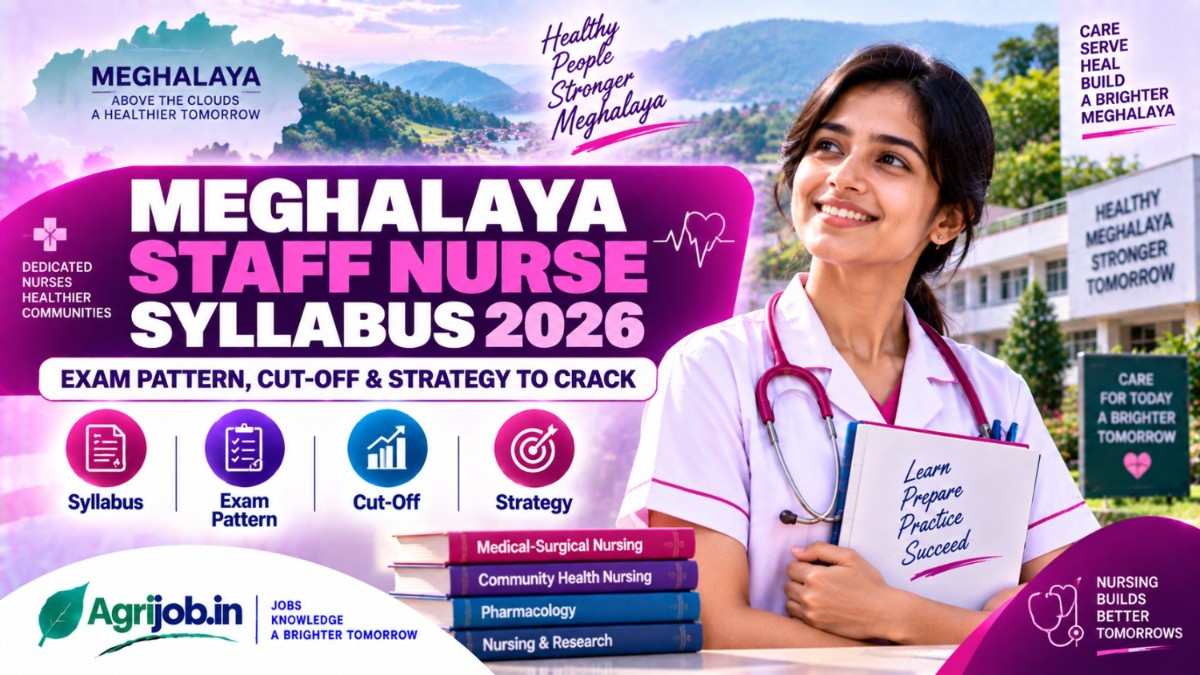
Meghalaya Staff Nurse Syllabus 2026 is now officially released by the Meghalaya Medical Services Recruitment Board (MMSRB) for 52 Staff Nurse posts under the Health and Family Welfare Department. The written exam carries 100 marks across 5 nursing subjects and is scheduled for 7 November 2026. This guide covers everything — subject-wise syllabus, exam pattern, category-wise vacancy breakdown, previous cut-off trends, and a step-by-step preparation strategy — so you can crack this exam on your first attempt.

The Meghalaya Staff Nurse Syllabus 2026 is based on the Indian Nursing Council (INC) curriculum — 90 marks across Medical-Surgical, Obstetrical & Gynecological, Child Health, Mental Health, and Community Health Nursing, plus 10 marks on Current National Health Programmes. The written exam has 100 MCQs in 120 minutes with no negative marking, and the minimum passing mark is 30 out of 100. Salary after selection is Rs.47,600–Rs.1,51,100 per month (Pay Level 8).
- Conducting Board: Meghalaya Medical Services Recruitment Board (MMSRB)
- Total Vacancies: 52 Staff Nurse posts (Regular)
- Pay Scale: Rs.47,600–Rs.1,51,100 (Pay Level 8)
- Exam Date: 7 November 2026
- Application Deadline: 30 September 2026
- Admit Card: 28 October 2026
- Total Marks: 100 (MCQ-based)
- Exam Duration: 120 Minutes
- Negative Marking: None
- Minimum Pass Marks: 30 out of 100
- Exam Medium: English Only
- Application Fee: Rs.460 (General) | Rs.230 (SC/ST/OST)
- Official Website: meghealth.gov.in / mmsrb.in
- What Is the Meghalaya Staff Nurse Syllabus 2026?
- Who Should Read This Guide?
- Salary & Pay Scale Details
- Eligibility Criteria & Application Fee
- Meghalaya Staff Nurse Exam Pattern 2026
- Subject-Wise Syllabus (Complete Breakdown)
- Vacancy & Category-Wise Reservation Breakdown
- Previous Cut-Off Trends & Analysis
- MMSRB Staff Nurse vs Other State Nursing Exams
- Advantages and Disadvantages of MMSRB Staff Nurse Job
- Important Nursing Terms Covered in Exam
- Important Dates & Timeline
- Important Links
- Conclusion
- Key Takeaways
- Frequently Asked Questions
What Is the Meghalaya Staff Nurse Syllabus 2026?
The Meghalaya Staff Nurse Syllabus 2026 is the official list of topics prescribed by the Meghalaya Medical Services Recruitment Board (MMSRB) for the written entrance exam held to fill government nursing posts in the state’s Health and Family Welfare Department. The syllabus is structured entirely around the Indian Nursing Council (INC) curriculum, which ensures uniform standards across all state-level nursing exams in India.
The exam tests five core nursing disciplines — Medical & Surgical Nursing, Obstetrical & Gynecological Nursing, Child Health Nursing, Mental Health Nursing, and Community Health Nursing — each carrying 20 marks. An additional 10 marks are reserved for Current National Health Programmes, making the total 100 marks in a 120-minute OMR-based test. There is no negative marking, which significantly benefits well-prepared candidates who attempt all 100 questions.

Who Should Read This Guide?
This complete guide is most useful for the following candidates:
- 🏥 GNM graduates from Meghalaya who are registered with the Meghalaya Nursing Council and want a permanent state government nursing post
- 🎓 B.Sc Nursing degree holders aged 18–32 years (up to 42 years for SC/ST) who are Meghalaya domicile holders
- 📋 Candidates who appeared in the 2023 or 2024 MMSRB cycle and are preparing for a second attempt in 2026
- ⏱️ Working nurses in private hospitals seeking to transition into the state government healthcare system
- 📚 Fresh GNM/B.Sc Nursing graduates appearing in their first competitive nursing exam and needing a structured study plan
- 🌿 Candidates from Khasi & Jaintia, Garo, and OST/SC categories wanting clarity on their reserved quota and cut-off expectations
- 🔎 Job seekers in Northeast India looking for stable government nursing jobs with Pay Level 8 salaries
Meghalaya Staff Nurse Salary & Pay Scale 2026
The selected Staff Nurses under the 2026 MMSRB recruitment will receive a salary of Rs.47,600–Rs.1,51,100 per month under Pay Level 8 of the Meghalaya Government Pay Matrix. This is a significant upgrade from the Rs.25,000 flat contractual remuneration offered in the 2023 drive, as the 2026 posts are regular (permanent) government positions with full benefits.
| Pay Component | Amount (Rs.) |
|---|---|
| Basic Pay (Entry Level – Pay Level 8) | Rs.47,600/month |
| Maximum Pay (Pay Level 8) | Rs.1,51,100/month |
| Dearness Allowance (DA) | As per Meghalaya Govt. rules |
| House Rent Allowance (HRA) | As per Meghalaya Govt. rules |
| Medical & Other Allowances | As admissible under state rules |
| Gross Monthly Emoluments (Estimated) | Rs.55,000–Rs.65,000 (entry level) |
| Annual In-Hand Earnings (Estimated) | Rs.6.6 lakh–Rs.7.8 lakh (entry) |
This Pay Level 8 salary makes the MMSRB Staff Nurse post one of the highest-paying nursing roles available through state-level recruitment in Northeast India in 2026. The gross package surpasses many central government nursing positions at the entry level, making this a highly competitive and sought-after posting.
Eligibility Criteria & Application Fee
Before studying the syllabus, ensure you meet all eligibility requirements for the MMSRB Staff Nurse 2026 recruitment:
- ✅ Nationality: Must be a citizen of India and domicile of Meghalaya
- ✅ Educational Qualification: B.Sc Nursing or General Nursing & Midwifery (GNM) from an INC-recognized institution
- ✅ Registration: Must be registered under the Meghalaya Nursing Council at the time of applying
- ✅ Age Limit: 18–32 years as on 01 January 2026
- ✅ Age Relaxation: 10 years for SC/ST candidates of Meghalaya (upper limit 42 years)
| Category | Application Fee |
|---|---|
| General / Unreserved | Rs.460/- |
| SC / ST / OST (Meghalaya) | Rs.230/- |
Meghalaya Staff Nurse Exam Pattern 2026
The MMSRB Staff Nurse 2026 written exam follows a straightforward MCQ pattern with no negative marking. Understanding the exam structure helps you plan time per question and allocate study hours to each subject accurately.
| Subject | No. of Questions | Marks |
|---|---|---|
| Medical & Surgical Nursing | 20 | 20 |
| Obstetrical & Gynecological Nursing | 20 | 20 |
| Child Health Nursing | 20 | 20 |
| Mental Health Nursing | 20 | 20 |
| Community Health Nursing | 20 | 20 |
| Current National Health Programmes | 10 | 10 |
| Total | 100 | 100 |
- Exam Mode: Pen & Paper (OMR Sheet) using Black Ball-Point Pen
- Duration: 120 Minutes (2 Hours)
- Question Type: Multiple Choice Questions (MCQ) — 1 mark each
- Negative Marking: None
- Minimum Qualifying Marks: 30 out of 100
- Medium: English Only
- INC Syllabus Marks: 90 marks
- National Health Programme: 10 marks
Since there is no negative marking, attempt all 100 questions without exception. Even a random attempt on the 10 questions you are unsure about gives you a statistically expected 2–3 marks — which could be the difference between making the merit list or not in a competitive cycle. Never leave any MCQ blank in this exam.
Subject-Wise Syllabus — Complete Breakdown
The Meghalaya Staff Nurse Syllabus 2026 is structured around the INC curriculum. Below is the complete topic list for all five subjects plus Current National Health Programmes:
1. Medical & Surgical Nursing (20 Marks)
- Hyponatremia and fluid-electrolyte imbalances
- Pre-operative and post-operative nursing care
- Postoperative complications and wound healing
- Principles of Intensive Care Unit (ICU) nursing
- Hemorrhage management and CPR
- Inflammation and infection control
- Management of common medical disorders (cardiovascular, respiratory, endocrine, renal)
- Surgical nursing — general surgery, orthopedic surgery, neurosurgery care
- Emergency nursing management
- Pain management and palliative care
2. Obstetrical & Gynecological Nursing (20 Marks)
- Unit I: Introduction to human reproduction, family welfare services, administration and management of OBG units
- Unit II: Normal pregnancy, intranatal care, postnatal care
- Unit III: High-risk pregnancy, abnormal labour, pre-term labour, obstetrical emergencies, postpartum complications
- Unit IV: Normal and high-risk newborn care
- Unit V: Gynecological problems and nursing management (PCOS, fibroid, cervical issues, reproductive cancers)
3. Child Health Nursing (20 Marks)
- Child’s growth and development (physical, cognitive, emotional)
- Nutrition of infants and children — breastfeeding, complementary feeding, malnutrition
- Children’s rights and safeguarding
- Care of the sick child — common pediatric illnesses, IMNCI protocols
- School health services and care of school children
- Care of adolescents and adolescent girls — reproductive health
- Immunization schedule and national childhood vaccination programmes
- Neonatal nursing — low birth weight, prematurity, birth asphyxia
4. Mental Health Nursing (20 Marks)
- Concept of mental health and mental illness; classification of mental illnesses (ICD-10, DSM-5)
- Historical perspectives and trends in psychiatric nursing
- National Mental Health Programme (NMHP) — human rights of the mentally ill
- Mental Health Act 2017 provisions
- Scope and standards of psychiatric nursing
- Concept of normal vs abnormal behaviour
- Multidisciplinary team and role of a nurse in psychiatry
- Management of common psychiatric disorders: schizophrenia, depression, bipolar, anxiety, substance use
- Therapeutic communication and de-escalation techniques
- Extended and expanded roles of the psychiatric nurse
5. Community Health Nursing (20 Marks)
- Concept and determinants of health; levels of prevention
- Community health practices and rural community dynamics
- Health problems and policies in India
- Health organization — Primary Health Centre, Sub-Centre, Community Health Centre, District Hospital
- Role of the health team — ANM, ASHA, MPW, PHN
- Structure and dynamics of community; community need assessment
- Community methods and health education media
- Counseling skills and community-based rehabilitation
- Environmental health — safe water, sanitation, waste disposal
- Occupational health and school health nursing
6. Current National Health Programmes (10 Marks)
- National Health Mission (NHM) — NRHM and NUHM components
- Ayushman Bharat — PM-JAY health insurance scheme
- Pradhan Mantri Surakshit Matritva Abhiyan (PMSMA)
- Janani Shishu Suraksha Karyakram (JSSK)
- Mission Indradhanush — Intensified Immunization Programme
- POSHAN Abhiyan and nutrition programmes
- National Programme for Control of Blindness (NPCB)
- National TB Elimination Programme (NTEP / End TB Mission)
- National AIDS Control Programme (NACP)
- National Mental Health Programme (NMHP)
Vacancy & Category-Wise Reservation Breakdown 2026
The MMSRB Staff Nurse 2026 recruitment follows the State Reservation Policy of Meghalaya, which is unique among Indian states. The reservation is based on tribal identity — Khasi & Jaintia, Garo, and Other Scheduled Tribes/Scheduled Castes — rather than the conventional OBC/SC/ST system used in most other states.
| Category | Staff Nurse Vacancies (2026) | Notes |
|---|---|---|
| Unreserved (UR) | 8 | Open to all domicile candidates |
| Khasi & Jaintia | 20 | Includes 1 Sports Person quota |
| Garo | 21 | Includes 1 Sports Person quota |
| Other STs / SCs (OST/SC) | 2 | Including 1 backlog Sports Person vacancy |
| Sports Person (within roster) | Included above | Must upload sports certificate at application stage |
| Total | 52 | Regular posts only |
Key point: Candidates claiming reserved-category status must hold a valid tribal/caste certificate issued by the competent authority of the Government of Meghalaya. General domicile candidates need a Residency Certificate from the Deputy Commissioner of their respective district.
Previous Cut-Off Trends & Analysis
MMSRB has not published official category-wise cut-off marks in a consolidated format for previous cycles. However, based on the selection pattern, vacancy count, and exam structure from the 2023 and 2024 recruitment cycles, the following trends can be established to guide 2026 applicants:
| Recruitment Year | Total Vacancies | Total Marks | Estimated General Cut-Off | Estimated Reserved Cut-Off |
|---|---|---|---|---|
| 2023 (DHS Meghalaya) | 288 Posts | 100 | ~55–65 marks | ~45–55 marks |
| 2024 (MMSRB) | 164 Staff Nurse Posts | 100 | ~60–68 marks | ~50–58 marks |
| 2026 (MMSRB – Projected) | 52 Posts | 100 | ~65–72 marks | ~55–62 marks |
Why is the 2026 cut-off projected higher? The 2026 drive has only 52 seats — significantly fewer than the 2023 cycle’s 288 posts. Fewer seats with a growing pool of GNM/B.Sc Nursing graduates in Meghalaya means steeper competition. Candidates targeting UR seats should aim for 70+ marks to be safe, while reserved category candidates should target 60+ marks as a practical benchmark.
Factors that will influence the 2026 cut-off:
- Number of valid applications received before the 30 September 2026 deadline
- Difficulty level of the 7 November 2026 written examination
- Proportion of UR vs reserved seats (UR has only 8 posts — very competitive)
- Whether all sportsperson quota seats are contested
MMSRB Staff Nurse 2026 vs Other Nursing Exams
How does the Meghalaya Staff Nurse exam compare with other government nursing recruitment exams in India?
| Feature | MMSRB Meghalaya 2026 | AIIMS NORCET | RRB Staff Nurse | ESIC Staff Nurse |
|---|---|---|---|---|
| Salary | Rs.47,600–Rs.1,51,100 | Rs.44,900–Rs.1,42,400 | Rs.35,400–Rs.1,12,400 | Rs.44,900–Rs.1,42,400 |
| Total Marks | 100 | 200 | 100 | 200 |
| Duration | 120 minutes | 180 minutes | 90 minutes | 120 minutes |
| Negative Marking | No | Yes (0.25) | No | Yes (0.25) |
| Eligibility Restriction | Meghalaya Domicile Only | Pan India | Pan India | Pan India |
| Syllabus Basis | INC Curriculum | INC Curriculum | INC + General | INC Curriculum |
| Competition Level | State-Limited (Moderate) | Very High | Very High | High |
| Best For | Meghalaya domicile nurses | Top-ranked nurses nationwide | Railway aspirants | Central PSU nurses |
For Meghalaya domicile nursing candidates, the MMSRB Staff Nurse 2026 is the single best opportunity in the current recruitment cycle. The salary at Pay Level 8 (Rs.47,600+) exceeds what many central government nursing posts offer at entry level, competition is limited to state residents only, and there is no negative marking — making it a high-reward, moderate-risk exam if you prepare with 6–8 weeks of focused study.
Advantages and Disadvantages of MMSRB Staff Nurse Job
Advantages (Pros):
- ✅ High Salary: Rs.47,600–Rs.1,51,100 at Pay Level 8 — among the best for state nursing jobs in the Northeast
- ✅ Permanent Government Job: Regular post with full pension, gratuity, and leave benefits
- ✅ No Negative Marking: Attempt all 100 questions without penalty, reducing examination risk
- ✅ State-Restricted Pool: Competition limited to Meghalaya domicile holders — easier than pan-India exams
- ✅ Pure Merit-Based: Selection on written exam marks alone — no interview bias in 2026 cycle
- ✅ Job Security: Government employment with structured promotions via Pay Matrix progression
Disadvantages (Cons):
- ❌ Very Few Seats: Only 52 posts — smaller than previous years (288 in 2023, 164 in 2024)
- ❌ Strict Domicile Requirement: Non-Meghalaya candidates cannot apply regardless of qualification
- ❌ English-Only Exam: No regional language option — disadvantageous for candidates more comfortable in Khasi or Garo
- ❌ Tribal Roster System: Only 8 UR seats — extremely competitive for general category candidates
Important Nursing Terms Covered in the Exam
The following high-frequency terms appear repeatedly across past nursing recruitment MCQs and are essential for Meghalaya Staff Nurse exam preparation:
- OMR Sheet: Optical Mark Recognition sheet used for the pen-and-paper MCQ exam; always use Black Ball-Point Pen only
- INC Syllabus: Indian Nursing Council curriculum — forms 90 out of 100 marks of the MMSRB exam
- CPR: Cardiopulmonary Resuscitation — a major Medical-Surgical Nursing topic covering rescue breathing and chest compressions
- IMNCI: Integrated Management of Neonatal and Childhood Illness — a key protocol tested under Child Health Nursing
- NMHP: National Mental Health Programme — India’s national policy to address the mental health burden, tested in Mental Health + Health Programmes sections
- NHM: National Health Mission — umbrella programme covering NRHM and NUHM, consistently tested in the 10-mark National Health Programmes section
- PHC: Primary Health Centre — foundational unit of rural health delivery; Community Health Nursing questions reference PHC staffing norms extensively
- Eclampsia: Severe pregnancy complication with seizures — a recurring topic in Obstetrical Nursing MCQs
- Apgar Score: Newborn assessment tool (Appearance, Pulse, Grimace, Activity, Respiration) — frequently tested in Child Health Nursing
- Schizophrenia: Chronic psychiatric disorder — the most frequently tested mental illness in Mental Health Nursing sections across all nursing recruitment exams
6-Step Strategy to Crack Meghalaya Staff Nurse Exam 2026
With the exam on 7 November 2026 and applications closing 30 September 2026, you have approximately 5–6 weeks of preparation time. Here is a structured strategy to maximise your score:
- Map the syllabus in Week 1: Print the five subject sections from this guide. Tick topics you already know well versus those needing revision. Prioritise topics with 4+ sub-points — these generate the most MCQs in exams.
- Study INC textbooks in Weeks 1–3: Cover each subject using your GNM/B.Sc Nursing textbooks. For Medical-Surgical, Brunner & Suddarth or Lippincott is the standard reference. For Community Health, use K. Park’s Preventive & Social Medicine for National Health Programmes.
- Focus 20% of time on National Health Programmes: The 10-mark section on Current National Health Programmes is the easiest to score in — no clinical application required, just factual recall. Study NHM, Ayushman Bharat, PM-JAY, Mission Indradhanush, NTEP, and NACP thoroughly.
- Practice MCQs daily from Week 2 onwards: Solve at least 50 MCQs per day using previous-year nursing exam papers (DHS Meghalaya 2023, AIIMS NORCET, RRB Nursing). Target INC-syllabus-based MCQ banks — the question pattern is similar across all state nursing exams.
- Attempt 2 full mock tests per week in Weeks 4–6: Simulate the exact exam — 100 questions in 120 minutes on paper. Analyse wrong answers immediately after each mock. Track accuracy per subject and identify your weakest of the five sections.
- Revise and consolidate in final week: Stop reading new content 5 days before the exam. Focus exclusively on quick-revision notes, flashcards of drug dosages, normal lab values, Apgar Score, CPR steps, and common MCQ-type facts (e.g., pH of blood, gestational weeks for viability, NMHP launch year).
Important Dates & Timeline
| Event | Date |
|---|---|
| Official Notification Released | 2 September 2026 |
| Online Application Opens | 4 September 2026 |
| Last Date to Apply Online | 30 September 2026 (Midnight) |
| Admit Card Download | 28 October 2026 |
| Written Exam Date | 7 November 2026 |
| Result Declaration | To be notified by MMSRB |
| Document Verification | After result declaration |
| Final Appointment | After police verification clearance |
Important Links
| Link | URL |
|---|---|
| Official MMSRB Portal (Apply Online) | mmsrb.in |
| Official Notification PDF (MMSRB 2026) | meghealth.gov.in |
| Meghalaya Health Department | meghealth.gov.in |
| Indian Nursing Council (INC) — Syllabus Reference | indiannursingcouncil.org |
| National Health Mission India | nhm.gov.in |
| Agrijob.in — Government Nursing Jobs | agrijob.in |
Conclusion
The Meghalaya Staff Nurse Syllabus 2026 is well-defined, INC-based, and entirely doable with 5–6 weeks of structured preparation. With 52 permanent posts at Pay Level 8 (Rs.47,600+), no negative marking, and a state-restricted applicant pool, this is one of the best government nursing job opportunities available in Northeast India right now. Apply before 30 September 2026, study the five subjects methodically, score 65+ marks on 7 November 2026, and you stand a strong chance of landing a permanent government nursing career in Meghalaya.
- The MMSRB Staff Nurse 2026 exam has 100 MCQs in 120 minutes with no negative marking — attempt all questions
- Salary for selected candidates is Rs.47,600–Rs.1,51,100/month (Pay Level 8) — a permanent government post
- The 10-mark National Health Programmes section is the easiest scoring opportunity — master NHM, Ayushman Bharat, and Mission Indradhanush
- With only 52 seats and 8 UR posts, the projected 2026 general cut-off is 65–72 marks — aim for 70+
- Khasi & Jaintia (20 seats) and Garo (21 seats) categories have the most vacancies — reserved category candidates have a better cut-off advantage
- Apply on mmsrb.in by 30 September 2026 and download your admit card by 28 October 2026
Frequently Asked Questions About Meghalaya Staff Nurse Syllabus 2026
What is the Meghalaya Staff Nurse Syllabus 2026?
The Meghalaya Staff Nurse Syllabus 2026, prescribed by MMSRB, covers five subjects — Medical & Surgical Nursing, Obstetrical & Gynecological Nursing, Child Health Nursing, Mental Health Nursing, and Community Health Nursing (20 marks each) — plus 10 marks on Current National Health Programmes. The entire syllabus is based on the Indian Nursing Council (INC) curriculum for GNM and B.Sc Nursing students.
What is the exam pattern for Meghalaya Staff Nurse 2026?
The MMSRB Staff Nurse 2026 exam is a pen-and-paper OMR-based test with 100 multiple-choice questions (1 mark each) to be completed in 120 minutes. There is no negative marking, and the minimum qualifying marks are 30 out of 100. The medium of the exam is English only.
What is the salary of Meghalaya Staff Nurse after selection?
Selected Staff Nurses under MMSRB 2026 will receive a salary of Rs.47,600–Rs.1,51,100 per month under Pay Level 8 of the Meghalaya Government Pay Matrix, along with DA, HRA, and other allowances as per state government rules. This is a permanent post, not contractual.
What is the expected cut-off for Meghalaya Staff Nurse 2026?
Based on previous cycle trends and the 2026 reduced vacancy count of 52 posts (vs 288 in 2023), the projected general/UR cut-off for 2026 is approximately 65–72 marks. Reserved category candidates (Khasi & Jaintia, Garo, OST/SC) can expect a cut-off of approximately 55–62 marks. Candidates should aim for 70+ marks to be safe across all categories.
What are the eligibility criteria for MMSRB Staff Nurse 2026?
Candidates must be Meghalaya domicile holders aged 18–32 years (42 years for SC/ST) and hold a B.Sc Nursing or GNM qualification from an INC-recognized institution. Crucially, candidates must be registered under the Meghalaya Nursing Council at the time of applying — a qualification alone is not sufficient for eligibility.
How many vacancies are there in MMSRB Staff Nurse 2026?
MMSRB has announced 52 Staff Nurse vacancies for 2026 — comprising 8 Unreserved, 20 Khasi & Jaintia, 21 Garo, and 2 OST/SC posts (plus 1 backlog sports-person vacancy). This is significantly fewer than 2024’s 164 posts, making the 2026 cycle highly competitive per available seat.
Is there negative marking in the Meghalaya Staff Nurse exam?
No — the MMSRB Staff Nurse 2026 written exam has no negative marking. Candidates should attempt all 100 questions, even those they are uncertain about. Each wrong answer carries zero penalty, so maximising attempts directly maximises your potential score.
What books should I use to prepare for Meghalaya Staff Nurse 2026?
For Medical-Surgical Nursing, use Brunner & Suddarth’s Textbook of Medical-Surgical Nursing or Lippincott. For Obstetrical Nursing, D.C. Dutta’s Textbook of Obstetrics is the standard reference. For Community Health, K. Park’s Preventive & Social Medicine covers National Health Programmes in depth. For MCQ practice, “Target High — One Nation One Book on Nursing Officer” and “Mission Old Paper” series covering 150+ previous year nursing papers are highly recommended for exam-pattern questions.
When is the Meghalaya Staff Nurse exam date 2026?
The MMSRB Staff Nurse written examination is scheduled for 7 November 2026. Admit cards will be available for download from 28 October 2026. The application deadline is 30 September 2026, and candidates must apply online through mmsrb.in or meghealth.gov.in.
This guide is reviewed and updated regularly for accuracy. Bookmark this page for the latest information on Meghalaya Staff Nurse Syllabus, exam dates, and recruitment updates. Always cross-verify key dates and details on the official MMSRB website at mmsrb.in and meghealth.gov.in.